

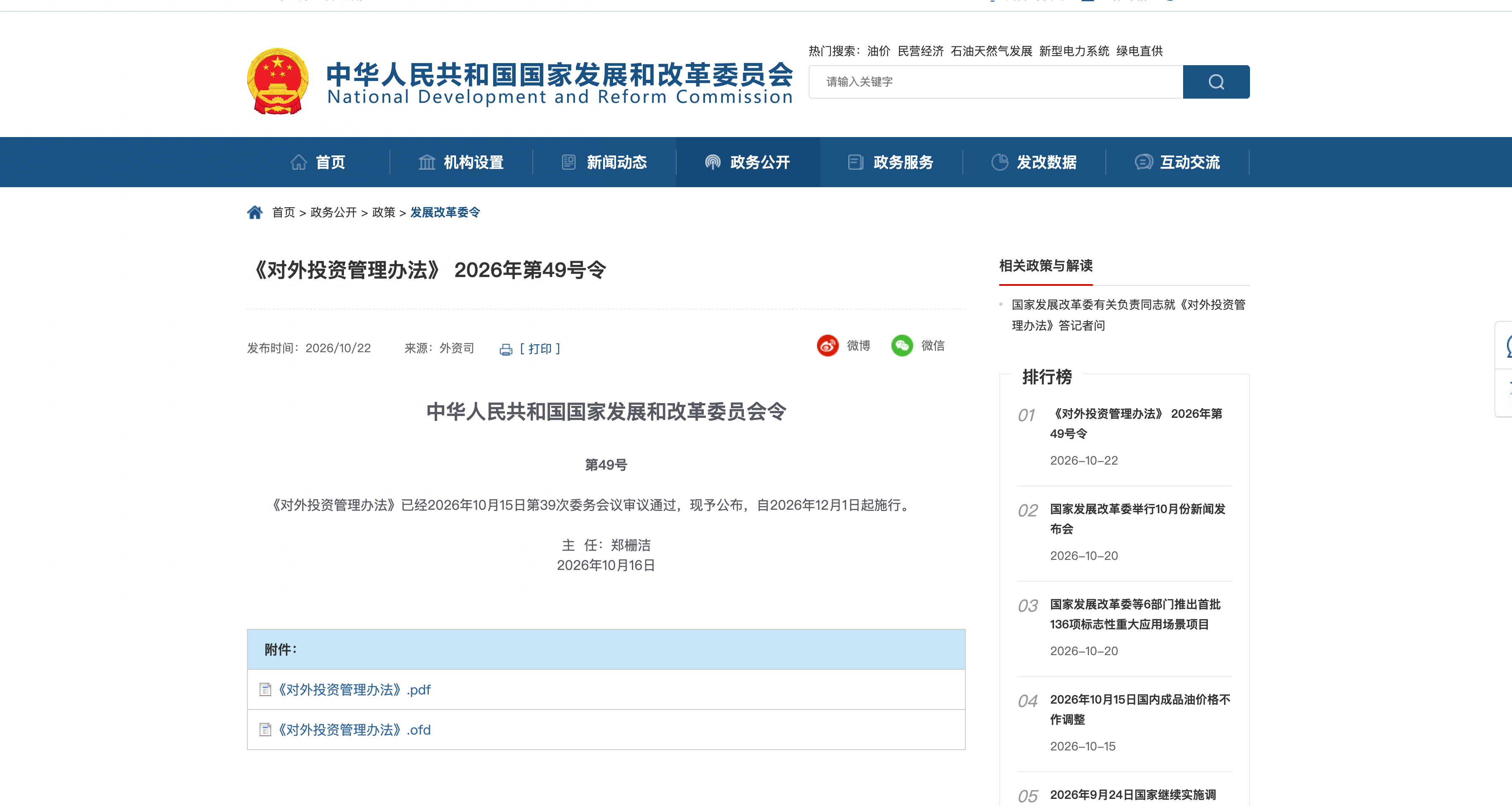
On October 22, 2026, China’s National Development and Reform Commission (NDRC) released the Measures for the Administration of Outbound Investment, which will take effect on December 1, replacing the 2017 Measures for the Administration of Outbound Investment by Enterprises.
The revised rules provide more detailed oversight of the entire investment lifecycle, from initial planning and business operations to reinvestment, asset sales and eventual exit. They also establish clearer procedures for companies seeking government assistance in dealing with risks and protecting their interests overseas.
In recent years, Chinese companies have significantly expanded their overseas investments, and the ways they invest have become increasingly diverse. Some build factories or acquire foreign companies directly, while others invest through overseas subsidiaries, establish investment funds, or contribute technology and intellectual property instead of cash. At the same time, the risks they face have become more complicated. Beyond wars, business losses and regulatory changes, companies may face demands from foreign governments to hand over technology or data, sell equity stakes, or even withdraw from certain markets altogether. Some of these challenges are simply too difficult for individual companies to handle on their own.
This is the context in which the State Council introduced the Regulations on Outbound Investment in June this year, which took effect on July 1. As a higher-level administrative regulation, it established the basic framework for outbound investment management, national security reviews and the protection of overseas interests.
The End of "Business Only" Overseas Expansion: China's New Outbound Investment Rules

China’s State Council has issued a new Regulation on Outbound Investment, which will take effect on July 1. At a high level, the regulation sends four important signals.
The NDRC’s new measures translate that framework into more specific filing, reporting and supervisory procedures within the agency’s responsibilities. Put simply, the State Council regulations set out the overarching rules, while the NDRC measures explain how they are implemented in practice. Both apply simultaneously, and the new measures replace only the NDRC’s 2017 rules.
The new measures retain China’s existing basic approach to outbound investment management. Investments involving sensitive countries, regions or industries require prior approval. Non-sensitive investments made directly by domestic investors generally require prior filing. Non-sensitive reinvestments made through controlled overseas entities are subject to reporting requirements. Companies remain responsible for making their own investment decisions and bearing the associated risks, but they must complete different procedures depending on the nature and structure of their investments.
Against this background, several changes are particularly worth highlighting.
First, the scope of regulation is more clearly defined, explicitly covering individuals and non-cash contributions such as technology and data.
The new measures bring domestic enterprises, other organizations and individual residents within the definition of investors, and clarify which authorities are responsible for handling filings by individual residents.
The rules also place greater emphasis on the substance of an investment rather than simply how money moves across borders. In addition to cash, contributions involving technology, data, intellectual property, financing and guarantees may all count toward the Chinese investment amount. Investments made through overseas companies, contractual arrangements or trusts may also fall within the rules, depending on the underlying ownership, control and actual arrangements.
For example, if a Chinese company contributes technology to an overseas business in exchange for equity, or makes an investment through an overseas subsidiary, it may still need to complete outbound investment procedures even if no money is actually transferred out of China.
Second, reporting requirements now apply earlier and continue throughout the investment lifecycle.
Under the previous rules, non-sensitive reinvestments made through controlled overseas entities generally had to be reported only when the Chinese investment amount reached US$300 million or more.
The new measures remove this monetary threshold. Companies must now submit an overseas reinvestment report at least ten working days before implementing the investment. Round-trip investments, where overseas entities reinvest back into China, are also covered.
For projects involving Chinese investment of US$100 million or more, or projects that may affect China’s foreign relations, reporting must take place even earlier, before major preparatory steps such as signing investment agreements or making investment commitments to foreign governments.
There are also reporting obligations after an investment is completed or terminated. In addition, investors must submit information about their outbound investments as of the end of the previous year by June 30 each year.
Third, national security reviews and the protection of overseas interests now more explicitly extend to the disposal of overseas assets.
The new measures require outbound investments that affect or may affect national security, as well as transfers or disposals of related assets and interests, to undergo security reviews in accordance with applicable rules.
This means that when a Chinese company sells an overseas business or transfers important assets, it may need to consider not only the commercial terms and local legal requirements, but also whether the transaction raises national security concerns under Chinese law.
The rules also address situations where foreign parties demand that Chinese companies provide technology or data, or transfer or dispose of assets and interests, in ways that threaten or harm China’s national interests or national security. In such cases, companies are required to report the situation immediately.
Where overseas investments that meet the relevant requirements face discriminatory measures or unreasonable restrictions imposed by foreign organizations or individuals, investors may request government assistance. Within its statutory responsibilities, the NDRC may take protective measures, including restricting the relevant foreign parties from investing in China or restricting domestic entities from conducting certain transactions or cooperation with them.
The legal basis for these national security reviews and protective measures was already established in the State Council regulations. The significance of the NDRC’s new measures is that they connect these powers with the routine reporting, supervision and assistance mechanisms that companies use in practice.
Why Countries Seek to Manage Outbound Investment
Preventing excessive and uncontrolled outflows of domestic capital is a challenge faced by virtually every major economy.
Capital naturally seeks higher returns. It tends to flow toward places with lower taxes, lighter regulation or better investment opportunities. Companies may also move production lines and supply chains overseas to take advantage of cheaper labor and land. Left entirely to market forces, these decisions can result in substantial amounts of capital and industrial activity moving abroad. There is no automatic mechanism that ensures capital will remain in its home country.
Excessive capital outflows can create real economic costs at home. They may put pressure on the domestic currency, weaken domestic investment, and affect employment and tax revenues. If the outflows become too large, they may also contribute to industrial hollowing-out, the loss of domestic jobs and the erosion of local supply chains. Where critical technologies or strategic assets are involved, the implications can extend directly to national security.
Countries use different approaches to address these concerns. Some rely more heavily on administrative procedures before investments are made, allowing governments to determine whether certain investments should proceed. Others place greater emphasis on taxes, subsidies and other economic incentives, making it more attractive for companies to keep capital, factories, research activities and intellectual property at home.
It is difficult to say that one approach is inherently better than the other. They reflect different national circumstances, economic structures and policy priorities.
Comparing China’s Approach with the United States
The United States has long been one of the strongest advocates of the free movement of capital around the world. But this does not mean it leaves outbound investment entirely unregulated.
Through measures including the Comprehensive Outbound Investment National Security Act (COINS Act), Executive Order 14105 and related federal regulations, the United States has established restrictions on certain overseas investments. Some covered transactions are prohibited, while others are subject to notification requirements.
Coincidentally, on the same day that China released its new outbound investment measures, the US Treasury Department opened a public consultation on proposed revisions to its outbound investment security regulations. The proposed changes would add areas such as high-performance computing and supercomputing, hypersonic systems and biotechnology, while expanding restrictions related to artificial intelligence.
Both China and the United States are increasingly linking cross-border investment with national security. Both are also paying closer attention to indirect investments and the actual relationships between companies and their overseas affiliates.
However, the two systems serve somewhat different purposes.
China’s outbound investment framework covers a broad range of industries and investment destinations. It is concerned not only with investment management, but also with industrial policy, risk prevention and the protection of overseas interests. One of its central policy questions is how Chinese companies can expand internationally and access overseas markets without undermining China’s domestic industrial base.
The US Treasury’s outbound investment security regime, by contrast, is more narrowly focused on specific countries, technologies and transactions. Its principal objective is to prevent US capital, together with the managerial expertise, professional networks and market access that may accompany it, from helping countries identified by Washington as foreign adversaries develop technological capabilities that could threaten US national security.
The two systems also differ in how they operate.
China primarily uses a combination of approval, filing and reporting procedures, many of which must be completed before an investment is implemented.
The United States, meanwhile, defines categories of prohibited and notifiable transactions in advance, leaving investors responsible for conducting due diligence and determining whether their transactions fall within those categories. Transactions subject to notification generally must be reported within 30 days after completion.
How the United States Uses Tax Policy and Subsidies to Influence Investment Decisions
Beyond national security reviews and restrictions on investments in sensitive sectors, the United States also makes extensive use of tax policy, subsidies and other government incentives to influence corporate investment decisions.
The basic idea is straightforward. Rather than simply telling companies that they cannot invest overseas, the US government changes the financial calculations behind their decisions.
American companies can still expand internationally. But if they shift profits to low-tax jurisdictions or locate strategically important production in countries that US policymakers do not favor, they may lose certain tax advantages or become ineligible for government subsidies.
In effect, the government lets companies do the math themselves. By changing the costs and benefits of different investment locations, it uses companies’ natural pursuit of profits to encourage capital and industrial activity to remain in, or return to, the United States.
Two approaches are particularly important.
1. Making Investment in the United States More Attractive
The most straightforward tool is tax reduction.
In 2017, the Trump administration introduced tax reforms that reduced the federal corporate income tax rate from 35% to 21%.
This meant that, for every US$100 in taxable profits, companies paid less federal corporate income tax and retained more earnings. All else being equal, this improved the after-tax returns on investments in the United States.
In 2025, the United States introduced further tax legislation designed to encourage business investment.
Previously, when companies purchased equipment or built factories, many of these costs could not be deducted from taxable income immediately. Instead, they had to be depreciated and deducted gradually over several years, or sometimes even decades.
Under the revised rules, certain equipment investments, domestic research and development expenditures, and qualifying manufacturing facility construction costs can be deducted earlier. Some expenditures may even qualify for immediate deduction.
Consider a company planning to invest US$10 billion in a new factory. During the first few years, it will need substantial amounts of capital before the project begins generating meaningful returns.
If tax rules allow the company to deduct investment costs earlier, it can reduce its tax payments sooner and retain more cash during the project’s early stages. That reduces the amount of financing it may need to raise.
This is particularly important for capital-intensive projects such as semiconductor fabs, data centers and energy infrastructure, where upfront investment is enormous and the payback period can be long.
2. Making Low-Tax Overseas Profit Structures Less Attractive
In the past, US multinational companies commonly established overseas subsidiaries and accumulated profits in jurisdictions with relatively low tax rates.
As long as those profits were not repatriated to the United States, companies could often defer US taxation.
Many technology companies also located patents, trademarks, algorithms and other intellectual property in low-tax jurisdictions, allowing their foreign subsidiaries to report more profits and reduce the group’s overall tax burden.
The 2017 tax reform began changing this system by introducing the Global Intangible Low-Taxed Income regime, or GILTI.
Following the 2025 tax legislation, this regime was renamed Net CFC Tested Income, or NCTI, beginning in 2026.
Despite the technical terminology, the basic principle is relatively simple: when a foreign company controlled by a US taxpayer earns certain types of income, the US taxpayer may have to include that income in its current US tax calculations, even if the money has not been brought back to the United States.
Beginning in 2026, the revised rules also eliminated the previous exclusion for certain returns associated with tangible assets held overseas.
Under the earlier system, investments in foreign factories and equipment could generate a tax benefit when calculating GILTI. Removing this exclusion means that more foreign earnings may now fall within the US tax calculation.
Under the current rules, the nominal federal tax rate applicable to NCTI is approximately 12.6%, although companies may claim foreign tax credits for a portion of the taxes they have already paid overseas.
Of course, this does not mean that every dollar earned overseas automatically faces an additional 12.6% US tax.
For example, companies operating in Europe or Japan may already pay substantial local taxes. Depending on their circumstances, foreign tax credits can significantly reduce or even eliminate additional US tax liability.
What the US government is primarily trying to discourage is a different situation: companies locating profits or business activities overseas mainly because taxes are lower, rather than because those locations offer customers, talent or supply-chain advantages.
At the same time, the United States retains another preferential tax regime known as Foreign-Derived Deduction Eligible Income, or FDDEI.
Broadly speaking, this provides favorable tax treatment for certain income earned by US businesses from supplying goods or services to foreign customers. From 2026, qualifying income is subject to a nominal federal tax rate of approximately 14%.
Taken together, NCTI and FDDEI illustrate the direction of US international tax policy.
The government seeks to reduce the tax advantages of shifting profits to low-tax foreign jurisdictions while offering incentives for certain income-generating activities based in the United States.
China Also Uses Tax Incentives and Measures Against Profit Shifting
Under existing policies, qualifying high-tech enterprises in China benefit from a reduced corporate income tax rate of 15%.
Eligible research and development expenses may also qualify for an additional 100% tax deduction. In practical terms, for every RMB 100 spent on qualifying R&D, a company may deduct the original RMB 100 as an expense and claim an additional RMB 100 deduction.
Government-backed investment funds also help attract private capital by providing financing and sharing investment risks.
China also has tax rules designed to prevent companies from accumulating profits indefinitely in low-tax overseas jurisdictions.
Article 45 of China’s Enterprise Income Tax Law provides that, where a foreign enterprise meets certain control and low-tax conditions and fails to distribute profits, or distributes insufficient profits, without reasonable business needs, the portion attributable to the Chinese resident enterprise may be included in its current taxable income.
This serves a purpose similar to the US NCTI regime: preventing indefinite tax deferral and protecting the domestic tax base. However, the conditions for application and the methods of calculation differ.
Why Tax Incentives Alone Are Not Enough
Relying primarily on tax incentives also has inherent limitations.
Some risks cannot be addressed simply by changing the after-tax returns of an investment.
For example, a transaction may involve the transfer of controlled technology, or a change in ownership of critical assets that could affect national security. Even if a company is willing to pay more tax, that does not eliminate the underlying security concern.
Other investments may create significant risks before they generate any profits at all.
In these situations, approval and filing requirements, information reporting, technology transfer restrictions and national security reviews can play an indispensable role.
China’s outbound investment framework also serves another important purpose: helping the government understand overseas investment activities, identify emerging risks and protect Chinese interests abroad.
Tax filings primarily focus on revenues, costs and tax liabilities. They cannot fully perform these broader functions.
Project-level reporting and annual outbound investment information reports, by contrast, can help authorities understand where Chinese companies are investing, who their partners are, how their assets are structured, and whether they are facing risks such as war, forced asset sales or other major disruptions.
Ultimately, the most effective approach is likely to combine regulatory controls with economic incentives, while adjusting the balance between the two according to each country’s circumstances and policy priorities.