

China’s State Council has issued a new Regulation on Outbound Investment, which will take effect on July 1. At a high level, the regulation sends four important signals.
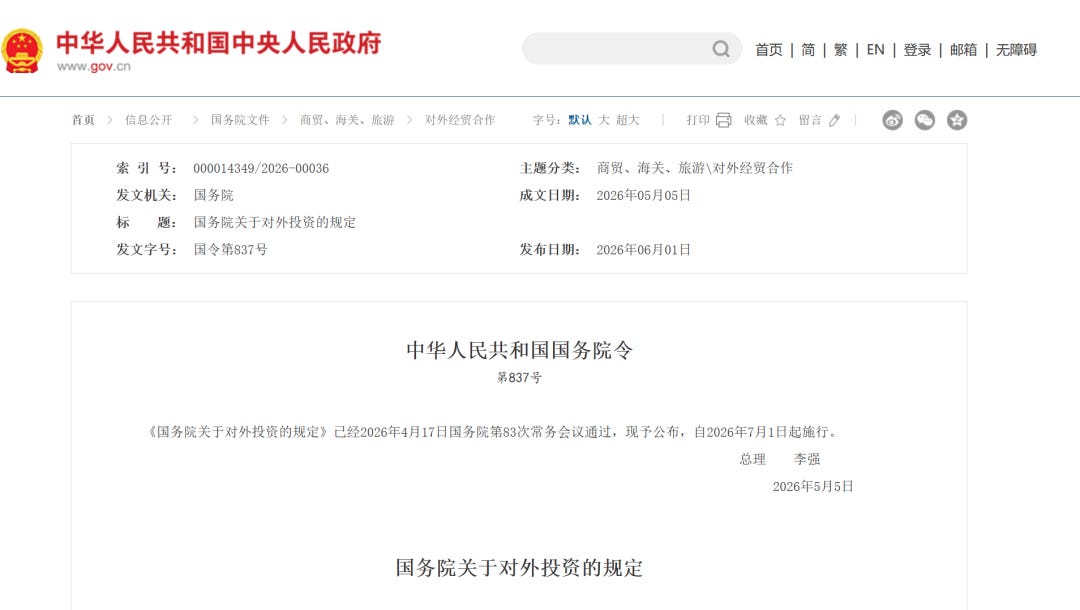
First, China is formally establishing a national security review mechanism for outbound investment. The National Development and Reform Commission (NDRC), the Ministry of Commerce (MOFCOM), and other relevant agencies will review overseas investments, as well as related transfers and disposals of assets and interests, that affect or may affect China’s national security.
Second, Beijing continues to encourage Chinese companies to “go global,” but outbound investment is increasingly viewed through a national security lens. Historically, regulators focused primarily on whether an investment was commercially viable and whether it could contribute to capital outflows. Going forward, authorities will also assess its implications for national security, critical technologies, data security, and supply chain resilience.
Third, companies cannot use overseas expansion as a vehicle to transfer technologies, services, or data that are subject to Chinese export restrictions. The regulation explicitly notes that dispatching engineers abroad, stationing technical experts overseas, conducting overseas training programs, or providing remote technical support may constitute transfers of controlled technologies.
Fourth, the regulation strengthens China’s legal basis for responding to foreign restrictions on Chinese investment. If another country imposes discriminatory investment barriers, sanctions Chinese firms, seizes Chinese-owned assets, or forces foreign companies to cut off business ties with Chinese entities, the Chinese government may adopt countermeasures, including adjusting investment policies, restricting trade or services, or invoking China’s counter-sanctions framework.
At the same time, the Regulation provides that the detailed rules governing outbound investment by Chinese resident individuals and other relevant investors will be formulated separately by the NDRC and MOFCOM.
The Regulation also states that investments made by investors in overseas financial markets shall be governed by the Regulation as well as other applicable state regulations. This means that dedicated financial regulatory frameworks governing overseas portfolio investment—such as QDII and QDLP—will continue to apply, consistent with China’s existing regulatory regime.
Because of the limits of ministerial rulemaking authority, existing regulations such as the NDRC’s Administrative Measures for Enterprise Overseas Investment and MOFCOM’s Administrative Measures for Overseas Investment have largely relied on measures such as restricting access to preferential policies and ordering corrective actions to address violations.
Building on this framework, the new Regulation further strengthens the legal liability regime for investors that violate outbound investment requirements. This is intended to “enhance risk prevention, safeguard national security and national interests, promote compliant corporate conduct, and support the rule-based development of China’s outbound investment activities”, according to the official interpretation of the Chinese government.
According to the official Q&A accompanying the regulation, the drafting process took more than a year and involved extensive consultation with government agencies, businesses, industry associations, academics, lawyers, local governments, and other stakeholders. The regulation was first included in the State Council’s 2025 legislative agenda and later elevated into the 2026 legislative work plan. Multiple rounds of consultation and revisions were conducted before the final text was approved by the State Council.
More broadly, China’s outbound investment regime has evolved through three distinct phases.
The first phase was characterized by strict approval requirements and foreign exchange controls. In an era of limited foreign currency reserves and tightly controlled capital accounts, outbound investment was treated less as a routine commercial activity and more as a matter of state resource allocation. A major turning point came in 2004, when the State Council formally established the principle of “who invests, who decides, who benefits, and who bears the risk,” laying the groundwork for a more market-oriented approach.
The second phase emerged under the “Going Global” strategy. Regulatory reforms in 2014 largely replaced comprehensive approval requirements with a filing-based system. Non-sensitive investments generally became subject to filing, while investments involving sensitive countries, regions, or sectors remained subject to government approval. The shift did not eliminate regulation; rather, it redirected regulatory resources toward higher-risk transactions.
The third phase began around 2017–2018, with a stronger emphasis on industrial policy guidance and “look-through” regulation. Authorities introduced the well-known categories of encouraged, restricted, and prohibited outbound investment, while expanding oversight to cover offshore reinvestments by overseas entities ultimately controlled by Chinese investors. The focus shifted from reviewing only the first layer of a transaction to examining the ultimate destination of capital and the underlying control structure.
In practice, China’s ODI compliance framework today operates through three interconnected regulatory channels.
The NDRC focuses on the investment project itself: whether the transaction involves a sensitive sector or destination, whether it raises policy concerns, and whether offshore structures are being used to circumvent regulation.
MOFCOM focuses on the investor and the overseas business arrangement: whether the transaction constitutes an outbound investment under Chinese law and whether ownership structures, investment details, and industry classifications are accurately disclosed.
SAFE focuses on the movement of funds. Since 2015, outbound investment foreign exchange registration has largely been delegated to commercial banks. As a result, banks have become a critical gatekeeper, particularly with respect to transaction authenticity, compliance reviews, and beneficial ownership verification.
These three tracks are not independent. Rather, they form a chain linking project legitimacy, investor compliance, and capital execution. In practice, whether a transaction can close often depends less on any single approval than on whether the descriptions, ownership structures, counterparties, funding sources, and ultimate destinations are consistent across all three regulatory channels.
From a policy perspective, elevating ODI governance into a State Council-level administrative regulation appears intended to address several longstanding issues. First, while NDRC, MOFCOM, and SAFE have developed a relatively stable division of responsibilities, inconsistencies in interpretation and local implementation remain. Second, key concepts such as look-through review, ultimate destination analysis, offshore reinvestment, and national security coordination have largely relied on ministerial rules and regulatory practice rather than higher-level legislation. Third, the existing framework has struggled to integrate three objectives simultaneously: promoting outbound investment, regulating risk, and protecting Chinese companies overseas.
The new regulation arguably marks the beginning of a fourth phase in China’s outbound investment regime—one increasingly centered on national security and technology security.
Some observers have speculated that recent high-profile cases, including the Manus case, may have contributed to the policy momentum behind the regulation, although neither the text nor the official explanatory materials make any reference to specific incidents. Historically, however, major regulatory initiatives in China have often followed prominent cases that exposed perceived gaps in the existing framework.
The practical implication is that Chinese companies expanding overseas may increasingly face a three-layer compliance framework. In addition to ODI regulation itself, firms may also need to navigate China’s technology export control regime administered by MOFCOM and China’s cross-border data transfer requirements overseen by the Cyberspace Administration of China (CAC). These regimes overlap in important ways, making outbound expansion significantly more complex than it was a decade ago.
Full translation (unofficial) of the New Regulation
Regulation of the State Council on Outbound Investment
Article 1
This Regulation is formulated in accordance with the Foreign Relations Law of the People’s Republic of China, the Foreign Trade Law of the People’s Republic of China, and other relevant laws, for the purposes of advancing high-standard opening up, promoting the high-quality development of outbound investment, strengthening the administration of outbound investment, protecting the lawful rights and interests of investors and their overseas investments, and safeguarding national sovereignty, security, and development interests.
Article 2
This Regulation shall apply to outbound investments conducted by investors within the territory of the People’s Republic of China (hereinafter referred to as “China”).
For the purposes of this Regulation, “outbound investment” or “overseas investment” refers to activities whereby investors directly or indirectly acquire ownership, control, management rights, or other related interests in enterprises, assets, or other interests located in foreign countries or regions through capital contributions, equity participation, financing, guarantees, or other means.
The term “investors” includes enterprises, other organizations, and individual residents within China.
Article 3
Outbound investment shall adhere to the fundamental national policy of opening up, implement a holistic approach to national security, coordinate development and security, balance domestic and international considerations, improve the management and service system for outbound investment, enhance the quality and effectiveness of outbound investment, and promote open cooperation and mutual benefit.
Article 4
The State shall proactively align with high-standard international economic and trade rules, advance high-quality Belt and Road cooperation, strengthen bilateral and multilateral investment cooperation mechanisms, actively participate in the formulation of international investment rules, promote international cooperation in industrial and supply chains, oppose unilateralism and protectionism, and support the development of an open global economy.
Article 5
The State supports investors in conducting outbound investment activities in accordance with market principles and participating actively in international competition and cooperation.
Investors shall enjoy autonomy in outbound investment in accordance with law, make independent investment decisions, bear risks independently, and assume responsibility for profits and losses.
When carrying out outbound investment and related activities, investors shall comply with applicable laws, regulations, and international practices; respect local customs and cultural traditions; observe business ethics; act in good faith and engage in fair competition; fulfill social responsibilities; and safeguard China’s national image.
Investors shall not disrupt market competition, damage the ecological environment, infringe upon the lawful rights and interests of workers, endanger China’s national security, or harm national interests or the public interest.
Article 6
The State shall improve the comprehensive overseas service system, promote the integration of trade and investment, enhance public platforms and services, coordinate resources relating to foreign affairs, legal affairs, taxation, finance, commerce, logistics, immigration, customs, and trade promotion, and provide support and services for investors.
People’s governments at or above the provincial level and their relevant departments shall improve public service capacity and provide investors with public services and products relating to laws and regulations, policies, investment guides, intellectual property, risk prevention and response, and rights protection.
Article 7
The State supports professional service institutions, including consulting, legal services, accounting and auditing, credit rating, mediation and arbitration, and intellectual property service providers, in expanding their overseas service networks and enhancing their international capabilities to provide high-quality professional services for investors and outbound investment activities.
Such institutions shall follow the principles of good faith, diligence, independence, and objectivity, establish effective risk-control and internal-control mechanisms, employ personnel with appropriate professional qualifications, and conduct their activities in accordance with law.
Article 8
Banking and financial institutions shall, within the scope of their business operations and in accordance with the principles of market orientation, rule of law, commercial sustainability, and prudent risk management, provide financing and other financial services for outbound investment activities.
Policy-oriented insurance institutions are encouraged to provide overseas investment insurance and related services.
Article 9
Relevant industry associations and chambers of commerce shall strengthen self-regulation in accordance with laws, regulations, and their respective charters, improve their capacity to serve investors and outbound investment activities, and promptly communicate industry concerns.
Industry associations, chambers of commerce, and trade and investment promotion organizations may provide information consulting, market development, economic and trade exchanges, rights protection, and dispute resolution services related to outbound investment in accordance with their governing rules.
Article 10
The State shall improve the outbound investment administration system, refine regulatory measures, implement classified and tiered supervision throughout the investment lifecycle, strengthen risk prevention and control, enhance the quality and security of outbound investment, and strike a balance between investment facilitation and risk management.
Article 11
The competent investment authority and commerce authority of the State Council, together with other relevant departments, shall formulate, adjust, and implement outbound investment policies in light of national economic and social development needs, changes in investment environments, and risk conditions in foreign countries and regions.
Such authorities shall identify encouraged, restricted, and prohibited categories of outbound investment, strengthen regulatory oversight, and guide and supervise investors in conducting compliant investment and business activities.
Article 12
Where outbound investment activities require approvals, filings, information reporting, cross-border capital registration, or other procedures under applicable laws and regulations, investors shall complete such procedures in accordance with relevant requirements, truthfully submit required materials, and cooperate with supervision and inspections conducted by competent authorities.
Article 13
Investors shall not export, use, or otherwise transfer goods, technologies, services, or related data that are prohibited from export under Chinese law, nor export, use, or transfer restricted goods, technologies, services, or related data without the required authorization.
Investors shall not transfer prohibited goods, technologies, services, or related data to foreign countries or regions through means such as dispatching technical personnel abroad, organizing personnel to work overseas, providing cross-border technical guidance, or arranging overseas training programs. Restricted items may not be transferred through such means without the required authorization.
Article 14
Matters relating to outbound investment involving foreign exchange, imports and exports of goods and technology, cross-border trade in services, cross-border data flows, immigration and emigration administration, merger control review, export controls, cybersecurity regulation, tax administration, and state-owned asset supervision shall be governed by applicable laws, administrative regulations, and relevant state provisions.
Article 15
The State shall establish and improve the national security review system for outbound investment.
The competent investment authority and commerce authority of the State Council, together with other relevant departments, shall conduct national security reviews of outbound investments and transfers or disposals of related assets and interests that affect or may affect national security.
Relevant organizations and individuals shall cooperate with such reviews, shall not refuse or obstruct review activities, and shall comply with review decisions.
Article 16
Investors and the enterprises they establish or invest in overseas shall improve their corporate governance structures, establish and strengthen systems for compliance management, internal controls, workplace safety, and emergency response, enhance risk identification, prevention, and mitigation capabilities, and allocate necessary personnel, funding, equipment, and other resources to ensure the safety of their employees and assets.
Article 17
Investors shall conduct investment and business activities in a lawful and orderly manner and shall not:
Damage the business reputation or commercial goodwill of other investors;
Infringe upon the trade secrets of others;
Dump products at unfairly low prices without legitimate justification;
Obtain improper benefits through bribery, fraud, or other improper means; or
Disrupt the order of the outbound investment market.
Article 18
Relevant departments of the State Council shall strengthen monitoring, early warning, and risk assessment mechanisms for outbound investment, promptly release information regarding security conditions in relevant countries and regions, provide investment risk alerts, guide and assist investors in risk prevention and mitigation, and safeguard China’s overseas interests and the lawful rights and interests of investors.
Article 19
In accordance with treaties and agreements concluded or acceded to by the People’s Republic of China, or on the basis of reciprocity, China shall engage in cooperation and exchanges with foreign countries, regions, and international organizations in law enforcement and related fields, with a view to protecting the safety of investors, their overseas enterprises, project personnel, assets, and the lawful rights and interests of relevant organizations and individuals.
The State shall actively negotiate bilateral and multilateral trade and investment agreements and other international economic agreements in order to strengthen protections for outbound investment and promote investment liberalization and facilitation.
Article 20
The State shall, in accordance with law, provide consular protection and assistance to Chinese citizens, organizations, and Chinese employees working for overseas enterprises and projects in which they have invested, and shall protect their lawful rights and interests.
Where wars, armed conflicts, riots, major natural disasters, serious accidents, major infectious disease outbreaks, terrorist attacks, or other major emergencies occur in a host country or region, and the personal safety or property of investors or Chinese personnel associated with overseas enterprises or projects is threatened, Chinese diplomatic and consular missions abroad shall promptly verify the situation, urge the relevant foreign authorities to take effective measures to protect Chinese citizens and organizations, and provide appropriate assistance where necessary.
Where the Chinese government adopts evacuation or other risk-avoidance arrangements, relevant organizations and individuals shall cooperate accordingly.
Article 21
Investors are encouraged to resolve disputes relating to outbound investment through consultation, mediation, arbitration, litigation, and other lawful means in order to protect their legitimate rights and interests.
Article 22
Where organizations or individuals within China participate in arbitration or litigation relating to outbound investment, or become subject to investigations conducted by foreign judicial or law-enforcement authorities, and need to provide evidence or other materials outside China, they shall comply with applicable laws, administrative regulations, and state requirements relating to state secrets protection, data security, personal information protection, technology export administration, export controls, and judicial assistance.
Where approval from a competent authority is required by law, the relevant legal procedures shall be followed.
Article 23
Where investors encounter trade-related investment barriers or other obstacles to investment and business operations in a host country or region, the competent commerce authority of the State Council may, independently or jointly with other relevant departments, conduct investigations.
Relevant organizations and individuals shall cooperate with such investigations.
Based on the findings of the investigation, relevant departments of the State Council may adopt measures including:
Adjusting country-specific investment policies;
Restricting or prohibiting the import or export of goods and technologies; or
Restricting or prohibiting international trade in services.
Article 24
Where any foreign country, region, or international organization adopts discriminatory prohibitions, restrictions, or similar measures against the People’s Republic of China in investment, business operations, or related matters in violation of international law or the basic norms governing international relations, the Chinese government and its relevant authorities may take corresponding measures as appropriate in order to protect the safety and legitimate rights and interests of investors and their overseas investments, and to safeguard China’s overseas interests from threats or infringement.
Relevant departments of the State Council may, in accordance with the Anti-Foreign Sanctions Law of the People’s Republic of China and related implementing regulations, place organizations and individuals that directly or indirectly participate in the formulation, decision-making, or implementation of such discriminatory measures on a countermeasures list and adopt corresponding actions against them.
Article 25
Where a foreign organization or individual:
Endangers China’s sovereignty, security, or development interests;
Violates normal market transaction principles by interrupting ordinary commercial dealings with Chinese enterprises, organizations, or individuals; or
Adopts discriminatory measures against investors or their overseas investments and unreasonably deprives or restricts their lawful rights and interests,
relevant departments of the State Council may adopt one or more of the following measures:
Restricting or prohibiting their involvement in import and export activities related to China;
Restricting or prohibiting their investment activities in China;
Restricting or prohibiting Chinese organizations and individuals from engaging in transactions or cooperation with them;
Restricting or prohibiting the entry into China of relevant individuals, products, or means of transportation; and
Revoking or restricting the right of relevant individuals to work, stay, or reside in China.
Such measures may also be applied to entities that are controlled by, or established and operated with the participation of, such foreign organizations or individuals.
Offical Q&A
China recently issued the Regulation on Outbound Investment (the “Regulation”), which will take effect on July 1, 2026. Officials from the Ministry of Justice (MOJ), the National Development and Reform Commission (NDRC), and the Ministry of Commerce (MOFCOM) recently answered questions from the press regarding the Regulation.
Q: Could you briefly explain the background behind the Regulation?
A: Outbound investment is an important component of China’s opening-up policy.
Since the 18th National Congress of the Communist Party of China, the CPC Central Committee and the State Council have introduced a series of measures to deepen reform in outbound investment and improve the legal framework governing overseas investment. China has remained one of the world’s leading sources of outbound investment, while its participation in international industrial cooperation has continued to deepen.
At the same time, profound global changes are accelerating, geopolitical risks are rising, and international competition is becoming increasingly intense. The long-standing model of regulating and servicing outbound investment primarily through ministerial regulations and normative documents is no longer sufficient to meet current needs.
There is therefore an urgent need to elevate effective long-standing regulatory measures into a higher-level legal framework, better align with high-standard international economic and trade rules, clarify the institutional arrangements governing outbound investment services, administration, and protection, effectively safeguard the lawful rights and interests of investors and their overseas investments, protect China’s sovereignty, security, and development interests, and promote the high-quality development of outbound investment under the rule of law.
The Regulation represents an important step in implementing the decisions of the Third and Fourth Plenary Sessions of the 20th CPC Central Committee regarding the improvement of China’s outbound investment management and service framework. It is a necessary measure for balancing development and security, promoting high-quality outbound investment, advancing China’s commitment to opening-up, and supporting a more open, inclusive, balanced, and mutually beneficial form of economic globalization.
It is of landmark significance in the history of China’s outbound investment development.
Q: How were opinions and comments solicited during the drafting process?
A: The drafting authorities strictly followed the principles of scientific, democratic, and law-based legislation and extensively consulted stakeholders throughout the drafting process.
The State Council’s 2025 Legislative Work Plan called for advancing legislation on outbound investment, and the Regulation was formally included in the State Council’s 2026 Legislative Work Plan.
The Ministry of Justice, NDRC, and MOFCOM systematically reviewed both the achievements and challenges of China’s outbound investment regime. They collected views through written consultations, local field research, company visits, and expert symposiums, while carefully studying and incorporating feedback from government agencies, enterprises, industry associations, academics, and legal practitioners.
Following the preparation of an initial draft, the Ministry of Justice conducted three rounds of consultations involving more than 100 central government agencies, local governments, and public organizations. Multiple expert reviews were organized, and additional feedback was sought from enterprises, industry associations, academics, National People’s Congress deputies, and members of the Chinese People’s Political Consultative Conference.
Field visits were also conducted across various localities. Based on these consultations, comments and recommendations were carefully reviewed, incorporated where appropriate, and repeatedly refined before the draft was submitted to the State Council Executive Meeting for deliberation and approval.
The Regulation therefore reflects broad consultation and extensive input from a wide range of stakeholders.
Q: What is the overall legislative approach behind the Regulation?
A: The Regulation is guided by Xi Jinping Thought on Socialism with Chinese Characteristics for a New Era and follows three main principles.
First, it implements the decisions and policy arrangements of the CPC Central Committee and the State Council by codifying the experience and reform achievements accumulated in outbound investment regulation since the 18th Party Congress.
Second, it adopts a problem-oriented approach by addressing emerging challenges, clarifying the fundamental principles governing outbound investment, and improving the legal framework for outbound investment services, administration, and protection.
Third, it balances development and security. The Regulation promotes the high-quality development of outbound investment through multiple measures, reaffirms China’s commitment to multilateralism and opening-up, and supports market-based outbound investment activities. At the same time, it establishes mechanisms for risk prevention and response in the investment sector and firmly safeguards China’s sovereignty, security, and development interests.
Q: What activities fall within the scope of the Regulation?
A: Based on long-standing regulatory practice, the Regulation applies to outbound investments conducted by investors within the territory of the People’s Republic of China.
Outbound investment, or overseas investment, refers to activities through which investors directly or indirectly acquire ownership, control, management rights, or other interests in enterprises or assets located in foreign countries or regions through capital contributions, equity investments, financing, guarantees, or other arrangements.
Investors include Chinese enterprises, other organizations, and individual residents.
Investments in Hong Kong, Macau, and Taiwan are generally subject to the Regulation by reference, unless otherwise provided by laws, administrative regulations, or separate State Council provisions.
Q: What fundamental principles govern outbound investment under the Regulation?
A: The Regulation establishes the guiding principles for China’s outbound investment policy.
It provides that outbound investment shall adhere to China’s fundamental policy of opening-up, implement a holistic approach to national security, coordinate development and security, balance domestic and international considerations, improve the outbound investment management and service system, enhance the quality and effectiveness of outbound investment, and promote open cooperation and mutual benefit.
The Regulation also reaffirms China’s commitment to high-level opening-up and support for outbound investment. China will actively align with high-standard international economic and trade rules, advance high-quality Belt and Road cooperation, strengthen bilateral and multilateral investment cooperation mechanisms, participate in the formulation of international investment rules, promote international industrial and supply-chain cooperation, oppose unilateralism and protectionism, and support the development of an open global economy.
Investors remain the principal actors in outbound investment activities. The Regulation supports investors in conducting outbound investment on market-oriented principles and participating in international competition and cooperation.
Investors enjoy autonomy in making investment decisions, bearing risks, and assuming responsibility for profits and losses.
At the same time, the Regulation emphasizes investor responsibility. Investors must comply with laws, regulations, and international practices; respect local customs and cultures; observe business ethics; conduct business in good faith and fair competition; fulfill social responsibilities; and safeguard China’s national image.
They must not disrupt market competition, damage the environment, infringe upon workers’ lawful rights and interests, endanger China’s national security, or harm national interests or the public interest.
And you could also find experts’ comments endorsed by the government here.