

On August 19, China’s Ministry of Justice issued Announcement No. 8 of 2026, declaring that certain investigative measures taken by the European Union in its Foreign Subsidies Regulation (FSR) investigation into JD.com constitute “improper extraterritorial jurisdiction,” and prohibiting any organization or individual from implementing or assisting in the implementation of those measures.
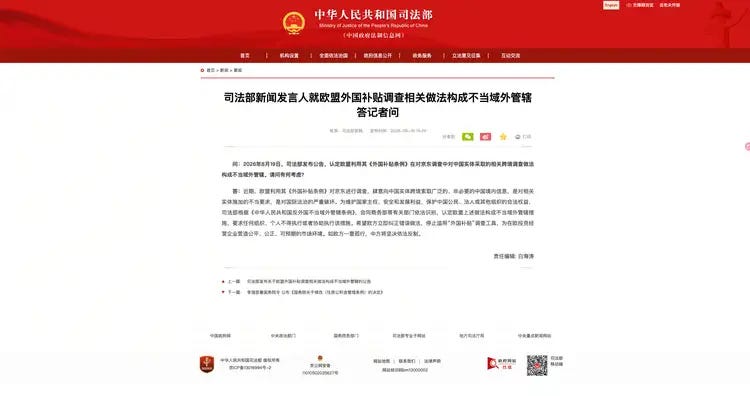
Announcement No.8 of the Ministry of Justice of the People’s Republic of China
Pursuant to Articles 3 and 6 of the Regulations of the People’s Republic of China on Countering Improper Extraterritorial Jurisdiction by Foreign States, the Ministry of Justice, together with the Ministry of Commerce and other relevant authorities, has conducted an investigation and determined that certain cross-border investigative practices adopted by the European Union against Chinese entities in its investigation into JD.com under the Foreign Subsidies Regulation constitute measures involving improper extraterritorial jurisdiction.
No organization or individual shall implement or assist in the implementation of such improper extraterritorial jurisdiction measures.
This Announcement shall take effect as of the date of publication.
The Ministry of Justice spokesperson also responded to questions from the press, calling on the EU to immediately stop abusing its foreign subsidies investigation tool and warning that, should the EU persist in its course, China will resolutely take countermeasures in accordance with the law.
Ministry of Justice Spokesperson Responds to Questions on the EU’s Foreign Subsidies Investigation Practices Constituting Improper Extraterritorial Jurisdiction
Q: On August 19, 2026, the Ministry of Justice issued an announcement determining that certain cross-border investigative practices adopted by the European Union against Chinese entities in its investigation into JD.com under the Foreign Subsidies Regulation constitute improper extraterritorial jurisdiction. What considerations led to this decision?
A: Recently, in its investigation into JD.com under the Foreign Subsidies Regulation, the European Union has arbitrarily demanded from Chinese entities, on a cross-border basis, extensive and unnecessary information located within China. These are improper demands imposed on the entities concerned and constitute a serious violation of the international rule of law.
In order to safeguard China’s sovereignty, security and development interests, and to protect the lawful rights and interests of Chinese citizens, legal persons and other organizations, the Ministry of Justice, pursuant to the Regulations of the People’s Republic of China on Countering Improper Extraterritorial Jurisdiction, worked together with the Ministry of Commerce and other relevant authorities to identify and assess the EU practices in accordance with the law. It has determined that the aforementioned EU practices constitute measures involving improper extraterritorial jurisdiction, and has required that no organization or individual implement or assist in the implementation of such measures.
We urge the EU to immediately correct its wrongful practices, stop abusing the foreign subsidies investigation tool, and create a fair, equitable and predictable market environment for companies investing and operating in Europe. Should the EU persist in pursuing this course, China will resolutely take countermeasures in accordance with the law.
Importantly, China has not declared that the EU lacks jurisdiction to review JD.com’s proposed acquisition, nor has it directly demanded that the European Commission terminate its investigation. What China is objecting to is the Commission extending its investigative powers into Chinese territory by requiring Chinese companies, banks and other institutions to cooperate and provide information that Beijing considers excessively broad in scope. The measure gives JD.com a basis under Chinese law for refusing certain information requests, but it also places the company in a much clearer conflict of laws: providing information to the Commission could violate the Chinese prohibition, while refusing to provide it could lead the Commission to conclude that JD.com has failed to cooperate and draw adverse inferences.
The investigation stems from JD.com’s proposed acquisition of German consumer-electronics retailer CECONOMY for approximately €2.2 billion. CECONOMY owns brands including MediaMarkt and Saturn and operates extensive online platforms and physical retail stores across Europe. The transaction represents an important step in JD.com’s expansion into the European retail market.
JD.com notified the transaction to the European Commission on April 17, 2026. On May 28, the Commission opened an in-depth investigation under the FSR. The Commission suspects that JD.com may have benefited from preferential financing, tax advantages and grants attributable to the Chinese government. Such support may have enabled JD.com to offer a higher price for CECONOMY and thereby distort the normal competitive process for the acquisition. Following completion of the transaction, JD.com might also use such support, together with its technological and logistics capabilities, to rapidly expand CECONOMY’s European operations and affect competition in local markets.
On July 22, the Commission issued JD.com a Statement of Reasons formally setting out its concerns, indicating that the investigation had entered a critical stage. The Commission had originally been expected to decide by October 2 whether to approve the transaction, approve it subject to conditions, or prohibit it.
JD.com’s response has been that the acquisition will be financed through commercial bank loans and cash generated from ordinary business operations, without subsidies from the Chinese government or any other non-EU government. JD.com has also stated that it has not received any foreign subsidies related to the transaction that could distort competition in the EU market.
However, JD.com and the Commission are not entirely answering the same question. JD.com is emphasizing that the acquisition financing itself does not involve government subsidies. The Commission’s inquiry is broader. It is examining not only where the money for the acquisition comes from, but also whether the JD.com group has received preferential loans, tax reductions, government grants or other forms of “foreign financial contribution” over the previous three years, and whether such support may have indirectly strengthened JD.com’s ability to bid for CECONOMY and expand in Europe. Demonstrating that the purchase price will be funded by commercial loans and JD.com’s own cash therefore does not, by itself, fully address the Commission’s concerns.
China’s latest response did not emerge suddenly. It is the latest step in a gradual escalation of Beijing’s response to the EU’s implementation of the FSR. In July 2024, the Ministry of Commerce launched a trade and investment barriers investigation into whether the EU’s application of the FSR discriminated against Chinese companies. In January 2025, the Ministry reached a final determination that the relevant EU practices constituted trade and investment barriers. Among the problems it identified were the disproportionate concentration of investigations on Chinese companies, an excessively broad definition of “foreign financial contributions,” heavy evidentiary burdens on companies, and demands for large amounts of information located within China.
In April 2026, China promulgated the Regulations on Countering Improper Extraterritorial Jurisdiction by Foreign States, establishing a comprehensive framework covering investigation and identification, public announcements, blocking measures and further countermeasures. Under the Regulations, the Ministry of Justice may investigate, together with the Ministry of Commerce and other authorities, whether a foreign measure constitutes improper extraterritorial jurisdiction. Once such a determination is made, organizations and individuals are, in principle, prohibited from implementing or assisting in the implementation of the measure. Chinese citizens and organizations with special needs may apply to the Ministry of Justice for exemptions within a specified scope.
On May 15, 2026, the Ministry of Justice exercised this authority for the first time. Announcement No. 5 determined that certain cross-border investigative demands made by the EU against Chinese entities in its investigation into Nuctech constituted improper extraterritorial jurisdiction. The Ministry of Commerce subsequently went further, stating that the Commission had not only required the company concerned to provide information, but had also compelled Chinese banking institutions to cooperate with the investigation and demanded substantial amounts of information located in China, some of which had no direct connection to the case.
I previously analysed in detail the measures taken by China’s MOJ and MOFCOM in response to the EU’s FSR investigation into Nuctech.
Announcement No. 8 concerning JD.com uses almost exactly the same language as the announcement concerning the FSR investigation into Nuctech. This suggests that the Chinese government may be developing a repeatable enforcement model. Under the boundary China appears to be drawing, the EU may investigate transactions and business activities occurring in Europe. But when the Commission requires companies, banks, government authorities or other institutions located in China to submit to investigation or provide broad categories of information located in China, Beijing may characterize those demands as improper extraterritorial jurisdiction and prohibit Chinese parties from complying.
The Announcement does not specify which particular questions, documents or information requests are covered by the prohibition. JD.com therefore cannot simply interpret it as meaning that none of the information requested by the Commission may be provided. It will still need to distinguish among materials generated within the EU, ordinary commercial information already held by the group, information involving third parties in China, and information that requires assistance from Chinese banks, government authorities, suppliers or other companies. The measures most directly affected by the prohibition are more likely to be compulsory investigative demands extending into Chinese territory, rather than the entirety of the EU investigative process.
China’s legal position on improper extraterritorial jurisdiction has itself developed gradually. Initially, the position was expressed primarily through diplomacy and international law. China has long argued that a state’s exercise of extraterritorial jurisdiction must be based on a genuine and reasonable connection with the conduct concerned, and that, without the consent of another state, it cannot directly conduct investigations, collect evidence, freeze assets or compel local companies and institutions to enforce its laws within that state’s territory. This position is principally grounded in sovereign equality, non-interference and territorial jurisdiction.
China subsequently began developing domestic blocking instruments. The Provisions on the Unreliable Entity List adopted in 2020 and the Rules on Counteracting Unjustified Extra-territorial Application of Foreign Legislation and Other Measures adopted in 2021 began providing Chinese companies with domestic legal tools for responding to foreign long-arm jurisdiction. At that stage, the principal concern was U.S. secondary sanctions—in particular, the use of U.S. law to pressure Chinese companies to terminate otherwise lawful transactions with third countries such as Iran and Russia.
The Anti-Foreign Sanctions Law, adopted in 2021, elevated China’s countermeasure authority to the level of national legislation and expressly prohibited organizations and individuals from implementing or assisting in the implementation of discriminatory restrictive measures imposed by foreign states against Chinese entities. Article 33 of the Foreign Relations Law, adopted in 2023, then provided a more general authorization for China to take corresponding countermeasures and restrictive measures against conduct that violates international law and basic norms governing international relations and harms China’s sovereignty, security or development interests.
By 2026, the Regulations on Countering Improper Extraterritorial Jurisdiction by Foreign States had further institutionalized these principles. For the first time, the Regulations expressly require consideration of whether there is an “appropriate connection” between the foreign state and the conduct it seeks to regulate, while establishing mechanisms for investigations, announcements, prohibitions on compliance, case-specific exemptions, countermeasure lists and judicial remedies. The Nuctech and JD.com announcements have now translated those abstract principles into prohibitions directed at specific foreign investigations. China’s response has therefore evolved from diplomatic protests and statements of principle into a domestic legal regime capable of directly regulating the conduct of companies and other entities.
The EU, however, is likely to respond that JD.com is seeking to acquire a European company and that the transaction will directly affect the EU market. On that basis, the EU can argue that its review of the transaction has a clear territorial nexus. From the EU perspective, this is therefore not an exercise of long-arm jurisdiction over a Chinese company with no meaningful connection to Europe, but a review necessary to determine whether a transaction taking place in the European market should be permitted.
The stronger part of China’s position concerns compulsory demands directed, without China’s consent, at third parties, banks and other institutions located within Chinese territory for broad categories of domestic information. The EU considers such information requests part of the conditions that companies must accept if they wish to access or complete transactions in the European market. China, by contrast, considers at least some of these demands to amount to compulsory investigative activity conducted within Chinese territory. The two sides therefore have fundamentally different understandings of where the jurisdictional boundary lies. No international court has issued a binding ruling resolving this dispute, but this increasingly appears to be the central point of disagreement between China and the EU.
For JD.com, the Announcement provides both protection and risk. JD.com can now invoke the Chinese prohibition to refuse at least some information requests involving China, and it may use the Announcement to press the Commission to narrow its requests or accept alternatives such as aggregated data, anonymized information, independent audit reports or materials already available within the EU. But none of this requires the Commission to terminate its investigation.
Article 16 of the EU Foreign Subsidies Regulation allows the Commission, where an undertaking fails to provide requested information, provides incomplete information or otherwise obstructs an investigation, to reach a decision on the basis of “facts available.” The outcome may therefore be less favorable than if the company had fully cooperated. The Commission may also suspend the review timetable or draw adverse conclusions from JD.com’s failure to cooperate.
The best-case outcome would be for JD.com and the Commission to renegotiate the scope of the information requests, with the Chinese authorities granting specific exemptions for materials that genuinely need to be submitted, or for the parties to agree on alternatives such as aggregated data and third-party audits. JD.com could also offer financing, operational or governance commitments in exchange for conditional approval. If the conflict over information and evidence cannot be resolved, however, the Commission could rely on the facts available and draw adverse inferences, potentially resulting in a lengthy delay or even prohibition of the transaction.
The JD.com case is in fact more difficult than the Nuctech case. Nuctech was responding to an investigation initiated by the Commission into its market activities. JD.com, by contrast, needs affirmative Commission approval before it can complete the acquisition of CECONOMY. The Commission therefore has direct power to block the transaction, making the commercial cost of refusing to provide information considerably higher for JD.com.
For other Chinese companies, the two Ministry of Justice announcements mean that responding to FSR investigations can no longer simply be treated as a process in which European counsel coordinates the collection and submission of information from across a global corporate group. Companies will first need to conduct a Chinese-law review: where the requested information is located; whether it involves Chinese banks, government authorities, suppliers or other independent third parties; whether data security, personal information, state secrets or commercial secrets are implicated; and whether the request falls within the “improper extraterritorial jurisdiction measures” identified in a Ministry of Justice announcement. Where necessary, companies may also need to consider applying to the Ministry for a specific exemption.
These requirements will increase the time, cost and uncertainty associated with European acquisitions, public procurement and major investments by Chinese companies. Transaction agreements will increasingly need to allocate FSR-related risks, conflicts over information disclosure, regulatory delays and potential transaction failure through conditions precedent, long-stop dates, regulatory cooperation obligations and termination arrangements.
The Commission is highly unlikely to accept that a Chinese announcement can restrict the application of EU law. The more interesting question is how its investigative practice may evolve in response. Could the Commission increasingly seek information already held by Chinese companies’ European subsidiaries, rely more heavily on public sources and information from EU-based banks, customers and competitors, accept independent audits or legal opinions, or simply draw conclusions from the facts available when Chinese information cannot lawfully be obtained? Could more cases ultimately be resolved through commitments rather than insisting on access to all underlying materials? Over the longer term, these conflicts may also create pressure for China and the EU to establish more formal arrangements governing the scope of FSR information requests, cross-border evidence gathering and cooperation between their respective authorities.