

On May 15, China’s Ministry of Justice issued an official announcement formally determining that the European Union’s cross-border investigative actions against Nuctech under the EU Foreign Subsidies Regulation (FSR) constitute “improper extraterritorial jurisdiction,” and ordering that no organization or individual may comply with or assist the EU investigation.
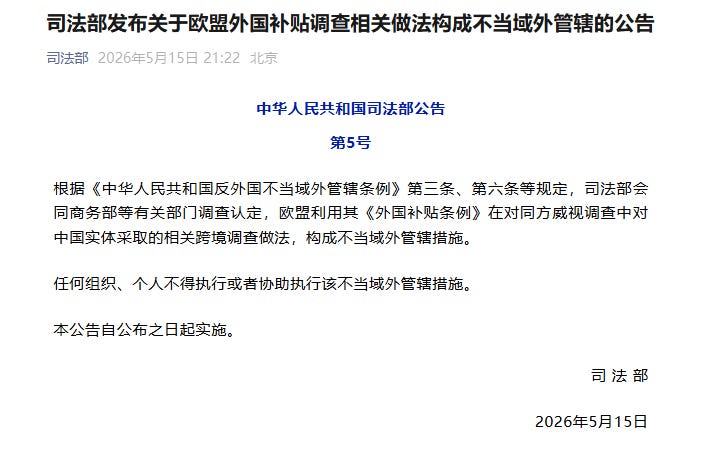
Announcement No. 5 of the Ministry of Justice of the People’s Republic of China
Pursuant to Articles 3 and 6 of the Regulations of the People’s Republic of China on Countering Improper Extraterritorial Application of Foreign Laws and Measures, the Ministry of Justice, together with the Ministry of Commerce and other relevant authorities, has investigated and determined that the European Union’s use of the Foreign Subsidies Regulation (FSR) to conduct cross-border investigative actions against Chinese entities in the Nuctech case constitutes an improper extraterritorial jurisdiction measure.
No organization or individual may implement or assist in implementing such improper extraterritorial jurisdiction measures.
This announcement takes effect immediately upon publication.
Ministry of Justice
May 15, 2026
Ministry of Justice Spokesperson’s Q&A on the EU’s Foreign Subsidies Investigation Practices Constituting Improper Extraterritorial Jurisdiction
Question: On May 15, 2026, the Ministry of Justice issued an announcement determining that the EU’s cross-border investigative actions against Chinese entities in the Nuctech case under the Foreign Subsidies Regulation constitute improper extraterritorial jurisdiction. What is the rationale behind this decision?
Answer:
The EU’s use of the Foreign Subsidies Regulation to investigate Nuctech involved arbitrarily demanding broad and unnecessary information located within China from Chinese entities. These demands constituted improper requirements imposed on the relevant entities and clearly violated international law and the basic principles governing international relations.In order to safeguard China’s sovereignty, security, and development interests, and to protect the lawful rights and interests of Chinese citizens, legal persons, and other organizations, the Ministry of Justice, together with the Ministry of Commerce and other relevant authorities, identified and determined in accordance with the Regulations on Countering Improper Extraterritorial Application of Foreign Laws and Measures that the EU’s actions constitute improper extraterritorial jurisdiction measures.
No organization or individual may implement or assist in implementing such measures.
The EU Foreign Subsidies Regulation is a unilateral instrument created by the EU itself. Since its implementation, the EU has frequently used the FSR to investigate Chinese companies in a manner that is clearly targeted and discriminatory, representing a typical case of using the banner of “fair competition” to pursue protectionism.
Back in January 2025, China’s Ministry of Commerce had already determined through investigation that relevant EU FSR practices constituted trade and investment barriers. Rather than correcting its actions, the EU has continued further down the wrong path.
China will never accept foreign countries or regions abusing “long-arm jurisdiction” against Chinese citizens and enterprises. This announcement is a concrete action implementing the Regulations on Countering Improper Extraterritorial Application of Foreign Laws and Measures in accordance with the law.
We urge the EU side to immediately correct its wrongful practices and create a fair, just, and predictable market environment for China-EU cooperation. If the EU insists on overstepping boundaries, China will resolutely take countermeasures in accordance with the law.
MOFCOM Spokesperson’s Q&A on the Determination that EU FSR Investigation Practices Constitute Improper Extraterritorial Jurisdiction Measures
Question: On May 15, the Ministry of Justice issued an announcement stating that the EU’s cross-border investigative actions against Chinese entities under the Foreign Subsidies Regulation constitute “improper extraterritorial jurisdiction measures.” What is MOFCOM’s response?
Answer:
China has consistently opposed the EU’s abuse of unilateral tools such as the Foreign Subsidies Regulation (FSR) to suppress Chinese companies.Recently, the EU has not only increased the frequency and scope of investigations targeting Chinese firms, but has also escalated investigations into companies such as Nuctech into in-depth probes. It has further compelled Chinese banking institutions to cooperate with investigations while unreasonably demanding broad amounts of information located within China that are unrelated to the investigation itself.
These actions have seriously negatively affected the normal investment and business operations of multiple Chinese companies and banking institutions in Europe.
As early as January 2025, MOFCOM had already determined through investigation that relevant EU FSR practices constituted trade and investment barriers and called on the EU to correct those practices while advocating proper management of differences through dialogue. However, the EU has insisted on continuing down the wrong path.
In response, the Ministry of Justice, together with MOFCOM, after conducting a full investigation and pursuant to the Regulations on Countering Improper Extraterritorial Application of Foreign Laws and Measures, determined that the EU’s cross-border investigative actions against Chinese entities in the Nuctech FSR investigation constitute improper extraterritorial jurisdiction measures, and ordered that no organization or individual may implement or assist in implementing such measures.
China reiterates its hope that the European Commission will quickly correct its wrongful practices, stop its unreasonable suppression of Chinese companies, stop abusing the FSR investigative tool, and provide a fair, just, and predictable business environment for Chinese companies operating and investing in Europe.
China has consistently advocated managing differences through dialogue and consultation and hopes the EU will work with China in the same direction to resolve problems through friendly consultation.
At the same time, China will closely monitor relevant EU developments and will take necessary measures to resolutely safeguard national security and the legitimate rights and interests of Chinese enterprises.
This marks the first real move since China’s new Regulations on Countering Improper Extraterritorial Application of Foreign Laws and Measures took effect a little over a month ago — and this time the direct target is the EU’s Foreign Subsidies Regulation, or FSR.
The FSR is a relatively new EU tool introduced in recent years. The basic logic is simple: if a non-EU company receives support from its home government and then competes in Europe, the EU believes it may have gained an “unfair advantage,” giving Brussels the right to investigate and intervene.
But many Chinese experts and commentators argue that the FSR is very different from the EU’s traditional anti-dumping or anti-subsidy tools. In their view, it looks much more like a regulatory framework specifically designed around the structure of the Chinese economy.
That’s because the FSR defines “foreign subsidies” extremely broadly. It’s not just direct government grants. Loans from Chinese state-owned banks, local tax incentives, or even buying electricity or steel from SOEs could potentially be treated as subsidies if the EU thinks the pricing was not fully “market-based.”
And that creates a structural issue for Chinese companies, because China’s economy naturally involves a large state sector. Many major Chinese firms inevitably deal with SOEs, state-owned banks, and local governments in financing, procurement, infrastructure, and industrial policy support. So under the FSR framework, a lot of completely normal business activity by Chinese companies can automatically end up looking “suspicious.”
The compliance burden is also huge. If a Chinese company wants to do a major acquisition or bid on a large public project in Europe, it has to disclose all forms of “financial contributions” received from non-EU governments over the previous three years. And this applies not just to the European subsidiary, but to the entire corporate group — including the China headquarters and all global affiliates.
So, for example, if a Chinese automaker wants to buy a factory in Europe, it may have to pull together years of records involving local governments, state-owned banks, and SOEs, organize everything, translate it, and hand it over to the EU for review. The compliance costs, legal fees, and due-diligence burden can be enormous.
What really makes companies nervous, though, is not the paperwork itself, but the investigative powers behind the FSR. The European Commission can demand huge amounts of internal material, conduct surprise inspections, and request access to emails, accounting records, and internal data. If companies refuse to cooperate — or if Brussels thinks the information provided is incomplete — they can face massive fines or even be blocked from mergers, acquisitions, or public procurement projects in Europe.
Because of this, many Chinese observers believe the FSR has already gone far beyond a normal regulatory tool and is starting to materially affect the operating environment for Chinese companies in Europe. In many cases, the EU doesn’t even need to issue an actual penalty. Simply launching an in-depth investigation can be enough to make Chinese firms back away on their own.
The reason is simple: FSR investigations are slow, expensive, and extremely intrusive. Companies face endless document requests, risks of data leaks and commercial secrets being exposed, scrutiny of executive emails, and long delays in merger approvals or procurement decisions. And for companies, time itself is a huge cost. Many projects lose commercial value long before any final ruling is made.
Several Chinese projects in Europe have already effectively collapsed under this pressure. Examples often mentioned include CRRC’s rail bid in Bulgaria and LONGi’s solar project in Romania. In both cases, once the EU escalated to an in-depth investigation, the Chinese companies eventually withdrew from the bidding process to limit losses. In other words, Brussels didn’t need to formally ban them from the market — the investigation process itself was enough to push them out.
There’s also a growing view in China that while the FSR officially applies to all non-EU companies — including American, Middle Eastern, and Japanese firms — in practice, most major enforcement cases have focused on Chinese companies.
The firms targeted so far — CRRC, LONGi, Shanghai Electric, Nuctech, Goldwind, and others — are all from sectors where Chinese companies have become globally competitive: high-speed rail, solar, wind power, and security equipment. These are precisely the industries where China’s cost structure, supply chains, and industrial scale have put enormous pressure on many European competitors.
That’s why many people in China increasingly see the FSR as something more than just a subsidy-control mechanism. In their view, it looks increasingly like a new form of industrial protection policy. In the past, Europe mainly relied on anti-dumping cases, anti-subsidy measures, and carbon tariffs. Now it is increasingly using more sophisticated legal and compliance tools to raise the cost for Chinese companies trying to enter the European market.
The Nuctech case has now pushed the tensions between China and the EU over the FSR fully into the open. In April 2024, EU officials carried out surprise inspections at Nuctech offices in Poland and the Netherlands. “Dawn raids” themselves are not unusual in EU competition investigations. What made this case especially sensitive, however, was that the EU was not only looking at data stored in Europe — it also demanded access to executive emails and internal communications.
The problem was that many of those email servers were actually located at Nuctech’s headquarters in China.
That immediately put the company in an impossible position. Under China’s data security and state secrecy laws, certain data located inside China cannot simply be handed over to a foreign government. But refusing to cooperate with the EU investigation could expose the company to huge fines or even market restrictions in Europe.
Nuctech later went to the EU courts to try to block the data requests, but the court took a very hard line. The basic message was: if you operate in Europe, and if computers in your European offices can technically access those emails and systems, then the EU has the right to demand them. Chinese domestic law, in the court’s view, is not a valid reason to refuse cooperation with an EU investigation.
That effectively turned the company into a “sandwich.” Hand over the data, and you may violate Chinese law. Refuse, and you risk punishment from Brussels.
China’s Ministry of Justice announcement this week sends three very clear signals.
First, Beijing believes the EU has gone beyond normal market regulation and crossed into extraterritorial overreach. In China’s view, the EU may investigate commercial conduct inside Europe, but it cannot use the FSR as a basis to directly reach into servers and data systems located inside China.
Second, China has now formally issued a blocking order. In practical terms, that means no organization or individual may cooperate with the EU’s requests involving data located inside China. And this applies not only to the company itself, but also to lawyers, technical staff, service providers, and other third parties.
Third — and perhaps most importantly — Chinese companies previously had to argue in European courts on their own that “Chinese law does not allow us to hand over this data.” European judges often found that argument unpersuasive. Now the situation is different. After the Ministry of Justice formally issued this announcement, companies can say much more clearly: it is not simply the company refusing to cooperate — the Chinese government itself has formally prohibited compliance.
That means the dispute over data, subsidies, cross-border investigations, and extraterritorial jurisdiction is no longer just a compliance issue for individual companies. It is increasingly turning into a broader legal and sovereignty dispute between China and the EU.
The Ministry of Justice statement also seemed to send another message quite clearly: the EU may investigate subsidies, but if it continues trying to bypass the Chinese government and directly access data and servers inside China, Beijing is prepared to escalate with additional countermeasures.
The question now is whether the EU courts will back down because of China’s formal blocking order.
The answer is probably not very encouraging.
Looking at past EU practice, whenever companies refuse to provide core data, the European Commission typically resorts to what is known as “Facts Available” — essentially making the most unfavorable assumptions possible based on whatever information it can obtain.
EU courts have consistently supported this approach. Across EU competition law, anti-subsidy investigations, and trade defense cases, there has long been a very strong expectation that companies must fully cooperate with investigators. If they do not, the Commission is given wide discretion to rely on alternative data, substitute benchmarks, and adverse inferences.
Put simply: if you refuse to hand over information, Brussels assumes the worst.
Chinese companies have already been burned by this system multiple times over the past fifteen years.
One of the earliest and most important cases was the coated fine paper anti-subsidy investigation around 2010–2011. At the time, the EU demanded detailed loan risk assessments, internal bank approval records, and other financing documents from Chinese banks connected to paper producers. Because of Chinese confidentiality restrictions, the banks did not fully hand over the underlying material.
The European Commission’s response was straightforward: if China would not provide the real data, Brussels would simply use its own.
The Commission then replaced Chinese financing data with much higher external benchmarks — including financing rates for lower-rated companies in Taiwan — and used those figures to conclude that Chinese firms had received abnormally cheap loans and therefore large subsidies.
Chinese companies later challenged the decision in EU court and lost.
The real significance of that case was that the EU courts effectively established a very hardline principle: if companies or related institutions fail to cooperate fully, the Commission may rely on “Facts Available” and is under no obligation to search for the most fair or precise alternative data.
The exact same logic later appeared again during the massive EU-China solar trade disputes between 2012 and 2017.
One of the core disputes involved loans from Chinese state-owned banks and data from Sinosure. China argued at the time that many of the requested materials were restricted under Chinese law and confidentiality rules and therefore could not legally be provided. In many ways, the argument was very similar to what Nuctech is saying today.
But Brussels again took a very tough position. The European Commission argued that no country’s domestic secrecy laws can exempt companies from their obligation to cooperate with EU anti-subsidy investigations. Once China refused to provide the information, the Commission treated it as non-cooperation and moved directly to adverse inferences, using assumptions and calculations that were highly unfavorable to Chinese companies. When the cases later reached judicial review, EU courts largely backed the Commission’s approach in full.
Another important case came in 2017, involving hot-rolled flat steel products. In that investigation, several Chinese state-owned banks refused to provide the European Commission with underlying loan approval documents, risk assessments, and other internal materials, arguing that they were restricted by Chinese regulatory requirements and confidentiality obligations.
The Commission’s response was blunt: if China refused to provide the data, Brussels could not verify whether the loans were truly market-based. And if it could not verify that, it would simply assume they were not market-based.
The Commission then activated the relevant “Facts Available” provisions and ultimately treated the loans as illegal subsidies.
You can see a very consistent EU logic here: if Chinese law prevents you from handing over information, that may be your problem — but it does not stop Brussels from continuing its subsidy investigation. In practice, Chinese confidentiality obligations do not automatically become a valid defense in EU investigations. In many cases, they actually trigger an “adverse inference” for non-cooperation.
By the time of the glass fiber fabric cases in 2020 and 2023, this approach had become even more established.
In those cases, Chinese banks and Sinosure again refused to provide core materials such as credit approvals and corporate governance information, citing regulatory requirements and commercial confidentiality.
In 2023, the EU General Court once again sided with the European Commission. The court’s reasoning can basically be summarized in three steps:
First, the Commission itself decides that certain materials are “necessary for the investigation.”
Second, regardless of what Chinese laws, confidentiality rules, or regulatory requirements companies invoke, the Commission can still conclude that the companies failed to cooperate fully.
Third, once the investigation reaches that “non-cooperation” determination, the Commission is free to make the most unfavorable substantive assumptions possible against the company.
So overall, the EU’s position on these issues is arguably even tougher than that of many U.S. courts. American judges will at least sometimes seriously discuss concepts like international comity or conflicts between national interests. The EU’s trade and subsidy enforcement system, by contrast, puts much greater emphasis on the idea that companies must fully cooperate with investigations.
It is worth noting that these kinds of legal clashes are not unique to China’s disputes with the U.S. or the EU. In fact, the U.S. and Europe have been fighting over these issues for decades, and many of the problems Chinese companies face today are very similar to what European companies experienced years ago.
The classic example is the 1987 Aérospatiale case. A helicopter manufactured by the French aerospace company Aérospatiale crashed in Iowa, and the victims’ families sued the company in U.S. federal court. The plaintiffs then demanded that the company produce design, manufacturing, and quality-control documents located in France under U.S. discovery rules.
The problem was that France at the time had a very well-known “blocking statute.” Under French law, providing certain commercial or technical documents to foreign judicial authorities without authorization could actually constitute a criminal offense.
The French company’s position was straightforward: if French law prohibited disclosure, then U.S. courts could not simply force a French company to hand over the data. If the U.S. wanted the evidence, it should go through the formal Hague Evidence Convention process — meaning Washington would submit a judicial assistance request to the French government, which would then decide what could or could not be provided.
But the case eventually reached the U.S. Supreme Court, and the Court took an extremely hard line. Instead of backing down because of French law, it established several principles that have shaped global cross-border litigation ever since.
First, the Hague Evidence Convention was not considered the mandatory first route. The Supreme Court said U.S. courts do not have to rely on international judicial assistance procedures before seeking evidence. As long as a foreign company falls under U.S. jurisdiction — for example by doing business in the U.S., selling products there, or being sued there — American judges can directly use domestic U.S. procedures to compel disclosure.
Second, foreign blocking statutes do not limit U.S. court authority. Even if foreign law explicitly prohibits disclosure and threatens criminal penalties, U.S. courts are not required to stop pursuing the evidence. In effect, the American position became: how your country regulates disclosure is your own issue, but it does not change our ability to require cooperation in U.S. litigation.
Third, the Supreme Court introduced what later became known as the “balancing test.” In theory, judges are supposed to weigh U.S. judicial interests against foreign sovereign interests, which sounds fair in principle. But in practice, U.S. courts have overwhelmingly concluded that the American interest in obtaining evidence for litigation is more important.
After that case, European companies gradually realized that domestic secrecy laws, confidentiality obligations, and blocking statutes were often not enough to stop U.S. courts. Many firms ultimately found themselves forced to choose between two risks: violate their own country’s laws and hand over the data, or refuse cooperation and face the consequences in U.S. court — including losing the case, contempt sanctions, heavy fines, or business restrictions.
In many ways, the situation Chinese companies now face in the U.S. and Europe looks very similar to what European firms experienced decades ago.
According to relevant commentary, China’s Data Security Law and related legislation impose mandatory legal restrictions on the cross-border transfer of certain categories of information. In the Nuctech case, however, the European Commission allegedly ignored those legal constraints and not only demanded materials located within the EU, but also sought large amounts of unrelated information from Chinese financial institutions located inside China, effectively extending its jurisdiction directly into Chinese territory.
In these views, the EU’s actions may not only violate international law and the basic principles governing international relations, but also harm the legitimate rights and interests of Chinese companies. He argued that China’s decision to classify the investigation as an instance of improper extraterritorial jurisdiction is fully consistent with the provisions of China’s regulations.
These comments also stressed that China’s move is not intended to “confront” the EU. Rather, by relying on its own domestic legal framework, Beijing is seeking to push the EU to clarify the boundaries of its rules and apply them in a more transparent manner, thereby preserving predictability in international economic and trade governance.
At the same time, it is argued that China’s response represents an attempt to participate in reshaping international rules and global governance through legal means. In his view, the goal is to prevent developed economies from using unilateral rules to lock in unequal international divisions of labor, while protecting the legitimate interests of developing countries and pushing international rules toward a more balanced and equitable direction.
From Beijing’s perspective, if China had stayed silent this time, it could have effectively amounted to accepting a very dangerous precedent: that the EU can rely on its own domestic laws to reach directly into servers located inside China and compel access to the data of Chinese companies.
Nuctech is not a company selling ordinary products like steel or solar panels. It is one of the world’s leading suppliers of security screening and threat-detection systems, with equipment deployed across airports, customs facilities, and critical infrastructure in multiple countries. The European Commission’s attempt to reach directly into servers located at Nuctech’s Beijing headquarters and obtain executive emails and internal data is therefore viewed in China not simply as a commercial issue, but as something involving sovereignty and national security.
From that perspective, even if Nuctech ultimately faces heavy EU penalties or is pushed out of the European market for “non-cooperation,” Beijing appears to believe that allowing core internal data to fall directly into the hands of a foreign government would be unacceptable.
And in the Chinese view, today it may be Nuctech — tomorrow it could be CATL, BYD, or other major Chinese firms. By issuing this order, China’s Ministry of Justice is effectively sending a message not only to Brussels but to the wider international community: Chinese data sovereignty cannot simply be bypassed. If foreign authorities want access to data located inside China, they must go through formal state-to-state judicial assistance channels, not pressure companies into handing over information through fines or regulatory threats.
In practical terms, the Ministry of Justice announcement also activates the broader countermeasure framework under China’s Regulations on Countering Improper Extraterritorial Application of Foreign Laws and Measures. If the EU insists on forcing access to data, China could potentially use the regulations to target third parties assisting EU investigations. That could include multinational law firms, accounting firms, IT service providers, or data custodians involved in collecting, translating, or transferring Chinese data for EU investigators.
Chinese regulators could theoretically conduct inspections, confiscate alleged illegal gains, impose major fines, or restrict operations. In more extreme scenarios, EU officials or foreign law firm partners directly involved in FSR-related investigations could potentially face visa restrictions, expulsions, or limitations on business activities in China.
At that point, the issue would no longer remain a single corporate dispute. It could escalate into a much broader political and legal confrontation affecting the overall China-EU relationship.
That said, the EU has historically seen itself as one of the world’s leading rule-makers and has been highly protective of its internal market regulatory system. Faced with this unprecedentedly direct pushback from Beijing, Brussels is unlikely to back down easily. From a procedural standpoint, it is highly unlikely that the European Commission will simply terminate the Nuctech investigation because of a Chinese blocking order. More likely, the EU will continue pushing the case forward through the legal process.
If that happens, China may respond more aggressively in return — raising the possibility that this case becomes a major new flashpoint in China-EU relations.