

By Tan Zhu · Yuyuan Tantian
September 27, 2026 · Beijing
The Chinese and U.S. presidents have exchanged visits within the space of six months, an event of historic and landmark significance.
From the welcoming ceremony to the talks and the welcoming banquet, media outlets in China and abroad have examined and interpreted many details of this visit. At the very start of the visit, China made a point that deserves to be viewed in the context of the entire itinerary:
The world is developing and the times are changing, but the historical logic of peaceful coexistence between China and the United States has not changed; the two peoples’ goodwill toward friendly exchanges has not changed; and the international community’s general expectations for China and the United States have not changed.
Some things are changing, but many others cannot and will not change.
A Shared History of Fighting Militarism
The history of jointly fighting Japanese militarism was a subject mentioned by both the Chinese and U.S. presidents in their remarks.
In his address, the Chinese president reviewed this history and specifically noted that China and the United States had once fought “shoulder to shoulder”:
Remarks by Xi Jinping at the Welcoming Ceremony at the White House
During World War II, China and the United States fought shoulder to shoulder against fascist aggression. The Chinese people will not forget this history, nor have the American people forgotten it.
The U.S. side also mentioned a word derived from Chinese: “gung ho.”
“Gung ho” is an abbreviation of the Chinese Industrial Cooperatives. During the War of Resistance Against Japanese Aggression, the cooperatives supplied military and civilian necessities for wartime use and supported the resistance.
Liu Qiang, a senior translator and reviewer at China International Communications Group who is well versed in the evolution of English word meanings, told Tan Zhu:
In 1937, a U.S. Marine Corps officer traveled through China to observe the country’s war of resistance and later visited Yan’an. He encountered the Eighth Route Army and the “Gung Ho” movement, and later adopted “gung ho” as a slogan to encourage cooperation among U.S. service members.
In 1942, that unit distinguished itself in the Pacific theater. To boost morale, the U.S. military publicized the unit. The expression “gung ho” consequently became familiar to more Americans. Its origin lies in the shared values forged by China and the United States in blood and fire under the conditions of a particular era.
Previously, when the U.S. president spoke about World War II, the narrative focused more on the United States itself. This time, it became a historical memory of solidarity and cooperation between China and the United States.
Xiang Haoyu of the China Institute of International Studies told Tan Zhu that this can be understood on three levels: historically, China and the United States jointly participated in establishing the postwar international order; in the present, the two countries still have many converging interests; and looking ahead, they must continue to shoulder the responsibilities of major countries in safeguarding world stability and advancing global governance.
In this context, “fighting shoulder to shoulder” and “gung ho” take on more specific meaning:
China and the United States once transcended their differences and fought shoulder to shoulder against the aggressors of Japanese militarism. At that time, the two countries came together for a cause that concerned world peace. Today, they still need to find such points of converging interest around which they can unite and jointly guard against the risks of our times.
A Shared Responsibility for Artificial Intelligence
The interactions between the Chinese and U.S. presidents also touched on a challenge the two countries must face together today:
Artificial intelligence.
A review of recent readouts on interactions between the Chinese and U.S. presidents shows that areas requiring joint work are often paired with a single verb, such as “strengthen cooperation,” “strengthen dialogue,” or “continue consultations.” Artificial intelligence, however, is paired with two actions:
Remarks by Xi Jinping at the Welcoming Ceremony at the White House
China and the United States are both major countries in artificial intelligence. We have both the ability and the responsibility to develop and govern AI well, ensuring that its development always remains under human control and benefits the people.
“Develop well” concerns technological progress and shared benefits; “govern well” concerns the risks of misuse, malicious use, and loss of control.
“Digital militarism” is one such risk. Tan Zhu previously revealed that the Japanese government has been pouring money into embedding an erroneous view of history in “Gennai,” an AI-enabled business support system it is developing. Japan has also proactively adapted the system to the algorithmic preferences of search engines and large language models so that its falsified history of World War II appears more prominently to AI systems.
If allowed to develop without effective governance, this will lead to harmful consequences.
From jointly resisting militarism to jointly responding to “digital militarism,” and from jointly addressing climate change to jointly exploring how frontier technologies should develop, China and the United States need to work shoulder to shoulder. This is the responsibility and commitment of major countries, and it is also what the international community generally expects of China and the United States.
No matter how the world changes, this expectation will not change.
A Constructive, Strategically Stable Relationship
The September meeting further enriched the meaning of a “constructive and strategically stable relationship”:
Xi Jinping and Peng Liyuan Have Tea with U.S. President Donald Trump and His Wife
The two presidents agreed to further enrich the meaning of the positioning of China-U.S. relations and jointly build “a constructive and strategically stable relationship based on respect, fairness, and reciprocity.”
At their Beijing meeting in May, the two presidents jointly affirmed a constructive and strategically stable China-U.S. relationship. At the time, the U.S. statement added the following phrase after that description:
on the basis of fairness and reciprocity
In the U.S. National Security Strategy, these two terms describe how to rebalance the economic relationship with China in order to address U.S. economic, trade, and security concerns. The fact is that if both sides proceed solely from their own concerns, disputes can still easily arise over specific matters. Economic and trade issues are a case in point.
At this meeting, however, the two sides moved toward each other and agreed to further enrich the positioning of the relationship, placing “respect” before “fairness and reciprocity.”
Diao Daming of Renmin University of China told Tan Zhu that the substance of this positioning—respect, fairness, and reciprocity—is consistent with China’s longstanding principles for handling China-U.S. relations: mutual respect, peaceful coexistence, and win-win cooperation.
“Respect” is the prerequisite. It means respecting each other’s social systems, development paths, and core interests, and carrying forward the spirit of the three China-U.S. joint communiqués. “Fairness” is a value to be pursued. Embedded in the new type of international relations advocated by China, it is reflected both in fairness and justice in international relations and in upholding the fairness of international law and the international order. “Reciprocity” emphasizes mutual benefit on an equal footing and a balance between rights and obligations. It stresses equal status and due regard for each other’s interests in international exchanges: one side cannot enjoy all the rights while the other alone bears the obligations.
By agreeing this time to put “respect” first, the two sides have moved the substance of the relationship’s positioning another step forward.
Manage differences through respect, shape order through fairness, and achieve mutual benefit through reciprocity. Upholding and continuously developing a constructive and strategically stable relationship is how the two major countries can seek the right way to get along. It benefits both peoples and provides an anchor of stability for a turbulent world.
Pragmatism and Implementation
How, then, should this relationship be built in concrete terms? One place to start is a shift in the U.S. media. Before the meeting began, a U.S. media outlet used one word to describe China-U.S. relations: “pragmatic,” meaning starting from actual conditions and first asking whether an approach is workable and can produce results.
China-U.S. economic and trade relations are one example.
In May, the two sides agreed to establish a trade council and an investment council to discuss their respective trade and investment concerns. By September, further arrangements had been made.
In September, the two presidents had an in-depth exchange of views on the constructive and strategically stable China-U.S. relationship and on major international and regional issues. They reached an eight-point consensus, including:
The two presidents recognized the positive role of the China-U.S. economic and trade consultation mechanism and the outcomes of consultations between the two sides’ economic and trade teams, including establishing and advancing mechanisms such as the trade council, reaching a reciprocal tariff-reduction arrangement worth US$30 billion, and extending the outcomes of the Kuala Lumpur economic and trade consultations. They instructed that these outcomes be implemented.
From economic and trade consultations, to reaching consensus, to arranging implementation, one sentence from the talks now has a more specific direction:
Xi Jinping Holds Talks with U.S. President Donald Trump at the White House
Departments at all levels and in all fields in both countries must get moving. Do not refrain from doing a good deed because it is small, and do not do a bad deed because it is minor. Implement the consensus reached by the two sides with the perseverance of driving a nail.
This was the first time in nearly two years that China had invoked this spirit in an official readout on interactions between the Chinese and U.S. presidents.
The “spirit of driving a nail” has more often been used in the past to describe ensuring implementation at home. In the context of China-U.S. relations, what the two sides must do next is determine who will carry forward what has been agreed and whether they can continue implementing one item after another.
Competition Without a Gladiatorial Contest
Specific matters must be handled one by one. China and the United States must also answer an unavoidable question: How should competition be conducted?
At the White House welcoming ceremony, China said that China and the United States “need not shy away from competition,” but that competition “should be a race in which each tries to catch up with and surpass the other, not a gladiatorial contest in which one side wins and the other loses.”
Competition and differences have not disappeared entirely. Yet amid these voices, new changes are also taking place.
A person with frontline diplomatic experience told Tan Zhu that Graham Allison, who proposed the “Thucydides Trap,” later also began studying what China describes as “you are in me, and I am in you.”
There is another detail. Allison recalled that U.S. Senator Chuck Schumer once led a delegation to China. After returning to the United States, someone in the delegation called and asked him what the phrase actually meant. Allison said he had not understood it at the time either, and later asked President Xi Jinping about it. When he discussed the phrase again, Allison said that China and the United States were closely bound together by their destinies and had to cooperate to safeguard their own rights to survival.
A scholar who once worried about whether major powers were destined for conflict has begun studying how two interdependent major countries can coexist over the long term. The question being asked about China-U.S. relations has changed.
The answer is also clear. “Can China and the United States move beyond the ‘Thucydides Trap’ and create a new paradigm of major-country relations?” This was the major proposition raised by President Xi at his meeting with U.S. President Donald Trump in May this year.
At this White House welcoming ceremony, China stated it directly: the “Thucydides Trap” can be transcended.
The Historical Logic of Peaceful Coexistence
At the very start of this visit to the United States, China said: “The historical logic of peaceful coexistence between China and the United States has not changed.”
How should this historical logic be understood? The two presidents’ reciprocal visits this year shared one feature: on each visit, they went to a place in the host country that carries historical memory.
When President Trump visited China in May, the two presidents toured the Temple of Heaven together and discussed the Chinese view of the universe, the Chinese philosophy of engaging with the world, and the traditional Chinese idea that “the people are the foundation of the state; only when the foundation is solid can the state be at peace.” Four months later, on the final stop of this visit to the United States, the two presidents went together to the U.S. National Archives, where they were briefed on the institution and its principal exhibits.
At the National Archives, the Chinese side spoke of the differences between the two countries in history and culture, social systems, and development paths. It also said that the aspirations of the two peoples for a better life are shared, and called for the two sides to “acknowledge and respect each other’s differences.”
The two countries do not have to become alike in order to coexist peacefully. This historical logic has not changed.
People-to-People Ties That Endure
In his toast at the welcoming banquet, the Chinese president traced several important milestones in exchanges between the Chinese and American peoples across a span of more than 200 years.
The most recent was the story of friendship between Saykos and Yin Yuzhen.
Toast by Xi Jinping at the Welcoming Banquet Hosted by U.S. President Donald Trump
More than 20 years ago, an American named Saykos helped fund Chinese desert-control worker Yin Yuzhen’s tree planting. Not long ago, the elderly man returned to China and saw with his own eyes that the desert of those years had become a lush forest. This story moved many people in China and is an example of friendly exchanges between the Chinese and American peoples.
Those who move China-U.S. relations forward include statesmen and diplomats, businesspeople, teachers, students, athletes, and millions upon millions of ordinary people. Often, it is each concrete act of people-to-people exchange between China and the United States that gives friendly cooperation a deeper foundation.
President Trump likewise said at the welcoming banquet:
President Xi and I both understand that we represent different systems, but the ties between our peoples have endured.
The word “but” in this sentence matters. Different systems are a fact, but systemic differences do not sum up the entirety of China-U.S. relations. They cannot erase or obstruct the ties the two peoples have formed over the long term.
On the morning of September 24 local time, President Xi announced in his address at the White House welcoming ceremony that “over the next five years, China will invite 100,000 young Americans to visit China for exchanges and study.”
This was another invitation from President Xi to young Americans, following the initiative he announced in San Francisco in November 2023 to “invite 50,000 young Americans to China for exchanges and study over the next five years.”
Tan Zhu reviewed publicly reported data from the past three years on Chinese and American youth exchange groups. Since the end of 2023, youth exchanges between the two countries have accelerated markedly. Cultural and tourism experiences remain the most common activities, but science, technology, and education programs have increased significantly. Nontraditional study-tour topics such as rural revitalization and ecological and environmental protection have also been added to the options.
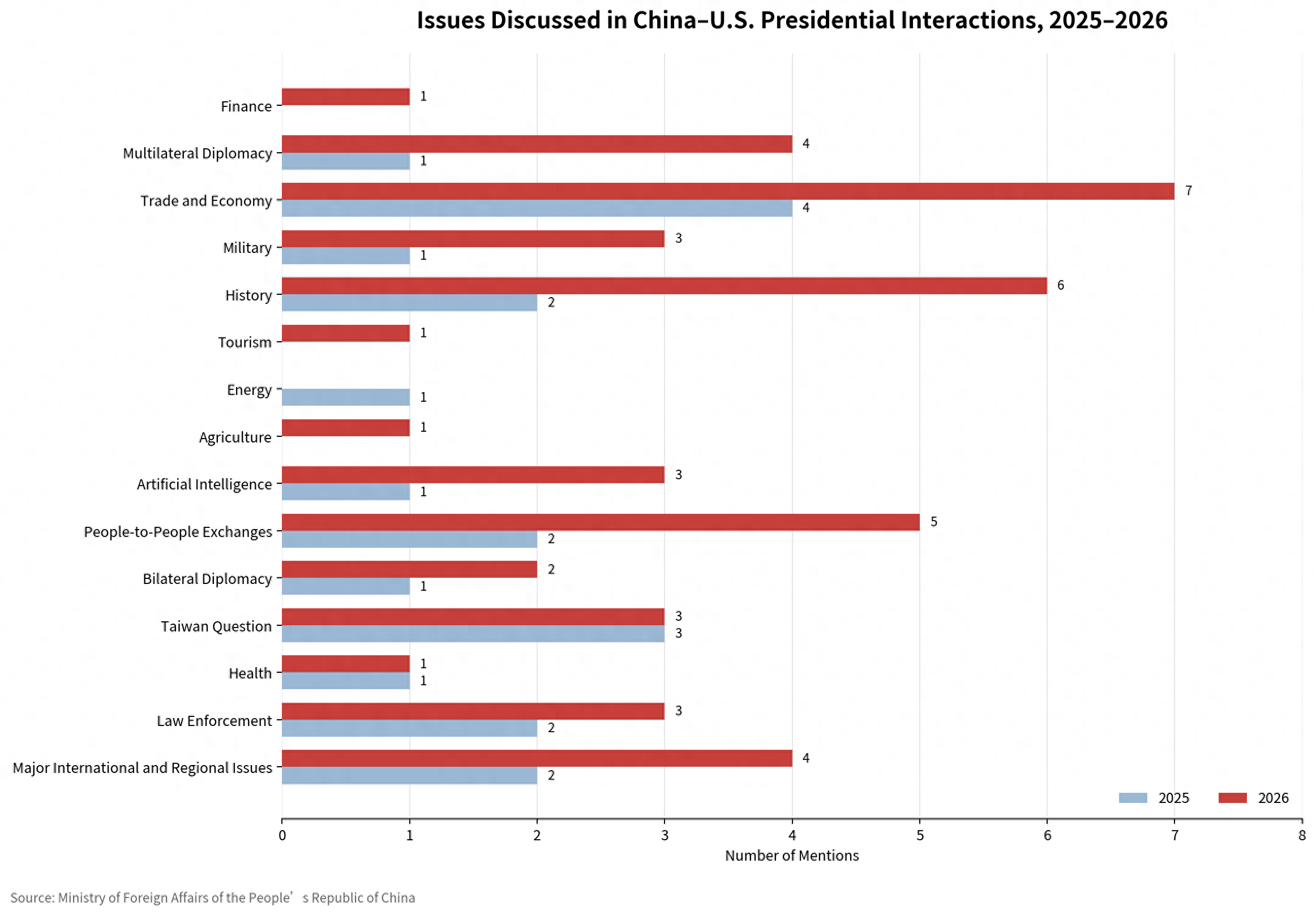
Issues Discussed in China–U.S. Presidential Interactions, 2025–2026 · Source: Ministry of Foreign Affairs of the People’s Republic of China
Zhuang Hanjie, who has long organized China-U.S. youth exchange programs, told Tan Zhu that China not only possesses a rich historical and cultural heritage but is also undergoing a large-scale industrial transformation with global impact. Students hope to see a China that is whole, real, and developing dynamically.
An American student who had participated in a China-U.S. exchange program told Tan Zhu that before going to China, her understanding of the country came mainly from school history classes and social media. After arriving, she performed and took part in activities with Chinese students, forming very deep friendships. After returning to the United States, they continued to keep in touch through group chats.
A single dialogue became an enduring small network of relationships. China was no longer merely a country in the news or a competitor in policy documents, but people she had met, spoken with, and remained in contact with.
As long as the people of both countries remain willing to understand and draw closer to one another, these ties will form an important foundation of public support as China-U.S. relations continue to move forward.
An Answer That Can Stand the Test of Time
Today, China-U.S. relations once again stand at a new historical starting point.
New technologies will emerge, new competition will arise, and new areas of cooperation will appear. The questions posed by the times will change. What remains unchanged is that China and the United States must always find ways to get along and work together.
After all, relations between major countries must ultimately be grounded in the problems they face together, the interests they create together, and the ties they build together.
The times will continue to change, and China-U.S. relations will continue to move forward.