

At the invitation of U.S. President Donald Trump, Chinese President Xi Jinping paid a state visit to the United States from September 23 to 25.
From personally greeting Xi at the airport to a grand welcoming ceremony and a carefully arranged White House state dinner, the U.S. side received the Chinese leader with a level of ceremony rarely seen in recent years.
Why did Trump attach such importance to the visit? With the Chinese and U.S. presidents making reciprocal visits—from Beijing to Washington—in less than six months, what new elements of stability have been added to the bilateral relationship?
To discuss these questions, Guancha.cn spoke with Professor Wu Xinbo, Dean of the Institute of International Studies and Director of the Center for American Studies at Fudan University. In Wu’s view, with the U.S. midterm elections approaching and several of Trump’s foreign-policy initiatives facing difficulties, stabilizing China-U.S. relations is very much in Trump’s interest. By building strategic trust, expanding strategic consensus and strengthening strategic engagement, the latest summit has further translated the vision of a “constructive and strategically stable China-U.S. relationship” into action.
Wu also believes that positive developments in trade and artificial intelligence have opened up additional room for cooperation, while China’s new initiative to invite 100,000 young Americans to China for exchanges and study over the next five years represents an investment in the future of China-U.S. relations.
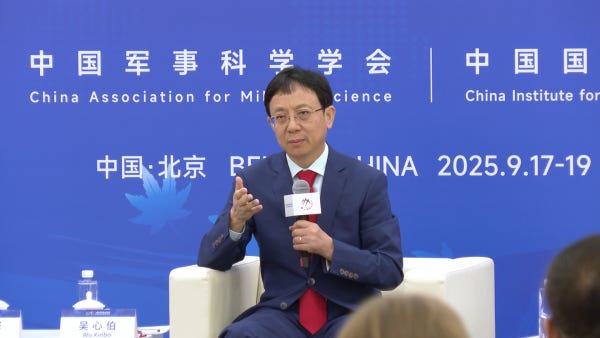
The following is the full interview.
Guancha.cn: At the China-U.S. summit in Beijing this May, the two presidents established a new goal of building a “constructive and strategically stable China-U.S. relationship.” At the Washington summit, President Xi further stressed that the two sides should translate this vision into action. Based on the information released so far, what is your most important observation about this second summit between the two leaders in less than six months? What new stabilizing factors has it added to the relationship?
Wu Xinbo: The discussions between the two presidents once again focused closely on the overarching goal of building a “constructive and strategically stable China-U.S. relationship.” To achieve this, China and the United States need a relatively high degree of strategic trust, strategic consensus on a number of important issues, and sustained, positive strategic engagement.
Less than six months after the Beijing summit, President Xi traveled to the United States for a state visit and held in-depth discussions with President Trump. This undoubtedly helps strengthen strategic trust between the two countries.
China and the United States also reached understandings on pursuing dialogue, coordination and cooperation in areas including trade and economic relations, artificial intelligence, military-to-military relations, and regional and international hotspot issues. These developments help expand strategic consensus between the two sides.
Meanwhile, around this state visit, the two countries conducted a series of high-level dialogues, consultations and face-to-face exchanges. These are manifestations of strategic engagement between China and the United States.
Overall, progress at these three levels has helped advance the goal of building a constructive and strategically stable China-U.S. relationship.
Guancha.cn: From Trump’s unusual decision to personally greet President Xi at the airport to the White House welcoming ceremony and state dinner, the United States clearly attached considerable importance to this visit. Given the approaching U.S. midterm elections and the current international situation, why do you think Trump placed such importance on the visit? What did he hope to achieve through the summit?
Wu Xinbo: At the personal level, this reflects the respect and admiration for President Xi that Trump has repeatedly spoken about, as well as the personal friendship that has developed between the two leaders.
In terms of Trump’s political needs, I think he wants to create a successful foreign-policy narrative around China that can help advance both his domestic and international policy objectives.
The U.S. midterm elections are approaching, and the Republican Party is currently facing a difficult electoral environment. If China-U.S. relations are handled well, China could purchase more U.S. agricultural products, energy products and perhaps even Boeing aircraft. That could help Republicans win votes in the midterms, which makes the relationship important to Trump.
If we look at Trump’s broader foreign-policy agenda, the United States is currently in a difficult position over the Middle East and Iran. Trump’s efforts to promote a Russia-Ukraine settlement have yet to make significant progress, while his desire to restart dialogue with the North Korean leader has not received a clearly positive response. On all of these issues, he hopes to receive support from China.
Trump is someone who acts when he sees an advantage. The fact that he has attached so much importance and devoted so much attention to this visit suggests that, from his perspective, there are substantial benefits to be gained from the China-U.S. relationship at this moment.
Guancha.cn: There were also many noteworthy details at the White House state dinner. For example, the U.S. side deliberately selected a sparkling wine with historical ties to the “Toast to Peace” during Nixon’s 1972 visit to China; red was used as the main color; and prominent American business and technology leaders, including Elon Musk, Jensen Huang, Lisa Su and Tim Cook, attended. What messages do you think these arrangements were intended to convey? In particular, what does the active participation of the U.S. business community tell us about its expectations for the current China-U.S. relationship?
Wu Xinbo: In its dealings with China, the United States has gradually come to understand that China is a country and culture that attaches considerable importance to history. As a result, the U.S. side also uses various forms of symbolism to highlight the historical significance of major events.
The use of the same type of wine associated with Nixon’s 1972 visit also suggests that China-U.S. relations are once again at an important and historically significant juncture. President Xi’s visit is historic and has milestone significance.
More than 130 people attended the state dinner, while the Chinese delegation accounted for only a small number—around 19 people. Why were there so few Chinese guests? Trump had explained beforehand that there simply were not enough seats because leading figures from many sectors in the United States wanted to attend.
Trump places considerable importance on his relationship with the U.S. business community. When he visited China in May, he also brought a large, high-level business delegation. So he wanted to reserve many of these seats for American business leaders and use the opportunity to encourage cooperation between the business community and the Trump administration.
For American businesses, attending an event of this kind also gives them an opportunity to demonstrate how seriously they take China-U.S. relations. Whether they accompanied Trump on his visit to China or attended the White House state dinner, behind their participation is a strong desire to deepen and develop economic and trade relations with China.
Guancha.cn: You attended the state dinner welcoming Trump to China in May. Based on your own experience, what kinds of opportunities can occasions such as state dinners create for interaction outside formal negotiations? What role can they play in improving mutual understanding and building trust?
Wu Xinbo: I think interactions outside formal meetings—whether taking a walk, having tea or visiting places of cultural and historical significance—can create a relaxed and informal atmosphere for the two leaders. This allows each side to gain a more genuine sense of what the other side is thinking and trying to convey. Such activities therefore have qualities that formal meetings do not.
Arranging informal activities also indicates that the relationship between the leaders is not purely an official working relationship. There is also a personal dimension, as friends. Developing that kind of relationship can have a positive effect on mutual trust between the two leaders.
Guancha.cn: China and the United States recently held another round of economic and trade consultations and reached a new joint arrangement. Based on the information disclosed so far, which developments are most significant? What do they mean for stabilizing expectations among businesses in both countries?
Wu Xinbo: First, the one-year trade “truce” agreement reached by China and the United States last October has been extended until January next year.
Second, the two sides have each exempted $30 billion worth of imported goods from tariffs. There is also a prospect of moving further beyond the initial $30 billion and bringing more products within the tariff-exemption framework. This will help expand and stabilize bilateral trade.
Third, I believe the two sides have reached certain agreements concerning increased purchases of each other’s products.
Fourth, China has proposed a package approach for managing China-U.S. economic and trade relations, covering trade, investment, technology and finance. These issues are interconnected. We cannot simply discuss trade in isolation from investment, or investment in isolation from other issues. They need to be considered together. The U.S. side has taken an open attitude toward this proposal, and the two sides will continue discussing it.
Fifth, the two sides held constructive discussions on artificial intelligence and agreed to establish a communication mechanism for AI safety risks. This is significant for cooperation between China and the United States in addressing the challenges created by the development of AI technology, and it also broadens the scope of bilateral cooperation.
Guancha.cn: Not long ago, China and the United States held their first dialogue on artificial intelligence under the bilateral economic and trade consultation mechanism. At this summit, both President Xi and President Trump stressed that China and the United States could continue dialogue and strengthen cooperation on AI. Given that technological competition between the two countries remains intense, what strategic considerations are reflected in their shared willingness to cooperate? What does this mean for exploring a way for competition and cooperation to coexist?
Wu Xinbo: I think the willingness of China and the United States to conduct dialogue and communication on artificial intelligence shows that, although the two countries compete intensely in the development of AI technology, they are also increasingly taking a pragmatic approach to the risks and challenges created by AI.
Artificial intelligence can benefit humanity, but it can also create enormous risks. These are not risks that any single country can address on its own. International cooperation is required, particularly cooperation between China and the United States, the two major powers in artificial intelligence.
In my view, China-U.S. cooperation on AI could be similar to the cooperation the two countries have pursued in the past on issues such as climate change, environmental protection and counterterrorism. It can open up a new area of cooperation in the bilateral relationship and help advance global governance in this field. That gives it considerable significance.
Guancha.cn: During the summit, President Xi said he hoped the United States would maintain the correct position of opposing “Taiwan independence” and handle the Taiwan question prudently. You previously observed that the U.S. approach to Taiwan over the past several months had generally been cautious. Can that caution continue? What concrete U.S. actions should we be watching most closely?
Wu Xinbo: The direction of the Trump administration’s Taiwan policy will depend, on the one hand, on changes in the U.S. domestic political situation and the political pressure Trump faces at home. On the other hand—and more importantly—it will depend on how firmly China maintains its position on the Taiwan question.
There have always been pro-Taiwan forces in the United States pushing for arms sales to Taiwan and related measures. Trump has to consider what China would do in response. If China makes clear to him that U.S. arms sales to Taiwan would trigger a firm Chinese response and result in greater losses to U.S. national interests, Trump will have to weigh the costs and benefits.
So I think the key is for China to remain firm. We need to state our position clearly: we oppose U.S. arms sales to Taiwan, oppose any form of military collusion between the United States and Taiwan, and oppose official contacts between the United States and senior officials of the Taiwan authorities. If the United States refrains from these actions, that constitutes opposition to “Taiwan independence” and would contribute to the development of China-U.S. relations.
Guancha.cn: Ahead of this China-U.S. summit, members of the U.S. Congress were actively pushing for arms sales to Taiwan. How do you think this issue will develop?
Wu Xinbo: Congress has consistently pushed Trump to loosen restrictions relating to Taiwan. If Republicans suffer a major setback in the midterm elections, that could create significant political pressure on Trump. Under those circumstances, pressure from pro-Taiwan forces could become more difficult for him to resist.
We therefore need to remain alert to the possibility that he could restart arms sales to Taiwan or promote high-level U.S.-Taiwan exchanges. In my view, the main risk point will come after the midterm elections.
Guancha.cn: China and the United States are the world’s two largest economies, and their relationship is one of the most important bilateral relationships in the world. Given today’s turbulent international environment, what concrete issues in global and regional affairs could the two countries work on together?
Wu Xinbo: During their meeting, President Xi and President Trump discussed the situation in the Middle East, the Ukraine crisis and the Korean Peninsula. This indicates that on these international and regional hotspot issues, China and the United States currently have room for dialogue and communication, and even for coordination and cooperation.
On the Middle East, China’s primary concern is when the Strait of Hormuz can reopen and when freedom of navigation can be restored. The prerequisite for achieving this is for the United States and Iran to return to the memorandum they reached in June. In this process, China will work with both Iran and the United States. Only in this way can the situation in the Middle East genuinely ease.
As for the Ukraine crisis, China’s position will remain one of promoting peace and encouraging negotiations. Trump has now renewed his efforts to promote Russia-Ukraine negotiations, and China and the United States can maintain communication and coordination in this process.
Regarding the Korean Peninsula, China has always supported steps conducive to easing tensions. Trump hopes to meet the North Korean leader and launch U.S.-DPRK dialogue in order to improve bilateral relations. We would certainly support this and help create favorable conditions.
In a world currently marked by conflict and instability, China and the United States, as two major powers, have broad scope for cooperation on international and regional affairs.
Guancha.cn: In San Francisco in 2023, President Xi proposed inviting 50,000 young Americans to China for exchange and study programs over five years, and that target has already been achieved ahead of schedule. During this visit, President Xi announced that China would invite 100,000 young Americans to China for exchanges and study over the next five years. You have worked in higher education for many years and have extensive exchanges with the U.S. academic community. Based on your observations, what perceptions of China are most likely to change when young Americans experience the country firsthand? And how can a short visit be turned into longer-term understanding and connections?
Wu Xinbo: Ultimately, seeing is believing.
Let me give you an example. For each of the past three summers, Harvard University has sent a group of undergraduates to the Center for American Studies at Fudan University for a summer program. They spend six to eight weeks in Shanghai, taking classes as well as visiting places and traveling.
On behalf of the Center for American Studies, I usually invite them to a meal and talk with them about their impressions of China. About half of these American students are visiting China for the first time. They generally tell us that only after coming here did they encounter the real China, and that it was very different from the China they had learned about in the United States.
They experience firsthand that China is safe, clean and convenient, with a pleasant environment, and that in many respects it performs even better than the United States. They ride fast subways and high-speed trains and experience Chinese new-energy vehicles. They may previously have thought of China as a developing country that should be relatively backward, only to find a prosperous and developed country in front of them. They may also have heard that China is very “anti-American,” but when they arrive they find ordinary Chinese people warm and friendly.
So facts speak louder than words.
After visiting China, they may be less likely to be influenced by reports that distort facts or smear China. Over the longer term, they may develop a more positive view of China and the Chinese people.
A number of U.S. opinion polls now show that respondents aged 19 to 30 have more positive views of China than respondents in other age groups. This is because young people are able to objectively experience China’s development and progress.
Building on the previous “50,000 in five years” initiative and moving to “100,000 in five years” is, in effect, an investment in the future of China-U.S. relations. Ten or twenty years from now, these young people will become members of America’s social and political elite. They will be the ones managing China-U.S. relations, and the situation will be different from today.
Guancha.cn: From Beijing to Washington, the Chinese and U.S. presidents have made reciprocal visits in less than six months. They have also confirmed that they will support each other in successfully hosting this year’s APEC Economic Leaders’ Meeting and the G20 Leaders’ Summit. What room does this continuing leader-level diplomacy create for the next stage of China-U.S. relations? What is your outlook for the relationship in the period ahead?
Wu Xinbo: I think there should be two more opportunities for meetings between the Chinese and U.S. presidents before the end of the year. Both would take place during major diplomatic events hosted respectively by China and the United States. That would mean four rounds of leader-level diplomacy between China and the United States within a single year, which would itself be unprecedented.
Through sustained leader-level diplomacy, the two countries can strengthen political trust, promote strategic understanding, make progress on specific issues, further improve the atmosphere of China-U.S. relations, and create greater momentum for stability and development in the relationship.
The biggest uncertainty this year is the U.S. midterm elections. From now until the end of the year, I am relatively optimistic about the overall trajectory of China-U.S. relations: broadly stable, with some progress.
However, when the new U.S. Congress takes office early next year, China-U.S. relations could face greater challenges. The new Congress’s approach toward China, as well as its relationship with the Trump administration, will both affect the bilateral relationship.