

I have participated in many dialogues between Chinese, American, and European experts on AI, and one topic that consistently arises is the question of how China views Artificial General Intelligence (AGI) and how far China has actually progressed toward it. Some experts speak quite candidly about the situation in the United States: discussions about when AGI might arrive, what the pathway toward Artificial Superintelligence (ASI) could look like, and whether the United States and China are engaged in an “ultimate AI race” are extremely intense. In academia, industry, and policy circles alike, these concepts are debated and modelled almost daily.
By contrast, official public statements from China tend to be more cautious and much less focused on explicit conceptual discussions of AGI. From the American perspective, this asymmetry in the intensity of discussion creates an information vacuum. In that vacuum, people often begin to speculate, fill in the gaps with their own assumptions, and sometimes construct exaggerated narratives—occasionally even wondering whether China might be hiding something akin to a “Manhattan Project–style” initiative.
Within China itself, the situation is also more complex than it might appear from the outside. Both academics and industry figures have discussed AGI publicly, but their understandings of what AGI actually means often differ significantly. Even when companies make public statements about AGI, those remarks frequently reflect personal views rather than a unified institutional position, because there is often no single, shared definition of AGI within the companies themselves.
Today, Song-Chun Zhu (朱松纯), Dean of the Beijing Institute for General Artificial Intelligence, had a one-on-one conversation with CGTN host Tian Wei and discussed his views on AGI.
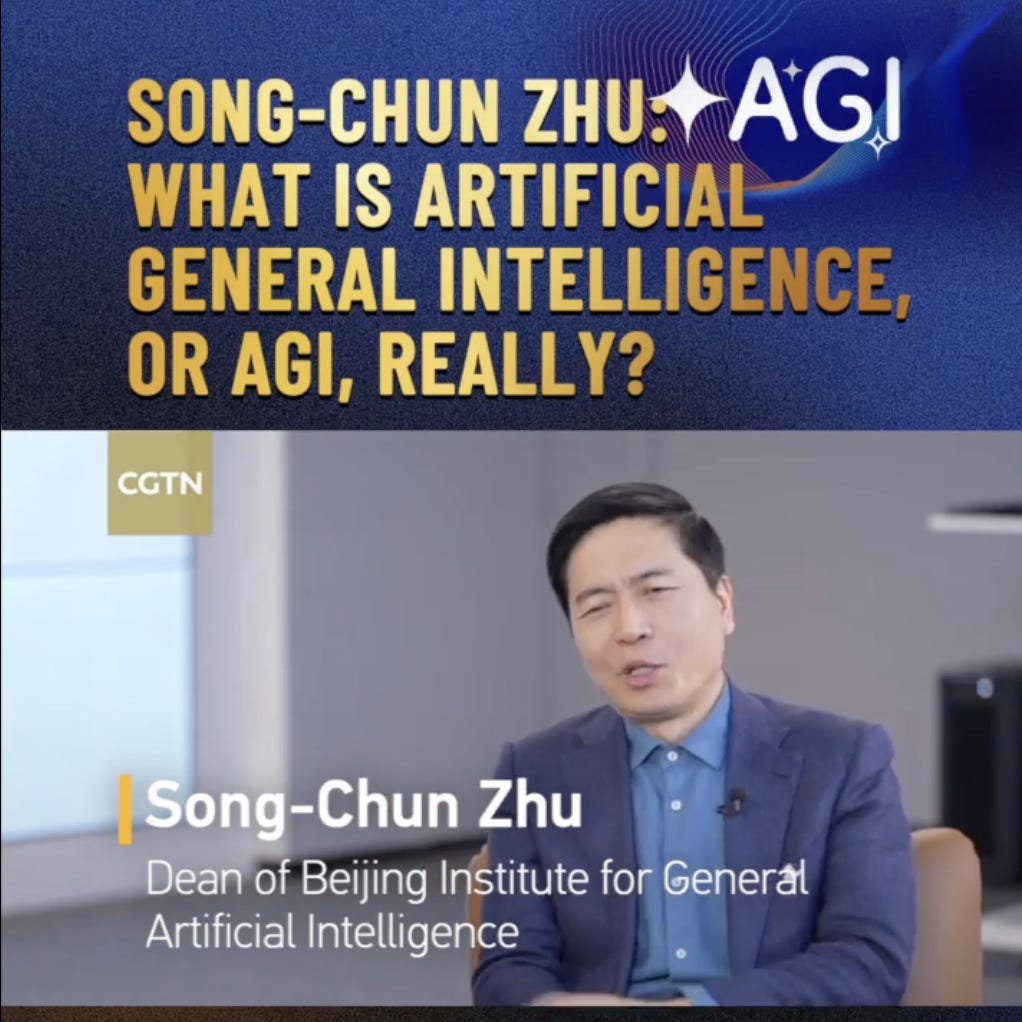
Zhu Song-Chun is a highly influential Chinese scientist in the fields of computer vision, artificial intelligence theory, and cognitive science. He holds an important position in both the Chinese and American academic communities: he spent many years teaching AI at leading universities in the United States, and in recent years he has also become one of the key figures promoting the development of major AI research institutions in China.
According to Zhu, most people just use AGI as a term for fundraising to attract public attention. AGI is an agent that learns to grow, step by step, in mathematical space. His creation "Tong Tong" proves it. Starting as a "baby" recognising toys, she now handles household chores and picks up clues in certain situations as a "digital citizen."
Below is Zhu’s remarks:
It has been simplified as the United States is trying to reach for the stars by developing AGI, while China is more about AI plus. I think that’s how the media frame it. You don’t mask, and you wanna go to, let’s think about human survival, to go to Mars and so on. Sounds like they’re exploring the frontiers. But I tell you, they’re not, most of the people who talk about AGI right now from companies haven’t really done deep research about AGI. They’re just entrepreneurs who try to use AGI as a term for fundraising, to attract public attention. So I think that’s wrong direction.
But let’s come back to AGI. AGI is a big mathematical space. Tongtong is really the first AGI agent. At the beginning, we just say, okay, we start with a little room. It’s like when you have a cradle, right? Baby comes through the world. It’s very little room. And there were only a desktop with different toys I remembered around. And that’s the entire world for her. And then she began to develop certain so-called embodied physics tasks. Right now, people think about a physical model, right? And then the physics try to pick up objects and move them around, and then pile them up and form a certain shape, and so on. And then we enlarge the scope to a room she can move around, and then she can walk and dance, just somersault, just body movement. We further give her an apartment with three bedrooms, one guest room, a toilet, and a washing machine. And then she began to deal with people like parents, grandparents, and later on, we introduced a younger brother, Tian Tian, to play with her. So this would be a family of four. So about a year and a half ago, we let her go to a kindergarten, a community.
Right now, what you saw was the AI Town. When she needed to solve a much bigger task, she needed to find out who was responsible for a streamed cat, right? Not a scratched lady. So this is the abstract task she comes back and forth, and dealing with different types of people.