

Overall Assessment of the Visit
Outside reactions to the visit appear highly divided. Some observers argue the summit produced relatively few concrete outcomes, pointing to the decline in U.S. stock markets afterward as a sign that expectations were not met. Others view the visit as broadly successful.
Judging from Wang Yi’s remarks, Beijing appears reasonably satisfied with the overall outcome.
The economic teams reached what looks like a generally balanced and constructive package, including implementing prior understandings, establishing trade and investment councils, addressing agricultural market-access concerns, and expanding two-way trade under a reciprocal tariff-reduction framework.
I believe both the US and the Chinese side actually did not enter the visit with particularly high expectations. The broader goal was more about creating a positive starting point and setting the tone for leader-level engagement over the rest of the year.
The real things to watch now are whether President Xi’s potential visit the White House this fall, as well as the upcoming APEC and G20 meetings later this year
I. Main Outcomes Confirmed by Both Sides
1. A New Framework for U.S.-China Relations
The most important and long-term political outcome of the visit was the establishment of a new framing for bilateral ties. According to the Chinese side, Xi and Trump agreed to define the relationship as a “constructive and strategically stable U.S.-China relationship,” which Beijing says should provide strategic guidance for at least the next three years and likely beyond.
China’s interpretation of the framework is: cooperation as the foundation, competition kept within limits, differences manageable, and conflict avoidable.
2. Economic and Trade Relations
According to an announcement(updated on 16th May)from China’s MOFCOM, the two sides reached preliminary outcomes in the economic and trade area in several key areas:
Both sides agreed to continue implementing the outcomes of previous consultations and reached positive consensus on relevant tariff arrangements.
The two sides agreed to establish a Trade Council and an Investment Council to discuss each side’s concerns in trade and investment. Through the Trade Council, the two sides will discuss tariff reductions on certain products and have, in principle, agreed to lower tariffs on products of roughly equivalent scale that are of concern to each side.
The two sides agreed to resolve or substantially advance solutions to some non-tariff barriers and market-access issues involving agricultural products. The U.S. side will actively work to address China’s longstanding concerns regarding automatic detention measures on dairy and aquatic products, exports of growing-medium bonsai plants to the U.S., and recognition of Shandong as an avian influenza-free zone. China, meanwhile, will actively work to address U.S. concerns regarding beef facility registrations and poultry exports from certain U.S. states.
Both sides agreed to promote expanded two-way trade, including in agricultural products, through arrangements such as reciprocal tariff reductions on certain categories of products.
The two sides also reached arrangements related to China’s purchase of aircraft from the United States, as well as U.S. guarantees regarding the supply of aircraft engines and components to China, and agreed to continue advancing cooperation in related sectors.
Besides trade, Wang Yi also said that both sides are willing to expand exchanges in areas including diplomacy, military-to-military relations, public health, agriculture, tourism, people-to-people exchanges, and law enforcement, injecting new momentum into the next phase of bilateral engagement.
Wang Yi described the outcomes reached by the two countries’ economic teams as “overall balanced and positive,” and said that working-level teams on both sides are still consulting on specific details and will move quickly to finalize and implement the agreements.
The U.S. side has not yet released a formal official statement. The following is based on a synthesis of publicly available information from multiple sources:
Purchases of U.S. Products: Trump said on Air Force One that China agreed to buy 200 Boeing aircraft, with the number potentially expanding to 750. He also mentioned GE engines. U.S. Trade Representative Jamieson Greer said China would purchase “tens of billions of dollars” worth of U.S. agricultural products annually and renew export licenses for American beef.
Trade Board: The U.S. side said the two countries are discussing a “managed trade” mechanism focused on non-sensitive goods. The rough idea being discussed is that each side could lower tariffs or other barriers on around $30 billion worth of products. The U.S. side may focus on energy and agricultural exports, while China likely wants reductions in some consumer-goods tariffs imposed during the earlier trade war.
Investment Board: The U.S. denied rumors that China would invest “trillions of dollars” into America, but confirmed discussions about creating an investment board for “non-sensitive sectors.” The goal would be to define in advance which industries are considered non-sensitive and non-strategic and therefore unlikely to trigger CFIUS reviews. WH said the two sides discussed ways to enhance economic cooperation between countries, including expanding market access for American businesses into China and increasing Chinese investment.
3. Taiwan
Beijing stressed that Taiwan remains the most important issue in U.S.-China relations. China said that if the issue is handled properly, overall stability can be maintained, but if mishandled, it could lead to confrontation or even conflict. Beijing also emphasized that “Taiwan independence” is incompatible with peace in the Taiwan Strait and urged Washington to handle the issue with extreme caution.
Xi reiterated opposition to “Taiwan independence” and U.S. arms sales to Taiwan.
Wang Yi said: During the meetings, we felt that the U.S. side understands China’s position and takes China’s concerns seriously. Like the broader international community, it does not support or accept Taiwan moving toward independence.”
U.S.-China expert Wu Xinbo, who is seen as close to the Chinese government, said that
Whether this new positioning of U.S.-China relations can actually take hold will depend to a large extent on how the Taiwan issue is handled.
Specifically, on arms sales to Taiwan, the U.S. would need to adjust its policy, stop arms sales, and make its opposition to “Taiwan independence” much clearer.
Trump’s comments on Taiwan were particularly notable:
On the Six Assurances:
1982 is a long way…that’s a big far distance away….Certainly [Xi] brought that [arms sales] up. He talked about that to me, obviously. What am I gonna do? Say I don’t want to talk about it because I have an agreement that was signed in 1982. We discussed the arms sales, too. The whole thing with the arms sales. In great detail actually. And I’ll be making decisions.
On arms sales and Lai Ching-te:
I’ll make a determination over the next fairly short period [on the arms sale]. I have to speak to the person who, you know who he is, who is running Taiwan.
If you kept it the way it is, I think China is going to be okay with that — but we’re not looking to have somebody say, ‘let’s go independent because the United States is backing us.’
On conflict:
You know, I think the last thing we need right now is a war that is 9500 miles away.
Xi reportedly asked Trump directly whether the U.S. would defend Taiwan militarily. Trump declined to answer publicly.
Rubio later said U.S. Taiwan policy “has not changed”, remains based on strategic ambiguity, and that China still appears to prefer peaceful reunification.
4. The Middle East and Ukraine
The U.S. side said both countries agree that Iran should not obtain nuclear weapons and that the Strait of Hormuz should reopen. Treasury Secretary Scott Bessent told CNBC that China has its own interests in reopening the Strait and could potentially play a role behind the scenes. Trump also said China told the U.S. it would not provide military equipment to Iran, supports a U.S.-Iran agreement, and is willing to help.
China’s Foreign Ministry focused more on supporting a ceasefire, resolving the Iran nuclear issue through negotiations, and reopening shipping routes as soon as possible.
According to Wang Yi, Xi reiterated China’s longstanding position, emphasizing that military force cannot solve problems and that dialogue is the right path forward. He said negotiations will not produce results overnight, but once the door to dialogue has been opened, it should not be closed again. China encourages both the United States and Iran to continue resolving differences — including the nuclear issue — through negotiations. China also supports reopening the Strait of Hormuz as soon as possible on the basis of maintaining the ceasefire, while stressing that the fundamental solution lies in achieving a permanent and comprehensive ceasefire. China, Xi said, has consistently worked to promote peace talks and will continue playing a constructive role in helping end the conflict and restore peace in the Middle East as soon as possible.
On the Ukraine crisis, Wang Yi said that both China and the United States hope the conflict will end as soon as possible, and that both sides have done considerable work in their own ways to promote peace talks. He noted that complex problems do not have simple solutions, and that peace negotiations are unlikely to produce quick results. China and the U.S., he said, are willing to continue maintaining communication and play a constructive role in seeking a political resolution to the crisis.
5. Chips and Export Controls
When asked by a New York Times reporter whether semiconductor export controls were discussed during the summit, China’s Foreign Ministry simply repeated that Beijing has “repeatedly stated its principled position” on U.S. chip restrictions.
U.S.-China expert Wu Xinbo, who is seen as close to the Chinese government, said that…
There is hope that technology could become one of the main areas where U.S.-China economic ties see a breakthrough next.
The key question now is whether both sides can use newly established cooperation mechanisms to restart broader economic engagement and turn technology cooperation into a major bright spot in the bilateral relationship.
Trump acknowledged that H200 exports to China were discussed, but said China has not agreed because it wants to develop its own chips. He added that he would discuss the issue with Jensen Huang and Michael Dell the following Monday.
6. AI Cooperation
Bessent said the U.S. and China will launch discussions or mechanisms focused on AI best practices and safety guardrails to prevent powerful AI systems from falling into the hands of non-state actors.
Trump also confirmed that the two sides would hold AI-related talks, while emphasizing that the U.S. remains far ahead of China in the AI race and “will win” that competition. He also claimed Xi was “very surprised” by America’s AI achievements.
When asked whether any concrete progress had been made on AI cooperation, China’s public response remained broad and cautious, emphasizing support for open, inclusive, accessible, and “beneficial” AI development.
II. China Rolled Out Exceptionally High-Level Treatment for Trump
Vice President Han Zheng greeted Trump at the airport, while Foreign Minister Wang Yi saw him off at departure.
On May 14, Xi hosted a welcoming ceremony, formal talks, and a state banquet for Trump at the Great Hall of the People. The formal talks alone lasted more than 2 hours and 15 minutes — already well beyond the length of a standard working visit. Including smaller meetings, tours, and banquets, the two leaders reportedly spent nearly nine hours interacting during the trip.
At the May 14 banquet, the orchestra played songs highly familiar to Trump, including “Y.M.C.A.” Xi also showed video footage of their 2017 meeting.
Xi accompanied Trump on a visit to the Temple of Heaven, revisiting memories of their 2017 Forbidden City tour while explaining traditional Chinese concepts such as “round heaven and square earth.” Trump reportedly praised China as “beautiful.”
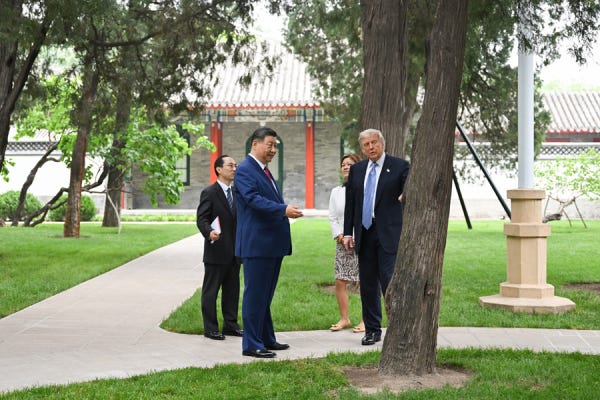
On the final morning of the trip, Xi hosted Trump again at Zhongnanhai for a smaller meeting. Chinese media emphasized the relaxed atmosphere, with the two leaders walking and chatting while admiring old trees and roses in the compound. Trump reportedly asked whether all foreign leaders are invited to Zhongnanhai, and Xi responded that very few are.
III. Trump Appeared Extremely Satisfied with the Visit
In China’s official readout, Trump said he was honored to pay a state visit to China. He called Xi a “great leader,” China a “great country,” and said he had “great respect for President Xi and the Chinese people.”At the opening of formal talks, Trump reportedly told Xi directly:
“You are a great leader,”
adding:
“Sometimes people don’t like me saying that, but I’ll say it anyway.”
On Air Force One after the trip, Trump again referred to Xi as “my old friend” and said he had “tremendous respect” for him.
Trump publicly described the visit as “historic” and “unforgettable,” while repeatedly praising what he called an “unmatched grand welcome” from the Chinese side.
During one meeting, Trump spontaneously asked the accompanying American CEOs to introduce themselves one by one to Xi. He described them as “the best representatives of American business,” emphasized that they respect and value China, and strongly encouraged them to expand cooperation with China. Xi reportedly told Trump afterward that the impromptu arrangement was “very good.”
Throughout the three-day trip, Trump gave relatively few off-the-cuff comments to reporters and largely avoided his usual heavy social-media activity. When reporters shouted questions about Taiwan during the Temple of Heaven visit, he did not respond. At the banquet, Trump — who normally does not drink alcohol — still raised a glass in a gesture of courtesy toward the hosts.
During the Temple of Heaven visit, Trump said he still clearly remembered touring the Forbidden City with Xi in 2017. He described the Temple of Heaven, still standing after more than 600 years, as “amazing,” saying it reflected the depth of Chinese civilization and traditional architecture. He also said both China and the U.S. are great countries with wise peoples and should deepen mutual understanding and friendship.
While visiting Zhongnanhai, Trump praised the scenery and joked that someone living there might never want to leave.
Before arriving in China, Rubio told Fox News that China is both America’s greatest geopolitical challenge and “the most important relationship that must be managed properly.” He warned that a breakdown in U.S.-China relations would have enormous consequences for the global economy and international stability, making it essential to find areas of cooperation while managing differences.
IV. U.S. and Chinese Business Leaders Involved in the Visit
The accompanying U.S. business delegation was unusually large and covered key sectors including technology, finance, semiconductors, aerospace, and agriculture.
Nvidia CEO Jensen Huang’s participation was particularly dramatic. He reportedly was not initially invited, but Trump later personally called him and asked him to join. Huang boarded Air Force One during a refueling stop in Alaska, becoming one of only two American CEOs on the plane alongside Elon Musk. Huang told CNBC directly:
“President Trump asked me to come.”
He also described the summit as:
“One of the most important summits in human history,”
and called the welcoming ceremony “inspiring.”
Some CEOs attended because their companies were tied directly to potential Chinese purchases — one of the key deliverables of the trip. Examples included Boeing CEO Kelly Ortberg and Cargill CEO Brian Sikes.
Others attended because deteriorating U.S.-China relations have directly affected their business operations. GE Aerospace CEO Larry Culp, for example, faces challenges tied to tighter U.S. export controls on aircraft engines, tariffs, and supply-chain frictions affecting GE’s China operations.
Illumina CEO Jacob Thaysen also joined the delegation. Illumina was added to China’s “Unreliable Entity List” and export-control list in 2025. After the October trade truce last year, China temporarily eased some restrictions on Illumina, and the company publicly thanked Beijing at the time. However, Illumina remains on the Unreliable Entity List.
Micron CEO Sanjay Mehrotra’s participation also drew attention. Micron has faced mounting difficulties in China since failing China’s cybersecurity review in 2023, which significantly affected its data-center business. By 2025, the company had effectively exited the mainland China data-center server chip market. Chinese media recently portrayed Micron as a major backer of legislative efforts like the MATCH Act aimed at further restricting Chinese memory-chip companies such as CXMT, creating substantial resentment inside China. Mehrotra’s trip was widely seen as an effort to gauge whether Beijing intends to tighten pressure on Micron further.
One surprise name on the list was Meta President Dina Powell McCormick. She is seen as having particularly close ties to Trump, and many observers view her appointment as part of Meta’s effort to rebuild relations with Trump and the American conservative camp. Some speculated whether Meta’s participation might involve discussions related to the Manus deal. More broadly, however, Meta likely wants to preserve and deepen its China-linked business interests. While Meta’s core products remain restricted in mainland China, Chinese exporters and cross-border e-commerce advertisers such as Temu and Shein remain major contributors to Meta’s advertising revenue. Meta also continues to rely heavily on Chinese supply chains for VR/AR, smart glasses, and wearable devices.
Finance was heavily represented as well, including BlackRock CEO Larry Fink, Blackstone CEO Stephen Schwarzman, Goldman Sachs CEO David Solomon, Citi CEO Jane Fraser, Mastercard CEO Michael Miebach, and Visa CEO Ryan McInerney.
Mastercard’s position was particularly interesting. The company is widely viewed as having developed strong government relations in China. In November 2023, Mastercard officially received approval for domestic RMB bank-card clearing operations through its China JV “Mastercard NetsUnion.” The company now hopes to expand in areas such as open finance, cross-border payments, and payment facilitation for inbound travelers, while integrating more deeply into China’s financial and internet ecosystems. Beijing’s broader push to further open the financial-services sector in 2025 also benefits Mastercard.
Visa, by contrast, still has not received approval for domestic RMB card-clearing operations in China. Trump reportedly raised the issue directly with Xi during the meetings, even pointing to Visa CEO Ryan McInerney and saying:
“How about letting Visa in?”
Trump also reportedly said Visa is a major company and should not be “blackballed.”
Several chip and ICT executives also joined the delegation, including Qualcomm CEO Cristiano Amon, Cisco CEO Chuck Robbins, and Coherent CEO Jim Anderson. All have major business exposure to China. Qualcomm, in particular, once derived nearly half its revenue from the Chinese market and continues to pursue partnerships in automotive chips, AI devices, and XR ecosystems. At the same time, all these firms face increasing competition from Chinese companies such as Huawei.
Musk and Cook’s participation surprised nobody. Tesla continues to seek approval for bringing FSD into China and for solar-equipment exports, while Apple still faces issues related to App Store regulation, app-filing requirements, and approval for Apple Intelligence in China.
During the meetings, Trump spontaneously asked the American CEOs to introduce themselves individually to Xi and emphasized that they represented “the best of American business.” Xi reportedly praised the arrangement afterward.
One Chinese business figure who drew attention at the banquet was Lens Technology founder Zhou Qunfei. While Lens is less famous than some other companies present, she was seated between Tim Cook and Elon Musk because of Lens Technology’s deep role in both Apple’s supply chain and Tesla’s smart-cabin and component ecosystem. The symbolism was clear: China is not merely a provider of low-cost manufacturing capacity, but remains deeply embedded in high-end precision manufacturing and supply-chain integration that major American tech firms cannot easily replace.
Xiaomi founder Lei Jun also drew attention after walking over to Musk during the banquet for a selfie. Musk responded with exaggerated facial expressions and a wink, quickly turning the moment into one of the most widely shared images on Chinese social media.
Musk also brought his son to some events, with the child reportedly wearing Chinese-style clothing. Musk later posted in Chinese on X:
“My son is learning Mandarin,” which drew substantial attention from Chinese internet users.
Overall, many U.S. CEOs gave positive reviews of the trip. Musk reportedly said the visit “felt great,” Huang praised the summit enthusiastically, Cook said “the China market remains very strong,” and Amon described himself as “very excited” to be in China.
President Xi told American CEOs that the door to business in China will “open wider”.
Premier Li Qiang also met with the U.S. business delegation and sent a clear message that China welcomes American companies to continue investing in and benefiting from the Chinese market.
NDRC Chairman Zheng Shanjie met Boeing CEO Kelly Ortberg to discuss China’s macroeconomy and aviation cooperation.
NDRC Chairman Zheng Shanjie met Boeing CEO Kelly Ortberg to discuss China’s macroeconomy and aviation cooperation.
NDRC Vice Chairman Li Chunlin met GE Aerospace CEO Larry Culp to discuss aircraft engines, supply-chain stability, and cooperation in China.
Commerce Minister Wang Wentao separately met Qualcomm CEO Cristiano Amon, Visa CEO Ryan McInerney, and Cargill CEO Brian Sikes to discuss trade, semiconductors, digital payments, agriculture, and supply chains.
According to brief public readouts from the PBOC and CSRC, the CEOs of Citi, Goldman Sachs, Blackstone, and BlackRock all separately met with PBOC Governor Pan Gongsheng and the CSRC chairman. Discussions mainly focused on further opening China’s capital markets, facilitating cross-border data flows, and the progress of financial license approvals.
CCPIT Chairman Ren Hongbin also held dedicated meetings with executives from Qualcomm, Boeing, and Cargill.