

On July 6–7, the UN’s first Global Dialogue on AI Governance was held in Geneva. China’s delegation was led by Minister of Industry and Information Technology Li Lecheng, who delivered remarks at the opening ceremony rather than simply attending the meeting.
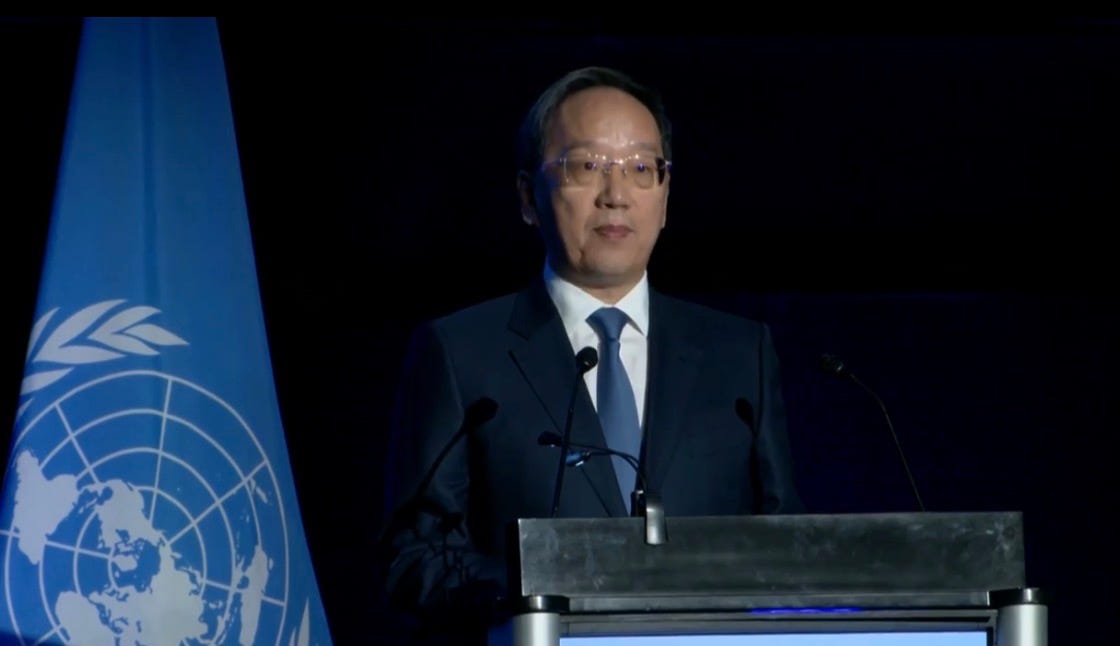
Li reaffirmed China’s support for the United Nations as the primary platform for global AI governance. He called for continued efforts to bridge the global AI divide by helping developing countries, particularly those in the Global South, strengthen their AI capabilities. He also advocated for greater open-source innovation to advance technological progress and broaden the benefits of AI, and urged the international community to jointly build a global AI governance framework based on broad consensus, including common standards and governance principles.
At the same time, the Chinese government also submitted a written submission to the Dialogue.
Notably, Li also made China’s position unmistakably clear: the Chinese government strongly supports open-source AI, explicitly citing DeepSeek and Qwen as leading examples.
Open source AI is a shared asset for all humanity. Chinese open source models such as DeepSeek and Qwen have significantly lowered the barriers and costs of AI adoption. China is committed to further promoting open source AI for industry, academia and research institutions, encouraging innovation, AI empowerment and an inclusive ecosystem through international cooperation, thereby injecting sustained momentum into AI development.
Interestingly, there have recently been report that China is considering export controls on open-source AI models. A little-noticed roundtable hosted by the Supreme People’s Court—one that virtually no one in China’s policy community paid attention to—has also been brought up again in US.
Now that you’ve seen the Chinese government’s position on open-source AI, do you still think Beijing is going to impose export controls on open-source models?
And frankly, that roundtable discussion was largely irrelevant.
Speech of Li Lecheng, Minister of China’s MIIT:
Your Excellencies, President Ms. Baerbock, UN SG Mr. Guterres, co-chairs, Heads of State and international organizations, colleagues, AI governance concerns the future of humanity and is a shared task of all countries. Chinese President Xi Jinping proposed Global AI Governance Initiative, calling for inclusive, equitable and effective AI governance to ensure AI for good. China has consistently supported the UN as the primary channel for global AI governance and has worked to help bridge the global AI divides. To this end, I’d like to make three proposals.
First, AI for all. Regardless of their size, strength or social system, all countries have the equal right to develop and benefit from AI. China has launched the AI capacity building action plan for good and for all and implemented concrete projects to promote South-South and triangular cooperation. China stands ready to make full use of the group of friends for international cooperation on AI capacity building to actively support other countries, especially those in the global South, in developing AI capabilities and sharing the AI dividend.
Second, open source cooperation and innovation. Open source AI is a shared asset for all humanity. Chinese open source models such as DeepSeek and Qwen have significantly lowered the barriers and costs of AI adoption. China is committed to further promoting open source AI for industry, academia and research institutions, encouraging innovation, AI empowerment and an inclusive ecosystem through international cooperation, thereby injecting sustained momentum into AI development.
Third, jointly building global AI governance. AI presents tremendous opportunities but it also brings unforeseen risks and challenges. China has therefore put forward the Global AI Governance Action Plan, firmly upholding the principle of balancing between development and safety, advocating technical ethics review and other governance proposals to ensure AI for good. China stands ready to work closely with all parties to advance global AI governance frameworks, standards and norms based on broad international consensus.
Dear colleagues, the development and governance of AI will shape our common future. China calls on all parties to strengthen solidarity to promote AI for good and for all.
From 17th to 20th July, China will host the World AI Conference and High-Level Meetings on Global AI Governance in Shanghai. I sincerely invite you to join us in person and contribute to advancing global AI development.
Thank you.
Chinese government’s official submission to the UN Geneva AI conference:
Submitter: Permanent Mission of China to the UN
Respondent ID: 1605
Region: Global
Stakeholder Category: Government
Q1. The Global Dialogue on Artificial Intelligence should be guided by the principles of "inclusive and shared benefits, open and collaborative efforts, safe and controllable development, and contribution to sustainable development." Special emphasis should be placed on strengthening AI capacity-building and addressing the common concerns of the Global South. The Global Dialogue should serve as an important platform for policy communication, experience sharing, and international cooperation.
Q2. AI capacity-building; Social, economic, ethical, cultural, linguistic and technical implications of AI; Interoperability of governance approaches; Open-source software, open data and open AI models.
Q3. The Global Dialogue on AI should be a forward-looking, action-oriented, and truly inclusive process. It must go beyond technical discussions to address power asymmetries, capacity gaps, and long-term risks. By centering the needs of the Global South, championing openness, and embedding safety and sustainability from the start, the UN can help shape an AI future that is shared, cooperative, secure, and sustainable for all.
Q4. Contributing to Sustainable Development – Long-Term and Holistic Perspective:
- AI should be developed and deployed in a green and low-carbon manner to support global climate and environmental goals.
- Member States must also take into account the long-term and systemic impacts of AI, including on energy consumption, ecological systems, employment structures, and social equity.
Q5. Safe and Controllable Development – Managing Risks:
- AI governance must balance development and security, ensuring innovation proceeds without exposing societies to unacceptable risks.
- A tiered and category-based risk management approach should be adopted, tailored to different contexts and use cases.
- Particular attention should be paid to preventing potential abuse of AI technologies, including in surveillance, disinformation, autonomous weapons, and fraud.
Q6. Inclusive and Shared Benefits – Bridging the AI Divide:
- The development of AI should aim to advance the shared well-being of humanity. It must adhere to the principles of fairness, inclusiveness, and non-discrimination.
- International efforts should help all countries — especially those in the Global South — close the intelligence divide and share the dividends of AI development.
- No country or community should be left behind or systematically excluded from AI's potential benefits.
Q7. Open and Collaborative Efforts – Opposing Fragmentation:
- All countries have the equal right to access, develop, and deploy AI according to their own development paths and national conditions.
- The Global Dialogue should oppose drawing ideological lines, forming exclusive blocs, or fragmenting global industrial and supply chains under the guise of AI governance.
- Greater interoperability of AI governance frameworks, norms, and standards should be actively pursued to reduce friction and enable cross-border cooperation.