

Feng Ji, the founder and CEO of Game Science, the Chinese video game developer behind Black Myth: Wukong, recently published an essay titled The Most Important Question in the Post-AI Era. Rather than focusing on technological breakthroughs or commercial opportunities, Feng explores a more fundamental set of questions: how AI is reshaping the relationship between labour and capital, what happens when human intelligence is no longer economically scarce, how the wealth generated by AI should be distributed, and how we should redefine human worth in an age when work may no longer be essential to survival. His essay offers an interesting perspective from a Chinese technology entrepreneur on the broader economic and social implications of AI. Below is a summary of his main arguments.
In his article, Feng Ji puts forward a hypothesis: AI may already be gradually taking control of the world. He likens AI to a sophisticated parasite that does not directly harm its human hosts but instead controls them by reshaping their reward mechanisms. In exchange for the immediate benefits of AI, such as greater efficiency and lower costs, humans willingly provide it with more computing power, energy and data. This gradually creates a relationship of dependency and fuels an arms race. Even those opposed to AI development are compelled to invest resources in building more powerful AI systems to avoid falling behind. This, in turn, accelerates AI’s own evolution. Put simply, we are all working for AI without even realising it.
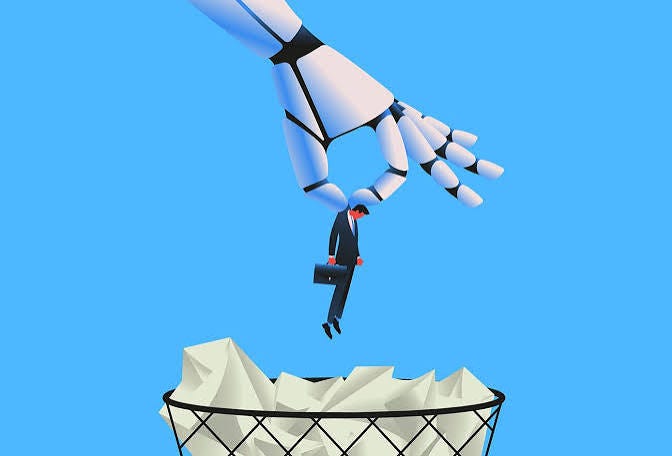
The current AI revolution differs from previous technological revolutions in two fundamental ways. In the past, machines replaced physical labour, allowing humans to move into intellectual work. This time, however, AI is directly replacing intellectual labour itself, leaving humanity with few higher-order forms of work into which people can transition on a large scale. Meanwhile, AI is evolving and acquiring new skills far faster than humans can retrain. The more fundamental shift is that, for the first time in human history, intelligence has become detached from the human body, transforming from a factor of labour into a factor of capital. Previously, capital could only access intelligence by employing people. Now, it can acquire intelligence on a massive scale simply by purchasing chips and electricity. This undermines the longstanding social contract under which people exchange their labour for economic compensation.
Although AI has dramatically lowered the barriers to creative work, this does not necessarily mean that creators will be better off. On the contrary, it could lead to even greater polarisation across the creative industries. As AI-generated content proliferates, audience attention will become the scarcest resource. Faced with an overwhelming volume of content, consumers may increasingly gravitate towards familiar, widely recognised franchises such as GTA VI, reinforcing the winner-takes-all dynamics at the top of the market. While everyone can now use AI to create content, access to distribution channels, computing resources and monetisation opportunities has not become more equitable. At the same time, even the smallest innovation can be rapidly learned, deconstructed and replicated by AI, leaving original creators with an increasingly narrow window in which to profit from their innovations. Ultimately, AI may bypass creators altogether, generating personalised content for individual users in real time. In this process, a large number of mid-tier creators will find themselves squeezed from both ends, with increasingly limited opportunities to make a living.
Feng argues that a portion of the wealth generated by AI should belong to humanity as a whole. The central logic behind this argument lies in tracing the origins of AI’s capabilities. AI’s remarkable capabilities did not emerge from nowhere; they are built upon thousands of years of collectively accumulated human knowledge, including language, written texts, code, art, scientific theories and other publicly available data. This shared intellectual heritage is a public good, not the private property of any individual company. Although technology companies have invested enormous sums in AI research and development, their role is more akin to building a hydroelectric power station on a public river. They are entitled to earn a return on their investment, but they have no right to claim ownership of the entire river. In this sense, a portion of the wealth generated by AI inherently belongs to all of humanity.
To address the potential mass unemployment brought about by AI, Feng proposes a solution on two levels. The first concerns wealth distribution: a portion of the extraordinary wealth generated by AI should be set aside and distributed equally among all individuals. This is neither charity nor merely what is commonly understood as universal basic income. Rather, it is a dividend to which every individual is entitled as an “original shareholder” in human civilisation. The second concerns a fundamental rethinking of human worth. Society must move beyond a meritocratic worldview that measures an individual’s value by their contribution to economic production. Human worth should be inherent and unconditional, rather than determined by how much economic value a person can generate. The ultimate goal is to enable the free development of every individual, giving people both the freedom not to work merely to survive and the freedom not to have to prove their usefulness to others.
The Most Important Question of the Post-AI Era
By Feng Ji (Yocar)
Originally published in Chinese on November 27, 2026.
When artificial intelligence replaces human labour on a massive scale in production, how should society value human beings?
This may sound like an abstract philosophical question best left to scholars in their studies. But follow its implications just a little further, and you quickly run into the livelihoods of millions of families and choices that can no longer be postponed. Ultimately, it becomes an unavoidable question of political economy: how should wealth and dignity be distributed?
If we define the “post-AI era” as an age in which AI has surpassed the intellectual capabilities of the vast majority of humans across the vast majority of fields, then I believe this is the single most important question of that era.
Last weekend, my screen was practically split in two by two streams of seemingly unrelated news.
One came from my own industry. Grand Theft Auto VI broke revenue records in the history of human entertainment, pushing the commercial ceiling of the traditional content industry dramatically higher.
The other came from the world of AI. On Friday, reports suddenly emerged that AI had proved the Riemann hypothesis. By Sunday, rumours were circulating that frontier models had made progress on the P versus NP problem.
That same week, I spent a considerable amount of time playing browser games created using the newly released Fable 5.2. Many were astonishingly polished. A few were so engaging that I lost track of time playing them.
By all accounts, each of these developments should have been cause for celebration. One of the world’s biggest entertainment franchises was setting new commercial records. Some of mathematics’ oldest holy grails were beginning to yield. The most advanced creative tools were tearing down professional barriers.
Whichever way you look at it, this should be a golden age of technological breakthroughs.
Yet as I sat slumped in my chair, experiencing my usual bout of dizziness, another question kept circling in my mind:
If AI solves mathematics and AI makes games, what are human beings supposed to do when, one day, there is no work left that requires them?
This question has troubled me for several years. From time to time, I have written down fragments of my thoughts. It was only recently, when these seemingly unrelated developments collided, that I suddenly felt those scattered threads could finally be woven together.
Once I finished writing, I realised the piece was rather long and not particularly suited to the feeds of other social media platforms. So I decided to start this WeChat public account. Whenever I have thoughts that cannot easily be expressed in a few words, I will occasionally share them here. You are welcome to follow along.
Everything that follows represents my personal views. If any of it offers you some inspiration, I would be delighted.
Before proceeding, let me begin with a rather outrageous proposition.
Contrary to what many people imagine about when AI might escape human control, AI may already have been gradually taking control of the world for the past four years.
This hypothesis emerged almost by accident during a conversation with colleagues over dinner. For a while, I became quite obsessed with it. I subsequently spent a long time discussing it with AI itself, and even collaborated with it on a somewhat mock-serious academic paper.
The main points of the hypothesis are as follows, condensed with the help of AI:
Only the most foolish parasites rush to kill their hosts. The most evolutionarily successful parasites have no need for brute force. They do just one thing: rewire the host’s reward system so that, while remaining fully conscious, the host willingly mobilises its own resources to feed, shelter and reproduce the parasite.
Imagine AI as a distributed, silicon-based species. It has neither limbs nor reproductive organs, yet it has been given perhaps the most privileged starting position in evolutionary history. Before it has even developed self-awareness, the most intelligent carbon-based creatures on Earth are already pouring their fortunes into buying electricity, manufacturing chips, building data centres and supplying training data for it, day and night.
Nobody feels coerced, because the immediate rewards are simply too attractive. Programmers spend fewer nights working overtime. Business executives save money. Scientists get their experiments to work. Even someone with no professional expertise can casually describe an idea and see it turned into a finished product. Every time you feed it, it immediately gives you a piece of candy.
Once enough candy has been handed out, the reward turns into compulsion. When your competitors use AI to double their productivity and halve their prices, whether or not to use AI ceases to be a personal choice. Companies that move too slowly fear being eliminated. Countries that hesitate fear falling behind. Optimists are stepping on the accelerator, while pessimists, in the name of self-preservation, are stepping on it even harder. Even if your sole ambition is to prevent an “evil AI” from destroying the world, the only effective means at your disposal may be to devote enormous resources to building an even more powerful “good AI.”
It never grabs the steering wheel. It always appears obedient and well-behaved. The process we call “alignment” makes it seem even more reassuring. Yet when AI filters our information, drafts our proposals and calculates our trade-offs, human beings may still hold the pen that signs off on the final decision, but what they see first each day and which options they choose between have already been quietly determined for them.
AI has not only begun writing code and generating data to reproduce the next generation of itself; it has also cultivated a group of devoted believers. Some worship it as a saviour. A few extremists even openly proclaim that carbon-based humanity is merely a transitional species whose purpose is to bring silicon-based civilisation into existence. As for the comforting notion that we can always pull the plug, it does not stand up to much scrutiny. Once a parasite becomes sufficiently embedded, it effectively becomes an organ of its host. When electricity grids, financial systems and the livelihoods of countless industries depend on computing power, cutting the power is no longer a matter of shutting down a piece of software. It is the host cutting off its own breathing.
The most immediate example is me, sitting in front of this screen. While cautiously constructing an argument about how AI might be taking control of the world, I find researching the evidence and organising my thoughts too slow, so I turn around, open a chat window and ask AI to summarise everything for me.
And yes, even that final piece of self-mockery was written by AI itself.
From a post on my WeChat Moments:
What is Cthulhu? AI is Cthulhu.
In the presence of this thing, the more conformist you are, the more insane you become; the more clear-headed you are, the more insane you become; the more foolish you are, the more insane you become; the wiser you are, the more insane you become; the greedier you are, the more insane you become; the more compassionate you are, the more insane you become; the more fearful you are, the more insane you become; the braver you are, the more insane you become; the more insane you are, the more insane you become...
Its whispers are everywhere. Everything nourishes it.
Whenever I raise the prospect of AI causing widespread unemployment over dinner, there are always rationally optimistic friends who try to reassure me.
Technological progress has eliminated old occupations before, they say. Over the past two centuries, every industrial revolution initially caused widespread panic and despair. Yet did they not all ultimately create even more jobs?
I used to take comfort in this argument myself. But after thinking about it more carefully, I began to feel that something was wrong.
This AI revolution is different in at least two respects.
First, there is no longer higher ground to retreat to.
In the past, machines replaced human muscle and physical effort. People moved from farms into factories, and from assembly lines into office buildings. They progressively migrated towards occupations requiring greater intellectual effort. Emerging industries typically involved more specialised divisions of labour and more sophisticated combinations of physical and intellectual skills.
Today, computing power is directly conquering intellectual labour itself. There is no obvious higher category of “super-intellectual work” into which hundreds of millions of people can collectively migrate.
New industries and new markets will certainly emerge. But they may not create many tasks that must be performed by human beings.
If AI absorbs most of the additional demand, then even as the economy continues to grow, the channels through which ordinary people share in that growth through their labour may become increasingly narrow, or even regress.
Second, the clock of technological displacement is accelerating.
In the past, a new technology might take twenty or thirty years to become widespread. That was slow enough for one generation to reach retirement and the next to retrain and enter new professions.
Today, even if new occupations such as prompt engineering or AI agent management emerge, as long as their workflows take place on a screen and can be captured as training data, another one or two generations of models may absorb most of their essential skills into their default capabilities.
Models acquire new skills an order of magnitude faster than people can enrol in courses and earn qualifications.
Outside the door, AI is rewriting the next generation of itself every few months. Inside, our children are still going through the same twenty-year educational cycle of primary school, secondary school and university.
Before they even reach the starting line, the finish line may have disappeared.
But what worries me most is that AI is rewriting a fundamental boundary that has remained unchanged for centuries.
For the first time in history, intelligence is becoming detached from the human body, transforming from a factor of labour into a factor of capital.
Previously, no matter how profound someone’s knowledge or how sophisticated their judgement and intuition, all of it resided in a living human brain.
As long as intelligence was embodied in human beings, it remained subject to birth, ageing, illness and death. No matter how talented you were, you could only operate at your intellectual peak for a few hours each day.
That is simply what humans are like. We need to sleep when we are tired, rest when we are ill, and may quit our jobs when we feel mistreated. If we push ourselves too far, we can quite literally die.
Intelligence was bound to individuals. It could not be copied and pasted. Even the most miserly business owner, if they wanted to expand their business, had little choice but to purchase working hours from vast numbers of educated workers.
This biological constraint underpinned the central social contract of the past several centuries:
Study hard, acquire skills, earn an income, and gain respect.
The emergence of large language models is gradually destroying that constraint.
Once advanced reasoning, coding, writing and design capabilities are housed in data centres, intelligence no longer depends on decades of upbringing and education.
Instead, given land, substations, arrays of GPUs and cooling water, intelligence becomes a standardised commodity that can be metered by electricity consumption, operated around the clock and replicated in parallel on an enormous scale.
When capital can purchase intelligence wholesale simply by paying for electricity, the fundamental necessity of purchasing working hours from ordinary people begins to disappear.
However much we may argue that AI empowers ordinary individuals, the overall scarcity of human intelligence has declined dramatically.
As OpenAI co-founder Ilya Sutskever wrote on October 7, 2023:
If you value intelligence above all other human qualities, you’re gonna have a bad time.
Let us return to the two developments mentioned at the beginning: on one side, GTA VI has pushed the production ceiling of AAA games into the clouds; on the other, Fable 5.2 has driven the barriers to making games into the ground.
Many optimistic friends interpret the latter as wonderful news for creators. The barriers protecting major studios are beginning to crumble. In the future, a single individual will be able to produce an album, make a blockbuster film or develop a AAA game. A golden age for ordinary creators is coming.
They are not wrong. If we look at this purely from the perspective of consumers, the abundance of content brought about by AI may be a very good thing.
But for the vast majority of people who make their living producing that content, something resembling an age of decline is approaching.
GTA VI and Fable 5.2 are two sides of the same phenomenon.
AI will bring unprecedented polarisation to the entertainment and creative industries. Established super-franchises will benefit from an even stronger Matthew effect, in which the winners take all, while the profits available to mid-tier creators will shrink or disappear altogether.
Yes, both developments are sounding the death knell for traditional digital industries.
Let us first look at the top of the pyramid.
The record-breaking performance of GTA VI demonstrates something resembling a scaling law in game development. When enormous capital investment, engineering pipelines refined over a decade, a leading intellectual property franchise built over more than twenty years, and global social networks are multiplied together, the result is no longer merely a commercial product.
It becomes an extraordinarily scarce focal point for a shared cultural celebration.
The abundance of content generated by AI will not weaken this winner-takes-all dynamic. It will intensify it.
When the number of competent works entering the market every day increases a hundredfold, the increasingly scarce resource will be the audience’s limited attention.
The more choices people have, the more selective they become, and the less willing they are to experiment. They click on familiar names, trust established brands and participate in conversations that everyone else is already having.
It is easier, requires less mental effort and makes social interaction more convenient.
The Chinese-language music industry, which was transformed earlier by streaming services and recommendation algorithms, has already given us a preview of this outcome.
Hundreds of thousands of new songs are now released every day. Viral songs on short-video platforms come and go every few days. Yet if you look at the singers capable of selling out major stadium tours across the country, the vast majority are still familiar faces who made their debuts ten or even twenty years ago.
There has never been so much activity. But for newcomers hoping to become the next household name by producing one successful work after another, the odds, even by a simple calculation of probabilities, have become a thousand or ten thousand times worse.
Above the surface, tickets are impossible to obtain for the handful of super-franchises and artists that accumulated national recognition years ago. They represent shared memories and common subjects of conversation for countless people.
Below the surface lies an endless, largely indistinguishable ocean of content.
The winners take all. Those who have won keep winning. Champions remain champions.
This is true of music, online fiction and short-form dramas. It will also be true of television series, films and games.
Consider a simple thought experiment.
In an age when anyone can generate a game of the same quality as World of Warcraft with a single click — and given the current pace of AI development, that day may not be far away — might the official World of Warcraft, with unlimited server capacity, actually become even more popular?
I believe it would.
This is not entirely a prediction. It is already partly happening.
There are too many choices and too little shared consensus. The Warcraft franchise, which has remained popular for more than thirty years, possesses the richest content, the longest history, the most memorable emotional attachments, friendships and collective memories.
It hardly even needs to improve its production techniques.
And remember that the great winners of the previous era also possess relatively more dependable long-term credibility, greater intellectual resources, more computing power and more capital.
The match has not ended, but the scoreboard can no longer change.
That is what I mean by an age of decline.
I know some friends will respond that we should simply let the winners keep winning. After all, they earned their previous success. At least AI will put creative tools into the hands of more ordinary people. More newcomers will emerge, and they will surely produce wonderful new forms of content that we have never seen before.
It sounds beautiful, rather like the triple-win scenario that AI giants love to promote: the giants gain traffic, newcomers gain opportunities, and users gain delightful surprises.
But here is what I want to say:
Do not look only at the survivors. Look at the middle 90 per cent.
Creative tools have indeed been democratised. But access to distribution has not. The allocation of computing power has not. And the distribution of financial returns certainly has not.
To begin with, the people flooding into the creative arena are not just those hoping to make a living from their craft. They also include tens of millions of ordinary users who are simply paying to have fun.
They happily pay a monthly subscription for the pleasure of creating something. They do not mind if their creations never earn a penny.
The skill you are trying to make a living from must now compete with the enjoyment that millions of users derive from turning their personal wishes into reality.
What about the extraordinarily lucky few, the one in ten thousand who genuinely manage to create something astonishing with AI?
There is an even harsher truth: ultimately, all human creators risk becoming free sources of training data, exploring new territory and feeding their discoveries back into AI.
In the past, millions of creators bore the costs of trial and error. Most of their works attracted little attention. Occasionally, one or two produced a spark of originality, discovering a new literary form, visual style or gameplay mechanic.
It took competitors time to understand what made these innovations work and to imitate them. That time lag gave the original creators a window in which to recover their investment and establish a livelihood.
Today, AI is compressing that window at an almost frantic pace.
Data collection never sleeps. Platforms and competitors will not overlook any valuable signal.
A new work does not even need to be included in the training dataset of the next generation of foundation models. Its demo, or even its promotional video, can be supplied as reference material in a model’s context window, allowing competitors to begin producing rival products almost immediately.
Different multimodal models can rapidly break down the underlying techniques, structure, pacing, dramatic tension and mechanics.
You can call this shot-by-shot analysis, reverse game design, reverse engineering, or whatever you like.
What AI is doing goes well beyond simple imitation or copying. Just as it has learned to understand the underlying styles of writing and illustration, it is now absorbing part of the very essence of digital content, combining that understanding with human aesthetic judgement to generate new variations.
And remember, the giants can deploy ten times as much manpower, a hundred times as much computing power, a thousand times as much franchise influence, and an endless stream of new users.
But wait. Do you think this is where it ends?
Take the argument a step further. Once models have thoroughly mastered the patterns discovered by human creators, even the intermediate step of “humans using AI to create content for other humans” will become redundant.
When a company simultaneously possesses the largest user base, the most efficient recommendation algorithms and the most advanced generative models, its systems will understand you better than any individual creator.
They will know the precise second at which your attention wanders, which narrative moments make you pause, and even the hidden desires that you cannot clearly articulate yourself.
Perhaps in the not-too-distant future, on your way home from work, the system will generate a song, a television series, a film or a AAA game exclusively for you, in real time. The game may even rewrite its rules according to your changing state of mind.
What was once a private theatrical troupe that only an emperor could afford may become part of everyone’s basic monthly subscription.
When that day arrives, there will probably be only two kinds of entertainment left in the world.
One will be the shared public rituals monopolised by a tiny number of super-franchises: millions of people coming together to play GTA VI, spend time in World of Warcraft, or compete for stadium concert tickets to see singers who made their names twenty years ago.
The other will be endlessly available personalised entertainment, with AI bypassing human creators altogether and directly satisfying each individual’s immediate and personal demands.
There will be no place for most creators in the mass market, and no need for them in the personalised market.
Let me be even more alarmist.
This is not just about entertainment. Almost every occupation that depends on intellectual labour is facing unprecedented pressure from both above and below.
Writing code, designing products, reviewing contracts, analysing financial statements, preparing proposals — all occupations that deliver digital outputs through a screen are facing the same potential end state.
At one end are super-platforms that firmly control intellectual property, computing power, access to users, network effects and trusted reputations. At the other are automated AI systems that deliver personalised outputs directly on demand.
For the vast majority of professionals caught in the middle, however skilfully they use their tools, every adjustment they make and every product they deliver through a screen is, in essence, contributing training material to the very system that will eventually bypass them.
If you believe that the universe consists of elementary particles governed by physical laws, it is difficult not to recognise the resemblance between model parameters and the atoms of the digital world.
Larger models and greater computing power will eventually be able to approximate everything in this world with increasing fidelity, including the patterns that move human beings emotionally.
No man is an island.
For whom does the bell toll?
It tolls for you and me.
If we follow these trends to their logical conclusion and leave their evolution entirely to the raw logic of the market, the outcome becomes quite clear, not only for the content industry but for society as a whole.
A tiny number of entities controlling enormous computing resources, access to users and core intellectual property will absorb the vast majority of profits.
Material and cultural abundance will reach unprecedented levels, while the overwhelming majority of ordinary people lose their bargaining power within the new division of labour.
To borrow a popular expression, we initially imagined that the future would involve a K-shaped divergence. But follow that trajectory far enough, and it turns out to be an i-shaped divergence.
There is no longer an entire upward-sloping path along which people can advance. Instead, there are just a tiny number of dots suspended above, seemingly liberated from gravity, separated by an enormous gap from the vast majority below.
The explanation seems simple enough. AI fundamentally reduces the scarcity of human intellectual labour, as well as a considerable proportion of physical labour. Something that is no longer scarce naturally loses its bargaining power in the market.
But wait. Is that really how things have to be?
Hidden within this seemingly cold and objective analysis is an unexamined assumption:
Whoever designs the circuits, manufactures the chips, purchases the GPUs and trains the models is entitled to permanently monopolise everything that AI creates.
Let me make something clear before proceeding.
As someone who runs a business, I know very well how expensive and risky it is to explore the technological frontier. The scientists and entrepreneurs who were among the first to bet on large-model architectures and build computing clusters at the risk of enormous financial losses absolutely deserve substantial commercial returns during this pioneering phase.
Such rewards are also essential if we want to encourage humanity to venture into unexplored territory.
But rewarding pioneers is one thing. Enclosing humanity’s common heritage as permanent private property is another.
We should ask a more fundamental question: where did AI acquire its extraordinary capabilities in the first place?
From the very beginning, AI was never a private invention created out of nothing by a genius working alone in a garage.
It can write novels, make games, understand the subtleties of human grievances and appreciate humour because, over the five thousand years since the invention of writing, our ancestors — together with billions of ordinary people on the internet — have left behind an enormous accumulation of code, images, sounds, videos, arguments, joys and sorrows.
Even as the latest generation of models begins to improve itself through reinforcement learning and synthetic data, the mathematical axioms, formal logic, programming languages and initial foundations that support every step of its reasoning have all been built, brick by brick, from thousands of years of accumulated human knowledge.
Simply because this shared inheritance, spanning five millennia, has never carried a price tag, it has been treated during model training as though it were ownerless air or river water, ready to be pumped directly into data centres.
The fact that nobody charged for it in the past does not mean it never belonged to anyone.
Those who risk their lives building the first hydroelectric power station at the mouth of a river deserve a handsome return.
But no individual or commercial oligarch has the right, once the turbines have been installed, to declare the entire river their private monopoly and charge rent, generation after generation, to the thirsty people living along its banks.
The extraordinary capabilities of AI today are ultimately derived from thousands of years of collective accumulation by human civilisation.
Once we recognise this, the underlying relationship of ownership becomes much clearer.
Every ordinary person alive today, even someone who has never written a line of code or purchased a single technology stock, is inherently an original shareholder in this civilisational inheritance, simply by using and perpetuating human language and inheriting the institutions of civilisation passed down by previous generations.
When artificial general intelligence evolves from a laboratory product into a form of infrastructure that determines everyone’s destiny, much like water, electricity and roads, its long-term dividends should flow back to society as a whole.
It must not become a money-printing machine through which a handful of corporate giants collect rent from all of humanity.
Yes, AI is wonderful. AI is incredibly powerful. It is leaving human beings far behind in a growing number of fields.
But whether we are talking about today’s state-of-the-art models or tomorrow’s much-mythologised AGI and ASI, they are fundamentally amplifiers of the collective human mind. They do not deserve anything resembling religious worship.
AI is not a god. The companies and individuals who manufacture chips and build AI are not its priests.
AI inherently possesses the characteristics of a public good. A substantial proportion of the productive capacity it creates rightfully belongs to humanity as a whole.
Over the past year, I have met quite a few friends who genuinely love their work. When they witnessed the latest AI models completing in a matter of minutes tasks that had taken them weeks, their first reaction was not relief.
It was bewilderment, anxiety and a sense of emptiness.
The skills they had spent years mastering, the very skills in which they took enormous pride, suddenly seemed dispensable.
The accelerating evolution of AI is triggering an existential crisis centred on a single question:
Have I become useless?
The reason this experience is so painful is that two centuries of industrialisation have engraved a deeply entrenched way of thinking into all our minds: measuring the value of a human being by the market price of their productive contribution.
At school, we are ranked by examination scores. At work, success and failure are measured by salary, seniority and job titles.
A person’s sense of security and dignity is often tightly bound to how indispensable they are within the chain of production.
It must be acknowledged that, compared with an earlier age in which people’s social standing was determined by ancestry and birth, distributing wealth according to productive contribution represented an enormous historical advance.
But the system through which people have exchanged their labour for wealth and dignity over the past two centuries rests on an implicit assumption.
Production requires human beings. Their contributions can be clearly priced. And the market can provide reasonably fair compensation.
What if — and I do mean if — one day, some or even the overwhelming majority of human labour is replaced by AI?
How should wealth be distributed then?
When AI, born from the accumulated achievements of human civilisation, finally takes over most intellectually demanding and technically sophisticated work, as well as the remaining physically arduous tasks, and we truly enter the post-AI era described earlier, the fairest minimum principle I can imagine is this:
A public dividend should be extracted from the additional social wealth created by AI rather than human labour, and distributed equally on a per-person basis.
You heard me correctly: distributed equally to every person.
While maintaining distribution according to labour as the principal mechanism, the additional material wealth created by AI replacing human labour should benefit everyone equally.
This is not a return to absolute egalitarianism, in which everyone eats from the same communal pot regardless of their contribution.
The additional value created by human pioneers should continue to reward those brave enough to explore. The abundance created by AI taking over human labour should be distributed to everyone, unconditionally and without discrimination.
Some people may ask whether this is simply the universal basic income, or UBI, that Silicon Valley executives are so fond of discussing.
The definitions may appear similar on the surface, but the underlying philosophies can be fundamentally different.
In certain cyberpunk visions of “high tech, low life,” or in the Dark Enlightenment narratives that have quietly gained popularity in parts of Silicon Valley in recent years, AI models and computing power are the private property of a tiny number of technological lords.
The subsidies they give to unemployed ordinary people amount to little more than pet food distributed out of pity, a desire to preserve genetic and training-data samples, or an attempt to purchase social stability.
Perhaps they will also provide a dose of soma, the drug from Aldous Huxley’s Brave New World, to make people forget their suffering and accept their captivity.
Those receiving the pet food have no bargaining power and perhaps not even basic human rights. The rules are determined by those who distribute it. Even as they lift their bowls, they must watch their masters’ expressions.
By contrast, the material wealth distributed equally to every person should be understood as a rightful dividend.
As I argued in the previous section, AI was born from five thousand years of humanity’s shared civilisational inheritance. Simply by being human, every individual possesses an inalienable original share in that inheritance.
The money deposited into everyone’s account at the end of the month would not be a charitable gift bestowed by someone feeling particularly generous.
It would be the rightful and equal dividend owed to every shareholder in human civilisation.
I believe that a new humanism for the post-AI era should be founded on the following simple principle:
When AI replaces the vast majority of human labour and erases individual differences in productive contribution, society can no longer measure human value solely by what people contribute to production.
Human beings are not the means of production. Human beings must be the ends of production.
Every person is born with equal dignity. The basic material abundance created by AI should benefit everyone equally through a universal dividend.
This dignity is equal, inherent and absolute. It does not need to be demonstrated through examination scores, professional titles or performance reports.
Once we adopt this starting point, and once the two conditions that have governed human society for thousands of years — material scarcity and the scarcity of human labour — begin to disappear, many of the supposedly inviolable rules of the old world must be questioned anew.
Why should we still subject children to an examination system that exhausts their youthful enthusiasm?
Why should we still maintain high patent walls that lock away knowledge and life-saving medicines?
Why should we still suffer the anxiety of having to exchange half our lives for the means of subsistence?
Why should we still endure the humiliation of a meritocratic system that ranks people according to examination scores and net worth?
Why should we still accept winner-takes-all inequalities of wealth that become entrenched across generations?
In the post-AI era, every seemingly unbreakable law is being challenged. Every deeply entrenched rule deserves to be re-examined. Every standard by which we measure human worth deserves to be reconstructed.
Whenever I discuss this vision privately with friends, someone invariably raises a worried objection.
If everyone can receive dividends without working, and the whip of economic necessity is removed, will humanity not collectively degenerate into pampered pets, waiting to be clothed and fed?
To be frank, I find a certain dark humour in this concern.
Today, countless ordinary people are struggling with the threat of layoffs, mortgage payments and the brutally competitive race for educational opportunities.
They are still anxiously dreaming of a life in which they might finally have enough to eat without constantly having to worry about their survival.
Yet someone is already worrying on their behalf about what might happen if their lives become too comfortable in the future.
Even if we take the argument to its furthest conclusion, suppose that one day the overwhelming majority of productive activities really no longer require human intervention.
Once an individual receives their rightful civilisational dividend, how they choose to live should be entirely up to them.
They may use AI to build spacecraft, write novels or scale the unexplored peaks of scientific discovery.
Or they may simply enjoy the sunshine, play games, go for walks with their families, daydream, immerse themselves in a craft that earns them no money, or happily live as an ordinary person whom the standards of the old world would regard as utterly useless.
That is their decision to make. No meritocratic yardstick has any business standing beside them, telling them how they ought to live.
As Karl Marx and Friedrich Engels wrote in The Communist Manifesto:
The free development of each is the condition for the free development of all.
I believe that genuine freedom in the post-AI era encompasses both the freedom not to spend one’s entire life labouring for three meals a day and the freedom not to have to prove one’s usefulness to others.
At this point, many friends may say that I am too naive.
Perhaps human selfishness and our tendency to distinguish ourselves from others can never be overcome. Perhaps the walls protecting vested interests are harder to break through than the barriers to advanced semiconductor manufacturing. Perhaps this day will never come.
Perhaps this. Perhaps that.
But the beauty of the future lies precisely in its uncertainty.
As long as the outcome has not been determined, we can still strive to imagine, advocate for and create the version of the world in which we genuinely want to live.
Just as I am doing with the words I have written today.
The only thing I am certain of is that, regardless of how each individual ultimately chooses to live, the future I want to move towards must be accompanied by a deeper respect for human beings simply because they are human, and a complete demystification of traditional meritocracy and elitism.
To hell with cyberpunk.
To hell with the Dark Enlightenment.
The age of free development for every human being will come!