

With just a few days to go before APEC, China and the United States have already begun making preparations for the leaders’ meeting.
On the evening of November 16, the lead negotiators for China-US economic and trade talks held a video call. According to the readouts issued by both sides, the call focused on implementing previously agreed economic and trade understandings and maintaining communication on bilateral trade issues. However, there were notable differences in emphasis. China stressed the importance of implementing the understandings reached between the two presidents, expressed serious concerns about recent US trade restrictions targeting China, and called for stronger cooperation, better management of differences, and stable bilateral economic relations. The US, by contrast, focused on China’s need to fully and immediately fulfil its previous commitments, particularly regarding agricultural purchases, rare earths, and other critical minerals, and said it would closely monitor and assess China’s implementation.
Chinese readout:
He Lifeng Holds Video Call with US Treasury Secretary Bessent and Trade Representative Greer
On the evening of November 6, 2026, Vice Premier He Lifeng, China’s lead representative for China-US economic and trade talks, held a video call with US Treasury Secretary Scott Bessent and US Trade Representative Jamieson Greer, the US lead representatives. The two sides had candid, in-depth and constructive exchanges on important economic and trade issues of mutual concern, focusing on implementing the important understandings reached by the two presidents during their meetings in Beijing and Washington, as well as the outcomes of previous economic and trade consultations. China expressed serious concerns about recent US economic and trade restrictions against China. Both sides agreed to continue making good use of the China-US economic and trade consultation mechanism under the strategic guidance of the two presidents, strengthen cooperation, properly manage differences, and promote the sustained and stable improvement of bilateral economic and trade relations, contributing to a relationship of constructive strategic stability based on respect, fairness and reciprocity.
At China's request, Secretary of State and National Security Advisor Marco Rubio spoke today with Director of the Office of the CCP Central Foreign Affairs Commission, Politburo Member, and Foreign Minister Wang Yi.
The two discussed President Trump's upcoming travel to the APEC Summit in China and General Secretary Xi's upcoming visit to Florida to attend the G20 Summit.
The Secretary and the Director recalled the bilateral leader-level commitment to a constructive relationship of strategic stability on the basis of respect, fairness, and reciprocity.
They agreed on the importance of meaningful leader-level conversations to advance goals such as peace and denuclearization, including at any potential trilateral leaders meeting with Russia.
US Treasury readout:
READOUT: Secretary of the Treasury Scott Bessent’s Call with China’s Vice Premier He Lifeng
WASHINGTON— Today, Secretary of the Treasury Scott Bessent and United States Trade Representative Jameison Greer spoke with Vice Premier He Lifeng of the People’s Republic of China to discuss the bilateral economic relationship and implementation of the Busan arrangement. The two officials reaffirmed the value of maintaining direct and candid communication.
Secretary Bessent emphasized the importance of China fully and immediately implementing its commitments made in Busan and raised concerns about recent Chinese actions. He underscored that continued progress depends on concrete results and that the United States will closely assess China’s implementation of the arrangement.
Secretary Bessent reiterated the Trump Administration’s commitment to pursuing trade and economic policies that benefit American workers, farmers, and businesses and strengthen U.S. economic and national security.
USTR readout:
Readout of Ambassador Greer’s Call with China’s Vice Premier He Lifeng
WASHINGTON – This morning, United States Trade Representative Jamieson Greer and Treasury Secretary Scott Bessent held a videoconference with Vice Premier He Lifeng of the People’s Republic of China regarding the U.S.-China trade and economic relationship.
During the call, Ambassador Greer emphasized the critical importance of China taking concrete actions to fully implement its past commitments, particularly as they relate to agricultural purchases, rare earths, and other critical minerals. The Trump Administration will continue to pursue balanced trade with China by monitoring compliance of past commitments while unlocking lasting benefits for American farmers, ranchers, manufacturers, and workers.
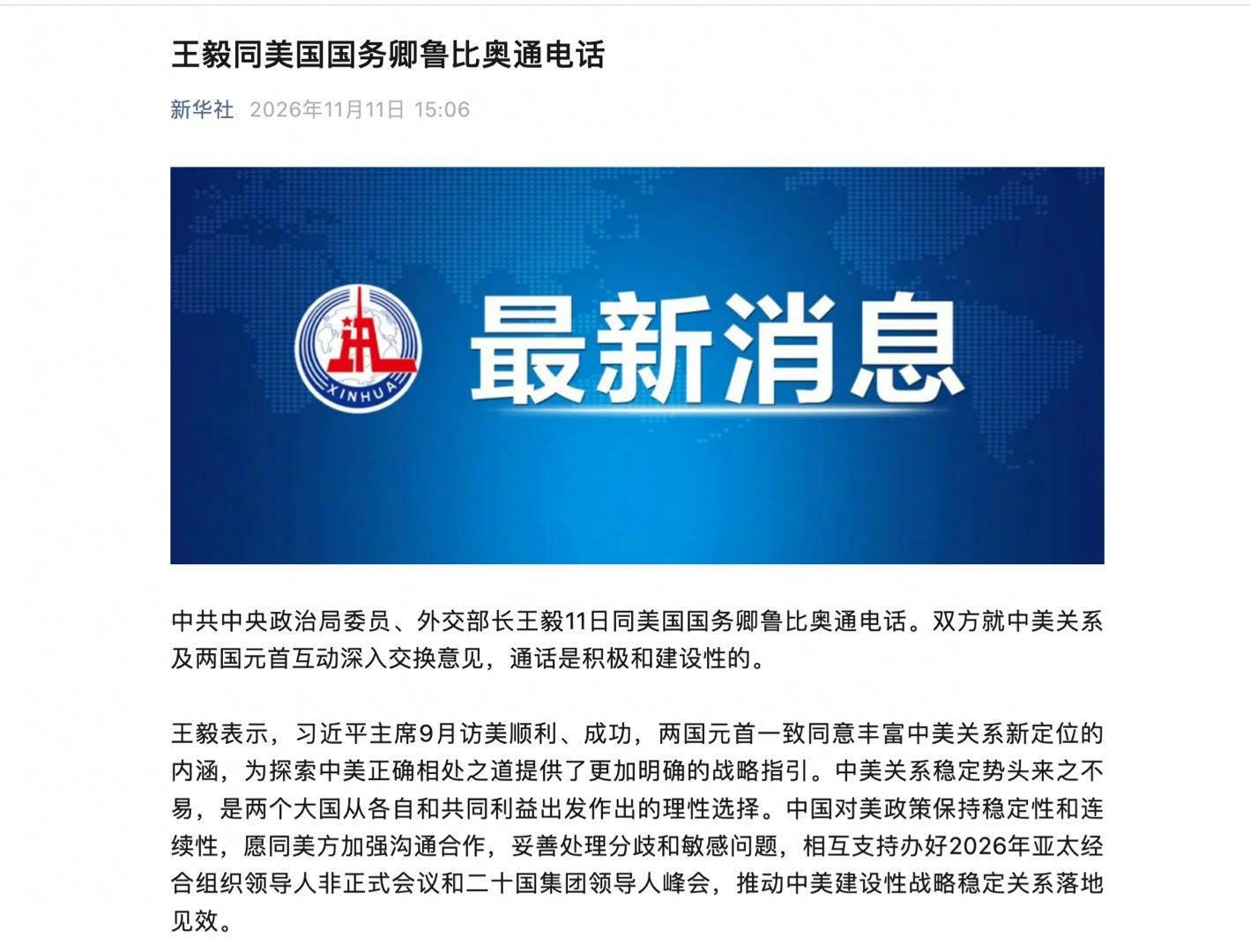
Chinese Foreign Minister Wang Yi also spoke by phone with US Secretary of State Marco Rubio. According to the Chinese readout, the call was “positive and constructive.” Unlike previous readouts, however, the Chinese statement made no mention of what Rubio said.
Wang Yi Holds Phone Call with US Secretary of State Marco Rubio
Wang Yi, Member of the Political Bureau of the CPC Central Committee and Minister of Foreign Affairs, spoke by phone with US Secretary of State Marco Rubio on November 11. The two sides exchanged views in depth on China-US relations and interactions between the two presidents. The call was positive and constructive.
Wang Yi said that President Xi Jinping’s visit to the United States in September was smooth and successful. The two presidents agreed to further enrich the substance of the new positioning of China-US relations, providing clearer strategic guidance for exploring the right way for China and the United States to get along. The momentum of stability in China-US relations has not come easily and represents a rational choice made by both major powers in light of their respective and shared interests. China’s policy towards the United States remains stable and consistent. China is willing to strengthen communication and cooperation with the US, properly handle differences and sensitive issues, support each other in successfully hosting the 2026 APEC Economic Leaders’ Meeting and the G20 Summit, and translate constructive strategic stability in China-US relations into concrete results.
There have also been several positive developments in bilateral economic relations ahead of the APEC leaders’ meeting. On November 6, GE Aerospace announced more than $12.9 billion in agreements for aircraft engines and related services during the China International Import Expo. These included an order from China Eastern Airlines for 202 LEAP-1A engines, demonstrating that commercial cooperation between the two countries in the aviation sector continues. Meanwhile, China has extended the suspension of certain rare earth export restrictions and signalled its willingness to increase imports of US agricultural products.
However, cooperation between China and the United States in artificial intelligence faces new uncertainties following the scandal involving Nvidia CEO Jensen Huang and Alice Huang, a woman suspected of being a Chinese intelligence operative.
Between November 9 and 11, China’s Ministry of Foreign Affairs and Taiwan Affairs Office responded to questions about the prospective China-US leaders’ meeting at APEC and the allegations involving Jensen Huang. Foreign Ministry spokesperson Guo Jiakun dismissed the claims of Chinese espionage as “groundless speculation and malicious smears.” He also said that China and the United States remained in communication about interactions between the two presidents later this year, without confirming specific arrangements for an APEC meeting or whether the Jensen Huang affair would be discussed.
Taiwan Affairs Office spokesperson Zhang Han, meanwhile, emphasised that cross-Strait cooperation in the semiconductor industry serves the interests of both sides and that maintaining stable and resilient industrial and supply chains is a practical necessity. Regarding the possibility of Taiwan-related discussions during APEC, she reiterated that the one-China principle and the three China-US joint communiqués form the political foundation of bilateral relations.
On November 11, US Treasury Secretary Scott Bessent delivered remarks at the National Committee on US-China Relations’ annual dinner, where he discussed new arrangements for bilateral dialogue on AI safety.
Turning to artificial intelligence, Bessent recalled Henry Kissinger’s concerns about AI risks in the final months of his life. He noted that Kissinger had remained focused on the challenges of the future and had come to believe that the emergence of superintelligence could create an entirely new category of strategic danger. Kissinger recognised that even countries with profound differences have a responsibility to find common ground when confronting shared risks.
Bessent then revealed that, at President Trump’s direction, the United States had established a new dialogue with China on superintelligence. The mechanism is intended to guard against shared risks and prevent misunderstandings between the two countries’ systems. He also said that China and the United States expect to exchange best practices for evaluating and testing advanced AI models before their release, as well as approaches to ensuring that human judgment remains firmly in control of the technology. In addition, the two countries are establishing a direct communication channel to enable either side to promptly notify the other of serious incidents involving its superintelligence models.
In the final months of his life, Henry Kissinger was preoccupied with the challenges of a world he would not live to see. Even at the age of 100, his gaze, characteristically, was fixed on the future. On his last trip, he met with President Xi in Beijing to discuss deeper collaboration.
Kissinger had come to believe that the advent of superintelligence could represent a novel class of strategic danger. And he recognized that the obligation of great nations, even—and perhaps especially—those with profound differences, is to find common purpose.
So, at President Trump’s direction, we have begun that important work by establishing a new dialogue with China on SI, designed to guard against shared risks and prevent a misunderstanding between our two systems. We also expect to exchange best practices for evaluating and testing advanced models before their release, and for keeping human judgment firmly in command of this technology. Finally, we are establishing a direct channel to ensure that either nation can promptly alert the other to serious incidents involving its SI models.
As SI advances, so will the need to engage in new areas of risk management—and to demonstrate how two nations can reconcile the demands of competition with the responsibilities of leadership. As we do so, we should harbor no illusions about the differences between the United States and China. As I stated earlier, our interests will not always coincide. And our approach to every challenge, likewise, will not always converge.
There are two particularly important new details concerning the bilateral AI safety dialogue.
First, China and the United States plan to exchange best practices for evaluating and testing advanced AI models before release.
China has already established several mechanisms for pre-release AI safety evaluation and testing. These include security assessments and regulatory filings for generative AI services, reviews of training data and generated content, red-teaming, adversarial testing, and third-party security evaluations. The Interim Measures for the Management of Generative Artificial Intelligence Services, the Basic Safety Requirements for Generative Artificial Intelligence Services, and Version 3.0 of the AI Safety Governance Framework provide regulatory and technical foundations for these assessments. The framework is also gradually expanding to address risks such as loss of control over AI models, highly autonomous agents, and the preservation of human oversight.
At the same time, some leading Chinese AI laboratories have developed promising practices. For example, certain laboratories have begun linking dangerous capability evaluations to model release decisions, including by deliberately reducing cyber-offensive materials in training to lower models’ success rates on vulnerability exploitation tasks. Others have worked with universities and cybersecurity teams to evaluate vulnerability discovery and exploitation capabilities, adopting a phased release approach in which a product is launched first, followed by further evaluation and hardening, with model weights released approximately two weeks later to reduce risks. Meanwhile, institutions such as the Shanghai Artificial Intelligence Laboratory have proposed the Frontier AI Risk Management Framework 2.0, which identifies 13 red lines across five categories of risk, including cyberattacks, biological and chemical safety, and loss of model control. The framework recommends normal deployment, restricted deployment, or suspension of release depending on the level of risk.
In the United States, a system for pre-release safety evaluations of advanced AI models has gradually emerged, centred on voluntary industry cooperation, government involvement, and independent third-party testing. In 2024, the AI Safety Institute under the US Department of Commerce signed cooperation agreements with OpenAI and Anthropic, gaining access to certain unreleased models for testing. In May 2026, this cooperation expanded to include Google DeepMind, Microsoft, and xAI. Testing has focused on biological and chemical risks, cyber-offensive capabilities, long-horizon autonomous behaviour, deceptive behaviour, and the ability to evade human oversight.
In August 2026, Reuters reported that the Trump administration was discussing a new, unpublished voluntary safety testing arrangement with Meta, Anthropic, Google, Nvidia, and OpenAI. The discussions focused on evaluating advanced cyber-offensive capabilities, while reportedly considering excluding open-weight models such as Llama and Nemotron. The United States has not established a mandatory pre-release approval system covering all frontier AI models, and these evaluations continue to rely primarily on voluntary industry participation.
Second, building on the previously announced AI safety incident notification mechanism, Bessent further clarified that the focus would be on “serious incidents.”
There is already considerable international experience in crisis communication, from the US-Soviet hotline to nuclear accident and cybersecurity incident notification mechanisms. These arrangements could offer useful lessons for a China-US AI safety incident notification mechanism. AI, however, presents some distinctive challenges. Many incidents are first discovered by private companies, and the information involved may be commercially sensitive or subject to data protection and export control requirements. China and the United States could therefore begin with a limited set of serious incidents with potential cross-border implications, such as major disruptions to critical infrastructure, serious physical harm, or unusual incidents that could lead to national security miscalculations. Companies could first report incidents to their respective governments, which would then decide what information should be shared with the other side. This would allow timely warnings while protecting sensitive information.
In practical terms, both countries could designate policy and technical points of contact, establish a 24-hour hotline or written notification channel, and agree in advance on which incidents require notification, expected response times, and procedures for providing updates. Matt Sheehan, a researcher at the Carnegie Endowment for International Peace, has even suggested considering fax communications, as written notifications would be easier for governments to verify and process internally, without requiring officials to respond immediately during a live conversation. The two sides should also agree on confidentiality and information-use rules, making clear that notifying the other party of an incident does not constitute an admission of responsibility or grant permission to investigate or access the reporting party’s systems. The mechanism could begin with a limited pilot before being gradually expanded based on practical experience.
On November 7, Cui Tiankai, former Chinese Vice Minister of Foreign Affairs and Ambassador to the United States, attended the “APEC China Year · Greater Bay Area Academic Roundtable” in Shenzhen, where he shared his views on China-US AI cooperation. Cui argued that artificial intelligence could become an important area of bilateral cooperation and contribute to constructive strategic stability.
He called for a relationship characterised by cooperation as the priority, competition within reasonable bounds, manageable differences, and the prospect of peace. Both countries, he said, should work together to strengthen AI governance and ensure that the technology remains under human control and benefits society. He stressed that China’s AI development is not intended to replace or challenge the United States. While technological competition is inevitable, it should not become a zero-sum game, nor should either country approach the other’s technological progress with fear, confrontation, or suspicion.
Cui reiterated that cooperation benefits both sides, while confrontation harms both, arguing that an adversarial approach is particularly inappropriate in a field as advanced as AI. He also expressed hope that domestic political developments in the United States would not undermine bilateral relations or AI cooperation, noting that America’s current challenges have deep-rooted structural causes that cannot be resolved simply by changing political leaders.
Former Chinese Ambassador Cui Tiankai on China-US Relations and AI Governance

On November 7, Cui Tiankai, former Chinese Vice Minister of Foreign Affairs and Ambassador to the United States, attended the “APEC China Year · Greater Bay Area Academic Roundtable” in Shenzhen, where he shared his views on China-US relations and AI governance.
On November 8, the Global Times, a Chinese state-affiliated newspaper known for its hawkish stance towards the United States, published a surprisingly conciliatory editorial. Against the backdrop of growing opposition to AI data centres in the US following the midterm elections, the editorial highlighted China’s advantages in electricity supply and infrastructure development. It suggested that, if the two countries could move beyond the excessive securitisation of technology issues, American technology companies might consider deploying some of their AI computing capacity in China, taking advantage of their complementary strengths in frontier AI research and infrastructure development to reduce the overall cost of AI.
Global Times: Could U.S. Technology Companies Build AI Data Centres in China? It is More Than Just a Joke

On November 8, the Global Times, a Chinese state-affiliated newspaper known for its hawkish stance towards the United States, published a surprisingly conciliatory editorial. Against the backdrop of growing opposition to AI data centres in the US following the midterm elections, the editorial highlighted China’s advantages in electricity supply and infr…