

The eight outcomes released by the Chinese side begin with the establishment of a constructive and strategically stable China-U.S. relationship based on respect, fairness and reciprocity. This is followed, in order, by mutual support for APEC and the G20; Iran’s commitment not to develop nuclear weapons; recognition of China and the United States as World War II allies; the bilateral economic and trade consultation mechanism and its outcomes, including reciprocal tariff reductions covering US$30 billion worth of trade; joint counternarcotics law enforcement; the AI dialogue; and the arrival of giant pandas in the United States.
The U.S. side placed counternarcotics cooperation and the loan of giant pandas to the United States in the first two positions, followed by trade and investment in third place and the constructive and strategically stable relationship in fourth. These were followed by mutual support for APEC and the G20, preventing Iran from acquiring nuclear weapons, recognition of the two countries’ World War II alliance, and the AI dialogue.
The same eight outcomes therefore appear in a different order in the two lists. China leads with the overall framework for the bilateral relationship, while the United States puts counternarcotics, pandas, and trade and investment first. This reflects different priorities in how the two sides publicly present the outcomes.
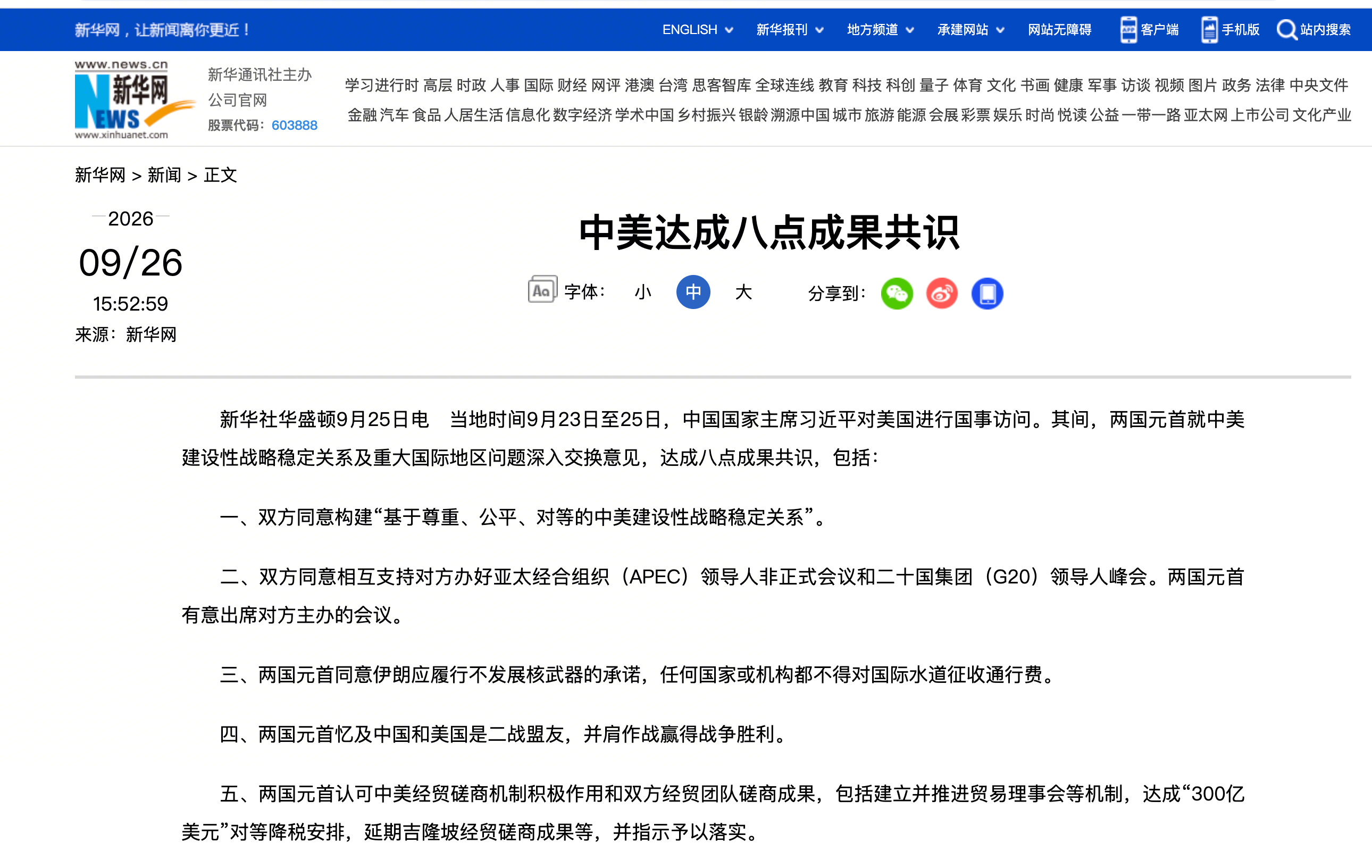
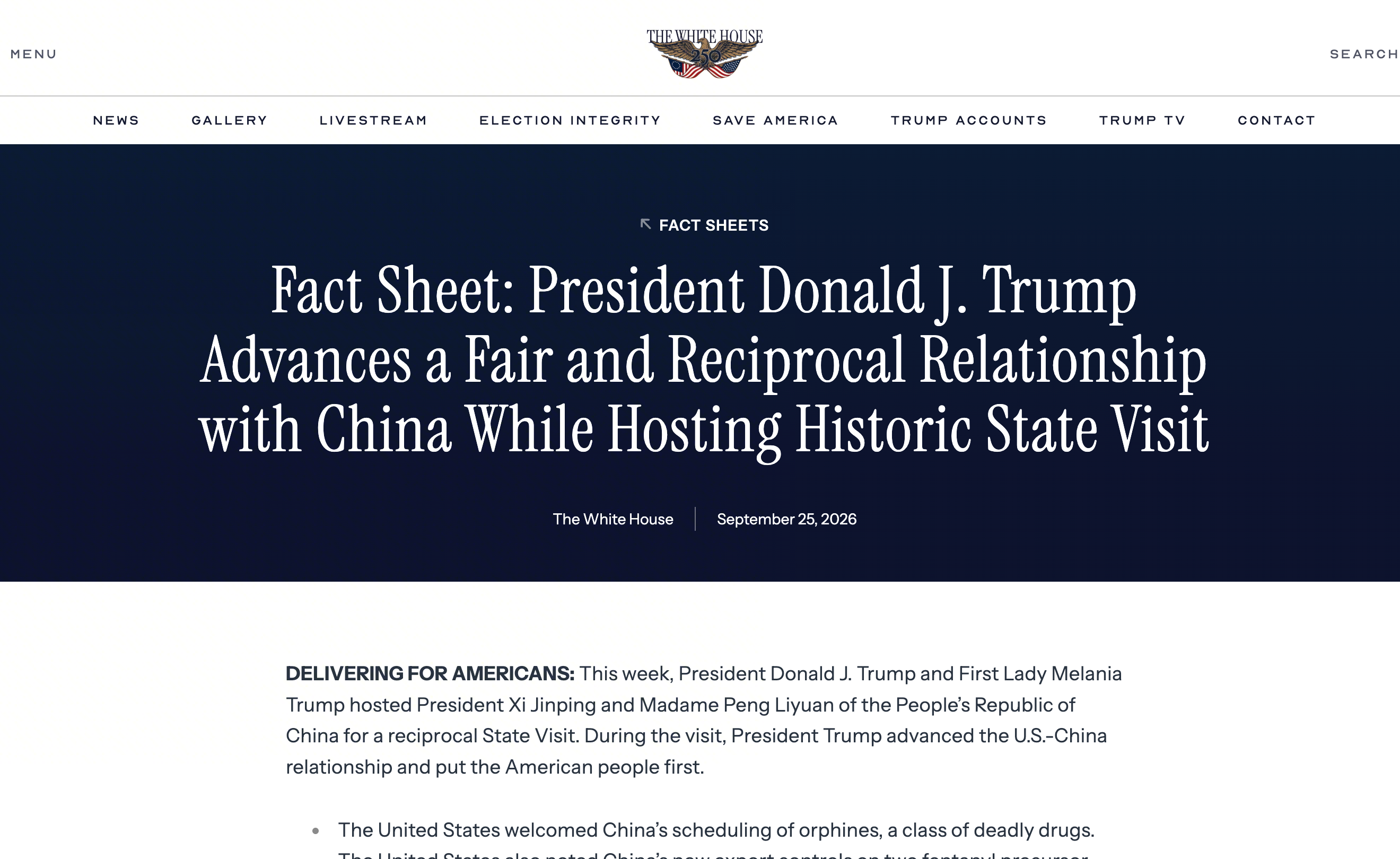
1. A New Framework for China-U.S. Relations
Both sides’ official documents confirm a “constructive and strategically stable China-U.S. relationship based on respect, fairness and reciprocity.”
The White House fact sheet uses the full English formulation corresponding to the Chinese version. China incorporated the concept of “respect,” to which it has attached particular importance, while also accepting “fairness” and “reciprocity,” concepts emphasized more strongly by the U.S. side.
2. Taiwan
The Chinese readout states that President Xi expressed the hope that the United States would maintain the correct position of “opposing Taiwan independence.”
The White House fact sheet does not mention Taiwan. It does, however, state that “since World War II, the U.S. military presence in the Indo-Pacific has sustained a free and open regional order that has underwritten American prosperity.” This could be read as indirectly emphasizing that maintaining the status quo across the Taiwan Strait remains in the U.S. interest.
Trump told reporters that the two sides did not spend much time discussing Taiwan and that China was very clear about his views on the issue.
In a media interview, U.S. Ambassador to China David Perdue said that although China had repeatedly pressed the United States to change its position on Taiwan, U.S. language and policy had not changed. The United States wants peace across the Taiwan Strait, opposes coercion and does not support Taiwan independence. In Washington’s view, Beijing understands the U.S. position. Perdue also said Trump had shown respect on the Taiwan issue and listened to the Chinese side, and that the U.S. position on Taiwan is now more stable than it has been in the past decade.
On arms sales, Secretary of State Marco Rubio said in response to a reporter’s question that decisions on arms sales to Taiwan depend not only on the political and security considerations of a particular region, but also on U.S. defense-industrial capacity, weapons inventories and defense requirements around the world. Washington therefore needs to assess whether it has sufficient capacity to sell the relevant weapons abroad. The proposed arms sales remain under review.
3. Trade and Economic Relations
The Chinese readout broadly refers to the establishment and advancement of mechanisms including a Trade Council, though it omits the Investment Council. It also mentions reciprocal tariff reductions covering US$30 billion worth of trade and an extension of the outcomes of the Kuala Lumpur economic and trade consultations.
The U.S. side provides considerably more detail:
It mentions the Investment Council and states that its role will be to explore potential investment opportunities and investment-related barriers, while providing both sides with a formal channel for addressing investment issues of practical commercial significance.
The two sides reached an understanding to provide more favorable tariff treatment for US$30 billion worth of non-sensitive goods from each country, with the U.S. fact sheet listing examples of the products concerned.
It also states that the Trade Council established a working group specifically focused on addressing market-access barriers in agriculture. Wang Yi subsequently confirmed this when discussing the outcomes of the visit.
The U.S. side also mentions several outcomes that do not appear in the Chinese readout:
China will import at least 10 million metric tons of coal from the United States in both 2027 and 2028.
China will ensure the continued and normal supply of rare earths and other critical minerals.
President Trump urged President Xi to increase production of refined petroleum products to help stabilize global supply.
The White House fact sheet does not mention the extension of the Kuala Lumpur economic and trade arrangements. Treasury Secretary Scott Bessent and other U.S. officials, however, have said that the arrangements were extended by two months, until January 10, 2027.
U.S. Trade Representative Jamieson Greer said the United States and China may periodically extend these trade “pauses,” but that Washington also regards them as periods for monitoring compliance. The United States will closely watch whether China follows through on commitments such as increasing purchases of U.S. agricultural products and maintaining rare-earth supplies before deciding whether to continue the current period of relative stability in bilateral economic relations.
4. Artificial Intelligence
Both sides confirm the establishment of an AI dialogue mechanism to exchange views on AI-related risks and benefits. The next dialogue will take place in November, and the two sides agreed to establish a bilateral communication channel for AI-related incidents. Bessent has referred to this channel as a “hotline.”
There are, however, differences in how the two sides describe AI itself.
The U.S. readout says the two leaders agreed to use the term “super intelligence” rather than “artificial intelligence” to describe these emerging technologies. On September 26, however, the Chinese Foreign Ministry specifically responded that China respects the U.S. preference for the term “super intelligence” but will continue to refer to it as “artificial intelligence.” China did not announce any agreement to adopt a common name.
Trump subsequently told reporters that the two sides had not spent much time discussing AI. He said the United States currently has a substantial lead over China in AI and intends to maintain that advantage. He nevertheless emphasized that the two leaders had discussed the term “super intelligence.”
5. International and Regional Issues
Iran
The third item in China’s eight-point list states explicitly that the two presidents agreed that Iran should honor its commitment not to develop nuclear weapons and that no country or entity should impose transit fees on international waterways. This broadly corresponds with the U.S. readout.
According to the U.S. side, Iran did not occupy a large portion of the meeting. U.S. officials declined to say clearly whether Washington would sanction Chinese entities trading with Iran. There have been reports suggesting that China might press Iran and assist Trump in resolving the conflict in the Middle East in exchange for the United States halting arms sales to Taiwan. Ambassador Perdue, however, explicitly rejected the idea that any arrangements or commitments concerning Iran and Taiwan were linked.
Japan and World War II
The Chinese side states that “the two presidents recalled that China and the United States were allies during World War II and fought side by side to achieve victory.” The U.S. side uses corresponding language.
APEC and the G20
The two sides use consistent language regarding their respective major multilateral events. Both agreed to support each other in successfully hosting the APEC Economic Leaders’ Meeting and the G20 Leaders’ Summit, and said the two presidents intend to attend the meetings hosted by the other side.
North Korea and Russia
The U.S. readout also mentions North Korea and Russia and states that the United States called for trilateral arms-control talks among the United States, Russia and China. None of these points appears in the Chinese readout.
6. Giant Pandas
The language on both sides is consistent. The United States welcomed the arrival of a pair of giant pandas loaned by China to Zoo Atlanta.
7. Fentanyl and Counternarcotics Cooperation
The Chinese side highlights the tangible results of China-U.S. counternarcotics law-enforcement cooperation. It also stresses that although the fentanyl problem was not caused by China, Beijing has, out of humanitarian considerations and with the broader China-U.S. relationship in mind, acted with the utmost goodwill and made every effort to assist the United States in addressing the fentanyl crisis. Recently, the two sides have worked closely together to jointly crack several cases involving new psychoactive substances and precursor chemicals, resulting in the arrest of dozens of suspects in both countries.
The U.S. account places greater emphasis on the fact that the operations were conducted “based on intelligence from U.S. law enforcement” and specifies that the suspects included 21 Chinese nationals. It adds that the United States “strongly urges” that the Chinese nationals involved receive the harshest available penalties, including the death penalty where applicable. The United States also welcomed China’s move ahead of the summit to impose export controls on additional drug precursors and “strongly encouraged” China to continue scheduling these and other substances and chemicals.
8. Military Relations
The Chinese readout states that the two militaries agreed to sign a memorandum of understanding as soon as possible to strengthen crisis communication and prevention, and to continue cooperation in searching for the remains of U.S. military personnel missing in China.
The U.S. readout does not mention either of these points.
9. Semiconductor Export Controls
Neither side’s summit readout mentions semiconductor export controls.
U.S. Trade Representative Jamieson Greer subsequently made clear that high-end advanced chips representing the “crown jewels of American technology,” as well as semiconductor manufacturing equipment requiring individual export licenses, are kept entirely separate from the bilateral trade negotiations. He said this is “how we maintain our lead in the super-intelligence race,” adding that discussions on these issues simply did not take place as part of the trade negotiations.
In its account of the visit’s outcomes, the Chinese side argued that some forces in the United States have overstretched the concept of national security, frequently politicized economic and trade issues, suppressed Chinese companies operating in the United States, restricted Chinese investment, created market-access barriers, and advocated “decoupling” and the severing of supply chains. China said such actions serve neither side’s interests and would only shrink the areas in which their interests overlap. President Xi stressed that cooperation is a two-way street and that stabilizing China-U.S. economic and trade relations requires both expanding the list of areas for cooperation and shortening the list of problems. He called on the United States to treat Chinese companies fairly and to seek solutions through dialogue and negotiation in a spirit of equality, respect and mutual benefit.