

The Trump-Xi bilateral has wrapped up. It lasted for 2 hours and 15 minutes.
CCTV coverage
China’s readout
Xinhua News Agency, Beijing, May 14 (Reporters Yang Yijun and Zhu Jichai) — On the morning of May 14, Chinese President Xi Jinping held talks at the Great Hall of the People in Beijing with U.S. President Donald Trump, who is paying a state visit to China.
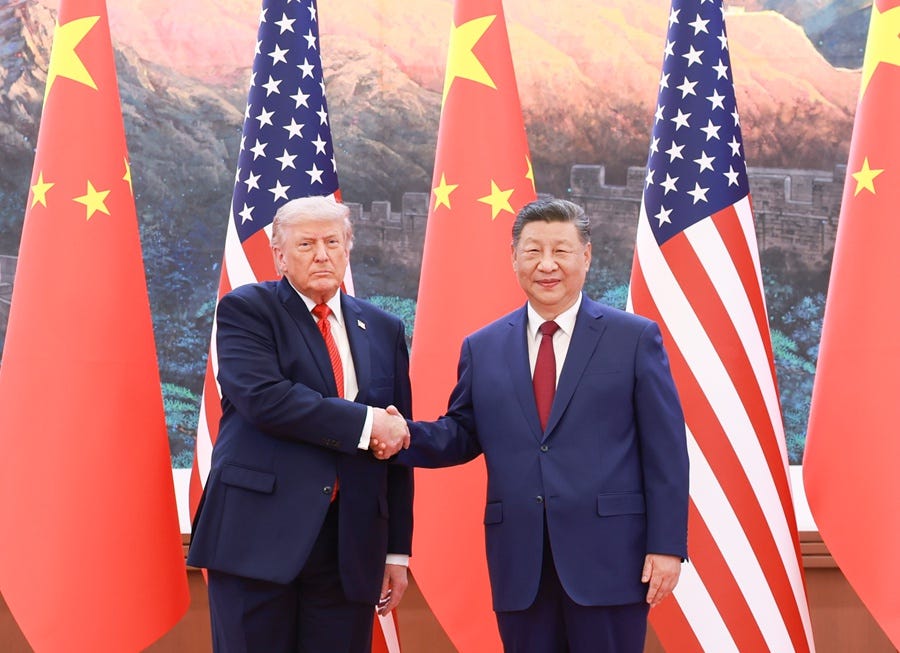
Xi Jinping noted that profound changes unseen in a century are accelerating, while the international landscape is increasingly turbulent and complex. He said the key questions facing China and the United States are: Can the two countries transcend the “Thucydides Trap” and pioneer a new paradigm for major-country relations? Can they work together to address global challenges and bring greater stability to the world? Can they focus on the well-being of their peoples and the future of humanity, and jointly create a better future for bilateral relations? These, Xi said, are questions posed by history, by the world, and by the people — and they are also the defining questions that leaders of major powers must answer together in this era. Xi added that he is willing to work with President Trump to steer the giant ship of China-U.S. relations onto the right course and ensure that 2026 becomes a historic and landmark year that carries forward and opens a new chapter in bilateral relations.
Xi emphasized that China is committed to the stable, healthy, and sustainable development of China-U.S. relations. He said that he and President Trump had agreed to define the relationship under a new framework of “constructive strategic stability between China and the United States,” which would provide strategic guidance for bilateral relations over the next three years and beyond, and would, he believed, be welcomed by both peoples and the international community. Xi said that “constructive strategic stability” should be a positive form of stability centered on cooperation, a healthy form of stability with managed competition, a normal form of stability with controllable differences, and a durable form of stability in which peace remains achievable. He stressed that “constructive strategic stability” should not remain merely a slogan, but must be translated into concrete actions moving toward each other.
Xi pointed out that the essence of China-U.S. economic and trade relations is mutual benefit and win-win cooperation, and that equal-footed consultation is the only correct way to address differences and frictions. He said the two countries’ economic and trade teams had achieved “overall balanced and positive outcomes” the previous day, which he described as good news for both peoples and for the world. Both sides, he said, should work together to preserve the hard-won positive momentum currently emerging in the relationship. Xi added that China’s door to opening-up will only open wider, and that U.S. companies are already deeply participating in China’s reform and opening-up process. China, he said, welcomes stronger mutually beneficial cooperation with American businesses.
Xi further stated that both sides should implement the important consensus already reached and make better use of political, diplomatic, and military-to-military communication channels, while expanding exchanges and cooperation in areas including trade, public health, agriculture, tourism, people-to-people exchanges, and law enforcement.
Xi stressed that the Taiwan issue remains the most important issue in China-U.S. relations. If handled properly, he said, bilateral ties can maintain overall stability; if mishandled, the two countries could face confrontation or even conflict, pushing the entire relationship into a highly dangerous situation. “Taiwan independence” and peace across the Taiwan Strait are fundamentally incompatible, Xi said, adding that maintaining peace and stability in the Taiwan Strait represents the greatest common interest shared by both China and the United States. He urged the U.S. side to handle Taiwan-related issues with the utmost prudence.
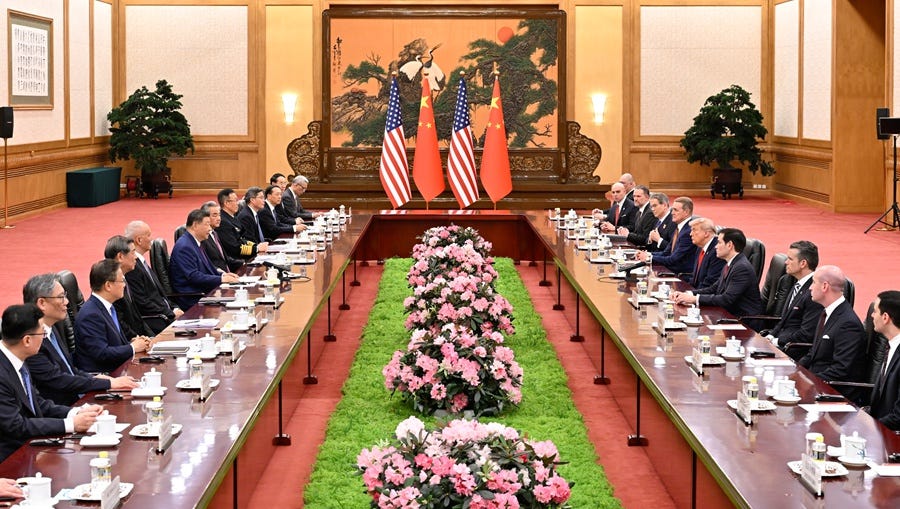
Trump said he was deeply honored to pay a state visit to China. U.S.-China relations, he said, are in a good state, and he and President Xi have established “the longest-lasting and best relationship ever between leaders of the United States and China.” He said the two sides have maintained friendly communication and resolved many important issues together. Trump described Xi as “a great leader” and China as “a great country,” adding that he has tremendous respect for Xi and for the Chinese people. He said today’s meeting was “a globally significant summit meeting.” Trump said he is willing to work together with Xi to strengthen communication and cooperation, properly manage differences, open the door to “the best U.S.-China relationship in history,” and create a brighter future for both countries. He added that the United States and China are the world’s most important and most powerful countries, and that cooperation between them can accomplish many major and positive things for both nations and for the world. Trump also noted that he had brought with him a distinguished delegation of American business leaders, all of whom deeply respect and value China, and whom he actively encourages to expand cooperation with China.
The two heads of state also exchanged views on major international and regional issues, including the situation in the Middle East, the Ukraine crisis, and the Korean Peninsula.
The two leaders agreed to support each other in hosting this year’s informal APEC Economic Leaders’ Meeting and the G20 Summit.
During the talks, Trump introduced the accompanying business executives to Xi one by one.
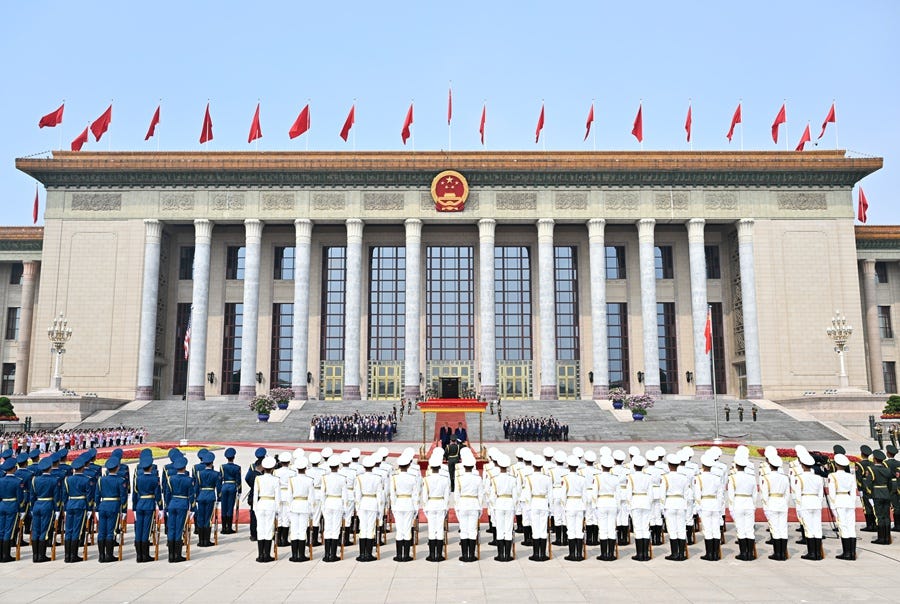
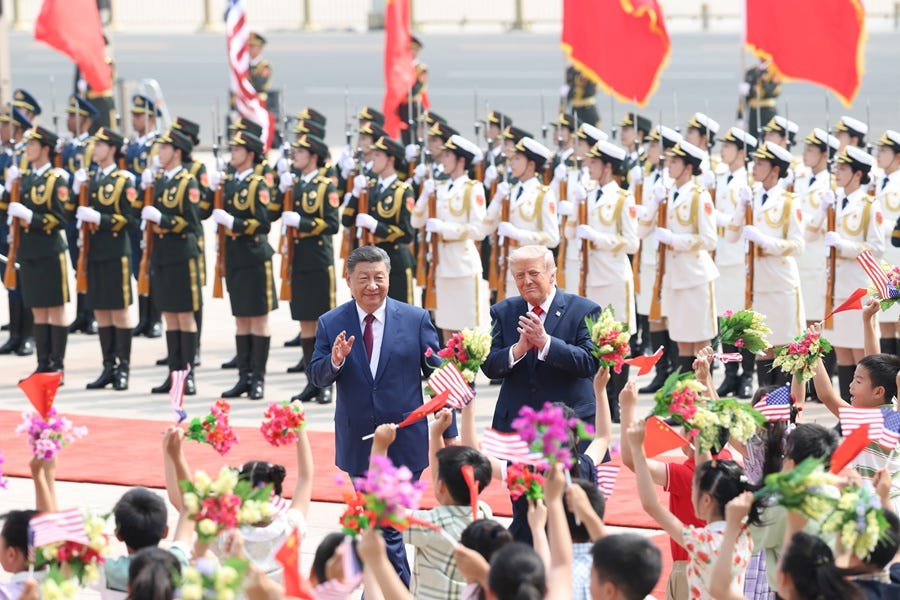
Before the talks, Xi held a welcoming ceremony for Trump at the East Gate Plaza outside the Great Hall of the People. Upon Trump’s arrival, an honor guard lined up in salute. The two heads of state stepped onto the reviewing stand as the military band played the national anthems of China and the United States, while a 21-gun salute was fired at Tiananmen Square. Accompanied by Xi, Trump reviewed the honor guard of the Chinese People’s Liberation Army and watched the ceremonial march-past.
Cai Qi, Wang Yi, and He Lifeng attended the talks.
White House readout
President Trump had a good meeting with President Xi of China. The two sides discussed ways to enhance economic cooperation between our two countries, including expanding market access for American businesses into China and increasing Chinese investment into our industries. Leaders from many of the United States’ largest companies joined a portion of the meeting. The Presidents also highlighted the need to build on progress in ending the flow of fentanyl precursors into the United States, as well as increasing Chinese purchases of American agricultural products. The two sides agreed that the Strait of Hormuz must remain open to support the free flow of energy. President Xi also made clear China’s opposition to the militarization of the Strait and any effort to charge a toll for its use, and he expressed interest in purchasing more American oil to reduce China’s dependence on the Strait in the future. Both countries agreed that Iran can never have a nuclear weapon.
THE WHITE HOUSE
Xi Jinping Meets with American Business Leaders Accompanying U.S. President Donald Trump on His Visit to China
During talks between Chinese President Xi Jinping and visiting U.S. President Donald Trump at the Great Hall of the People in Beijing on the morning of May 14, Xi also met with the American business leaders accompanying Trump on his state visit to China.
Trump said that he had brought with him a distinguished group of representatives from the American business community, all of whom respect and value China, and that he encourages them to expand cooperation with China. Trump then introduced the accompanying executives to Xi one by one.
The American business leaders said they attach great importance to the Chinese market, hope to deepen their presence in China, and seek to strengthen cooperation with Chinese partners.
Xi stated that American companies have been deeply involved in China’s reform and opening-up process, and that both sides have benefited from this engagement. China’s door to opening-up, he said, will only continue to open wider. China welcomes stronger mutually beneficial cooperation with the United States and believes American companies will enjoy even broader prospects in the Chinese market.
Xi Jinping and Donald Trump Visit the Temple of Heaven Together
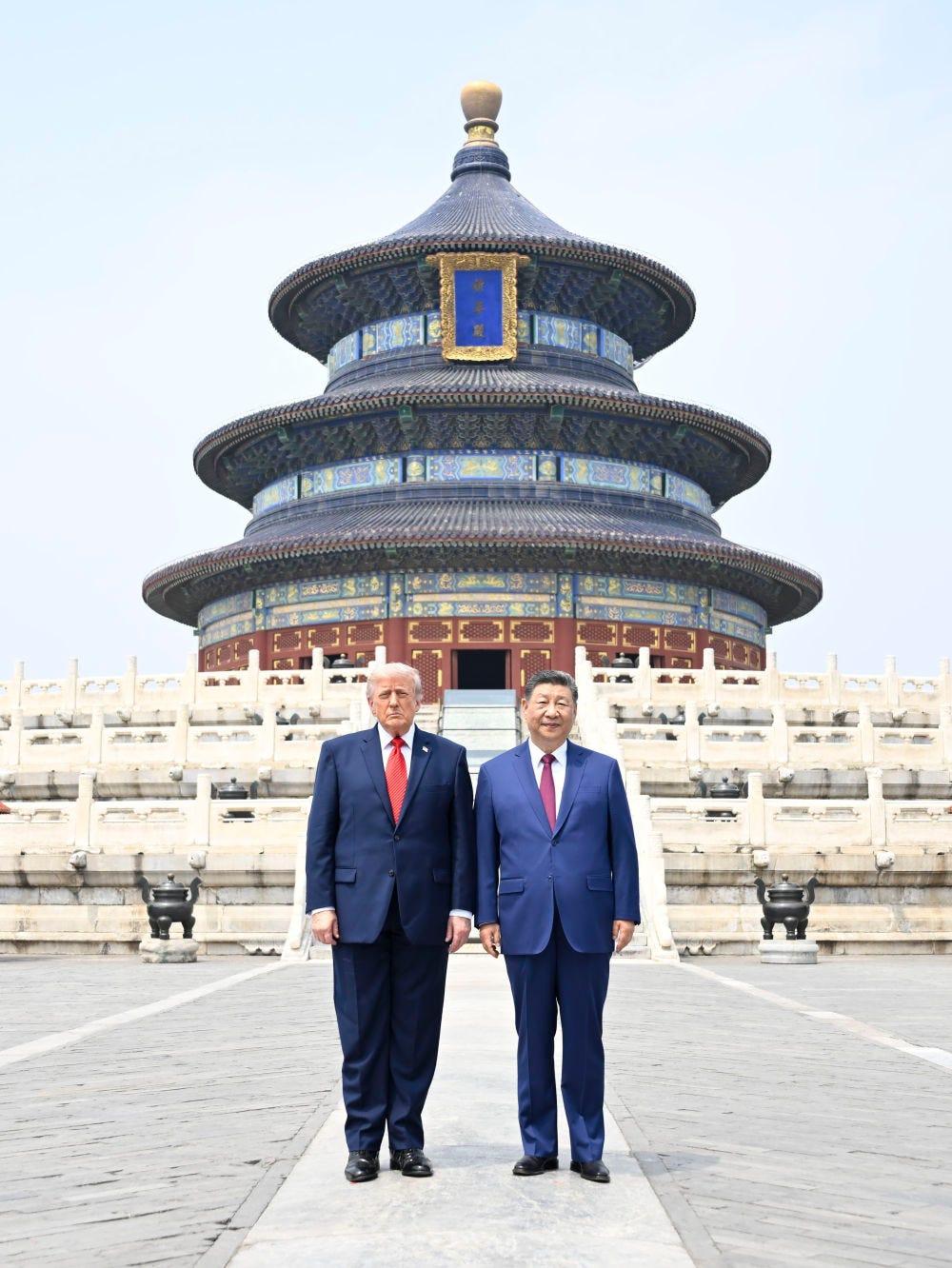
On May 14, Chinese President Xi Jinping visited the Temple of Heaven together with visiting U.S. President Donald Trump, who is paying a state visit to China.
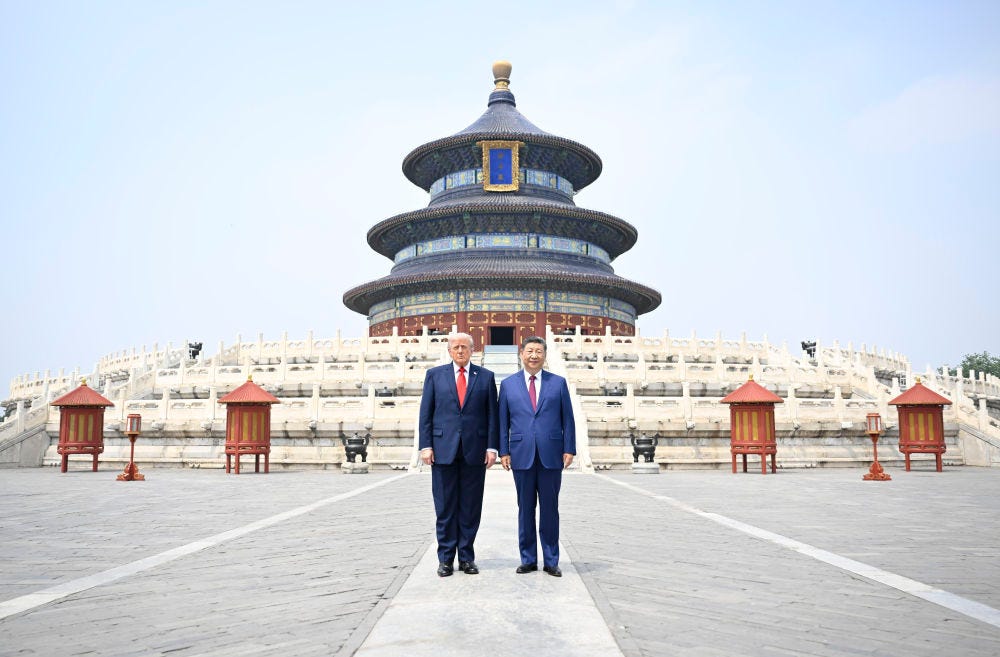
Xi welcomed Trump at the Hall of Prayer for Good Harvests. The two heads of state posed for a group photo in the square outside the hall and toured the Hall of Prayer for Good Harvests together.
Li Qiang Meets with Representatives of the American Business Community
Xinhua News Agency, Beijing, May 14 — On the afternoon of May 14, Chinese Premier Li Qiang met at the Great Hall of the People with representatives of the American business community accompanying U.S. President Donald Trump on his visit to China.
Representatives from Apple, NVIDIA, Meta, Cargill, Tesla, Boeing, Citigroup, Goldman Sachs, GE Aerospace, Qualcomm, Visa, Micron Technology, Mastercard, BlackRock, Blackstone, Coherent, Illumina, as well as the New York Stock Exchange, attended the meeting.
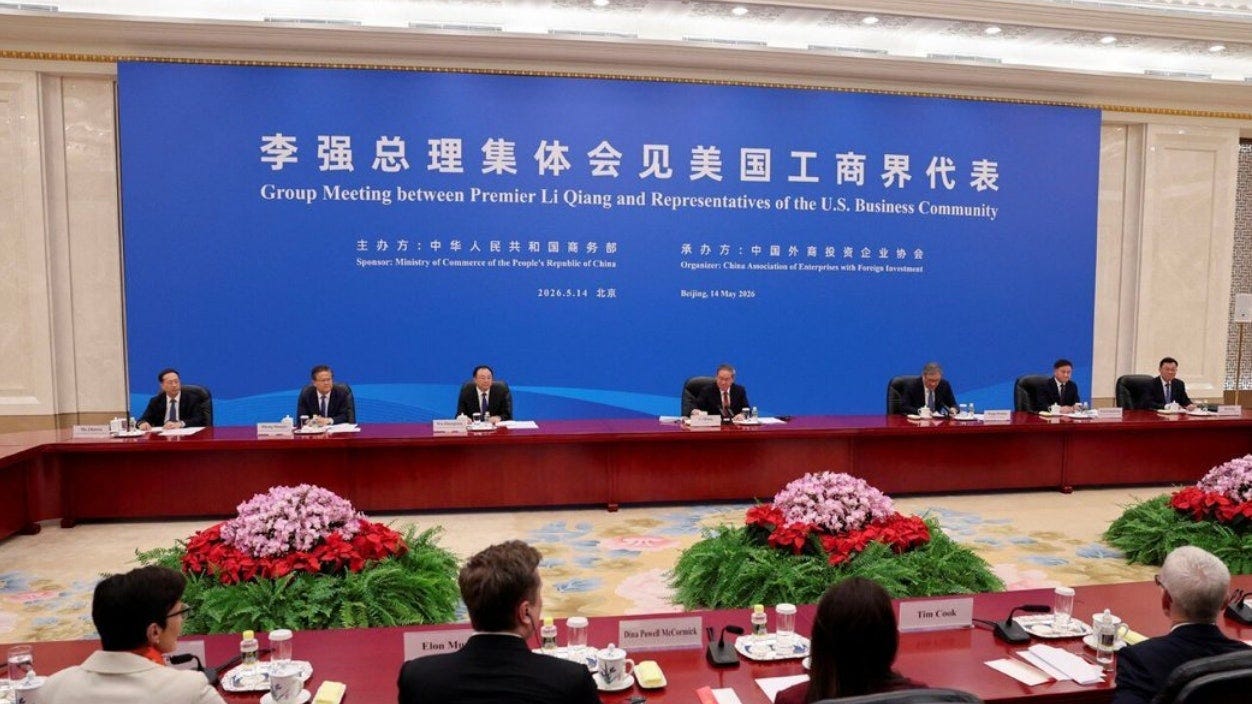
Li Qiang said that earlier in the day, President Xi Jinping and President Trump held talks and exchanged in-depth views on major issues of mutual concern, providing strategic guidance for the development of China-U.S. relations. Against the backdrop of growing instability and uncertainty in the international landscape, Li said that maintaining candid and smooth dialogue and communication between China and the United States, while actively preserving stable and healthy bilateral relations, is not only of major significance to the two countries, but will also inject certainty and positive energy into global peace and development. China, he said, is willing to work with the United States to implement the important consensus reached by the two heads of state, strive for more positive outcomes, achieve mutual success and shared prosperity, and better benefit the peoples of both countries and the world.
Li noted that in today’s turbulent and rapidly changing world, stability has become even more valuable and requires joint efforts to safeguard. A stable and predictable China-U.S. economic and trade relationship, he said, serves the interests of both countries and the world. China-U.S. economic cooperation is vast in scale, with extensive links between markets and industries. Strengthening cooperation, he said, can not only promote mutual benefit and win-win outcomes, but also contribute to global economic growth. As the world’s two largest economies, China and the United States should move toward each other, take the lead in promoting openness and cooperation, properly handle and manage differences, and maintain sound economic and trade relations so as to serve as forces for stability and constructive engagement globally.
Li added that a stable and developing Chinese economy will provide more opportunities for companies from around the world, including American firms. China is currently implementing its 15th Five-Year Plan, and the Chinese market, he said, demonstrates clear advantages in scale, growth potential, and stability. New demand is being released rapidly, new drivers of growth are continuously strengthening, and the economy is maintaining stable and positive momentum. China welcomes more foreign companies to expand in the Chinese market and share in its opportunities.
He stressed that a stable and open policy environment is a long-term commitment of the Chinese government. China, he said, will continue expanding high-level opening-up, consistently provide strong support and services for foreign-invested enterprises, improve policies and administrative efficiency, fully listen to the concerns and requests of businesses, and actively help resolve difficulties, so that companies can confidently plan for the future and focus on their own development.
Li Qiang stated that the stable, healthy, and sustainable development of China-U.S. relations requires joint efforts from all sectors in both countries. He expressed hope that more American companies would continue deepening their presence in the Chinese market, strengthen the ties of mutually beneficial China-U.S. cooperation, and continue serving as bridges for dialogue and communication between the two countries, helping more people in the United States view China’s development in a more objective and rational manner and promoting greater mutual trust and friendship.
Representatives of the American business community said that U.S.-China relations are critically important. The successful meeting between the two heads of state, they said, has injected new momentum into bilateral economic and trade cooperation and provided certainty for the global economy. They expressed hope that the two countries would strengthen dialogue and communication, expand common interests, and achieve shared prosperity. The representatives also said the American business community remains optimistic about China’s development prospects, positively evaluates China’s continued efforts to expand high-level opening-up and create a world-class business environment, and is willing to expand cooperation with China while making greater efforts to enhance mutual understanding and cooperation between the two countries.
Wu Zhenglong attended the meeting.
President Xi’s welcoming remarks
I’ll say a few words first and then I'd like to invite you, Mr. President, to deliver your opening remarks.
President Trump, I'm very pleased to meet you in Beijing. Welcome back to China after nine years. The whole world is watching our meeting. Currently, transformation not seen in a century is accelerating across the globe and the international situation is fluid and turbulent. The world has come to a new crossroads. Can China and the United States overcome the fusidities trap? and create a new paradigm of major country relations. Can we meet global challenges together and provide more stability for the world? Can we in the interests of the well‑being of our two peoples and the future of humanity build a brighter future together for our bilateral relations? These are the questions vital to history, to the world, and to the people. They are the questions of our times that you and I need to answer as leaders of major countries.
This year is the 250th anniversary of American independence. Congratulations to you and to the American people. I always believe that our two countries have more common interests than differences. Success in one is an opportunity for the other. And a stable bilateral relationship is good for the world. China and the United States both stand to gain from cooperation and lose from confrontation. We should be partners, not rivals. We should help each other succeed and prosper together and find the right way for major countries to get along well with each other in the new era.
Mr. President, I look forward to our discussions on major issues important to our two countries and the world and working together with you to set the course for and steer the giant ship of China US relations so as to make 2026 a historic landmark year that opens up a new chapter in China US relations. I will pause here and hand over to you Mr. President.
Thank you.
President Trump’s opening remarks
Well, President Xi, I wanna thank you very much. Yeah, first of all, that was another one like few have ever seen before. And I think I was particularly impressed by those children. They were happy, that were beautiful. The military is obvious. It couldn’t be better.
But those children were amazing, and they represent so much. And I know they represent so much to you, and I have known each other now for a long time. In fact, the longest relationship of our two countries that any president and president has had. And it’s to me, an honor.
We’ve had a fantastic relationship. We’ve gotten along. When there were difficulties, we worked it out. I would call you, and you would call me. And whenever we had a problem, people didn’t know; whenever we had a problem, we worked very quickly. And we’re going to have a fantastic future together.
I respect China for the job you’ve done. You’re a great leader. I say it to everybody. You’re a great leader. Sometimes people don’t like me saying it, but I say it anyway because it’s true. I only say the truth. And I just wanna say on behalf of all of the great delegation that we have, the greatest businessman, the biggest, I guess, the best in the world. We have amazing people, and they’re all with me. They, every single one of them. And we ask the top 30 in the world, every single one of them said yes. And I didn’t want the second or the third in the company. I wanted only the top. And they’re here today to pay respects to you, to China, and they look forward to trade and doing business. And it’s going to be totally receptive on our behalf.
So I really look very much forward to our discussions, a big discussion. There are those who say this is maybe the biggest summit ever. They can never remember anything like it. It’s, I can say in the United States, it’s, people aren’t talking about anything else. But it’s an honour to be with you. It’s an honour to be your friend. And the relationship between China and the USA is going to be better than ever before. Thank you very much. Thank you.
State Dinner remarks
President Xi
Honourable President Donald J. Trump. Ladies and gentlemen, it is a great pleasure to host the State Banquet in honour of President Trump during his state visit to China. On behalf of the Chinese government and people, I’d like to extend a warm welcome to President Trump and the US delegation.
This is a historic visit; this year marks the. The start of China’s 15th Five-Year Plan for Economic and Social Development. The over 1.4 billion people of China, drawing on the rich heritage of our over 5,000-year civilisation, are advancing Chinese modernisation on all fronts through high-quality development.
This year is also the two hundred and fiftieth anniversary of American independence. The over 300 million American people are reinvigorating the spirit of patriotism, innovation and enterprise and ushering in a new journey for the development of the United States. The people of China and the United States are both great peoples. Achieving the great rejuvenation of the Chinese nation and making America great again can go hand in hand. We can help each other succeed and advance the well-being of the whole world.
Fifty- five years ago, President Richard Nixon. Send Doctor Henry Kissinger to visit China. And ping pong diplomacy was carried out between our two countries through the efforts of the two governments and peoples. The door that had remained frozen for over 20 years was opened, marking a milestone in contemporary international relations. From then on, China and the United States have written many chapters of friendship through mutual openness and cooperation. Under the new situation, President Trump and I, fully aware of the expectations of our two nations and the international community, have had multiple meetings and phone calls and kept China-US relations generally stable.
Today, President Trump and I had in-depth exchanges on China, US relations and international and regional dynamics. We both believe that the China-US relationship is the most important bilateral relationship in the world. We must make it work and never mess it up. Both China and the United States stand to gain from cooperation and lose from confrontation. Our two countries should be partners rather than rivals. President Trump and I also agreed to build a constructive China-US relationship of strategic stability to promote the steady, sound and sustainable development of China-US relations and bring more peace, prosperity and progress to the world.
Honourable President Donald J. Trump. Ladies and gentlemen, friends. Looking back at the course of China-US relations, whether or not we could have mutual respect, peaceful coexistence and win cooperation is the key to whether the relationship can advance steadily. The world today is changing and turbulent. China-US relations concern the well-being of the over 1.7 billion people of both countries and affect the interests of the over 8 billion people of the world. Both sides should rise up to this historic responsibility and steer the giant ship of China US relations forward steadily and in the right direction.
Now. Please join me in a toast to the development and prosperity of China and the United States and the well-being of our people. To the bright future of China, US relations and the friendship between the two peoples, and to the health of President Trump and all the friends present. Cheers.
President Trump
Thank you, President Xi.
Well, thank you very much. This is a great honor, was a fantastic day. And in particular, I wanna thank President Xi, my friend, for this magnificent welcome. And it really was a magnificent welcome like none other, and for so graciously hosting us on this very historic state visit.
We had extremely positive and productive conversations and meetings today with the Chinese delegation earlier. And this evening is another cherished opportunity to discuss among friends some of the things that we discussed today, all good for the United States and for China. And it was a great honor to be with you. Please.
The relationship between the American and Chinese people goes all the way back to America’s founding. The first American council to China, Samuel Shaw, arrived on the first American trading ship to reach these shores. And 1784, the Chinese merchants had a name for the Americans. They call their visions the New People. Two and a half centuries later, that first connection is grown into one of. The most consequential relationships in world history.
From the beginning, our citizens have shared a deep sense of mutual respect. Founding Father Benjamin Franklin published the sayings of Confucius in his colonial newspaper. Today’s sculpture, recognising that ancient Chinese sage, is carved into the face of the United States Supreme Court very proudly.
The appreciation ran in both directions. Chinese admirers of President George Washington gifted a stone tablet honoring his memory to adorn the Washington Monument. It bears the words of a Chinese official who called the great general and statesman a hero among men.
And across the centuries, this mutual esteem grew into a relationship that reflected the tremendous talent and potential of our two people. Chinese workers helped lay the railroad tracks that connected our Atlantic coast to the Pacific. American travellers to China helped spread literacy and modern medicine. And at the request of China’s ambassador was President Theodore Roosevelt, who provided the funds to establish President Xi’s Alma mater. The Tsinghua University.
As allies in World War 2. President Franklin Roosevelt mentioned the brave people of China, who were cheered through loud cheers and his speeches in the United States, and everybody loved what he had to say. Just as many Chinese now love basketball and blue jeans, Chinese restaurants in America today outnumber the five largest fast food chains in the United States all combined. That’s a pretty big statement.
This bond of commerce and respect that stretches back 250 years is the foundation for a future that benefits both of our nations. The American and Chinese people share much in common. We value hard work. We value courage and achievement. We love our families and we love our countries. Together, we have the chance to draw these values to create a future of greater prosperity, cooperation and happiness and peace for our children. We love our children. This region and the world is a special world with the two of us united and together.
Thank you again, President Xi. For this beautiful welcome. And tonight, it is my honor to extend an invitation to you and Madam Peng to visit us at the White House this September 24th, and we look forward to it. And I’d now like to raise it less and propose a toast to the rich and enduring ties between the American and Chinese people. It’s a very special relationship. And I want to thank you again. This has been an amazing period of time.
Thank you, President. Thank you, everybody.
Bessent’s interview with CNBC
PART I
JOE KERNEN: I did speak with him in the middle of the night, here, over there it’s like the afternoon or something, and I started by asking him to delineate any concrete progress that has come out of his meeting earlier with with the Vice Premier and what is likely to come from the President’s summit with President Xi. Here it is.
SCOTT BESSENT: Joe, the Chinese don’t like any surprises, which is why President Trump is especially effective with them. But the Vice Premier and I, who have a very good working relationship, I think we’ve seen each other, this was either eight or ninth meeting, worked on the agenda for today’s meeting in terms of the economics, the deliverables. And so, we talked about purchases. We talked about some issues that the Chinese side had. And we’re going to talk about forming a board of trade for the bilateral trade between the U.S. and China. And we’re going to talk about a board of investment that will be responsible for investment in non-sensitive areas.
KERNEN: Mr. Secretary, you know, foreign investment in the U.S. is always a priority for this president, and I’m sure he’d like to announce a commitment that starts with the T-word, with the letter T, or trillions of dollars from China to make its way onto our shores. How do, how do we balance such an increase in cooperation with all the ongoing security concerns we have with a country that we know wants to eventually eclipse the United States?
BESSENT: Well, again, Joe, I’m not sure where this trillion-dollar investment number has come from. It’s somehow gotten out into the ether. And the purpose of this board of investment is to decide up front, what are the non-strategic, non-sensitive areas where it would be possible for the Chinese to invest. I chair something called CFIUS, the Committee on Foreign Investment in the United States. And what we want to do is make sure that these investments don’t get referred to CFIUS. So this would pre-game those investments just to make sure that they’re not of a strategic or sensitive area. But look, there are plenty of things that the Chinese could invest in, in the U.S. and we’re trying to push the same thing in the U.S. President Trump today told Xi Jinping that he wants to open up China, and China should open up. China’s domestic economy has been weak. The Chinese consumer needs to get a larger share of wages, or labor needs to get a larger share of the GDP. It all tends to go back into manufacturing now, and China really needs to create a bigger consumer economy. And President Trump and the entire administration have been pushing them to do that.
KERNEN: Sir, there’s a report from “Reuters” that just came out that the U.S. has cleared around 10 Chinese firms to buy Nvidia’s second most powerful A.I. chip, the H200. No deliveries have been made so far, but this is obviously something that CEO Jensen Huang probably would like to see happen as far as a breakthrough. Can you, can you confirm that’s true and which companies would be allowed, approved which Chinese firms to buy those chips?
BESSENT: Yeah. Joe, this is news to me. I know there’s been a lot of back and forth on the H200 and we’ll have to see on that. That’s a Commerce Department function.
KERNEN: Okay. At the same time, there’s some competing narratives about the overall environment that we’re looking at there. China’s export economy continues. Xi apparently wants to show that he will not be bullied. Meanwhile, China is feeling the pinch from a myriad of internal and external pressures that we talk about, whether it’s real estate, and I think it’s in their best interest to stabilize relations with the U.S. But at the same time, President Trump is, would probably like to announce some positive news at this point. He’s brought all those business leaders. Who is in a stronger bargaining position, in your view? Who needs a deal more in your view and has the upper hand?
BESSENT: Well, I, again, the U.S. is the deficit nation in terms of trade. And I used to teach economic history and the his – economic history would tell you that the deficit country always has a stronger position because we do have a deficit. And we are China’s largest customer. Although President Trump has brought the trade deficit down to, it seems crazy to say, only $200 billion. He’s laser-focused on getting it into, into balance. And that’s, that’s the goal here. And that can be done one of two ways. Either the U.S. receives fewer imports from China, or we sell more to China. And we’re trying to balance that out. What’s happened to China over the past year has been President Trump put up the tariff wall, and China continued to push out goods into their export market. But the U.S. much of that market was blocked, and the goods went to the rest of the world. And there was a lot of price pressure on those goods. So I don’t know if you’re familiar with the old saying, Joe, is we lose a dollar on every item, but we make up for it in volume. So the Chinese have tried to make up for it in volume. They’ve got a tremendous trade surplus. But if you look at the statistics, the profitability of the Chinese firms is way down. And that is even with massive subsidies from the government.
KERNEN: We had Steve Daines, the senator on yesterday, just returned from China after leading a delegation, Mr. Secretary. He told us, I hadn’t heard this before. The three Bs, Boeing, beef and beans. Will those all be discussed? And what else?
BESSENT: Well, those are big. I think we’re going to see the large Boeing orders. Beef was more, they’re not, they’re non-tariff trade barriers against our great American ranchers. The, and then soybeans, we have a very large purchase commitment from the Busan agreement that for the next three years. So beans are really all taken care of. Although if I were the Chinese, I’d probably buy more beans now because there’s a weather pattern called El Nino that we’re probably going to see this year that typically results in very high soybean prices.
KERNEN: Could there be some breakthrough on tariffs? I there, is another report that the two presidents may discuss cuts on roughly $30 billion worth of imports. Do you know which sectors are on the table there? And is this a good way to do it? To pick winners and decide which ones we’re going to allow in without tariffs and which ones we won’t?
BESSENT: So we’re going to form a board of trade.
KERNEN: OK.
BESSENT: And the idea will be for the, non-critical, non-strategic areas things that the U.S. doesn’t want to make that we’re never going to reshore. So something like fireworks or very low-end consumer goods that are going to keep coming from China no matter what. So we can un-tariff those. And then there are many things that they want to buy from us. There was talk today about the Chinese buying more U.S. energy, and the U.S. is exporting a record amount of crude and LNG. Now, the only binding constraint is our export facilities. We’re going to be building more export facilities. We’re going to be ramping up in Alaska, which is a natural for China. And given what’s going on in the Mideast, we think that not only China, but countries all around the world are going to look to diversify away from the Middle East for more stable source of energy, and what better place than the U.S. But the idea of starting with $30 billion by $30 billion that both sides can designate, again, for non-critical areas and areas that we’re not trying to reshore.
KERNEN: Mr. Secretary, do you have a sense on whether China will help with the strait and what China has communicated to us about the Strait of Hormuz? And, I mean, it’s obviously important to them as well. Do you think they’re going to help?
BESSENT: I think they’re going to do with, do what they can. And here, the, China has a much bigger interest in reopening the strait than the U.S. does. China gets about a third of its energy needs from the Gulf. So, a reopening of the strait benefits China. Unfortunately, they’ve been buying, they were the largest consumer of Iranian oil. They were buying about 90 percent of it. Iranian oil represented about 10 percent of their energy that they took in. But the rest of the countries in the Gulf were also substantial contributors, whether it was Saudi, UAE, Qatar. And China gets a substantial amount of their LNG from the Gulf also.
KERNEN: You’ve talked about—
BESSENT: It’s, where we have—
KERNEN: I’m sorry, sir. Go ahead.
BESSENT: No, I was just going to say that China, it’s very much in their interest to get the strait reopened and I think they will be working with, behind the scenes, to the extent anyone has any say over the Iranian leadership. And the real problem here, Joe, is, as you’re aware, we didn’t change the regime, but the regime changed. And, you know, it was several layers of leadership that were decapitated. And it’s very tough there just to communicate anything to anyone who is able to either act or get a, get an overall agreement and speak on behalf of the Iranian leadership.
KERNEN: Yeah. You’ve talked about this a lot, Mr. Secretary, and that is the strain that Iran is under right now, severe strain with the continuing blockade, hyperinflation, plunging currency, food and water shortages. The supreme leader, allegedly, as you said, we’re not sure who we’re talking to at times. Allegedly, it’s begged companies to stop laying off workers for the good of Iran. Is there a breaking point for a regime whose priorities don’t include the welfare of its people?
BESSENT: Sure there is, Joe. And what we’re seeing is the loading facility, the main loading facility for Iranian oil is a facility called Kharg Island. We’ve seen that there have been no loadings in the past three days. We believe their storage is full. None, none of the ships are getting out. None are coming in. So they’re not able to store oil on the water. So they’re going to start shutting down their, they’re going to start shutting down their production. We can see that that’s happening from satellite photos. But more importantly, Joe, exactly as you said, this is a diabolical regime. Thus far this year, they’ve executed 30,000, 40,000 people. Many, many of them peaceful protesters. And so how do you deal with a regime like that? You squeeze them economically. And we believe we’re at the point where soldiers aren’t getting paid. They’re not able to replenish their weapons stocks from abroad. So, I think that they are on their last legs. And the blockade, President Trump’s blockade has been a resounding success.
KERNEN: The, at the same time, it’s still a blockade on oil. Oil is up at over $100 a barrel today just on West Texas, even higher on Brent. Do you still believe that the surge we’ve seen in gas prices, and inflation in general had some hot numbers, PPI yesterday, CPI earlier. They’re hot. Do you view that as a, as something that will be reversed quickly if the strait is reopened? And I guess I’d go on to say, do you think the president will accept no rate cuts right off the bat from the new Fed chief, Kevin Warsh?
BESSENT: Well, lots to unpack there, Joe. So let’s, let’s do it one by one.
KERNEN: OK.
BESSENT: I think in terms of what we’re seeing, I think in terms of what we’re seeing here, you know, we can see that crude, West Texas crude, six, nine months out, is substantially lower. The curve is in substantial backwardation. That’s when the front month is much higher than the back month. So I believe the crude will come down quickly. We’ve seen the UAE come out of OPEC. So the market’s going to be very, very well-supplied. I think all the other energy producers, having not gotten oil out for a long time, are going to pump like crazy. And as I said earlier, the U.S., we’re at record production. We’re an energy superpower, and we’re just going to, we’re going to keep pumping. So I think there’s a potential for energy, crude, gasoline to come trundling back very quickly, which will mean that the look through to inflation will also come down very quickly. I was never on team transient during COVID, and a lot of that had to do with what happened with very expansionary fiscal policy that was financed by debt purchases from the Central Bank, kind of an experiment in modern monetary theory that caused inflation. And, but here, I firmly believe that nothing is more transient than a supply shock. And we can, we can look through that because before the Iranian conflict began, core inflation was coming down. So I think core inflation will continue coming down. We’ll get to the other side of this, and I don’t know whether it’s a few days or a few weeks, and energy inflation will come back down. And we’ve got the start of the Warsh Fed. Kevin was confirmed last night. Only one Democrat, John Fetterman from Pennsylvania, voted for him. Just shows the dysfunction of the Democratic Party. He got a 99 voice vote when he was a governor last time. And I think that he’s going to bring an open mind to this. And I actually think he’s going to be in a very good position, because we may get a series, one or two more hot inflation numbers, but then I think we’re going to see substantial disinflation.
KERNEN: I know that, you know, we talked briefly about the Nvidia chips. And there’s this A.I. We just can’t go a sentence on CNBC without mentioning A.I., Mr. Secretary. There’s a front-page piece today in “The Journal”. I don’t know if you’ve seen it about Anthropic surpassing OpenAI in a lot of different areas. And, you know, you say Anthropic and it just conjures up all kinds of things, whether it’s, you know, being on the blacklist or whatever you want to call it with the U.S. and Mythos. Hackers can use that. How do we, you know, how do we navigate through the A.I. sitch in your view?
ANDREW ROSS SORKIN: Okay, we’re going to pause that interview for just a moment, because President Trump is beginning to speak in Beijing right now. And let’s take that live.
PART II
KERNEN: Let’s get back to our conversation with Secretary, Treasury Secretary Bessent. I asked him, you probably saw if you were watching earlier, how he sees the U.S. navigating through the A.I. revolution.
BESSENT: Well, the, all three of the leading companies, Anthropic, OpenAI and Google/Gemini, their large language models are increasing in power very quickly. We saw a step function jump with Anthropic Mythos. I think we’re going to see a big step function jump with OpenAI’s next release. And I think in a few months, we’re going to see a big step function jump with Gemini. And, Joe, first of all, the good news is the U.S. is the undisputed leader in the world here. We have the greatest A.I. companies. We’re actually going to be discussing the A.I. guardrails with the Chinese. It will, because the Chinese are substantially behind us, but they have a very advanced A.I. industry here. So the two A.I. superpowers are going to start talking. We’re going to set up a protocol in terms of, how do we go forward with best practices for A.I. to make sure non-state actors don’t get ahold of these models. And you know, Joe, what I will tell you is all three of the big players have been very good partners with the U.S. government because what we don’t want to do is stifle innovation. So our responsibility is to come up with the highest performance calculus, where we can get the most innovation and the highest level of safety. And we, I am very satisfied that we are well on our way to that. Everything has been voluntary on the, by the companies, and they have been very good partners with the U.S. government.
KERNEN: And we will be open to working with the leading companies, whether it’s Anthropic. There’s not, will there be eventually some type of resolution to some of the issues, whether it’s, whether it’s Mythos, whether it’s supply chain issues with Anthropic? Will that be handled? What can you tell us?
BESSENT: Again, I’m not going to speak for the Department of War. I would isolate their issue with Anthropic. Anthropic has been very engaged with the White House, with Treasury in terms of Mythos and, you know, all their new releases. So I think, Joe, the way to think about it here is with these large model, large language models now, we had a big step function increase. And the U.S. government has begun consulting with the firms. And again, we don’t want to stifle innovation. We’re just consulting with them. They’ve been very good partners. And going forward, I would think that we will be much more on a ramp than a step function in terms of what we see, how the models affect the business community, and we’re going to be working with the companies to ensure that everything, where there are vulnerabilities, they get patched. At Treasury, we’ve been working with the 11 largest banks, and now we’re taking that down to the super regionals. And they are compiling data for us that we will then start sharing with the small and community banks. So again, the process is working very smoothly, and I am highly confident that we can have a very good transition into this exciting new technology. And, Joe, you know, sitting here in China right now, it is of the utmost importance that the U.S. maintain our lead in A.I. The reason we are able to have fulsome discussions with the Chinese on A.I. is because we are in the lead. I do not think we would be having the same discussions if they were this far ahead of us. So we’re going to put in U.S., the best practices, U.S. values on this, and then roll those out to the world.
KERNEN: So many times I’ve, and this will be the final question. I know you got to run, Mr. Secretary. But you have so many different hats. I’m going to ask you, it’s kind of a Treasury, kind of a secretary of war question, I guess. Will Taiwan come up? Do you know whether President Xi is going to ask President Trump to change the long-standing strategic ambiguity? Or will there be any requests from President Xi to limit arms sales to Taiwan at this point? Do you know? Can you comment on that at all?
BESSENT: Sure, sure, Joe. It wouldn’t be a U.S.-China summit without the Taiwan issue coming up. And I’m confident that President Trump, the, understands the issues around that and the, is very resolute the, in his answers. And I’m sure we’ll be hearing more from him in the coming days on that.
KERNEN: Do you think at this point that the president would, I don’t know, give a concession to President Xi and perhaps, I don’t know, like I say, change the long-standing practice that we’ve had of, I don’t even, it’s so ambiguous. It’s hard to even describe, but we’re kind of like, don’t have an opinion on whether Taiwan should be part of the mainland or not. Do you think that will change?
BESSENT: Again, I’m not going to get out ahead of the president. You’ll be hearing more from him either this evening, tomorrow. But again, President Trump is the, understands the issues here and understands the sensitivities around all of this. And you know, anyone who’s been saying otherwise does not understand the negotiating style of Donald Trump.
Rubio on Taiwan and Iran
CBS Reporter
President Xi stressed to President Trump that the Taiwan question is the most important in China-US relations. Talk to me about that.
Rubio
Moment. Well, they certainly feel that way, and they always raise that issue, and we understand they raise that issue. From our perspective, any forced change in the status quo in the situation that’s there now would be bad for both countries. One of the things that Chinese emphasize, which we agree, is strategic stability in our relationship, a constructive relationship, but also one that establishes strategic stability so that we don’t have misunderstandings that can lead to broader conflict. And so we always reiterate the point, we hear them when they say this, we always respond by saying anything that would compel or force a change in what we have now would be problematic and that we would certainly, our policies on that have not changed. It’s even pretty consistent across multiple presidential administrations. That remains consistent. Now, did.
CBS Reporter
President Xi requests that President Trump not sell weapons to Taiwan?
Rubio
Well. That topic may have been, has been discussed in the past. It did not feature primarily in today’s discussion. We know what their position on that is already. Remember, Congress plays a role in that process as well. And we have sold them weapons in the past that existed as recently as December, which they were very upset about. And that’s a decision the president gets to make as Congress appropriates, and as Congress decides what to do with those topics, we will respond accordingly.
CBS Reporter
But nothing has changed in the way the US user relationship with Taiwan. It will defend Taiwan as has been.
Rubio
Yeah, US policy on the issue of Taiwan is unchanged as of today, and as of the meeting that we had here today, it was raised. They always raise it on their side. We always make clear our position and we move on to the other topics. We know where they stand, and I think they know where we stand.
CBS Reporter
Do you think China wants to invade Taiwan?
Rubio
Well, I think China’s preference is probably to have Taiwan willingly, voluntarily join them. In a perfect world, what they would want is some vote or a random reference in Taiwan that agrees to fold in. I think that’s what they would prefer ultimately, it’s featured prominently in the Present Xi’s mandate.
In the time he’s been in office, he’s made clear that what they call reunifications, what they call it, is something that has to happen at some point. We think it would be a terrible mistake to force that through force or anything of that nature. There would be repercussions for that globally, not just from the United States. And we kind of leave it there; that sort of ambiguity is what I think has defined our care, the way we characterise this issue. And the reason being strategic ambiguity is we don’t want to see conflict. We don’t want to see something disrupt have happened because I think it would be very disruptive for the world and for both countries.
CBS Reporter
I know you’re watching China. Don’t you think they’re ramping up their military? Something in Taiwan?
Rubio
Well. I think they’re ramping up their military in general. I mean, the space of growth in the Chinese military over the last 10 years has no precedent, none. I mean, just what they’ve done with their Navy alone over the live, they put billions and billions of dollars in their system. So it’s, you know, you look at it and it’s hard to ignore how fast and how big. So I don’t think it’s just limited to Taiwan. I think they have ambitions to ultimately be able to project power globally the way the US does. Now. They’re not, they’re still behind us in that regard, but there’s, nonetheless, they are investing a lot of money. They are right now the world’s second most powerful military, without a doubt.
CBS Reporter
Did President Trump raise the issue of Iran with China?
Rubio
He did. And it was important because the Chinese side said they are not in favour of militarising the Straits of Hormuz and they’re not in favour of a tolling system. And that’s our position. We don’t, we will never support an Iranian tolling system in the Straits of Hormuz. Nor do we think they have a right to put mines in international waters. And so it’s good that we have an alliance or at least an agreement on that point.
I think the fundamental question is, what are we gonna do about it? We have a resolution now before the United Nations, in which 100 and something countries of the world did. The Bahrainis are about the sponsor, but we’re strongly behind it and have been pushing very hard on it, and it very clearly makes those points. So we hope the Chinese will vote for it. So right now, we haven’t gotten their commitment to vote for it yet at the United Nations. Maybe that’ll change after today’s meeting. I don’t know.
CBS Reporter
Can you help me understand what exactly did President Trump ask President Xi for when it comes to Iran?
Rubio
He didn’t ask him for anything. I mean, we’re not asking for China’s help or we don’t need their help. But he raises the issue. We raise the issue to make clear what our position is and to make it clear so they understand because, I mean, it’s logical we would talk about it given how dominant that issue is. Our position is very clear. Iran cannot have a nuclear weapon. And that’s what they were, you know, they were trying, they were on the verge of building a conventional capability where they had so many rockets, so many drones that you couldn’t do anything against them. They would hide behind that conventional shield to do whatever they wanted with their nuclear program in the future. That’s why the president chose to act in response to that. Iran has decided that they’re gonna take an international waterway and turn it into theirs and charge tolls for it. We’re not gonna allow that to happen. And that’s why there’s a blockade. There’s a direct result of what they’ve done. Does.
CBS Reporter
Does China agree with the United States that Iran should not have a nuclear weapon?
Rubio
Then what they’ve said is that Iran is signatory to the Non-Proliferation Treaty, and so therefore, they should not have a nuclear weapon. And they reiterated that point again today, maybe not as forcefully as I’m making it, but they’ve certainly reiterated that in the past. Today wouldn’t be the first. So the.
CBS Reporter
The US and China came to a common ground on the fact that they both don’t want Iran. Nuclear weapon. I just wanna make sure we’re clear. But.
Rubio
Certainly, all of their Gulf neighbours would say the same thing as well.Let me be clear on this. I don’t know if there’s a country on the planet. I don’t know about North Korea, but I don’t know there’s a country on the planet that is in favour of this regime and Iran having nuclear weapons. I don’t know of any. I think the difference is that we are actually trying to do something about it. Other countries are against it, but they’re not willing to do anything about it. So I think the Chinese simply reiterated what has been their position in the past, which is that they don’t want to see them have a nuclear weapon. The Russians would say the same thing, right? Certainly all of their Gulf neighbors would say the same thing as well. I think the difference, of course, is we’re actually trying to do something about it. As the.
CBS Reporter
President was leaving for China, did he make a mistake when he told a reporter that America’s financial situation isn’t playing, quote, even a little bit of a role in his motivations to make a deal with Iran.
Rubio
No, I think what the president is saying is that Iran’s not gonna use that.
CBS Reporter
Doesn’t that sound out of touch, though? I mean. No. Americans are spending so much for gas.
Rubio
Because I think what the president is making clear is that we’re not gonna let Iran use that as leverage. Think about what the Iranians are thinking. The Iranians, and they watch this. Remember, there’s no free press. There is no U in Iran, right? There is no press in Iran that can criticise the regime or say, you know, create any pressure on them. And I think what the president’s making clear is if the Iranians think that they are going to, you know, use our domestic politics to pressure him into a bad deal. That’s not going to happen.
Rubio
If we’ve taken extraordinary measures to keep gas prices lower than they are in some other parts of the world, they will go down. Those straits will be open, and we will see those prices go down. And actually, I think you’re gonna see a dramatic reduction in oil over time because all of that pent-up oil that’s being held hostage by Iran, once that reaches the marketplace, it’ll have a very positive impact. But I would also say there’s a price attached to a nuclear Iran. If Iran ever acquires a nuclear weapon, they will immediately. What would stop them from controlling the straits then? And then forget about it being a three-month or a six-month problem; it could be a permanent one.