

The Xinhua readout of the meeting between Xi Jinping and Donald Trump in Shenzhen contains several noteworthy policy signals.
First, the two sides reaffirmed the new framework of a “constructive strategic stability relationship”, emphasizing three principles: respect, fairness, and reciprocity. They also agreed to develop an action plan to implement the understandings reached by the two leaders. At least judging from the Chinese readout, both sides appear keen to translate their previous understandings into more concrete mechanisms for bilateral cooperation and managing differences.
Second, AI emerged as a particularly prominent area of bilateral cooperation in the readout. Xi called for stronger communication and coordination between China and the United States to address AI safety risks and ensure that AI always remains under human control. However, President Xi kept the word “AI” rather than using “SI” that Trump preferred. Trump, meanwhile, specifically mentioned “SI” among the areas in which the two countries should strengthen cooperation.
Third, both sides struck a relatively positive tone on economic and trade relations. Xi emphasized the need to strengthen communication, address each other’s concerns, and pursue mutually beneficial outcomes. Trump, for his part, highlighted specific areas for cooperation, including agricultural products and energy.
Fourth, Taiwan remained a central issue explicitly emphasized by the Chinese side. Xi urged the United States to avoid major disruptions to bilateral relations, while Trump, according to the Chinese readout, stated that the United States does not support Taiwan independence.
Xi Jinping Meets with U.S. President Donald Trump
On the afternoon of November 19, President Xi Jinping met with U.S. President Donald Trump, who was visiting China to attend the APEC Economic Leaders’ Meeting, in Shenzhen.
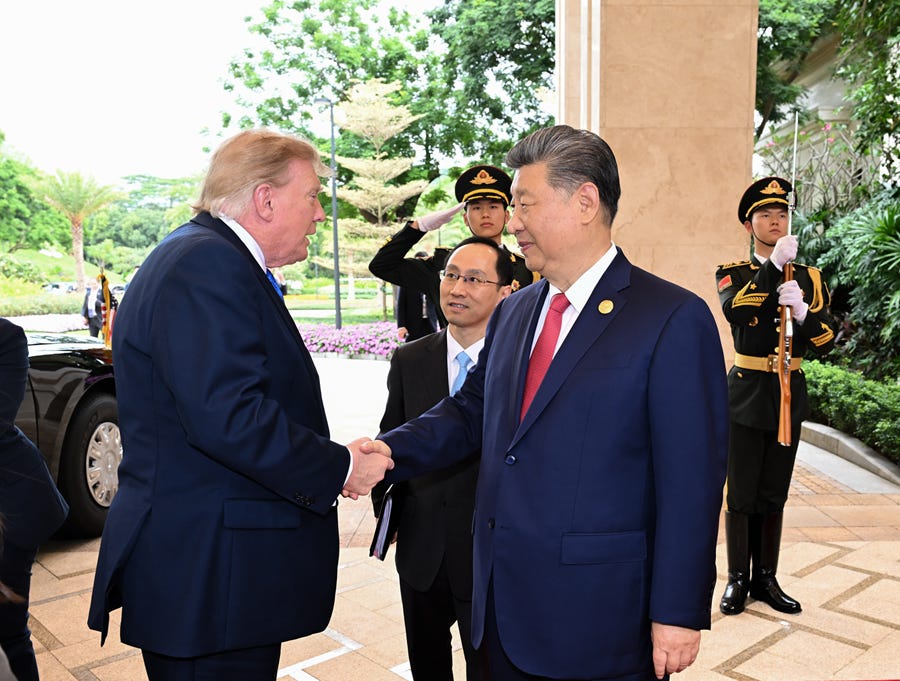
Xi Jinping noted that over the past few months, from Beijing to Washington, he and President Trump had jointly explored the right way for China and the United States, as two major countries, to get along. They had established a new positioning for bilateral relations as a “constructive strategic stability relationship between China and the United States,” giving it new substance based on “respect, fairness, and reciprocity.” This had won recognition from the people of both countries and been welcomed by the international community. China-U.S. relations had remained generally stable and continued to improve, bringing tangible benefits to the people of both countries while injecting stability and certainty into the world. Xi expressed his expectation of continuing to work with President Trump to steer China-U.S. relations and ensure that the ship of bilateral relations would always sail in the right direction.
Xi Jinping emphasized that building a constructive strategic stability relationship between China and the United States was an unprecedented and pioneering undertaking that required the courage to explore new approaches, a down-to-earth attitude, and a commitment to achieving concrete results. The guiding role of head-of-state diplomacy in China-U.S. relations is irreplaceable. The key to sustaining the current positive momentum in bilateral relations is to take concrete action to implement the understandings reached by the two presidents. Communication between the two sides’ teams must also keep pace. The two countries should expand the list of areas for cooperation and shorten the list of contentious issues. Differences that cannot be resolved immediately should be managed constructively to prevent tensions from escalating. On the Taiwan question, the United States should continue to do the right thing and avoid major disruptions to China-U.S. relations. In the economic and trade fields, the two sides should strengthen communication, address each other’s concerns, and strive for mutual benefit. Cooperation between the two countries in combating drug trafficking, repatriating illegal immigrants, and cracking down on telecommunications and online fraud has produced fruitful results. Such cooperation can be further strengthened on the basis of respect, fairness, and reciprocity. China and the United States should strengthen communication and coordination to guard against artificial intelligence safety risks and ensure that AI always remains under human control.
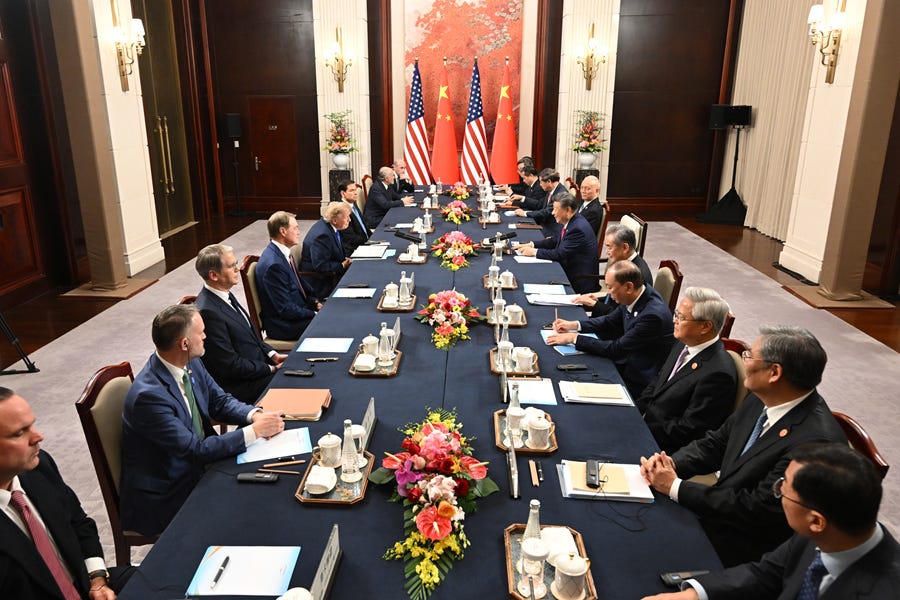
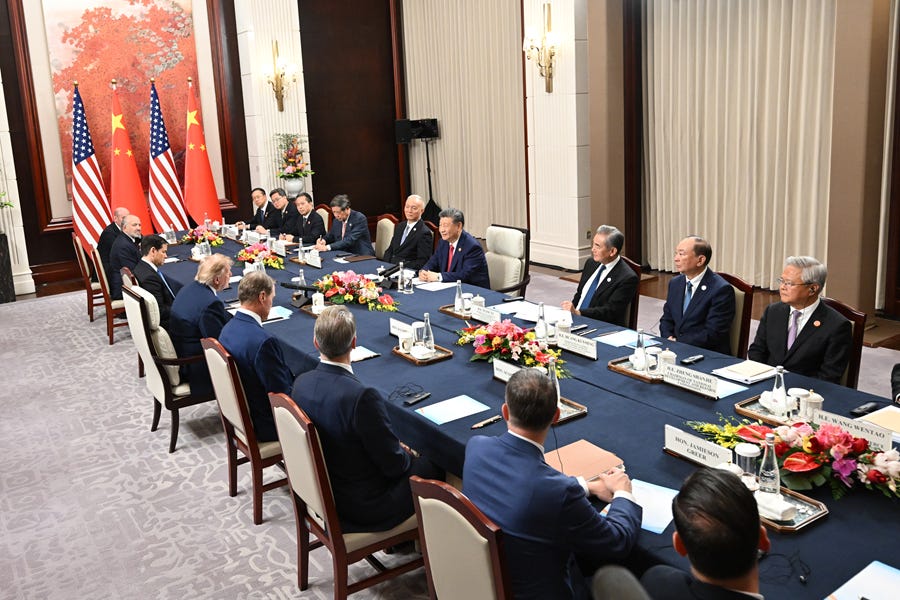
Trump expressed his sincere appreciation for the warm hospitality extended by the Chinese side. He said that U.S.-China relations had made remarkable progress over the more than four decades since the establishment of diplomatic relations. He had maintained close contact with President Xi, and their friendship had continued to deepen as they jointly guided the development of U.S.-China relations. Trade and investment ties between the two countries had continued to strengthen, and cooperation in areas such as fentanyl had yielded results. The two sides should maintain the momentum of stable development in U.S.-China relations, strengthen cooperation in areas including agricultural products, energy, and superintelligence, and address each other’s concerns fairly. The United States does not support “Taiwan independence.” Trump congratulated China on successfully hosting the APEC Economic Leaders’ Meeting. The United States is very powerful, and China is also very powerful. The two countries should work together to guide and promote world peace and stability.
Both sides considered the meeting positive and constructive and agreed to formulate an Action Plan for a Constructive Strategic Stability Relationship, implement the understandings reached by the two presidents, and build a constructive strategic stability relationship between China and the United States based on respect, fairness, and reciprocity.
The two presidents also exchanged views on international and regional issues of mutual concern.
Cai Qi, Wang Yi, He Lifeng, Huang Kunming, and other officials attended the meeting.