

For everyone following the Trump–Xi summit, President Trump has now arrived in Beijing and received a notably warm welcome at the airport. The Chinese official sent to receive him was Vice President Han Zheng.
For a long stretch after the founding of the PRC, airport receptions themselves were considered an important part of state diplomacy, especially when receiving leaders from socialist countries or major friendly states. It was not unusual in those years to see Mao Zedong, Liu Shaoqi, Zhu De, Zhou Enlai and other top Chinese leaders collectively appearing at the airport to greet visiting heads of state.
For example, when Soviet Presidium Chairman Kliment Voroshilov visited China in 1957, or when Indonesian President Sukarno visited in 1956, Mao, Liu Shaoqi, Zhu De and Zhou Enlai all went to the airport personally. At the time, Zhu De was serving as Vice President.
After the 1980s, China gradually standardized state visit protocol, and airport receptions were usually handled by officials such as vice foreign ministers. So when a sitting Chinese Vice President personally goes to the airport, it is generally viewed as a clear signal of elevated protocol treatment — something usually reserved for U.S. presidents.
There are several precedents. When Bill Clinton visited China in 1998, then–Vice President Hu Jintao greeted him at the airport.
And when Barack Obama visited China in 2009, the person greeting him was then–Vice President Xi.
Notably, when Trump visited China in 2017, he was received at the airport by then State Councilor Yang Jiechi rather than the then Vice President Li Yuanchao. But in terms of proximity to Xi’s core decision-making circle — and relevance to U.S.-China relations specifically — Yang Jiechi was clearly the more appropriate choice.
Tomorrow, Trump is also expected to visit the Temple of Heaven, and there are reports that Xi himself may accompany him. If the two leaders tour the Temple of Heaven together, it would likely set a precedent.
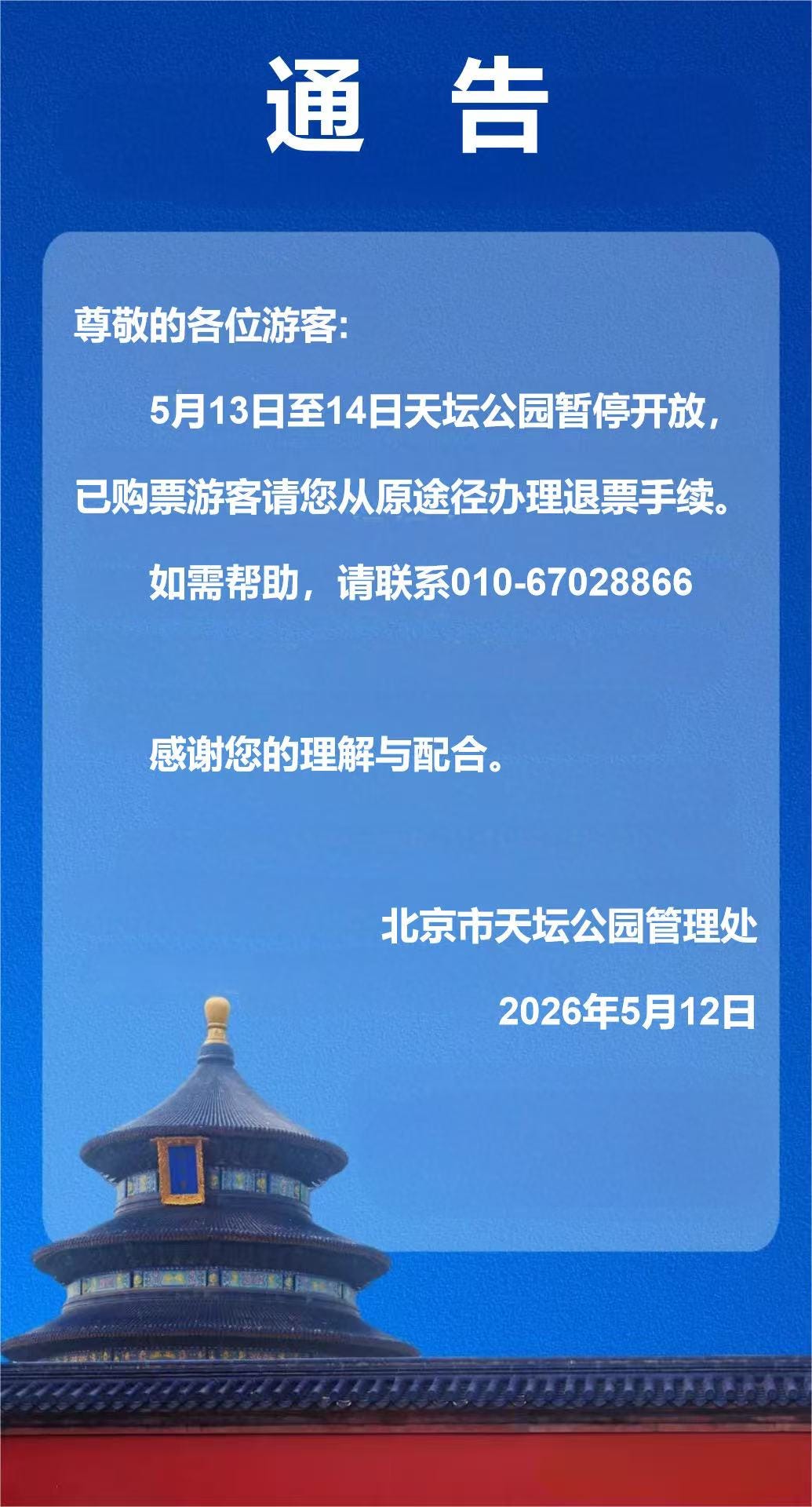
A few days ago, the Temple of Heaven authorities had already announced that the site would be closed to the public on May 14–15, and advised visitors who had already purchased tickets to apply for refunds.
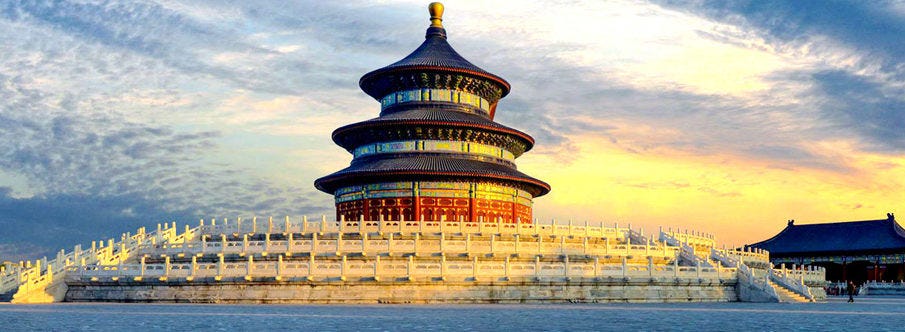
The Temple of Heaven was where the emperors of the Ming and Qing dynasties held annual ceremonies to worship Heaven and pray for good harvests. It is renowned for its rigorous architectural layout, unique structural design, and magnificent decorative artistry. Covering a total area of roughly 2.7 million square meters, the complex consists of an Inner Altar and an Outer Altar, and remains the largest surviving imperial sacrificial architecture complex in China.
Previous foreign dignitaries who visited the Temple of Heaven included U.S. President Gerald Ford, as well as Queen Elizabeth II and Prince Philip, the Duke of Edinburgh.
There’s a well-known anecdote from the Queen’s visit: after touring the Hall of Prayer for Good Harvests and already reaching the Gate of Prayer for Good Harvests, she reportedly said she still hadn’t seen enough of the “beautiful round hall” and wanted to walk back for another look.
But notably, all of these foreign leaders toured the Temple of Heaven on their own. None of them were accompanied there by China’s top leader at the time.
The Ming dynasty’s Da Ming Hui Dian (大明会典)— the institutional codebook of the empire — already contained provisions allowing foreign envoys to visit the Temple of Heaven:
“Special permission may be granted for envoys, accompanying officials, and several attendants to tour the suburban altars and the Imperial Academy, accompanied by protocol officials and guards, as a mark of distinction.”
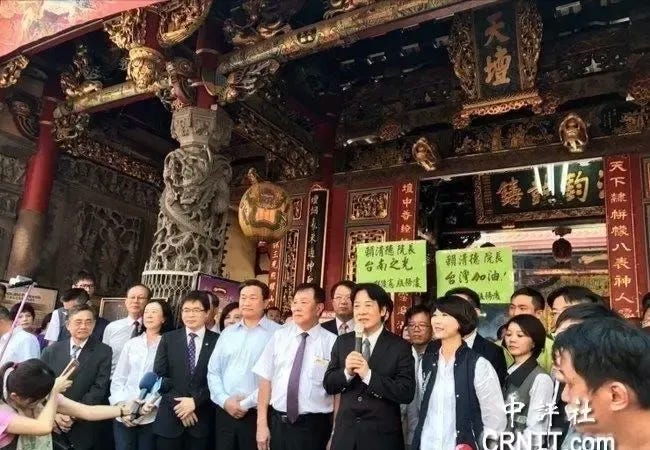
Taiwan, interestingly enough, also has its own “Temple of Heaven.” After Zheng Chenggong (Koxinga) retook Taiwan, a Temple of Heaven was established in Tainan. Ceremonies are still held there every year today — both to worship Heaven and to honor Zheng Chenggong. Even Lai Ching-te, despite often being criticized by mainland commentators as “forgetting his roots,” still attends the rituals. In fact, it was Lai himself who once said: “The Temple of Heaven is the spiritual center of Taiwan.”
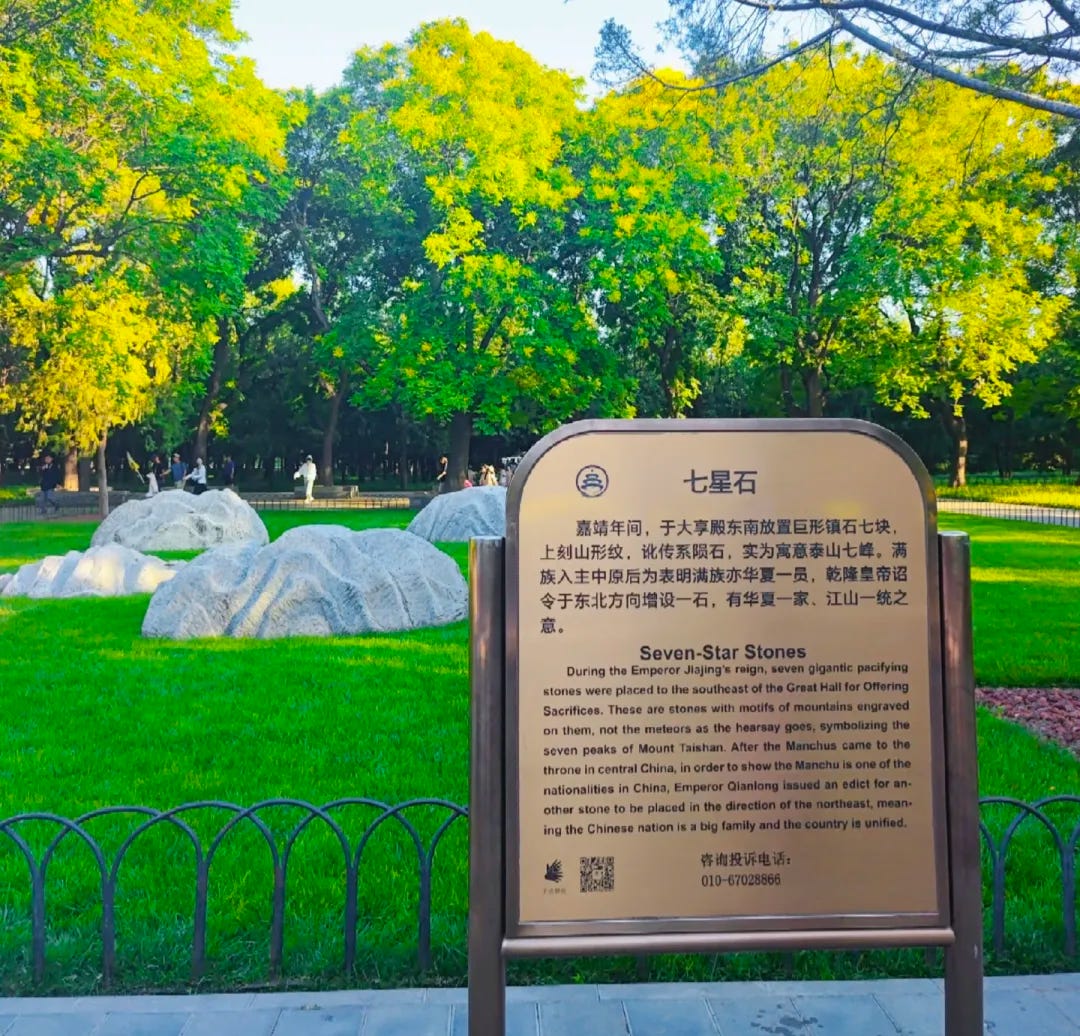
One more historical detail: Emperor Qianlong of the Qing dynasty ordered an additional stone to be placed beside the famous “Seven-Star Stones” at the Temple of Heaven, symbolizing the idea of “one unified Chinese civilization under one realm.”(华夏一家,江山一统)
The only problem this week is the weather — Beijing is getting surprisingly hot, around 34°C. Hopefully President Trump packed some short sleeves.
Of course, another major point of attention today was Jensen Huang.
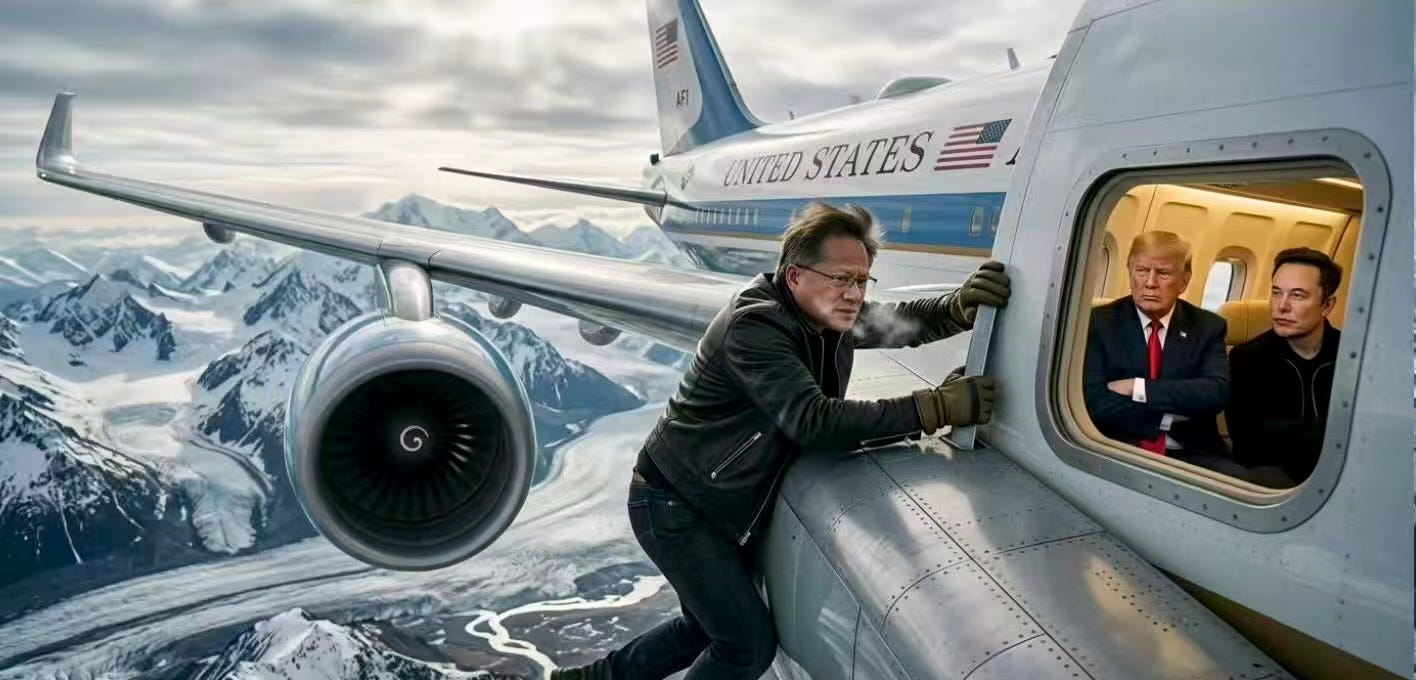
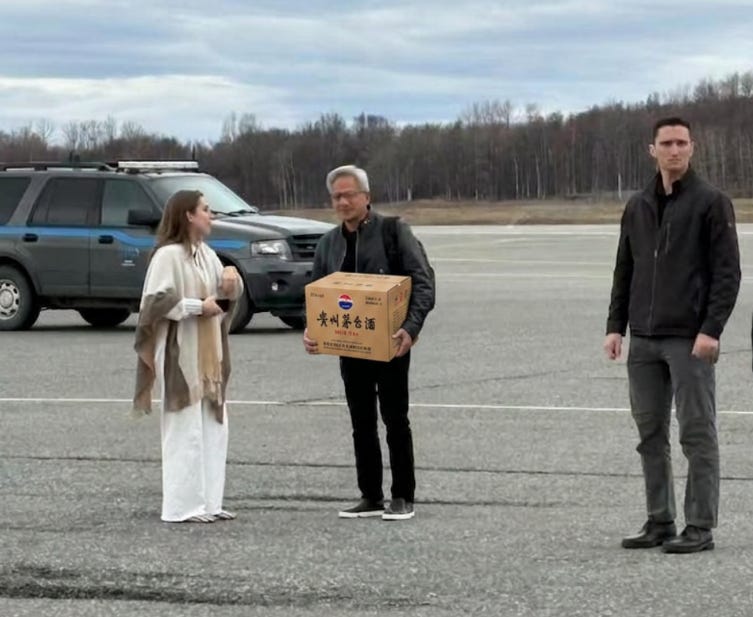
Jensen did not depart from Washington with the delegation. Instead, he reportedly boarded Air Force One during its refueling stop in Anchorage, Alaska. The detail was first spotted and posted on X by White House pool reporters, and was later confirmed by both the BBC and the South China Morning Post.
According to CNBC, after seeing widespread media reports claiming that Jensen Huang had not been invited, Trump personally called him and asked him to join the trip. Huang then reportedly flew separately to Alaska in order to catch Air Force One. Trump himself later posted a lengthy statement personally confirming that Huang had indeed been invited.
Semafor later reported that the White House had initially avoided inviting Huang in order to “avoid political awkwardness and tensions” while discussing semiconductor sales to China.
White House Communications Director Steven Cheung publicly downplayed the whole situation with a simple line:
“It just happened to work out.”
In any case, Jensen successfully made it onto the plane and is now traveling with the delegation to China — a development that immediately boosted Chinese AI-related stocks. Fueled by market expectations that Chinese model companies could gain greater access to advanced Nvidia chips, shares of MiniMax and Zhipu reportedly surged 18% and 38% respectively.
Chinese internet users, meanwhile, seem absolutely delighted by the whole thing, generating endless AI memes and parody images online.
Meanwhile, on May 13 local time in Seoul, Chinese Vice Premier He Lifeng and U.S. Treasury Secretary Scott Bessent held another round of economic and trade consultations. According to the official Chinese readout, the two sides — guided by the important consensus reached between the two heads of state and adhering to the principles of mutual respect, peaceful coexistence, and win-win cooperation — conducted “frank, in-depth, and constructive exchanges” on trade concerns and the further expansion of practical cooperation.