

CCP Readout
General Secretary Xi Jinping Meets with Kuomintang Chair Cheng Li-wun
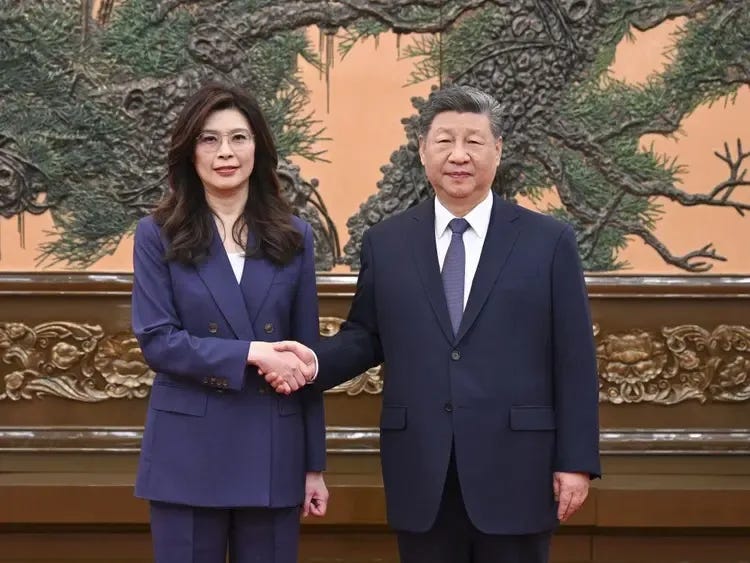
On the morning of the 10th, Xi Jinping, General Secretary of the CPC Central Committee, met in Beijing with a Kuomintang delegation led by Chairperson Cheng Li-wun.
Xi Jinping welcomed Cheng Li-wun and her delegation. He pointed out that the meeting between the leaders of the Communist Party of China and the Kuomintang, after a gap of ten years, is of great significance for relations between the two parties and for the development of cross-Strait relations. Compatriots on both sides of the Strait all belong to the Chinese nation. People of all ethnic groups, including Taiwan compatriots, jointly built a unified multi-ethnic state, jointly wrote the glorious history of China, jointly created the splendid Chinese civilization, and jointly fostered the great national spirit. They have also forged the shared conviction that the territory cannot be divided, the country cannot be thrown into disorder, the nation cannot be split apart, and civilization cannot be broken, guiding the Chinese nation in its unremitting self-strengthening and ensuring the continuity of Chinese civilization.
Xi Jinping stressed that no matter how the international situation or the situation in the Taiwan Strait may change, the overarching trend toward the great rejuvenation of the Chinese nation will not change, and the broad trend of compatriots on both sides of the Strait becoming closer, interacting more, and coming together will not change. Compatriots on both sides all hope for peace and stability in the Taiwan Strait, for improvement and development in cross-Strait relations, and for a better life. This is a responsibility that the CPC and the Kuomintang cannot shirk, and also the driving force for working together. On the common political basis of adhering to the “1992 Consensus” and opposing “Taiwan independence,” we are willing to strengthen exchanges and dialogue together with all political parties, groups, and people from all sectors in Taiwan, including the Kuomintang, in order to seek peace for the two sides, well-being for compatriots, and rejuvenation for the nation, and to keep the future of cross-Strait relations firmly in the hands of the Chinese people themselves.
Xi Jinping put forward four points of opinion on the development of cross-Strait relations.
First, uphold correct identification in order to promote spiritual affinity. Compatriots on both sides of the Strait share the same roots, language, ethnicity, and bloodline, and form a community with a shared destiny through thick and thin. When family members interact, so long as they speak frankly and consult more on matters, there are no contradictions or differences that cannot be resolved. Differences in social systems are not an excuse for division. The CPC and the Kuomintang, as well as compatriots on both sides of the Strait, should stand firm in their national position, inherit and promote Chinese culture, strengthen identification with the Chinese nation, Chinese culture, and the great motherland, and build the resolve, backbone, and confidence of being upright Chinese people.
Second, uphold peaceful development in order to safeguard the common home. The mainland and Taiwan both belong to one China, and China is the common home of the Chinese nation. Compatriots on both sides should protect and build this common home well. The foundation lies in adhering to the “1992 Consensus” and opposing “Taiwan independence,” and the core lies in recognizing that both sides of the Strait belong to one China. Harmony in the family leads to prosperity in all things. We welcome any proposition that is conducive to the peaceful development of cross-Strait relations, and we will do our utmost in anything that is conducive to that peaceful development. “Taiwan independence” is the chief culprit in undermining peace in the Taiwan Strait, and we will never condone or tolerate it. The CPC and the Kuomintang, as well as compatriots on both sides, should uphold the greater national cause, oppose separatism for “Taiwan independence” and external interference, promote the peaceful development of cross-Strait relations, and firmly safeguard the common home of the Chinese nation.
Third, uphold exchange and integration in order to improve people’s well-being. The goal of developing cross-Strait relations is to enable compatriots on both sides to live better lives. We will continue to uphold the concept that people on both sides are one family, and actively do practical, good, and helpful things for Taiwan compatriots. The mainland of the motherland has magnificent landscapes and a vast market. Taiwan compatriots are welcome to come home often, Taiwan youth are welcome to come to the mainland for exchange and development, and Taiwan agricultural, fishery, and quality products are welcome to enter households across the mainland. The CPC and the Kuomintang, along with compatriots on both sides, should jointly expand exchanges, contacts, and integration across the Strait, and enhance kinship and well-being for compatriots on both sides.
Fourth, uphold unity and struggle in order to realize the great rejuvenation of the Chinese nation. This year marks the 160th anniversary of the birth of Sun Yat-sen, whose lifelong pursuit was the revitalization of China and national reunification. Today, we have successfully embarked on a path of Chinese modernization, and the great rejuvenation of the Chinese nation is unstoppable. We firmly believe that more and more Taiwan compatriots will come to properly understand the mainland’s social system and development path, and will deeply recognize that Taiwan’s future development lies in a strong motherland, and that the interests and well-being of Taiwan compatriots are tied to the great rejuvenation of the Chinese nation. This year marks the opening year of the mainland’s 15th Five-Year Plan. We are willing to share development opportunities and outcome with the broad masses of Taiwan compatriots, and jointly strengthen the Chinese national economy. The CPC and the Kuomintang should consolidate political mutual trust, maintain positive interaction, unite compatriots on both sides of the Strait, and work hand in hand to create a bright future of national reunification and national rejuvenation.
Cheng Li-wun said that the people on both sides of the Strait are all descendants of the Yan and Huang Emperors, all belong to the Chinese nation, are all nurtured by Chinese culture, and are all Chinese and members of one family. They should work together to advance the cause of revitalizing China proposed by Sun Yat-sen. The CPC and the Kuomintang should, on the common political basis of adhering to the “1992 Consensus” and opposing “Taiwan independence,” strengthen political mutual trust, give full play to the function of the communication platform, commit themselves to preserving Chinese history and promoting Chinese culture, advance exchanges and cooperation across the Strait in such areas as civil society, grassroots communities, economy and trade, and culture, support youth exchange and development, improve the shared well-being of the people, promote the peaceful development of cross-Strait relations, create a bright future for cross-Strait relations, and realize the great rejuvenation of the Chinese nation.
Wang Huning, Cai Qi, and others attended the meeting.
KMT readout
Formal talks between the Kuomintang (KMT) and the Chinese Communist Party (CCP) resume after a decade
Chairwoman Cheng Li-wun calls for joint cross-strait efforts to develop institutions and initiatives that contribute to global peace
She envisions the Taiwan Strait as a channel that connects kinship and civilization, and as a symbol of safeguarding peace
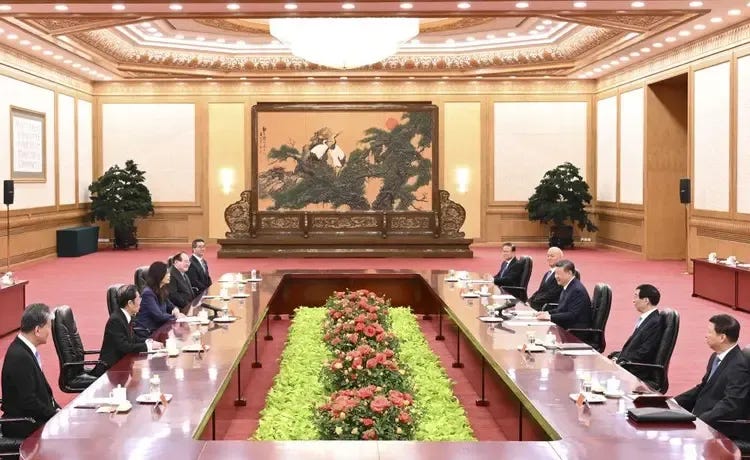
Chairwoman Cheng Li-wun of the Chinese Kuomintang (KMT) led a delegation this morning (April 10) to the Great Hall of the People in Beijing for formal party-to-party talks with the Central Committee of the CCP and General Secretary Xi Jinping. Reflecting on this first formal meeting between the two parties in a decade, Chairwoman Zheng stated that reconciliation and peace across the Taiwan Strait should be seen only as the starting point of joint efforts, and that both parties bear a greater responsibility and mission toward people on both sides of the Strait and all descendants of the Chinese nation.
Chairwoman Zheng expressed her firm belief that peace is a shared moral value across the Strait. She emphasized that both sides should move beyond political confrontation and work together to conceptualize and build a “community of shared destiny” characterized by mutual benefit and prosperity. She also called for exploring institutional solutions to prevent and avoid war, turning the Taiwan Strait into a model for the peaceful resolution of conflicts worldwide.
She further expressed hope that the KMT and CCP would jointly promote the institutionalization of cross-strait peace, and advance the planning and construction of structured and sustainable mechanisms for dialogue and cooperation. Such efforts, she noted, would help make peaceful development across the Strait irreversible and fundamentally eliminate the drivers of conflict.
Participants from the KMT side included Chairwoman Cheng Li-wun; Vice Chair and Secretary-General Lee Chien-lung; Vice Chairs Chang Jung-kung and Hsiao Hsu-tsen; Vice Chairman of the think tank Lee Hung-yuan; Presidium members of the Central Evaluation Committee Su Chi and Yuan Chien-sheng; Special Advisor to the Chair Lee Te-wei; Director of the Cultural and Communications Committee Yin Nai-ching; Director of the Mainland Affairs Department Chang Ya-ping; Director of the Youth Affairs Development Committee Lien Sheng-wu; Spokesperson Chiang Yi-chen; Director of the International Affairs Department Tung Chia-yu; and Central Party Affairs Advisor Lei Hung-yi.
Remarks of the two Presidents:
President Xi
Good afternoon. It is a great pleasure to meet you all at this time of spring blossoms. Yesterday felt like the drizzly Qingming season, but today the weather is bright and sunny—making this gathering all the more welcome.
fter a gap of ten years, the leaders of our two parties are meeting once again. Ten years have passed in what feels like the blink of an eye. Who was here at our last meeting? (Xi gestures toward Chang Jung-kung.) Yes, exactly. That is right.
This meeting is of great significance for the development of relations between our two parties and for the development of cross-Strait relations.
First of all, on behalf of the Central Committee of the Communist Party of China, I would like to extend a warm welcome to Chair Cheng Li-wun and the delegation on their visit.
Compatriots on both sides of the Taiwan Strait are all members of the Chinese nation. (Xi turns to Lee Chien-lung.) Eight generations in Quanzhou. (Lee is reportedly ancestrally from Anxi, Quanzhou, Fujian Province.) The Chinese nation, with more than 5,000 years of civilization, has been jointly built by all its people, including our compatriots in Taiwan. Together, we have opened up this vast land, established a unified multi-ethnic state, written a glorious history, created a rich and enduring civilization, and cultivated a great national spirit. This shared heritage has forged a deep sense that our territory must not be divided, our country must not fall into disorder, our nation must not be fragmented, and our civilization must not be interrupted. It has guided the Chinese nation in its continuous self-strengthening and ensured the enduring vitality of Chinese civilization.
Despite the many trials of history, our compatriots in Taiwan have never forgotten their roots on the mainland. Their hearts remain connected to the motherland and to the Chinese nation. Even during the painful period when Taiwan was occupied, people in Taiwan maintained a strong sense of Chinese identity and deep cultural attachment. Many made great sacrifices, even giving their lives, to demonstrate that they are an inseparable part of the Chinese nation. The shared roots and spirit of the Chinese people are carried in our blood, grounded in history, and embedded in our hearts—something that cannot be forgotten or erased.
Today, the world is undergoing profound changes unseen in a century. Yet no matter how the international situation evolves, the overall direction of human progress will not change, the great rejuvenation of the Chinese nation will not be halted, and the trend of closer interaction and connection between people on both sides of the Strait will continue. This is the course of history, and we have full confidence in it.
The world today is far from peaceful, and peace is all the more precious. People on both sides of the Strait are all Chinese—members of one family. We all seek peace, development, exchange, and cooperation. This is the shared aspiration of our people. The meeting between leaders of our two parties today is precisely to safeguard peace and stability in our common home, to promote the peaceful development of cross-Strait relations, and to ensure that future generations can share a better future.
We are willing, on the basis of upholding the 1992 Consensus and opposing “Taiwan independence,” to work together with all political parties in Taiwan—including the Kuomintang—as well as with people from all sectors of society, to strengthen exchanges and cooperation, promote peace across the Strait, improve the well-being of our compatriots, and advance national rejuvenation. The future of cross-Strait relations should firmly remain in the hands of the Chinese people themselves.
That is all I would like to say. I now look forward to hearing Chairperson Cheng Li-wun’s views.
President Cheng Li-wun
Respected General Secretary Xi Jinping and distinguished leaders, good afternoon:
Today, the leaders of your party and ours are able to gather together for dialogue after a full decade. At this very moment, I deeply feel that the eyes of global concern, as well as the heavy responsibility entrusted by history, are upon every one of us here. What we are facing together today is a highly turbulent and unsettled era, but also an era full of hope; an era in which conflict has spread more widely than at any time since the Second World War, yet it may also be an era in which all sides, after painful reflection, become determined to rebuild peace. The future direction of relations across the Taiwan Strait is a question we must face together.
There is no denying that in more than a century of interaction, relations between the Kuomintang and the Communist Party have been full of twists and turns. Yet what we have always pursued in common has been how to enable the Chinese nation to move from decline toward rejuvenation. Since our party chairman Lien Chan’s peace journey broke the ice in 2005, the two parties have approached the issue with a forward-looking historical vision, standing at the level of the nation and the times, and have committed themselves to promoting reconciliation and peaceful development across the Strait.
In fact, peace and reconciliation across the Strait should be only the starting point of the joint efforts of your party and ours. We bear an even greater responsibility and mission toward the people on both sides of the Strait and toward all descendants of the Yan and Huang Emperors. Therefore, the “great rejuvenation of the Chinese nation” should be a shared rejuvenation for people on both sides of the Strait; it is a renewed awakening and flourishing of the spirit of Chinese civilization, and also a compassionate vision of a world of great harmony, making a positive contribution to world peace and human progress. I firmly believe that this path of “revitalizing China” will surely inspire hearts and lead the times, and that this alone can be the shared value and common responsibility of both sides of the Strait.
Under the leadership of General Secretary Xi, the mainland’s development has not only achieved complete poverty alleviation and built a moderately prosperous society in all respects, with extraordinary accomplishments, but has also continued to soar. The 15th Five-Year Plan has just begun, and it will surely reach a new level, something worth looking forward to. Although people on both sides of the Strait live under different systems, we should respect one another and also move toward one another. I believe that peace is a shared moral principle and value across the Strait. Both sides should rise above political confrontation and jointly think through and build a “community of shared destiny” of mutual benefit and common prosperity across the Strait, and seek an institutional solution to prevent and avoid war, so that the Taiwan Strait may become a model for the peaceful resolution of conflict in the world.
Moreover, even though the world is becoming increasingly polarized and some values shared by humanity are gradually being cast aside, we will stand together in upholding the shared concept of sustainability for humankind. We should work hand in hand in areas such as new energy, disease prevention and control, and the ethics and application of artificial intelligence, using technology to serve human well-being and to promote sustainable development in the world.
I hope that through the tireless efforts of your party and ours, the Taiwan Strait will no longer be a focal point of potential conflict, nor will it become a chessboard for external intervention. The Taiwan Strait should be a strait that connects kinship, civilization, and hope, and a symbol of peace jointly safeguarded by Chinese people on both sides. We will show the world that people on both sides of the Strait who share Chinese civilization possess the highest wisdom to resolve difficult differences, and the greatest compassion to make crucial contributions to peace and development for humanity. Your party and ours should work together to build a modern civilization of the Chinese nation and set an example for the integration and prosperity of human civilizations.
I look forward to the Kuomintang and the Communist Party jointly promoting the institutionalization of peace across the Strait. On the common political foundation of adhering to the 1992 Consensus and opposing Taiwan independence, the two sides should further plan and establish institutionalized and sustainable mechanisms for dialogue and cooperation, so that peaceful development across the Strait becomes irreversible and all sources of conflict are fundamentally removed. We should work together to launch a “Chinese Civilization Rejuvenation Project”: taking Chinese culture as the foundation and harmony and coexistence as the core, the two sides should jointly study and promote various systems and initiatives that help eliminate disputes and create peace, and transform successful experience into a model that conflict regions around the world can learn from.
Therefore, at present, there are at least three directions in which both sides can work together:
First, to commit ourselves to preserving Chinese history and promoting Chinese culture:
The overwhelming majority of Taiwanese people’s ancestors crossed from the mainland to Taiwan; they bear Chinese surnames, speak Chinese, celebrate Chinese festivals, and worship Chinese deities. Over the centuries, migrants who moved to Taiwan from various parts of the mainland at different times have continuously enriched the Chinese cultural content of Taiwanese society. Chinese culture has always been part of Taiwan society’s very DNA, and it is practiced in the daily lives of Taiwanese people.
On the gravestones of many Taiwanese ancestors are inscribed their places of origin on the mainland, such as Yingchuan in Henan, or various places in Fujian Province, and so on. The deities worshipped in temples throughout Taiwan—such as the Yellow Emperor, Fuxi, Shennong, Guan Gong, and Mazu, as well as Baosheng Dadi, the Sacred King Who Opened Zhangzhou, Qingshui Patriarch, and the Kings of the Three Mountains—all originated on the mainland.
Therefore, the people on both sides of the Strait are all descendants of the Yan and Huang Emperors, all belong to the Chinese nation, and are all nourished by Chinese culture; we are one family. In modern history, from the standpoint of being Chinese, we have shared the experience of defending our homeland and resisting foreign invasion. By continually promoting these common roots, and reinforcing that the mainland and Taiwan belong to one nation, share one culture, and inherit the same historical memory, there will be no differences across the Strait that cannot be resolved, no emotional bonds that cannot be set aside, and only then can history move forward.
Second, to commit ourselves to enhancing shared well-being and promoting exchanges and cooperation:
In 2005, the Kuomintang and the Communist Party reached five common visions, opening a golden period of peaceful development in cross-Strait relations. Starting in 2006, think tanks from the two parties cooperated in holding eleven Cross-Strait Forums, putting forward more than one hundred common views and promoting cross-Strait economic, trade, and cultural exchanges and cooperation. During the Kuomintang’s eight years in office, the two sides signed 23 agreements, which continue to benefit people’s livelihoods on both sides to this day. This February, the think tanks of the two parties resumed the Cross-Strait Forum after a ten-year gap and reached fifteen common views, hoping to once again guide and advance public support for mutually beneficial integration across the Strait.
On the basis of these existing achievements, the two sides should actively promote grassroots exchanges and cooperation in economic and trade matters, culture, youth, and other fields and at all levels, continuously accumulating goodwill and deepening mutual understanding. People on both sides should travel more, make more friends, and strengthen industrial linkages so as to expand mutual benefit. By continually improving the shared well-being of both sides, we will create the strongest guarantee for the peaceful development of cross-Strait relations.
Taiwanese businesspeople and compatriots are important drivers of cross-Strait exchange and cooperation, bridges of mutual understanding between people on both sides, and the most important supporting force and supervising force for the peaceful development of cross-Strait relations. The Chinese Kuomintang has always cared about the well-being and rights protection of Taiwanese businesspeople and compatriots on the mainland. I look forward to, and believe, that in the future the mainland’s protection of the rights and interests of Taiwanese businesspeople and compatriots will certainly become even more complete.
Third, to commit ourselves to moving toward a better cross-Strait future and strengthening people’s livelihoods and well-being:
Human society is currently at the wealthiest stage in history, yet it is also an era in which development and distribution are the most unequal. The global geopolitical landscape is becoming increasingly volatile, and uncertainty in the global economy is rising accordingly. People on both sides of the Strait enjoy advanced technology and convenient lives, but the difficulties and challenges we face may also be unprecedented. I believe that no hardship or obstacle can stop the determination of people on both sides of the Strait to join hands in pursuing a better life.
Because of the closeness between the two sides in terms of geography, social patterns, cultural customs, and industrial structure, our experiences and strengths can complement each other and generate mutual benefit when dealing with modern challenges such as climate change, energy security, technology governance, and population aging. I hope the two sides can continue to strengthen exchanges and cooperation in several forward-looking fields, including energy conservation and carbon reduction, disaster prevention and mitigation, medical care and elder care, and artificial intelligence, so that together we can build a future vision that will surely help improve a community with a shared future for mankind.
The young people of both sides today are the generation in the history of the Chinese nation with the highest level of education, the broadest and deepest understanding of the world, the greatest vitality and creativity, and the clearest sense of how to use peaceful development to realize their talents. The hope of both sides lies in the youth. We should encourage young people to engage in more exchanges, explore life’s questions and development visions, and work together toward the future. When young people on both sides appreciate each other, inspire each other, and grow together, cross-Strait relations will continue to develop in a positive direction and endure over the long term.
On this trip, I take “peace across the Strait, benefiting people’s livelihoods” as my personal aspiration, and on this basis I would like to put forward the following five propositions:
First, to promote the peaceful development of cross-Strait relations:
The peaceful development of cross-Strait relations accords with the common wishes of the people on both sides and with the overall interests of the Chinese nation, and it must be firmly advanced.
Peace and development are basic human needs. People on both sides of the Strait should not stand in opposition to one another, but should live in harmony. Both sides, and both the Kuomintang and the Communist Party, have a responsibility to promote Chinese culture, to foster peace through exchange, to enhance development through cooperation, to institutionalize the peaceful development of cross-Strait relations, and to gradually achieve a peace framework.
Second, to seek the restoration of cross-Strait consultation mechanisms:
Cross-Strait consultation and contact mechanisms once played an indispensable role in peace and development for both sides, and they should be restored.
The laws and regulations on each side of the Strait both stipulate that the two sides are not state-to-state relations. In 1992, the authorized bodies of both sides reached a consensus that each side would express, by oral statement, its adherence to the one-China principle, while at the same time seeking common ground while reserving differences. This became the political foundation of cross-Strait consultation and contact mechanisms. Historical facts cannot be denied. On this basis, the consultation mechanism should be restored so as to build a virtuous cycle of goodwill.
Third, to maintain peace and stability in the Taiwan Strait and enhance mutual benefit across the Strait:
A peaceful and stable Taiwan Strait is what all parties in the region hope for, and mutually beneficial cross-Strait relations are what public opinion on both sides looks forward to. The two reinforce one another. The relevant provisions on both sides and international reality all reflect one China. On the basis of these provisions and realities, the two sides should cooperate with each other, handle differences, and consult on resolving the state of confrontation, thereby contributing to regional security. The 23 agreements on economic cooperation, including the three direct links and tariff reductions, have promoted common development and shared prosperity. Their results are clear for all to see, have been affirmed by all sectors on both sides, and should continue to be advanced on the basis of the shared political foundation so as to expand tangible benefits and strengthen public support for peace across the Strait.
Fourth, to expand Taiwan’s international participation space through political mutual trust:
Taiwan once participated in the World Health Assembly and the International Civil Aviation Organization Assembly in an appropriate manner on the basis of the 1992 Consensus, but later lost that opportunity.
In the future, once the two sides rebuild political mutual trust, they should work to enable Taiwan to return to the World Health Assembly and the International Civil Aviation Organization Assembly, and explore Taiwan’s participation in forums such as the General Assembly of INTERPOL. Regional economic integration bears directly on Taiwan’s economic development. Cross-Strait economic cooperation can be mutually reinforcing with Taiwan’s participation in regional economic integration, and the two sides should explore Taiwan’s accession to the Regional Comprehensive Economic Partnership and the Comprehensive and Progressive Agreement for Trans-Pacific Partnership.
Fifth, to continue giving full play to the communication platform between the Kuomintang and the Communist Party:
The communication platform between the Kuomintang and the Communist Party has always been a force for the right path in the peaceful development of cross-Strait relations and peace and stability in the Taiwan Strait, and it should continue to play its role.
The mechanisms of the platform, including high-level dialogue, think tank forums, youth exchanges, grassroots exchanges, and protections for Taiwanese businesspeople, have all played a leading and supportive role in opening up cross-Strait relations. At present and in the future, we should continue to use this platform to encourage exchanges, cooperation, communication, and consultation in various fields and at all levels across the Strait, so as to bring peace to the Taiwan Strait and greater well-being to the people.
Finally, I would like once again to thank the CPC Central Committee and General Secretary Xi for the invitation. Exchanges and interactions should naturally be reciprocal. I sincerely hope that one day in the future I may have the opportunity to be the host and welcome General Secretary Xi and everyone present here in Taiwan.
Thank you all.
Cheng Li-wun‘s press conference
Cheng Li-wun
First of all, I would like to express my sincere thanks to all our friends in the media for your hard work in covering this visit over the past few days. Since the day we arrived, everything has gone very smoothly. I am also deeply grateful to the Taiwan Work Office of the CPC Central Committee, as well as to our hosts in Jiangsu, Shanghai, and Beijing, for their thoughtful hospitality and the high level of reception they extended to us, which made every member of our delegation feel warmly welcomed and at ease.
Today was the centrepiece everyone had been waiting for. Early this morning, the weather was especially fine, with warm sunshine all around. In a way, it seemed to reflect the atmosphere of the meeting itself. After a gap of ten years, the leaders of our two parties met once again, and the meeting was marked by genuine feeling, candour, and sincerity. It fully demonstrated the shared aspiration, goodwill, and sincerity for peaceful development across the Strait.
This was precisely the outcome I had most sincerely hoped this visit would achieve: to send a clear message together to both sides of the Strait, to Taiwan, and to the world. Everything this morning therefore proceeded especially smoothly. About five minutes after I delivered my remarks, members of the media left the meeting room, so I would like to take this opportunity to offer a little further explanation.
In the talks that followed, I raised three main areas in which both sides can work together. The first is to preserve Chinese history and carry forward Chinese culture. The second is to enhance shared well-being and promote exchanges and cooperation. The third is to build a better cross-Strait future and improve people’s livelihoods and well-being.
During the meeting, I also put forward five proposals, guided by the aspiration for cross-Strait peace and better livelihoods. The first is to promote the peaceful development of cross-Strait relations. The second is to seek the restoration of cross-Strait consultation mechanisms. The third is to safeguard peace and stability in the Taiwan Strait and expand mutual benefit across the Strait. The fourth is to expand Taiwan’s space for international participation on the basis of political mutual trust. The fifth is to continue making good use of the communication platform between the Kuomintang and the Communist Party. We will provide our friends in the media with the full details later in a complete press release.
Today’s exchange was therefore very substantive. Over the ten years since contact was interrupted, as everyone has felt, cross-Strait relations have grown increasingly tense, and the cycle of ill will has only intensified. No one wants to see events take a negative turn. That is why I believe today’s meeting carries profound and critical significance. People on both sides of the Strait can have confidence that, so long as our starting point is sound and sincere, peaceful development across the Strait still holds every possibility for a positive and optimistic future. Today, an important first step has been taken, and what comes next will require the efforts of many more people working together.
Of course, the Chinese Kuomintang cannot shirk its responsibility. During this exchange visit, when I visited the Sun Yat-sen Mausoleum, I was especially struck by the Three Principles of the People, which are so familiar to us all: nationalism, democracy, and people’s livelihood. Yet at the mausoleum, it is people’s livelihood that is placed at the centre. When the mausoleum was built, the point that was especially emphasised was this: what are nationalism and democracy ultimately for? They are for people’s livelihood.
When we visited Shanghai, we also saw General Secretary Xi Jinping’s vision for the city: that it should be a “people’s city,” and that all of Shanghai’s development and prosperity should ultimately serve the people. In the same way, the reason we must work to resolve political division and confrontation across the Strait is also for the people, for their livelihoods, so that everyone may live a good life. The wish is really as simple and plain as that. Whatever obstacles may stand in our way, I believe that so long as our original intention is right, and so long as we persevere together, the future will surely bear fruit.
That is my brief report to you. I would now like to leave more time for your questions. Thank you.
China Times
Madam Chair, hello. This is a question from the Taiwan-based China Times. During this visit, you repeatedly mentioned the differences and divergences across the Strait. The outside world is also very concerned about whether, during the closed-door meeting this morning, you raised this issue with General Secretary Xi, especially the part about “one China, respective interpretations.”
In addition, the 1992 Consensus and the one-China principle have long been the common political foundation between the Kuomintang and the Communist Party. But it is also true that young people in Taiwan who are now in university or graduate school, as well as many first-time voters, were all born after the 1992 Consensus was reached. Most young people feel rather indifferent toward it. How will the Kuomintang show young people, or persuade party members, that the 1992 Consensus still stands the test of time and is not electoral poison? Thank you.
Cheng Li-wun
On the cross-Strait differences you mentioned at the outset, General Secretary Xi in fact addressed this point directly in the closed-door meeting just now. I took careful notes, although of course I was not able to record his remarks verbatim. Xinhua will issue a full report of the relevant content.
That in fact answers your question. He spoke specifically about the divergences you just mentioned, which I also referred to several times. He said these differences have deep historical roots, but he also stressed that we must proceed with patience and perseverance, in the spirit of Yu Gong moving mountains and Jingwei filling the sea. The freeze did not happen overnight, and it will not be resolved overnight either. But as long as there is open communication and a willingness to consult with one another, then everything can be discussed.
What struck me in particular was that General Secretary Xi said that, with regard to these cross-Strait differences, the Mainland respects the social system and way of life chosen by Taiwan compatriots, even though they differ from those on the Mainland. At the same time, he also expressed the hope that Taiwan would acknowledge the Mainland’s development achievements. This only underscores the need for more opportunities for exchange, more chances to know one another, and more opportunities to understand one another.
General Secretary Xi also stressed that meeting face to face is especially important, and that being able to see one another in person makes a very great difference. So I believe both sides share a strong common aspiration and common starting point: to narrow differences, deepen mutual understanding, expand mutual goodwill, and build greater mutual trust. These are all vital foundations for peaceful and stable cross-Strait relations in the future, and they are exactly the points I have repeatedly emphasised. As I have said, so long as something contributes to peace across the Strait, I am willing to do it; so long as a person contributes to peace across the Strait, I am willing to meet them.
General Secretary Xi also said that so long as a proposition is conducive to the peaceful development of cross-Strait relations, it should be pursued with full effort; and so long as a matter is conducive to the peaceful development of cross-Strait relations, it should likewise be pursued with full effort. This is therefore a goal and direction both sides are working toward together.
You also mentioned the 1992 Consensus and opposition to Taiwan independence. In my later remarks, I once again fully restated the substance of the 1992 Consensus. Let me think for a moment—I cannot quite remember whether General Secretary Xi said this during the meeting or over lunch—but he did specifically refer to the 1992 Consensus across the Strait. Because I had mentioned the Koo-Wang talks earlier in Shanghai, he brought that up as well, noting that those talks had in fact made the meaning of the 1992 Consensus very clear. General Secretary Xi then said that, unless one is deliberately pretending not to understand, one should not fail to see what the 1992 Consensus really means. There is therefore no need to maliciously distort it, still less to maliciously undermine reconciliation and the peaceful development of cross-Strait relations.
So, to your first point, today’s successful meeting has once again confirmed what I have been telling everyone over the past few months: that the one and only political foundation for cross-Strait exchange and dialogue is adherence to the 1992 Consensus and opposition to Taiwan independence. Of course, we must keep pace with the times by using language and forms of expression suited to the present moment, so that each generation of young people can understand the challenge we face at this stage, and understand how adherence to the 1992 Consensus and opposition to Taiwan independence can help avert war and tragedy, build peace together, and, on the basis of peace, pursue the greatest possible well-being for the people. I believe that should be the shared expectation and wish of any normal person—unless, of course, someone is intent on destroying peace, or has a special personal agenda and is willing to make the lives and property of the people of Taiwan the price of cross-Strait war. That is what we oppose, what we must stop, and what we must prevent. We hope the two sides of the Strait can be like today’s weather: calm, pleasant, and comfortable.
People’s Daily
Thank you. A question from People’s Daily. This morning, General Secretary Xi Jinping met with Chair Cheng Li-wun. What important significance do you think this has for promoting relations between the Kuomintang and the Communist Party and for the peaceful development of cross-Strait relations? Thank you.
Cheng Li-wun
I was especially grateful today that General Secretary Xi said that, on the same political foundation, the CPC Central Committee is willing to engage in exchange and dialogue not only with the Chinese Kuomintang, but with all political parties in Taiwan. I would therefore also like to say clearly that the Kuomintang and the Communist Party have a long and complicated history marked by both conflict and cooperation. The Chinese Kuomintang therefore naturally has an important responsibility to help resolve the grievances and entanglements between the two parties.
But when it comes to the peaceful development of cross-Strait relations, we also hope that all political parties in Taiwan will not treat this as a tool for party competition or vote-gathering. This issue rises above that level, because it is ultimately a choice between peace and war. I therefore very much hope that, on cross-Strait relations, all political parties in Taiwan can put aside their inter-party differences and work together for peace. General Secretary Xi also extended this significant goodwill just now. Such exchanges are absolutely not limited to the Kuomintang and the Communist Party alone. I believe this breadth of vision and openness is also something the Chinese Kuomintang very much welcomes.
We did not come here today for the private interests of one party. We came because we bear a historical responsibility, and because we cannot allow Taiwan and the Taiwan Strait to become a battlefield. So we are taking the lead. Once the road has begun to open, it will only become wider and smoother. Just as I said the other day at Yangshan Port, everyone is welcome to join; others may do even better and even more brilliantly than I have, and we would be glad to see that. So today, at a moment when the world had grown deeply pessimistic and no longer even dared to hope for anything from cross-Strait relations, the leaders of the Kuomintang and the Communist Party have shown the world that things are not as difficult as people imagine.
There was also one further point on which I felt particularly in tune with General Secretary Xi during the exchange: political leaders must not forget their original intention, and must not allow personal or partisan interests to blind them to the role political leaders ought to play and the responsibilities they ought to fulfil. I believe this is also something I have always expected of myself. At this moment, each of us is very small. But in the great arena and pivotal moments of history, one must make the right choice.
So in this process of exchange, I believe we have laid a foundation that will allow us to move ahead with greater confidence, no matter how complex and turbulent the global situation may become, and no matter what internal challenges may arise across the Strait. We must succeed; failure is not an option.
NBC
Thank you, Madam Chairwoman. When we spoke recently, you said that this trip was about seeking reconciliation with the Mainland as the best way forward for Taiwan. Having made this trip and having met with President Xi, would you now say that you share his goal of unification for Taiwan? Is that the way forward?
Cheng Li-wun
I think that, throughout today’s talks, what was truly highlighted and valued was the sense of kinship that comes from belonging to the Chinese nation. As I mentioned earlier, General Secretary Xi in fact recognised and respected Taiwan’s different way of life and system, and also hoped that this would be reciprocal—that Taiwan, too, would respect and acknowledge the Mainland’s development achievements. He also specifically said that he hopes there will be no conflict across the Strait, and that in the future both sides, as one family, can engage in more exchanges and grow closer to one another.
He also said that the freeze did not happen overnight. This requires a sustained process of effort, and it requires firm hope for the future, so that both sides may strive together in solidarity to realise the great rejuvenation of the Chinese nation. So, in this process, matters must be handled one by one, every issue addressed one by one, and the road walked step by step.
I think that, on this point, General Secretary Xi and I were both very pragmatic, and both hope to proceed step by step, just as I said earlier. At the very outset, General Secretary Xi in fact said that although social systems and political propositions may differ, our common ancestors and the bloodline of the nation cannot be severed; differences in social systems should not be used as an excuse for division.
I believe this was a very important expression of goodwill. We must face pragmatically the many differences that have arisen over the long course of cross-Strait history. But Taiwan’s achievements today and the Mainland’s achievements today are both great and remarkable achievements of the Chinese nation. We can appreciate one another, respect one another, and even learn from one another. In the future, there are even greater opportunities for cooperation, so that the achievements both sides have already attained may be expanded further, to benefit not only both sides of the Strait, but humanity as a whole.
So, in answer to your question, we hope to consolidate and strengthen a peaceful and stable relationship. On that basis, we should handle matters one by one and move forward steadily, step by step. Thank you.
China Review News
Thank you. A question from China Review News. Chair Cheng, hello. We know this is your first meeting with General Secretary Xi. At noon today, General Secretary Xi also hosted a special luncheon for you and the main members of the delegation. Could you share whether there were any details from that occasion that left a particularly deep impression on you? In addition, what important outcomes do you think this meeting achieved? Thank you.
Cheng Li-wun
I am of course very grateful for General Secretary Xi’s hospitality. We have just had a very warm luncheon. The first detail that left a particularly deep impression on me was the very first dish, because General Secretary Xi specifically said it was a Fujian dish—Fujian sea clam. This was the same dish that had been served at the state banquet when the Communist Party hosted President Nixon. He said that banquet had included two Fujian dishes, and one of them was this sea clam in chicken broth. The sea clam itself was very special. That was the first point.
The second is that General Secretary Xi was also very thoughtful and attentive to the members of our delegation. In particular, because I do not come to the Mainland very often, he asked whether I had adapted well over the past few days, whether I was in good health, and whether everything else was going smoothly. He also expressed particular concern for Chairman Lien Chan and Chairman Ma Ying-jeou, and asked us to pass on his regards and greetings to both of them. He especially recalled the Ma-Xi meeting at the time, as well as many details from Singapore. All of this gave us a very strong sense of warmth and familiarity.
Since we were also fortunate to have the Chairman of the National Development and Reform Commission present today, I specifically discussed the situation facing various sectors of Taiwanese industry, and whether there might in future be greater possibilities for alignment and cooperation. We talked about many things, including the ethnic minority group in Yunnan from which I come by birth, as well as various aspects of Taiwan’s Indigenous peoples.
So I felt that the entire conversation was very pleasant and very cordial. Thank you.
As for the achievements, I have actually already touched on them. First of all, the most important thing I hope to bring back to Taiwan is a message of peace. It is clear rather than vague, firm, and intended to continue over the long term. I believe that matters more than anything else. Beyond the issues we raised regarding Taiwanese industry, especially the situation facing traditional manufacturing and the services sector, General Secretary Xi also showed particular concern for our agricultural and fishery products. He specifically said that Taiwanese agricultural and fishery products are very welcome in the Mainland market. We also exchanged views on the expectations, conditions, and needs of different sectors in Taiwan. Thank you.
United Daily News
Chair Cheng, hello. A question from United Daily News. In your remarks, you said that you hoped to institutionalise the peaceful development of cross-Strait relations and gradually reach a framework for peace. Could you elaborate further on this concept of a peace framework? Also, in your remarks, you said you hoped to rebuild political mutual trust so that Taiwan could return to certain international organisations, and even join RCEP and the CPTPP. May I ask whether General Secretary Xi gave any concrete and positive response on these points during the closed-door meeting? Thank you.
Cheng Li-wun
In fact, General Secretary Xi’s response was especially positive. Beyond stressing our shared roots and common nationality, he said that so long as both sides achieve a meeting of minds—as I have already mentioned several times—everything can be discussed. He also stated specifically that the proposals and expectations I put forward in my remarks, every single one of them, could be actively and comprehensively studied, coordinated, and advanced. So, in our talks just now, I believe General Secretary Xi conveyed a very clear and highly positive message, and showed that he attaches great importance to Taiwan’s expectations and needs.
I should also add that he spoke specifically about Taiwanese businesspeople. Because he spent such a long time in Fujian, he knows many old friends among Taiwanese businesspeople there. He also places great importance on them. Our vice chairman quoted what General Secretary Xi had just said: with regard to the expectations we mentioned, he said he would attach great importance to them and actively consider them.
You also asked about the framework for peace. In fact, during Chairman Lien’s first Journey of Peace, many important foundations were already laid. On that basis, we have continued to work in that direction. But even more importantly, throughout this process—and General Secretary Xi referred repeatedly just now to much of the earlier history between the Kuomintang and the Communist Party, including more recent exchanges and the Xi-Ma meeting—he specifically said that we once had a very good opportunity, but unfortunately did not firmly seize it at the time. That is why, in my public remarks, I especially stressed that I hope a peaceful cross-Strait relationship can become irreversible and never move backwards.
That is why we hope for institutionalisation, and ultimately even the emergence of a cross-Strait peace framework. Once that uncertainty is removed, every possibility exists for securing a peaceful and stable future across the Strait. This requires efforts from both sides. Even more importantly, of course, we hope that the Kuomintang will return to office in 2028 and regain governing power, so that it can formally and officially represent the people of Taiwan in seeking with the Mainland the institutionalised and sustainable cross-Strait framework I have just mentioned.
We also hope that such an experience can be shared more broadly with the rest of the world, so that places where conflict may arise can draw on similar examples and experiences, turning swords into ploughshares and ensuring that war no longer takes place anywhere on earth. Thank you.
CTi News
Chair Cheng, hello. I am Chang Yang-hao from CTi News. Chair, I would like to ask: you just mentioned that, in your talks with President Xi, you raised the point that Taiwan’s space for international participation should be expanded on the basis of political mutual trust. I heard in your response just now that General Secretary Xi gave a fairly positive reply to that. Under such circumstances, does that mean these things can only be achieved after the Kuomintang comes to power? Or is it possible that, in the more immediate term, some of the county and city governments currently governed by the pan-blue/KMT camp could already carry out certain related cross-Strait exchanges?
Also, one report mentioned that, at the end of the meeting, you said you hoped that one day you might have the chance to serve as host in Taiwan and welcome everyone. Does that mean you have ambitions to move to an even higher position?
Cheng Li-wun
This is an exchange between the two parties. Today I came to the Mainland at the invitation of General Secretary Xi as the representative of the Kuomintang. So, in my capacity as Chair of the Kuomintang, I naturally also hope that, following another rotation of parties in government in the future, I may be able to invite General Secretary Xi to visit Taiwan, Penghu, Kinmen, and Matsu. So when I said that I hoped one day to serve as host in Taiwan, what I meant was simply that I genuinely look forward to, and hope for, an opportunity to invite General Secretary Xi and other leaders to Taiwan so that they may come and see it for themselves.
Phoenix TV
Chair, hello. I am Peng Shih-ting from Phoenix TV. I want to ask: since taking office, you have repeatedly stressed that you want to prove to the outside world that peace is a viable path, and one that can work. We also hope that through exchanges like this, many peace dividends can be created. But the problem is that, so long as the Kuomintang is not in power, those peace dividends are difficult to realise fully. So in the future, as the Kuomintang promotes these kinds of cross-Strait exchanges, how can it avoid having them manipulated by rival parties and still win the support of mainstream public opinion? How can that balance be struck? Thank you.
Cheng Li-wun
In fact, after I took office as party chair, all kinds of strange stories began circulating in Taiwan from various quarters. Many false accounts were fabricated, and many false messages were spread. That only exposed their unease and lack of confidence, as if they were deeply afraid that we might actually succeed in accomplishing these things, just as we have done today.
From the day I formally took office as party chair on 1 November until today, it has only been a little over four months. That is why I have repeatedly told everyone that this is not some distant and unattainable goal, nor is it something harder than ascending to heaven. I do not possess any extraordinary powers. I have stressed again and again that there are no other obstacles, no other demands, and no so-called “admission ticket” of the kind some people talk about. It comes down to one thing only: the 1992 Consensus and opposition to Taiwan independence.
Taiwan has sacrificed nothing, Taiwan has given up nothing, and yet we can already see spring returning, smiles on both sides, hands extended in greeting, and people sitting down together for exchange and dialogue. So many of the inner demons and obstacles people talk about have in fact been deliberately manufactured and manipulated.
I have also said that this will be a major electoral benefit for Taiwan. You may not all have felt it yourselves, but after ten years of interruption, with cross-Strait relations growing ever more tense and confrontational, many sectors have suffered unspeakably and have not even known whether their industries or family businesses could continue. That kind of pain and anxiety is not something politicians can brush aside with a few easy words. That is why I specifically stressed just now that all politics, in its original intention and proper breadth of mind, should take the people as its starting point.
In just these short four months, people from all walks of life and all sectors have come to see me. I have travelled all over Taiwan—I have lost count of how many times I have circled the island—and everywhere I have gone, people have consistently expressed their strong hope for peaceful exchange across the Strait, not to mention their unwillingness to see Taiwan’s next generation sent onto the battlefield. All of this will ultimately be reflected in votes.
Of course, in Taiwan, only by winning elections can we implement our political ideas and principles. That is a challenge the Kuomintang must face, and we are confronting this year’s election very seriously, with careful planning step by step. But I still want to say once again that I truly do not hope this becomes merely a calculation about elections and votes. This issue stands above that level. Yet in the face of the obstacles and opponents we may encounter, we must also overcome every difficulty and every challenge. Winning the people’s endorsement through their votes will allow the path of peace across the Strait to be pursued more steadily and more successfully.
TVBS
Chair Cheng, I am Feng Wei from TVBS. I would like to ask: just now you mentioned that you put forward five requests, and in the fourth point you spoke of expanding space for international participation. Did you raise that fourth point directly with General Secretary Xi? And was his reply positive? Secondly, there is a strong possibility that a Trump-Xi meeting will take place in May. In your remarks today, you also specifically said that you hope the Taiwan Strait will not become a chessboard for external interference. Did you exchange views with General Secretary Xi on that issue as well?
Cheng Li-wun
Regarding the fourth point, this is how I stated it: on the basis of the 1992 Consensus, Taiwan once participated, in an appropriate capacity, in the World Health Assembly and the International Civil Aviation Organization Assembly. Unfortunately, that opportunity was later lost. In the future, once political mutual trust has been rebuilt, efforts should be made to enable Taiwan to return to the World Health Assembly and the International Civil Aviation Organization Assembly, while also actively exploring Taiwan’s participation in the INTERPOL General Assembly.
In addition, regional economic integration bears directly on Taiwan’s economic development. Cross-Strait economic cooperation and Taiwan’s participation in regional economic integration can reinforce one another. Both sides may explore Taiwan’s accession to the Regional Comprehensive Economic Partnership, or RCEP, and the Comprehensive and Progressive Agreement for Trans-Pacific Partnership, or CPTPP. That was the substance of my remarks just now.
Taken as a whole, with regard to these and other requests and proposals we raised, as I said, General Secretary Xi viewed them and responded to them all very positively.
TVBS
And the Trump-Xi meeting?
Cheng Li-wun
No, that was not mentioned. That was not brought up.
Good stuff. I am a Malaysian with Chinese heritage, and we look forward to Taiwanese authorities to affirm it’s status as part of China, break off all formal and informal diplomatic relations with other countries other than through the government of China in Beijing. Please get this done within our lifetime.