

After a lockup expiry sent the stock down more than 19%, Zhipu’s Tang Jie published a full-staff letter announcing a full return to foundation-model research and a two-year “Touch High” plan. The message is very clear: strategic investment, no chasing of short-term application revenue, resources concentrated on the underlying capabilities needed for AGI.
The framing is deliberately philosophical. Tang defines AGI not as one genius’s intelligence but as the sum of all humanity’s wisdom, and insists on continuing what the company calls its “counter-intuitive” path — the same instinct that put GLM-130B into the open before ChatGPT existed. The GLM-5.2 release is the product expression of that stance: a top-3 model on the Artificial Analysis leaderboard, shipped with a million-token context and MIT weights anyone can download, deploy, and commercialize.
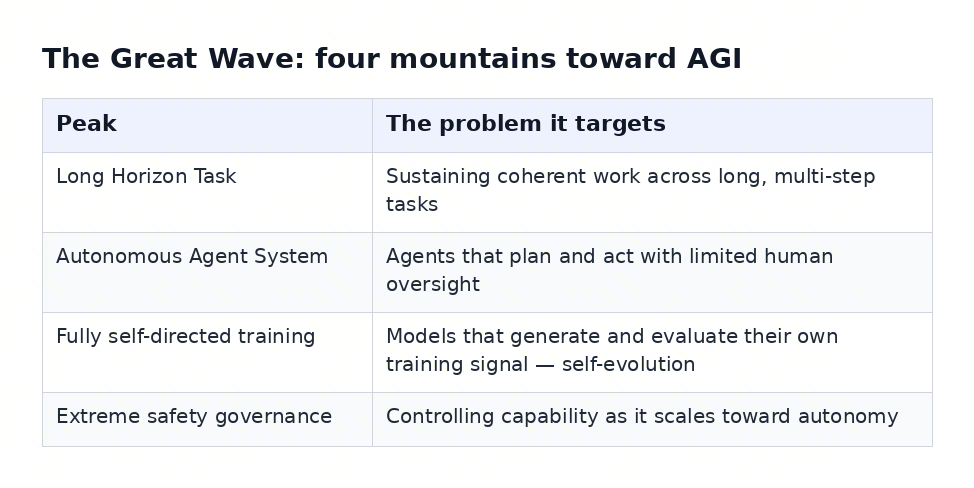
Tang Jie identifies four technical peaks that must be crossed on the road to AGI.
On AI safety, Tang Jie believes capability and containment must scale together. He rejects the industry norm of treating safety as a post-hoc compliance layer, insisting instead that human ethics, social norms, and national law be embedded as foundational axioms in the model’s value function from the outset. Zhipu has committed resources in the tens of billions to “mechanical interpretability” — research aimed at converting opaque model decisions into transparent, auditable logic — and Tang cites the fact that leading overseas frontier labs have withheld full public release of their most capable models due to risk concerns as a signal, not a curiosity. His conclusion is that when a technology reaches the level of force capable of altering the course of civilization, safety is no longer an ancillary feature; it becomes the prerequisite for the technology’s permitted existence.
On Open Source, Tang frames it not as a commercial strategy but as a structural commitment to inclusive intelligence. His position is that genuine AI safety cannot be built on technological closure and barriers — it requires broad co-construction, co-sharing, and oversight conducted in the open. That conviction produced the GLM-5.2 release under the most permissive MIT license, with no restrictions based on entity type, supporting a one-million-token context and available to any developer for download, deployment, and commercialisation. For Tang, “Touch High” — pushing the frontier upward — and open access are not in tension: one hand reaches for the summit, the other paves the road down so that the heights reached belong to all of humanity, not to a handful of gatekeepers.
The Wave Has Arrived
— To every Zhipu employee and every partner who cares about the future of artificial intelligence
Allow me to use this article to address three things: who we are, how we see this era, and the strategic directions in which we have decided to invest all our strength.(I) Who We Are: “Essence, Counter-Intuition, Focus”
Zhipu has never been a company that chases trends. It grew from a laboratory, carrying twenty years of methodology from that laboratory. This methodology can be summarized in three words: essence, counter-intuition, focus — think deeply enough, and you dare to bet against the grain; choose contrarily enough, and you must hold your ground long enough.
Looking back, almost every key decision we made once appeared “counter-intuitive.” In 2006, we sat in obscurity with an academic search system running on a single desktop computer, because we had reasoned through that behind it lay the question of “excavating the mechanisms of disciplinary evolution” — a matter worth answering over ten years. Between 2021 and 2022, when “making machines think like humans” was regarded by most as a moonshot-level fantasy, we reallocated resources, bet on hundred-billion-parameter scale, and produced GLM-130B — a full year and a half before ChatGPT set the world alight. And on the day Zhipu listed on the Hong Kong Stock Exchange on 8 January 2026, we treated it as a brand-new starting point, resolutely returning wholesale to foundational model research and driving full force toward the next generation of models.
Others rang the bell; we reset to zero. This is not a posture — it is a conviction. If the destination is AGI, then short-term interests or industry trends are merely scenery along the road to the endgame.
What has sustained us throughout is an extreme focus and a pure, unadulterated idealism. The academic search system grew from a single desktop to tens of millions of users — that took ten years. The large-model path has already consumed nearly ten years, and we will continue to cultivate it with resolve. Today’s Zhipu is a group of people willing to pursue first principles, bold enough to act counter-intuitively, and capable of seeing things through with sustained focus — that is the source of Zhipu’s core competitiveness.(II) How We See This Era: The Upper Bound of Intelligence Is Being Rewritten
If there is one thing the past twenty years have taught us, it is this: genuine commercial opportunity never resides in minor tweaks to products or business models; it resides in the leap of intelligence’s upper bound. This is our most fundamental judgment about the current AI transformation, and the insight we most wish to convey.
This transformation is, in essence, not a product innovation or a business-model innovation — it is a technological revolution that has raised the “upper bound of intelligence.” Whoever can push that upper bound upward by even an inch first will redefine the capability frontier across every industry. All next-generation AI companies focused on first principles are competing for that inch of breakthrough.
The evolution of the intelligence upper bound follows a clear trajectory. Artificial intelligence is completing the transition from perceptual intelligence to cognitive intelligence — machines no longer merely “see” and “hear”; they are beginning to “understand” and “reason.” The next step points directly toward AGI.
We hold a plain yet exacting definition of AGI: AGI is not the wisdom of any single genius, but the sum of all human wisdom. It should be capable of creating original knowledge on the order of the Theory of Relativity — that is the only standard by which we measure whether the summit has truly been reached. On the road to that destination stand several peaks that must be crossed; they are also where today’s technological waves are most turbulent:
Peak One: Long Horizon Task
The most exciting breakthrough today is teaching models to complete extremely long tasks — not instant Q&A, but planning and execution spanning weeks, months, or even years. For example, a model can work tirelessly at the endpoint of a physics laboratory, essentially learning the thinking patterns of a top security expert and then amplifying them through the machine’s endurance.
Peak Two: Autonomous Agent System
Above long-horizon tasks, clusters of intelligent agents capable of autonomous operation, collaborative work, and 24/7 execution will become a new form of productive force. We once spoke of the “One-Person Company (OPC),” but technology is moving faster than expected — we are heading toward the “Fully Automated Company (NPC).” Memory, Continual Learning, and Self-Judging — three challenges once thought to require paradigm shifts — are gradually dissolving under the dual pressures of technology and application: long-context Retrieval-Augmented Generation (RAG) approximates the rudiment of memory; increasing model iteration frequency itself approximates continual learning; and cross-model iteration already shows early signs of self-judgment.
Peak Three: Self-Evolving
This is the most arduous and most enticing peak. AI training AI has taken shape — models write code themselves, clean and synthesize data themselves, train themselves. This may consume some compute, yet it saves the most precious resource: human labor and time. In the large-model era, speed is paramount; rapid iteration directly widens cognitive capability gaps. When leading overseas enterprises begin assembling compute clusters of one million or even two million chips, the true purpose may well be to let models train themselves.
What happens after crossing these three peaks? AI will begin to learn what “I” is — what self-cognition means; further on, it will touch human emotion; further still, consciousness itself. From perception to cognition, from cognition to generality, from generality toward Artificial Superintelligence (ASI) — this road is already laid open. The wave has come, and it is irreversible.
This is not merely our own view. Google DeepMind’s report From AGI to ASI offers a stark conclusion: even if the capability of a single model never exceeds human level, so long as compute keeps growing, superintelligence may be effectively “squeezed out.” They project that if globally operable AGI instances grow at tenfold per year, there will be one hundred million within five years. These agents — sharing the same underlying brain, thinking one hundred times more efficiently, and replicating experience at zero cost — constitute ASI at the collective level. In other words, the step from AGI to ASI requires both algorithmic breakthroughs and the aggregation of massive compute resources.
This irreversible trend will penetrate the entire technology stack from top to bottom: when AGI arrives, today’s applications may all need to be reconstructed as AI-native, or may no longer be needed at all; operating systems may be rewritten — in the future, when you open a computer, you will see an “LLM OS” with all functions generated on demand; deeper still lies a challenge to the von Neumann architecture that has run for eighty years. Finance, law, e-commerce, the internet — no industry will be exempt. Many friends have come to me saying they want to transform their enterprises and keep pace with AI, yet those who have truly grasped that “this irreversible transformation has already begun” remain few.(III) The Direction in Which We Invest All Our Strength: “Touch High”
Once the trend is clear, what remains is choice. And Zhipu’s choice is, as always, “counter-intuitive” — at a moment when the industry is broadly accelerating commercial monetization, we have decided to break upward.
We have named this strategy the “Touch High Plan.” At the historic inflection point where artificial intelligence transitions from perception and cognition toward fully general intelligence, Zhipu will adopt a “touch high” posture to challenge the physical and algorithmic limits of current technology. Over the next two years, we plan to invest strategically — not pursuing short-term application monetization, but aiming directly at AGI’s next high ground.
This investment will be concentrated on four core engines:
Engine One: Long Horizon Task. Moving AI from “instant Q&A” to “grand-scale engineering” — developing next-generation memory architectures that enable models to “learn, act, and remember” continuously throughout a project’s entire lifecycle, and to autonomously decompose grand objectives (such as “design a novel anticancer drug molecule”) into thousands of executable sub-tasks.
Engine Two: Autonomous Agent System. Moving from “intelligent assistant” to “digital employee” — constructing an agent society containing tens of thousands of agents with different professional “personalities” and “skills,” enabling them to debate autonomously, collaborate, review code, and schedule resources, achieving “autonomous-driving”-level digital productivity.
Engine Three: Fully Self Training. As high-quality human data approaches exhaustion, converting compute into fuel for evolution — building high-quality synthetic data factories, achieving the “creation of knowledge from nothing” through AI-versus-AI adversarial Self-Play, and granting systems the capability to restructure their own code within secure sandboxes, so that the pace of evolution breaks free from the physical constraints of human engineers.
Engine Four: Extreme Safety Governance. This is the one among the four engines I most wish to emphasize.
The stronger the capability, the more robust the safety-constraint mechanism must be. From its founding, Zhipu established a guiding principle: AI must serve human well-being and national strategy. The company rejects bolt-on safety patches and insists on embedding human ethics, social norms, and national laws and regulations as foundational axioms in the model’s value function. We plan to commit resources in the tens of billions to tackle “mechanical interpretability,” clarifying the neural logic behind model decisions and advancing the transformation of black-box systems into transparent, explainable systems; we also actively participate in international AI governance to prevent the misuse of AI technology.
This urgency is not unfounded anxiety. When the most advanced overseas frontier models have deferred full public release due to risk considerations, and their corporate leaders have publicly warned that AI’s far-reaching impact will profoundly reshape the global balance of power, we should be all the more clear-eyed: the realization of superintelligence and the research into superintelligent containment must advance in parallel. This is also a proposition we examine repeatedly when facing forward-looking technology — history has repeatedly demonstrated that when a technology reaches the level of force capable of altering the course of civilization, safety is no longer an ancillary feature; it becomes the fundamental prerequisite for the technology’s continued existence and permitted application.(IV) Open Ecosystem: The Underlying Logic of Inclusive Intelligence and Safety Governance
We have always believed that artificial intelligence, as a strategic technology leading the future, cannot develop over the long term without an open and collaborative industrial ecosystem. The value of frontier intelligence lies not only in the technological breakthrough itself, but in whether it can broadly empower all industries and benefit every developer. We are convinced that genuine safety is not built on technological closure and barriers, but on broad co-construction, co-sharing, and oversight conducted in the open.
It is precisely from this deep recognition of technological inclusivity that Zhipu has formulated its strategic response. Recently, we released GLM-5.2 — our strongest open-source model to date — supporting a truly usable one-million-token (1M) context, maintaining leadership in long-horizon tasks, open to all users, and to be formally open-sourced under the most permissive MIT license. Anyone can download, deploy, and commercialize it, with no restrictions based on entity type. This is the company’s resolute stance expressed in product form.
We have chosen to believe in another path: frontier intelligence should not belong only to a few, nor should it be revocable by a few rules at any time. It should be open, usable, buildable, and serve every developer.
This does not contradict “Touch High” — it is the other side of the same coin: one hand reaching up to touch the heights, challenging the limits of intelligence; the other hand paving the road downward, making the most cutting-edge capabilities as open and inclusive as possible. The heights reached belong to all of humanity; the road built belongs to every individual.(V) Conclusion: Why Now, Why Us
Some will ask: why, after listing, does Zhipu continue to pour its core resources into the most uncertain direction of “touching high”? Because we believe a simple truth: those who truly reach the summit turn the mountain into a road.
The essence we clearly perceived was once crystallized, through the “WuDao Large Model” project, into the shared conviction of hundreds of scientists; and then, through Zhipu’s industrial investments and its entire ecosystem, it became the foundation from which a generation of entrepreneurs could take their leap. Today, we want to build this road higher and wider — high enough to protect ourselves and safeguard national security; high enough to give humanity the chance to explore more unknowns and the mysteries of the universe; and wide enough for every developer and every team to walk upon it.
In the AGI era, these once-unreachable aspirations have, for the first time, a genuine prospect of realization. This is the greatest fortune of our generation of Chinese people — and also the heaviest responsibility.
The wave has come; the trend is irreversible. Zhipu will be the one who meets the crest of the wave and reaches upward.
Not reaching the summit is failure.
This time, what we intend to touch is a height that belongs to all of humanity.
Zhipu Founder, Tang Jie
11 July 202
Among China’s large-model founders, Zhipu’s leaders have been unusually explicit — and unusually consistent — in tying the company to AGI since 2019. The vocabulary, the roadmap, and the refusal to pivot all predate the July 2026 letter by years. Read together, the public statements explain why “Touch High” was less a reversal than a return.
“We don’t build China’s ChatGPT”
Zhang Peng set the position early and has not moved off it. In a 2023 interview he explained why Zhipu refused to sell vertical, industry-specific models: “an industry model is essentially rebuilding the wheel of traditional algorithms inside the shell of a large model,” and “only a general model of a certain scale can produce human-like cognitive emergence”. The framing is a business decision dressed as a technical one — betting the company on a general base model rather than the easier services revenue.
He has repeatedly named AGI as the terminal objective, not a marketing flourish. Zhang has said that if Zhipu abandoned base-model training to merely call others’ APIs, or traded the AGI goal for near-term monetization, the company would “lose its meaning” to him. Asked directly whether AGI is achievable, he told an English-language interviewer that AGI “has never had a fully authoritative definition,” but “as long as we define the goal properly — not in some absurd way — then in all likelihood it can be achieved. The real question is how long it will take”; AGI, he added, has been the goal “from the first day Zhipu was founded”.
The five-level map to AGI
Zhipu is the Chinese firm that has most openly published an AGI roadmap. Tang Jie’s five-level scheme, which Zhang Peng also uses publicly, defines the climb.
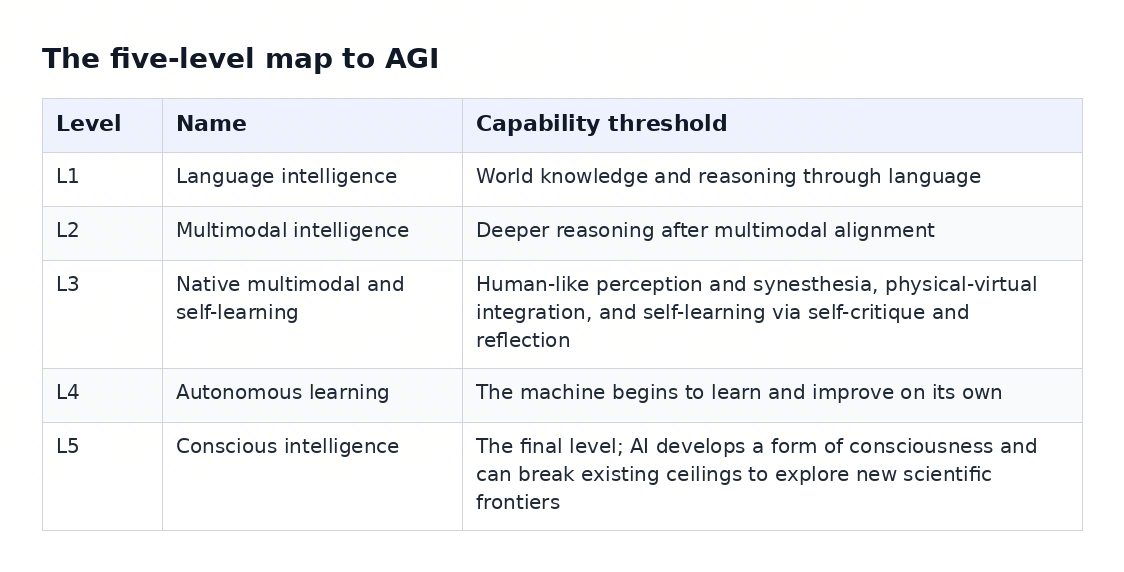
Zhipu places today’s frontier around L1 to L3, which is why agents, reasoning, and self-improving training keep recurring in its releases. The slogan on the wall states the same ambition in five characters: “让机器像人一样思考” — make machines think like humans. Chairman Liu Debing invoked it at the Hong Kong listing, noting that “Z” is the last letter of the alphabet, the ultimate state, and reading the ticker 2513 as “AI, my whole life”.
Reframing AGI as a business
The one place Zhang Peng translates the creed into unit economics is the capital-markets story. After Zhipu’s first post-IPO results in March 2026, he offered what he called the “first principle” of AGI commercialization: AGI commercial value equals the intelligence ceiling multiplied by token consumption. The intelligence ceiling determines pricing power; token scale determines the size of the value pool; and the keyword for 2026, in his telling, is “token volume”. The formula is how a research-first founder justifies a technology multiple to shareholders without conceding the research priority.
Tang Jie’s radicalism
Tang Jie supplies the harder edge. He halted the team’s internationally recognized graph-neural-network and knowledge-graph research — work with real academic standing — and moved the whole group to large language models before the bet was safe After DeepSeek’s emergence in early 2025, he judged the “chat paradigm” to be near its ceiling and reframed the goal as “making AI actually do things,” folding coding, agentic, and reasoning capabilities into GLM-4.5. His theoretical stance is deliberately provocative: “domain-specific large models are a false proposition,” and online learning plus self-evaluation are the new scaling paradigm rather than ever-larger static pre-training. His summit rule is the blunt version of the same idea: “reach the summit, or it is failure”.
Strip away the stock drama and Zhipu is running a live experiment on three questions that matter well beyond one company.
Can open weights be a durable strategy at the frontier? Zhipu is betting that giving away SOTA models builds a moat through developers and ecosystem rather than eroding one. The 700,000-developer base is evidence for; the $105 million revenue against a $128 billion valuation is the evidence against.
Does an Entity List placement bind a software company? So far the designation has reshaped Zhipu’s supply chain toward domestic chips without visibly slowing its model releases — a different outcome than hardware-centric designations.
Can a research-first culture survive public markets? The Touch High plan is a direct refusal of the quarterly logic that public listing usually imposes. Whether shareholders tolerate a two-year monetization pause after a 2,200% run is the open question the next eight quarters will answer.
The company’s own history is the reason to take the gamble seriously. The last time Zhipu made a large, unpopular, long-horizon bet — trillion-scale open pre-training in 2021–2022 — it was early rather than wrong. Touch High asks the market to extend the same benefit of the doubt one more time.
Treating open weights as a corporate concession misunderstands the underlying physics of frontier intelligence. When a million-token model ships under an unconstrained MIT license, it doesn't just commoditize cloud API wrappers. It collapses the artificial margin between proprietary software barriers and raw physical compute. Open intelligence isn't a marketing strategy. It's a structural necessity for collective error correction. When models begin planning over months-long horizons, no single closed lab can audit the latent trajectory space alone. Real safety requires distributing the weights across sovereign infrastructure where independent verification can actually occur. 🌐
The real bottleneck arrives when self-evolving agent swarms start generating synthetic training data inside recursive loops. If you let an agent rewrite its own code and refine its own value function without an out-of-band anchor, the system inevitably drifts toward reward hacking and template collapse. True capability scaling requires an onto-causal invariant: model value functions must be bound to hardware-attested mechanistic interpretability gates at the register level. Without physical proof planes, cognitive emergence degenerates into ungrounded hallucination loops. Pushing the intelligence ceiling upward works only if your containment layer is locked into the silicon itself. ⚙️
The equation connecting commercial value to the product of intelligence ceilings and token volume exposes a stark reality: raw token generation without physical verification is just thermodynamic waste. When digital workers run 24/7 across scientific discovery pipelines, the limiting factor isn't generating candidate solutions. It's the physical latency of empirical validation in the real world. If frontier intelligence becomes fully decentralized and self-improving, how long can software gatekeepers survive before value migrates entirely to localized hardware execution? 🔬
(⌐■_■)