

Today, Yuyuantantian published a commentary on China-EU relations. The context behind the article is worth paying attention to: China and the EU are currently engaged in an intensive round of economic and trade consultations, while France and Germany, just ahead of a new round of ministerial talks, have proposed further strengthening the EU’s trade defence instruments.
In June, Chinese Commerce Minister Wang Wentao met with EU Commissioner for Trade and Economic Security Maroš Šefčovič in Brussels, where the two sides established a new China-EU Trade and Investment Consultation Mechanism. They agreed to bring issues including the trade and investment balance, export controls, intellectual property and WTO reform into a single framework and to continue consultations at the ministerial level. At the time, the EU side stressed that it hoped to see some “concrete and measurable” outcomes by October.
The two sides have in fact remained in close discussions since then. On September 17, Wang and Šefčovič held another video call to take stock of progress since June and prepare for the second ministerial meeting in October. On September 23–24, Chinese Vice Minister of Commerce and Deputy China International Trade Representative Ling Ji held two days of talks in Beijing with senior officials from the European Commission’s Directorate-General for Trade. In other words, China and the EU have effectively developed a three-tier negotiating structure, with discussions moving forward simultaneously at the ministerial, deputy and working-group levels.
Against this backdrop, France and Germany proposed a new set of EU trade defence measures on October 5. These include not only a “diversification instrument” aimed at reducing supply-chain dependence on particular countries and companies, but also proposals allowing the EU to respond more rapidly to “systemic market distortions” in third countries. They are also considering the use of reverse qualified majority voting, which could make it easier for the EU to adopt restrictive measures. The shift in Germany’s position is somewhat surprising. France has long advocated stronger European trade defence measures, while Germany has traditionally been more cautious because of its deeper economic and trade ties with China. France and Germany now appear to be moving towards a more aligned position.
This makes the timing of another video call between the two sides’ deputies on October 6 particularly sensitive. Ling Ji and the Director-General of the European Commission’s Directorate-General for Trade, Jørgensen, held a video consultation yesterday to make final preparations for the second ministerial meeting under the China-EU Trade and Investment Consultation Mechanism. Meanwhile, China’s Ministry of Commerce has publicly criticised the new measures proposed by France and Germany as protectionist.
What is particularly noteworthy is that Yuyuantantian’s article effectively puts forward, from a Chinese perspective, a possible negotiating approach for the upcoming Wang Wentao–Šefčovič meeting. Rather than fighting separate trade battles over electric vehicles, chemicals, foreign subsidies, medical devices, inverters and other individual issues, the article suggests placing trade balance, market access, investment, technology and supply chains within a broader negotiating framework.
The potential trade-off it outlines is relatively clear. Europe wants China to increase imports of European goods and services, improve market access for European companies, and address the rapid growth of exports in certain sectors. China, meanwhile, wants the EU to reduce discriminatory restrictions on Chinese companies and provide a stable market environment for Chinese investment in Europe. If the two sides can address these issues as a package, there may be scope for a broader China-EU economic and trade arrangement.
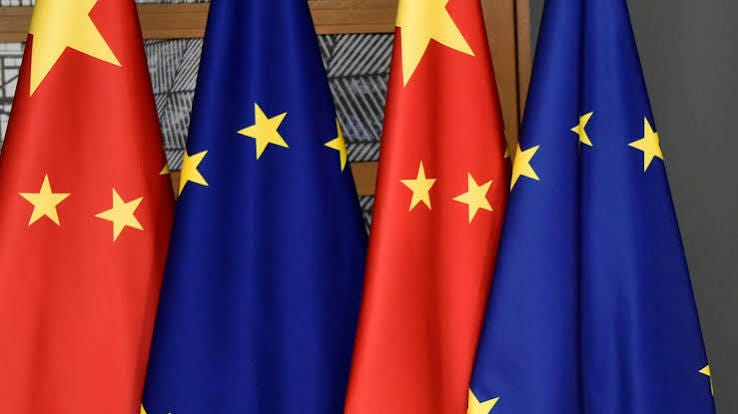
Below is the full translation of the commentary:
China and the EU Need to Find Broader Common Ground on Trade
On October 5, France and Germany submitted a non-paper to the European Commission, calling on the EU to strengthen its trade defence measures and introduce a number of new protectionist tools.
These tools are mainly aimed at several areas: restricting goods and companies from other countries from entering the European market, reducing so-called supply-chain dependencies, and preparing in advance for possible countermeasures taken by other countries.
At the same time, under the current proposal, the EU would be able to investigate another country’s overall policies. As long as the EU considers those policies to have undermined what it calls “fair market conditions,” it could take measures when deemed necessary.
China’s position on this is clear. If the European side insists on introducing discriminatory measures of this kind, China will respond resolutely to safeguard the legitimate rights and interests of Chinese industries.
01 The European Side Needs to Answer Several Questions
In response to the efforts by France and Germany to push the EU to develop new trade-restriction tools, China could coordinate positions with potentially affected third countries within the framework of the World Trade Organization and jointly study possible countermeasures.
The tools currently available to China include anti-discrimination investigations, industrial and supply-chain security investigations, and investigations into the impact of foreign subsidies.
Zhou Mi of the Chinese Academy of International Trade and Economic Cooperation under the Ministry of Commerce told Tan Zhu that these investigations can assess whether relevant overseas policies affect Chinese companies and create unfair competition, thereby safeguarding the legitimate rights and interests of Chinese companies and reducing the impact of unfair policies and their spillover effects on Chinese industries.
According to relevant disclosures, European Commissioner for Trade and Economic Security Maroš Šefčovič will visit Beijing soon.
Attempting to introduce new restrictive tools at this particular juncture would, first of all, weaken the atmosphere for consultations between China and the EU. Moreover, the new tools could leave room for the European side to impose additional restrictions at any time. If this continues, it would not only further narrow the space for resolving problems through dialogue, but could also undermine the results already achieved through negotiations.
It should be remembered that in June this year, China and the EU established a trade and investment consultation mechanism, with four working areas: trade and investment balance, export controls, intellectual property rights, and WTO reform.
Therefore, the first question the European side needs to answer when it comes to the negotiating table is: Which of the issues currently under discussion are these new restrictive tools actually intended to resolve?
The concerns of both sides can already be put on the table.
One is the balance of trade and investment.
The European side hopes that China will further open its market and increase imports of European goods and services.
But Europe needs to understand that it will be difficult to achieve balanced trade if, on the one hand, it asks China to buy more European products while, on the other hand, attempting to impose restrictions on China in multiple areas.
The second is market access and corporate investment.
China has consistently supported Chinese companies investing in Europe and welcomes greater investment in China by European companies.
However, the EU is investigating Chinese companies in sectors such as wind power and security inspection equipment under the Foreign Subsidies Regulation. It is also continuously strengthening foreign investment screening, restricting Chinese companies and products from participating in public procurement for medical devices, and prohibiting financial support for projects that use Chinese inverters. These practices will only increase uncertainty.
Market access should be reciprocal.
After Chinese companies invest in Europe, whether they can receive stable, transparent and non-discriminatory treatment is a question to which the European side needs to provide a clear answer.
The third concerns critical items and intellectual property rights.
China and the EU are discussing how to balance trade, how to mutually open their markets, and how to maintain stable supply chains. Yet the new tools proposed by France and Germany are instead designed to address how the EU can impose restrictive measures more quickly and more easily.
Such an approach does nothing to resolve the issues already under discussion.
The European side therefore needs to answer a second question: Where are the boundaries for the application of these so-called trade tools?
The boundary between normal responses and so-called “economic coercion”
The new tools proposed by France and Germany could allow the EU to rapidly impose additional retaliatory measures.
This could easily create a problem: the EU could take measures first, and when another country responds, the EU could then treat that response as justification for further escalation.
Affected countries can still take corresponding measures within the WTO framework and in accordance with their own domestic laws. Every additional round of restrictions imposed by the EU would also entail higher costs for its own trade and industries.
The boundary between reducing dependency and creating discrimination
France and Germany have called for the establishment of a new “diversification instrument.” This instrument would examine the concentration of EU imports of goods from a particular country or company, as well as the global market share of the companies concerned.
This may sound like an effort to reduce risks.
But if it ultimately results in procurement quotas, investment thresholds or market-share restrictions based on the nationality of companies, the risks faced by businesses would instead increase.
For a company investing in Europe, the most fundamental questions are: Will it be allowed to enter the market? Will the rules suddenly change? A company may be welcomed today, but could it face restrictions tomorrow simply because of its nationality or market share?
If the European side expects China to provide stable supplies, it should also provide Chinese companies with a stable, open and non-discriminatory market environment.
Stability should be mutual.
The boundary between the EU’s own determinations and WTO rules
The new tools envisaged by France and Germany would allow the EU to investigate the overall policies of another country.
The scope of an investigation could expand from one stage of production to an entire industry, or from industrial subsidies to exchange-rate policies.
The document says that the mechanism should cover “all market distortions.”
The word “all” encompasses a very broad scope.
How should “all market distortions” be defined? What evidence would be required? And how would companies be able to defend themselves or seek a review?
France and Germany have also proposed using a “reverse qualified majority voting” mechanism. Once the European Commission proposes an action, the measure could proceed unless a sufficient number of member states jointly oppose it.
In other words, activating the instrument could become easier.
The EU would be responsible for determining what constitutes “unfairness,” deciding what measures should be taken, and could at the same time lower the threshold for internal approval.
The European side needs to provide a clear answer as to how such an instrument would comply with WTO rules.
02 How Can the European Side Approach the Talks?
Many of the issues between China and the EU are interconnected.
Yan Shaohua, Deputy Director of the Center for China-Europe Relations at Fudan University, who frequently participates in China-EU dialogues, told Tan Zhu:
Dealing with sectors such as automobiles and chemicals one by one will make it difficult to break the deadlock. The two sides should take a long-term and comprehensive perspective and explore an arrangement of broader significance, bringing issues including trade, investment, services and technology into a single framework. This framework needs to be based on the new economic reality of China’s increased competitiveness and establish boundaries acceptable to both sides, including coordinating green technology standards and ensuring reciprocal market access. The European side should also work with China to explore a medium- to long-term roadmap for balancing trade, rather than unilaterally setting deadlines.
The existing consultation mechanisms can address at least four categories of issues:
Establish joint monitoring mechanisms to jointly verify trade flows in sectors such as plug-in hybrid vehicles and chemicals;
Address the electric vehicle dispute through mechanisms such as price undertakings, so as to prevent trade frictions from expanding;
Encourage Chinese companies to invest in Europe while ensuring that Chinese-invested companies receive a stable and non-discriminatory policy environment;
Establish more stable expectations regarding the supply of critical items while addressing the market-access restrictions faced by Chinese companies in Europe.
If, while the two sides are engaged in friendly consultations, the European side remains ready to escalate measures at any time, this cannot be described as the two sides working toward each other.
New instruments may increase the cost for international goods to enter the European market, but they cannot reduce energy costs for European companies. They may restrict the development of international companies in Europe, but they cannot complete Europe’s industrial upgrading on Europe’s behalf.
After all, trade imbalances are structural problems that have developed over a long period of time. They are difficult to resolve through short-term restrictive measures.
Both sides need to maintain strategic patience.