

On February 24, Chris Xu (许仰天), founder of SHEIN, attended the Guangdong High-Quality Development Conference in Guangzhou and delivered a speech.
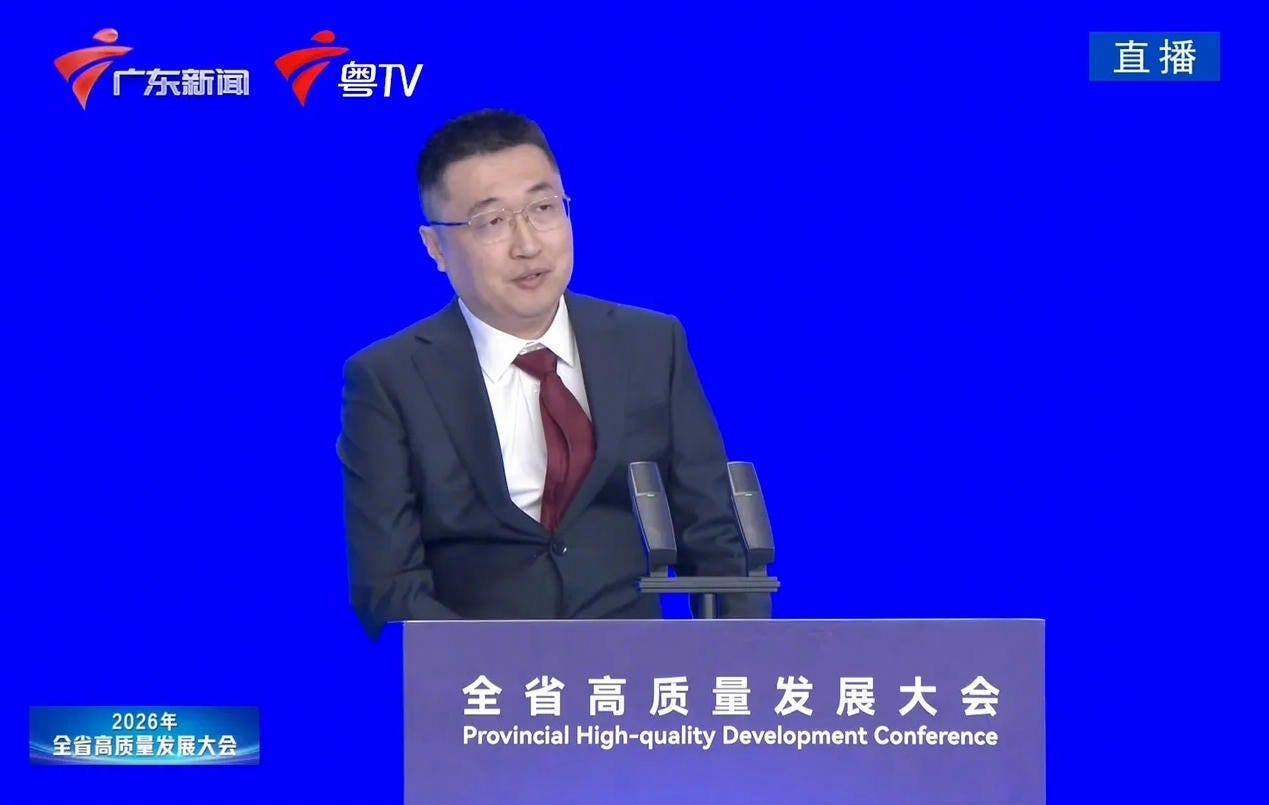
He reviewed SHEIN’s development since establishing operations in Guangzhou in 2014 and expressed gratitude to the Guangdong Provincial Party Committee, the provincial government, and various departments at all levels for their long-standing support.
He said that leveraging Guangdong’s comprehensive apparel industry supply chain, mature cross-border e-commerce ecosystem, and highly efficient international logistics system, SHEIN built its “small-batch, rapid replenishment” model, achieving an operational cycle of just two to three weeks from design to delivery. The company now serves more than 160 countries and regions worldwide, with cumulative platform export value exceeding RMB 100 billion. Guangdong’s first-class business environment and its “non-interference unless necessary, full support when needed” service philosophy have provided strong institutional backing for enterprise growth. As a result, Guangdong has become SHEIN’s supply chain headquarters and its most important development base, supporting nearly 10,000 partner suppliers and generating hundreds of thousands of jobs.
Chris Xu also summarized three key lessons from the company’s growth:
First, industrial ecosystems and the business environment are the foundation for enterprise expansion.
Second, digitalization serves as the bridge integrating manufacturing and services—driving production with data and optimizing manufacturing through real-time market feedback to build a competitive advantage of “speed plus precision.”
Third, as a supply chain leader, SHEIN proactively assumes social responsibility by empowering Guangdong manufacturing to expand globally with higher quality.
According to Chris Xu, SHEIN will continue increasing investment in Guangdong, deepening integration between cross-border e-commerce and industrial clusters, opening digital tools to partners, strengthening talent training and smart supply chain development, and investing over RMB 10 billion to build a world-class fashion industry cluster—helping “Guangdong products reach the world” while achieving mutual growth with the province in the course of high-quality development.
Below is the video recording and full text of Chris Xu’s speech:
Distinguished Secretary Kunming, Governor Fanli, respected leaders, fellow entrepreneurs, Happy New Year.
Standing here today as a representative of enterprises, I feel deeply grateful and inspired. Every step of SHEIN’s growth has been nurtured by this vibrant land of Guangdong. Since establishing ourselves in Guangzhou in 2014, we have maintained rapid growth, achieving cumulative platform export value exceeding RMB 100 billion. Our product offerings now cover apparel, footwear, beauty, and home goods, serving customers in over 160 countries and regions and becoming a globally recognized fashion retailer. On behalf of SHEIN Group, I would like to extend my sincerest appreciation to all government leaders and partners who have supported us.
Allow me to share three reflections from SHEIN’s journey:
First, Guangdong’s comprehensive industrial ecosystem and first-class business environment have enabled SHEIN’s rapid growth.
Our connection with Guangdong began with deep recognition of its industrial ecosystem. From apparel factories in Panyu to logistics hubs in Baiyun, and the cross-border ecosystem spanning the province, these elements form the backbone of our small-batch, rapid replenishment model. From design to final delivery into customers’ hands, we can compress the entire cycle to two to three weeks—reflecting the ultimate efficiency of Guangdong’s apparel supply chain and the high performance of its international logistics system.
What has touched us even more is Guangdong’s world-class business environment. SHEIN’s achievements would not have been possible without the care and guidance of the provincial Party Committee and government, the strong support of the Guangzhou municipal leadership, and the precise assistance from departments such as the provincial and municipal commerce bureaus, customs, and taxation authorities. When we first arrived in Guangzhou, leaders at provincial, municipal, and district levels proactively helped coordinate supply chain resources and implement supportive policies. This “non-interference unless necessary, full support when needed” approach gave us the confidence to base our supply chain headquarters in Guangzhou. Today, SHEIN works with nearly 10,000 suppliers in Guangdong, supporting over 600,000 jobs across the province. Guangdong has truly become our fertile ground for development.
Second, deep integration between manufacturing and services has enabled SHEIN’s global business expansion.
Leveraging the new cross-border e-commerce model and digitalization as a bridge, SHEIN embeds user insights, supply chain responsiveness, and global service networks throughout the manufacturing value chain, exploring new pathways for integrating manufacturing and services.
On the manufacturing side, demand has become the core engine driving production. Under the small-batch, rapid replenishment model, we use technology and digital analytics to capture global fashion trends, forecast industry movements, and translate fragmented market demand into frontline production instructions.
On the service side, we deeply integrate cross-border logistics and localized operations with manufacturing, using real-time sales data to guide factory production allocation, dynamically adjusting logistics delivery and task distribution across the chain. Customer feedback can directly trigger replenishment or product optimization, driving manufacturing upgrades in reverse.
It is precisely this integration—manufacturing embedded in services, and services driving manufacturing—that has enabled SHEIN to build a dual moat of speed and precision, becoming a leading global fashion enterprise.
Third, as a supply chain leader, SHEIN is committed to supporting the high-quality global expansion of Guangdong manufacturing.
We regard serving the high-quality development of Guangdong manufacturing as our core mission. SHEIN’s digital factory toolkits are fully open across the supply chain, helping factories achieve information transparency and refined management. We have built smart supply chain networks in Guangzhou, Foshan, Zhaoqing, and Jiangmen, stimulating growth in warehousing and logistics industries. We have also established an apparel manufacturing innovation center as a shared training base integrating industry, education, and evaluation. In 2025 alone, we conducted nearly 600 training sessions, benefiting 37,000 participants from supplier companies, strengthening the talent foundation for high-quality development.
Looking forward, SHEIN will further strengthen its responsibility as a supply chain leader. Since launching the “High-Quality Industrial Belt Global Expansion Plan,” Guangdong has become a model province, achieving full coverage of all 21 prefecture-level cities in 2024. Over the next three years, we will actively participate in “cross-border e-commerce + industrial belt” pilot programs, enabling more SMEs to benefit from cross-border trade and helping Guangdong products reach global markets steadily and sustainably. We will continue investing in supply chain empowerment and talent development, advancing digital transformation in traditional manufacturing and supplying more interdisciplinary talent to the Greater Bay Area. We will remain rooted in Guangdong, investing over RMB 10 billion to build SHEIN’s smart supply chain system and jointly create a world-class fashion industry cluster.
Distinguished leaders and colleagues, Guangdong is SHEIN’s root and the starting point of our journey. We firmly believe that amid Guangdong’s high-quality development wave, SHEIN will grow together with this vibrant land, making “Guangdong Intelligent Manufacturing” a new benchmark for the global fashion industry.
Thank you.
As Chris Xu noted, SHEIN’s rapid growth stems from its unique business model—flexible, on-demand production; small-batch, rapid replenishment; and direct-to-consumer sales.
Specifically, SHEIN typically launches small batches of 100–200 units to test customer response before deciding whether to scale production. This highly automated process ensures alignment between demand and supply while minimizing overproduction. SHEIN’s production waste rate remains in the single digits—far below industry averages. Behind this on-demand production model lies deep digital transformation of the supply chain.
SHEIN operates in close coordination with its suppliers. Through SHEIN’s proprietary supply chain technology solutions suite, suppliers gain visibility into production capacity, inventory levels, and demand signals, enabling more informed manufacturing decisions. SHEIN also invests in suppliers’ technological upgrades to ensure compatibility with its digital systems. Suppliers’ ability to assess demand signals and optimize production processes is central to SHEIN’s agile, efficient, small-batch approach. Meanwhile, SHEIN’s direct-to-consumer sales strategy enables rapid payment cycles, far shorter than industry norms. The company maintains long-term relationships with more than 5,000 third-party contract manufacturers.
With high levels of coordination across the supply chain, SHEIN’s design and production speed outpaces other fast fashion brands. Core suppliers are geographically concentrated, primarily in Guangzhou. Suppliers must complete design and production within 10 days—significantly faster than Zara’s well-known three-week turnaround time.
Originally incorporated in Nanjing, SHEIN later changed its operating entity to Guangzhou SHEIN International Import & Export Co., Ltd., controlled by Hong Kong–based Zoetop Business Co. At the end of 2021, ultimate control shifted to Singapore-based Roadget Business Pte. Ltd., making Singapore the company’s headquarters. The previously financed Nanjing Lingtian Information Technology Co., Ltd. has since been deregistered. According to Public Eye, both Zoetop Business and Roadget Business are owned by Beauty of Fashion Investment, a British Virgin Islands entity.
Although SHEIN has formally distanced itself from China in corporate structure, it continues to source nearly all products from China. These Chinese suppliers underpin the company’s small-batch, rapid replenishment model. In the short term, SHEIN cannot easily relocate its supply chain and therefore remains closely tied to China.