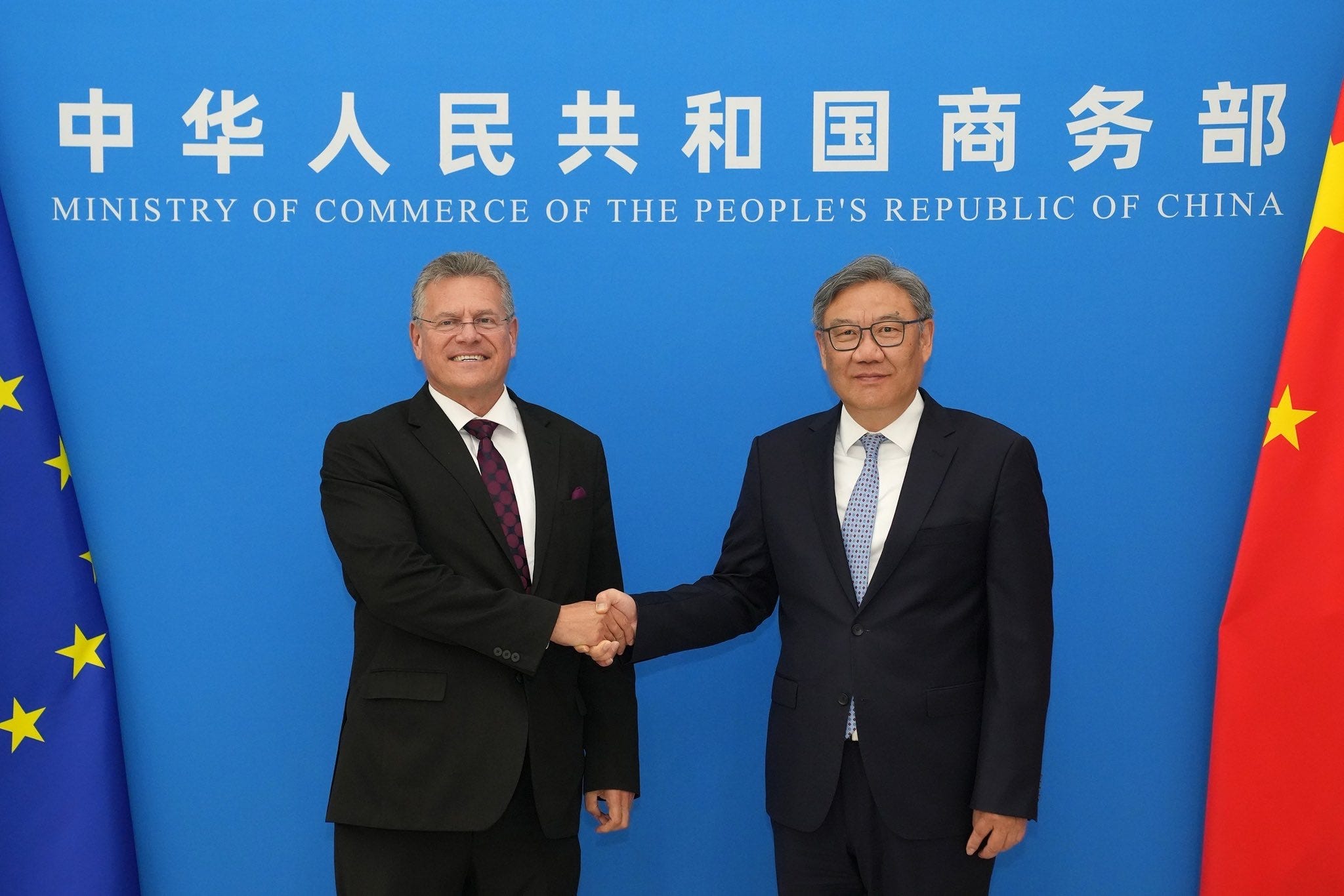
Today, China's Ministry of Commerce clarified several aspects of its recent understanding with the European Union on hybrid vehicles.
1. Official Statement by China's Ministry of Commerce
MOFCOM Spokesperson Responds to Media Questions on the China–EU Understanding Regarding Hybrid and Electric Vehicles
Question:
China and the EU recently held in-depth discussions on trade in hybrid and electric vehicles under their Trade and Investment Consultation Mechanism, helping to prevent an escalation of trade tensions. Some foreign media outlets have speculated about the quantitative limits and other details of the arrangements concerning hybrid vehicle trade. What is China's response?
Answer:
China and the EU have maintained continuous dialogue under their Trade and Investment Consultation Mechanism and reached consensus on a number of outcomes, contributing to a stable and balanced relationship between the two sides as key trading partners.
Guided by the principles of mutual respect and consultation on an equal footing, the two sides have engaged in intensive discussions on trade in hybrid and electric vehicles, seeking to address their trade differences and respective concerns in a balanced manner.
Regarding hybrid vehicles, both sides have emphasized and confirmed three fundamental principles.
First, respect for facts. According to Eurostat, the EU imported 107,000 hybrid vehicles from China in 2024 and 302,000 in 2025. Building on the 2025 baseline, the two sides have agreed on an arrangement that allows for further growth, ensuring room for Chinese companies to export and achieve stable growth while accommodating the legitimate, fact-based concerns of both industries.
Second, non-discrimination. Any measures adopted must not specifically target Chinese products or discriminate against Chinese companies. The quota allocated to China must not be lower than that allocated to any other source of imports into the EU.
Third, compliance with international trade rules. Both sides have confirmed that any trade arrangements must comply with WTO rules. China reserves all its rights under the WTO framework, including the right to initiate dispute settlement proceedings and seek trade compensation.
These three principles have guided the discussions throughout and provide a solid foundation for protecting the legitimate rights and interests of Chinese companies.
Regarding electric vehicles, China and the EU achieved a "soft landing" in the anti-subsidy case in January this year, when the EU published general guidance on price undertakings. The EU will continue to advance the relevant procedures for price undertakings submitted by individual companies, as well as other review procedures related to the electric vehicle case.
On the basis of reciprocity and mutual benefit, these understandings have effectively protected the practical interests of Chinese companies, prevented an escalation of China–EU trade frictions, and helped create a stable, predictable and sustainable environment for bilateral trade and investment. They will also contribute to the stable, balanced and healthy development of China–EU economic and trade relations.
2. What Has Been Reported About the Agreement?
Based on earlier media reports, China explicitly rejected the EU's proposal for voluntary export restraints, prompting the European Commission to consider temporary import restrictions instead.
On October 10, Bloomberg cited several people familiar with the discussions as saying that the EU was leaning towards safeguard measures. The precise mechanism still needed to be discussed by political leaders, but the measures could reportedly take effect as early as December.
Under the reported proposal, the EU would reduce annual imports of hybrid vehicles from approximately 800,000 units projected for 2026 to around 400,000 units. The EU also reportedly intends to use this arrangement as a pilot that could potentially be extended to other sectors where it believes trade imbalances exist.
Noah Barkin, a senior adviser on China at Rhodium Group and a long-time observer of China–EU relations, believes that China has signalled its willingness to accept EU safeguard measures that would limit exports of conventional hybrid and plug-in hybrid vehicles to approximately 350,000 units annually over the next four years. However, this would be conditional on the quota being allowed to increase gradually between 2027 and 2030.
In previous safeguard cases, the European Commission has allowed quotas to increase annually. For example, steel quotas have been increased by 5% per year.
China is expected to export approximately 300,000 conventional hybrid vehicles and 400,000 plug-in hybrid vehicles to the EU in 2026. A quota of 350,000 vehicles would therefore represent roughly half of this year's projected total. European officials estimate that this would account for approximately 10–15% of all hybrid vehicles sold annually in the EU.
According to reports, the European Commission briefed member states over the weekend on the trade agreement reached with China. EU leaders are expected to decide whether to endorse the agreement at the regular European Council meeting in Brussels next Thursday and Friday.
3. What Are Safeguard Measures?
Safeguard measures are temporary trade restrictions that a country may introduce when a sudden increase in imports causes, or threatens to cause, serious injury to a domestic industry.
In simple terms, they allow a government to temporarily raise tariffs or restrict import volumes, giving domestic companies time to adjust.
For example, suppose Europe originally imported 500,000 Chinese hybrid vehicles annually, but that figure rose to 1.5 million within a few years. European carmakers might experience significant declines in sales and market share, with some factories facing layoffs or production shutdowns.
In such circumstances, the EU could consider safeguard measures to temporarily limit import growth and give its automotive industry time to adapt.
Safeguard measures are a trade defence instrument permitted under WTO rules. Their principal legal basis is Article XIX of the General Agreement on Tariffs and Trade (GATT) and the WTO Agreement on Safeguards.
The WTO's basic objective is to reduce trade barriers and allow goods from different countries to compete fairly. However, it also recognises that trade liberalisation can sometimes place significant pressure on domestic industries.
Safeguard measures therefore provide WTO members with a temporary emergency mechanism. If imports rise sharply and a domestic industry suffers serious injury, governments may introduce temporary protection, subject to strict conditions.
First, there must be evidence. A government cannot restrict imports simply because domestic companies complain about intense competition. It must conduct an investigation and establish a causal link between increased imports and serious injury to the domestic industry.
Second, the measures must be temporary. The initial period generally cannot exceed four years. Extensions are possible under certain conditions, but the total duration normally cannot exceed eight years.
Third, protection cannot be unlimited. Measures must be limited to what is necessary to prevent or remedy serious injury and facilitate industrial adjustment. Where measures remain in place for an extended period, they generally need to be progressively liberalised.
Fourth, trade compensation must be considered. Affected exporting countries may request consultations and seek compensation. Under certain WTO conditions, they may also suspend equivalent trade concessions.
Whether the EU will ultimately proceed with safeguard measures remains to be seen. Nevertheless, where rapidly increasing imports are placing pressure on domestic industries, safeguards offer the EU a potentially suitable legal instrument.
Anti-dumping measures require evidence of dumping, while countervailing duties require evidence of actionable subsidies. Safeguard measures are different. The EU would not need to prove that Chinese carmakers received government subsidies or sold vehicles at dumped prices.
Instead, it would need to demonstrate that imports had increased and that this increase was causing, or threatening to cause, serious injury to the relevant European industry, while satisfying the other applicable legal requirements.
There are two main ways to implement safeguard measures.
One option is to increase tariffs. For example, if a Chinese vehicle is normally subject to a 10% import tariff, the EU could temporarily impose an additional tariff, provided the relevant legal conditions are met. This would raise the price of Chinese vehicles in Europe and potentially ease competitive pressure on European manufacturers.
The other option is to restrict import volumes through quotas. For example, the EU could establish an annual import quota for certain vehicles. Imports exceeding that quota could either be restricted or subject to higher tariffs. The latter arrangement is commonly known as a tariff-rate quota (TRQ).
In principle, safeguard measures must apply to a category of imported products rather than arbitrarily targeting one particular country.
For example, if the EU introduces safeguards on hybrid vehicles, the measures should generally apply to relevant imports from all countries, rather than exclusively to China. WTO rules do, however, provide for certain exceptions.
4. Why Would the EU Still Need Formal Safeguard Measures If China Has Already Agreed to Restrain Export Growth?
This raises an interesting question. If China and the EU have already reached an understanding on controlling export growth, why would the EU still need to initiate formal safeguard measures?
The reason is that WTO rules prohibit members from arranging so-called VERs through bilateral agreements.
Suppose the EU tells China: "If you agree to limit your exports of hybrid vehicles to one million units annually, we will not impose additional tariffs."
Even if China accepts, such an intergovernmental arrangement could directly violate Article 11 of the WTO Agreement on Safeguards.
By contrast, if the EU conducts an investigation under WTO rules, establishes that increased imports are causing serious injury to its automotive industry, and then lawfully introduces temporary tariffs or quotas, those measures could potentially comply with WTO requirements.
5. What Legal Procedures Would the EU Need to Follow?
A political understanding between China and the EU would only be the first step.
If the EU ultimately decides to introduce safeguard measures on hybrid vehicles, it would still need to complete its internal legal procedures.
Under EU law, the European Commission would need to formally launch an investigation, define which vehicle categories are covered, identify the European industries potentially affected, collect evidence on import volumes, company performance and employment, and provide interested parties with opportunities to present their views.
Only after the investigation could the Commission decide whether definitive restrictions were justified and how extensive they should be.
Under EU Regulation 2015/478, safeguard investigations should normally be completed within nine months of initiation, with a possible extension of up to two additional months in exceptional circumstances.
This is a maximum timeframe, not a requirement to wait nine months.
In urgent circumstances, the EU may introduce provisional measures on the basis of preliminary evidence, for a maximum of 200 days. However, it must establish that delay could cause damage that would be difficult to repair.
Provisional safeguard measures generally take the form of increased tariffs. Tariff-rate quotas may also be considered as part of the broader safeguard arrangements, allowing imports within a specified volume at the normal tariff rate while imposing higher duties on imports exceeding that threshold. The EU adopted a similar approach in its 2018 steel safeguard measures.
Definitive measures must also go through the relevant member-state voting procedures. Under the applicable qualified-majority rules, this generally requires support from at least 15 member states representing more than 65% of the EU population.
Political endorsement by EU leaders is therefore important, but it cannot replace the formal investigation and decision-making procedures. Nor is unanimous approval by all 27 member states required.
Notably, under the Franco-German proposal, the European Commission would be able to adopt measures directly, without first securing the support of a qualified majority of member states. The measures could only be blocked if a qualified majority explicitly opposed them. However, the proposal would still need to be approved by the European Council before it could take effect, which will take times. At this stage, it remains unclear whether the EU will ultimately follow the traditional procedure or adopt this new approach.
The initial duration of safeguard measures cannot exceed four years, including any provisional measures. Extensions are possible under certain conditions, but the total duration generally cannot exceed eight years.
6. The Legal Challenges Facing Potential EU Safeguards on Hybrid Vehicles
For hybrid vehicles, one of the more complicated questions is how the EU would establish a sound legal basis for the restrictions.
There are several issues.
First, which vehicles would be covered?
Conventional hybrids, plug-in hybrids, mild hybrids and range-extended electric vehicles are not identical products.
If the EU investigates only plug-in hybrids, it would need to demonstrate that increased imports of those vehicles were causing injury to the relevant European industry.
If it includes multiple types of hybrid vehicles in the same investigation, it would need to explain why those products can reasonably be grouped together and which European-made vehicles compete directly with them.
Second, how would the EU prove that increased imports were causing serious injury?
The EU cannot simply point to declining sales or falling profits among European carmakers and conclude that Chinese imports are responsible.
It would need evidence relating to production, sales, profitability, employment and other relevant indicators, and demonstrate a causal relationship between increased imports and serious injury to the domestic industry.
Other factors, such as weak demand in the European automotive market, rising energy costs and difficulties associated with industrial restructuring, would also need to be examined separately. Their effects cannot simply be attributed to Chinese imports.
WTO rules also require an explanation of the relationship between increased imports, unforeseen developments and the relevant trade obligations.
The EU has previously faced criticism from WTO panels in disputes concerning its steel safeguard measures over deficiencies in this part of its legal reasoning.
Third, could the EU target China alone?
This could be one of the EU's most difficult legal challenges.
Under WTO rules, safeguard measures generally apply to imported products as a category rather than to one particular exporting country.
In other words, if the EU determines that increased imports of hybrid vehicles are harming its automotive industry, it generally cannot restrict Chinese vehicles while completely exempting comparable imports from Japan, South Korea, the United Kingdom and other exporting countries.
There are exceptions, and WTO rules allow country-specific quota allocations based on factors such as historical trade shares. However, such arrangements must have a reasonable legal basis.
If the EU includes other exporting countries in the restrictions, it risks creating tensions with additional trading partners. If it restricts China alone, it may face challenges over compliance with WTO rules.
There is also a requirement for consistency between the imports examined during the injury investigation and those covered by the eventual measures.
The EU cannot simply attribute injury to imports from all countries during the investigation and then impose restrictions exclusively on China without a legally defensible justification.
Fourth, how restrictive could the quotas be?
The EU cannot arbitrarily establish an import ceiling.
Under WTO rules, where quantitative restrictions are introduced, the quota should generally be based on the average level of imports during the last three representative years for which statistics are available.
A lower quota would require additional justification demonstrating that the restriction was necessary.
Even where a tariff-rate quota is used, both the quota volume and the additional tariff imposed on imports exceeding that volume must be proportionate to the need to remedy serious injury.
7. What Would Safeguard Measures Mean for Chinese Carmakers?
If the EU eventually introduces safeguard measures on hybrid vehicles, the implications for Chinese manufacturers would fall into three broad areas.
First, future export growth would be constrained.
The number of vehicles currently being exported might not decline significantly, but it would become much harder for Chinese manufacturers to continue expanding their European sales at the same pace over the next few years.
If the EU introduces tariff-rate quotas, vehicles imported within the quota could continue to enter at the normal tariff rate, while those exceeding the quota would face additional duties.
This could encourage manufacturers to reduce aggressive price competition and focus more on higher-priced, higher-margin models.
Second, the impact would vary considerably across manufacturers.
If quotas are allocated according to historical export volumes, established brands with an existing European market presence, such as Geely-owned Volvo and Lynk & Co, could enjoy an advantage.
By contrast, fast-growing manufacturers such as BYD and Chery could face greater constraints on their expansion.
SAIC's MG brand would also need to consider how to protect its existing market share.
For Chinese brands that have not yet entered Europe, gaining a foothold could become more difficult.
Third, the measures could accelerate Chinese investment in European manufacturing.
If the restrictions apply to imported vehicles rather than vehicles manufactured within Europe, companies that already have European production facilities would be better positioned.
Manufacturers that rely primarily on production in China and exports to Europe would face greater challenges.
However, which companies would ultimately be most affected would depend on several unresolved questions.
Would the restrictions cover conventional hybrids, plug-in hybrids or all hybrid vehicles? How many vehicles would be allowed into the EU each year, and what additional tariffs would apply above the quota? Would quotas be allocated by country, by individual manufacturer, or on a first-come, first-served basis? How long would the measures remain in place? And would vehicles produced locally in Europe be exempt?
The two most consequential issues may be how quotas are allocated and whether European-made vehicles remain outside the restrictions.
If quotas are allocated according to historical sales, established manufacturers would find it easier to defend their market positions, while newer entrants would face higher barriers.
If locally manufactured vehicles are not subject to the restrictions, companies capable of building factories in Europe could continue expanding despite import controls.
Over time, this could change the nature of competition among Chinese carmakers in Europe.
In the past, competition was largely about price, product quality and sales volumes. In the future, access to import quotas and local manufacturing capacity could become increasingly important.
How many vehicles a Chinese manufacturer can sell in Europe may no longer depend solely on how competitive its products are or how attractive its prices are. It may also depend on how much import quota it can secure and whether it has the resources to manufacture vehicles within Europe.