

On February 13, during the Munich Security Conference, U.S. Secretary of State Rubio met with Chinese Foreign Minister Wang Yi. The following is the readout released by the Chinese side:
Wang Yi Meets with U.S. Secretary of State Rubio
Member of the Political Bureau of the CPC Central Committee and Foreign Minister Wang Yi met with U.S. Secretary of State Rubio on the sidelines of the Munich Security Conference.
Wang Yi stated that President Xi Jinping and President Donald Trump have provided strategic guidance for the development of China-U.S. relations. We should work together to implement the important consensus reached by the two heads of state and make 2026 a year in which China and the U.S. move toward mutual respect, peaceful coexistence, and win-win cooperation. Dialogue is better than confrontation, cooperation is better than conflict, and win-win is better than zero-sum. As long as both sides uphold the principles of equality, mutual respect, and reciprocity, they will be able to find ways to address each other’s concerns and properly manage differences. Both sides should make joint efforts to continuously expand the list of cooperation areas and reduce the list of issues, putting China-U.S. relations on a stable, healthy, and sustainable development track and sending more positive signals to the world.
Both sides agreed that the meeting was positive and constructive. They agreed to jointly implement the important consensus reached by the two heads of state, leverage political and diplomatic channels to coordinate efforts, support high-level exchanges between the two countries, enhance dialogue and cooperation in various fields, and promote stable development of China-U.S. relations.
The below is attributable to Principal Deputy Spokesperson Tommy Pigott:
Secretary of State Marco Rubio met on February 13 with the Director of the Office of the CCP Central Foreign Affairs Commission and China’s Foreign Minister Wang Yi. The meeting was positive and constructive. Secretary Rubio emphasized the importance of results-oriented communication and cooperation on a range of bilateral, regional, and global issues.
They also discussed President Trump’s planned visit to China in April.
A few hours after the meeting between Wang Yi and U.S. Secretary of State Rubio, the U.S. Department of Defense released an updated 1260H list, adding 78 companies including Alibaba and BYD.
However, less than an hour later, the update disappeared. The latest notice on the Federal Register indicates that following the list’s publication, the Department of Defense received an interagency letter requesting its withdrawal. The document will remain publicly viewable until February 17, 2026.
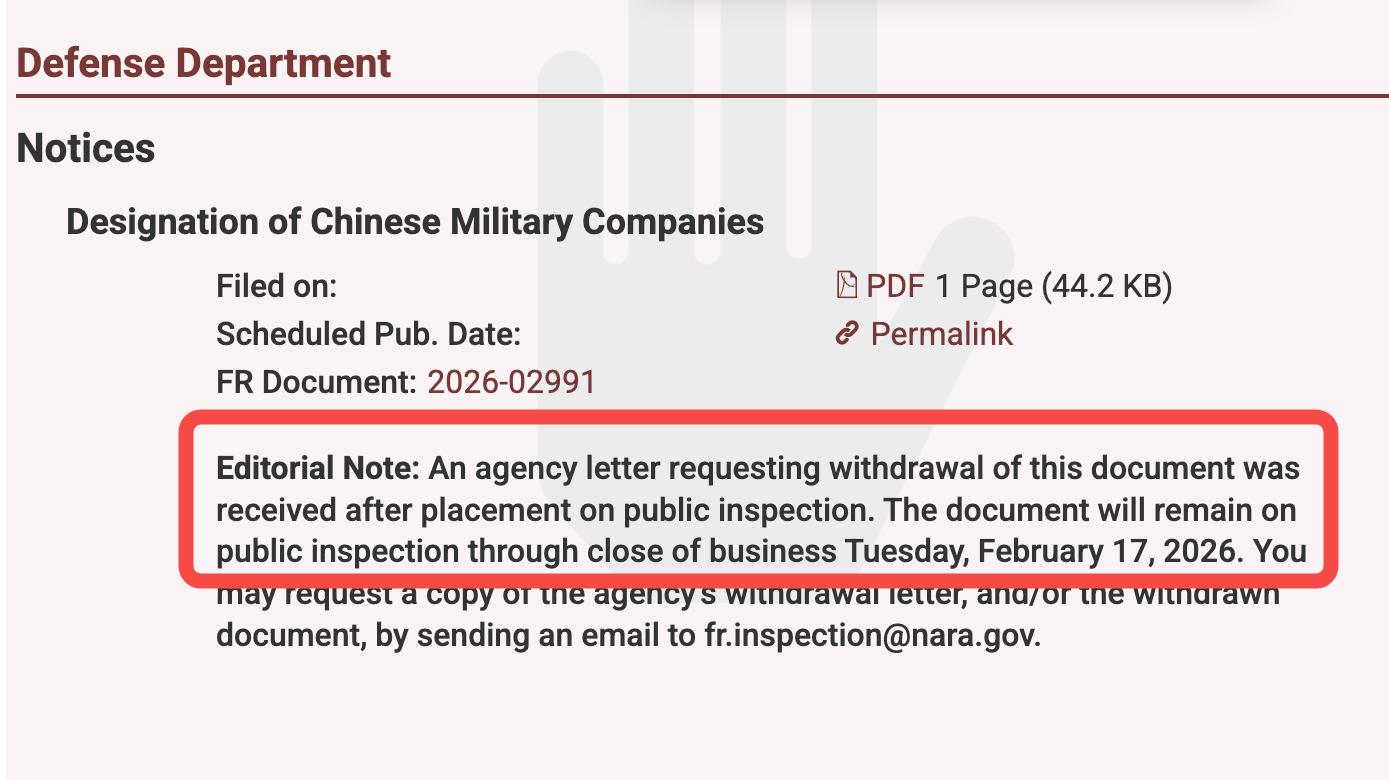
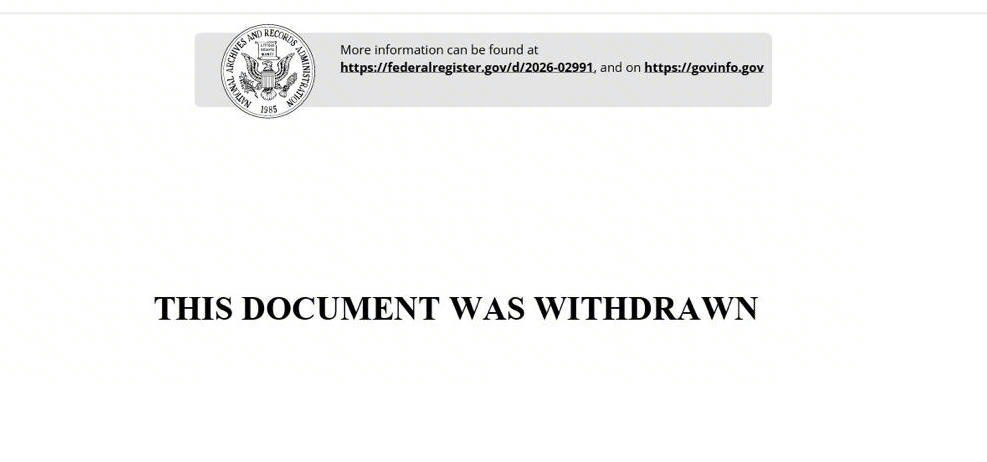
This incident has drawn significant attention in China, with many trying to interpret the implications behind the move. Some analysts have noted that this scenario feels familiar: on May 13 of last year, the U.S. Department of Commerce issued guidance suggesting that procuring or using Huawei’s Ascend chips anywhere in the world would violate U.S. export controls. Two days later, BIS quietly revised the language, softening it to a warning that using Huawei chips “entails risks.” According to media reports, that change stemmed from a lack of coordination among U.S. government agencies. The rapid release and withdrawal of the updated 1260H list may be a recurrence of a similar interagency misalignment.
However, some speculations from the U.S. side suggest it might just be a technical error, that companies like YMTC and CXMT, which weren’t supposed to be removed from the list, were taken off by mistake. Now it’s just a correction, and the revised list might be reissued next week.