

On the morning of April 30, 2026, Chinese President Xi Jinping attended a symposium in Shanghai on strengthening basic research (基础研究) and delivered an important speech. Today, Qiushi — a publication whose significance should need little explanation for most China watchers — published the full text of Xi’s remarks.

In the speech, President Xi acknowledged that China still lags behind the world’s leading science and technology powers in basic research, and called for a greater sense of urgency and stronger, more concrete efforts to close the gap. He also criticized some local governments and institutions for not giving basic research enough attention, urging officials to correct what he described as a distorted focus on short-term, visible achievements and to make basic research a genuine policy priority.
President Xi also pointed to a significant funding gap. Basic research now accounts for more than 7 percent of China’s total R&D spending, compared with 15–20 percent in leading science and technology powers. He called for that share to rise gradually, through increased government funding as well as greater investment from companies and other parts of society.
On problems within China’s research community, President Xi called for breaking down entrenched academic cliques and hierarchies. He criticized a system that places excessive weight on the number of papers published, publications in top journals, prestigious titles and awards, and called for tougher action against research misconduct and corruption.
At the same time, President Xi emphasized a larger role for industry. He said leading technology companies should be encouraged to lead or participate in basic research projects, deepen collaboration between industry, universities and research institutions, and better connect basic research with applied development and commercialization.
AI was another notable part of the speech. President Xi called for greater use of AI in basic research, including the development of foundation models for scientific research and specialized models for individual disciplines. He also called for intelligent research platforms and systems that could help accelerate scientific discovery across a wide range of fields.
Below is an unofficial English translation:
Let me make a few points.
First, we must fully recognize the importance and urgency of strengthening basic research.
Basic research is the source of the entire scientific system, the foundation for addressing all technological challenges, and a front line in global science and technology competition. The history of human development shows that every major breakthrough in basic research has driven enormous advances in science and technology and significant leaps in social productivity. One important measure of a country’s scientific and technological strength is the level of its basic research. If we are to become a global science and technology power, we must strengthen our capabilities in basic research.
Today, a new round of technological revolution and industrial transformation is accelerating. Global technology competition is increasingly focused on the frontiers of basic research. Scientific discovery and technological invention are reinforcing each other, while original and disruptive innovation is becoming increasingly important. For us, this presents both a historic opportunity and a new challenge.
Since the 18th National Congress of the Communist Party of China, the CPC Central Committee has attached great importance to basic research. By improving the organization of scientific research, increasing investment and support, and reforming institutions and mechanisms, China has significantly strengthened its capabilities in this area. At the same time, we must recognize that there remains a gap between China and the world’s leading science and technology powers. We therefore need a greater sense of urgency and must strengthen basic research with greater determination and more concrete measures.
Overall, awareness of the importance of basic research has improved across different levels of government and relevant institutions, but some localities and organizations still do not give it sufficient attention. Basic research is an undertaking that lays foundations for the future. We must neither seek quick results nor remain passive. We need the vision and sense of responsibility embodied in the idea that “one generation plants the trees under whose shade future generations will rest,” as well as the perseverance required to “spend ten years sharpening a sword.”
This is not simply a question of how scientific research is managed; it is also a question of how we understand the bigger picture and how we assess political and administrative performance. We must seriously identify and correct distorted approaches to evaluating performance in scientific research, and ensure that authorities and institutions at all levels genuinely place basic research high on their agendas, devote sustained effort to it, and continue producing new results.
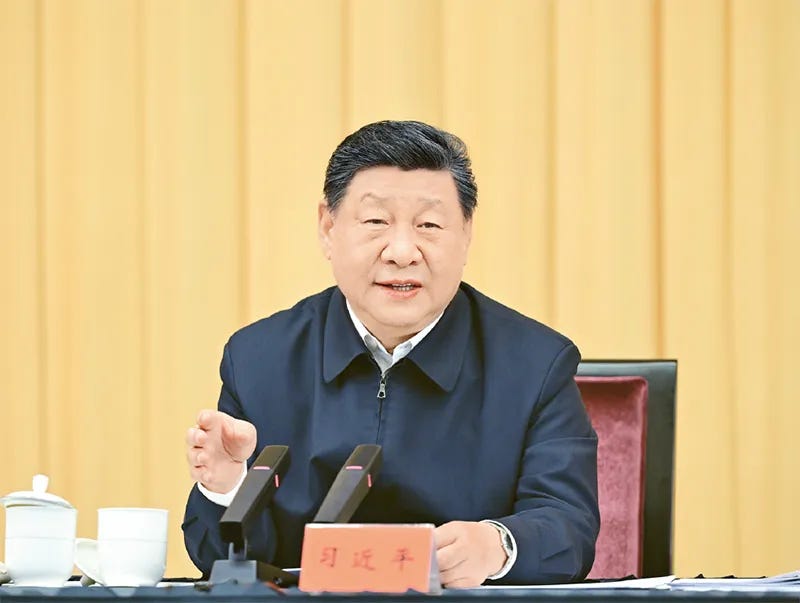
On April 30, 2026, President Xi Jinping attended a symposium on strengthening basic research in Shanghai, where he delivered a major speech.
Second, we must optimize the overall structure of basic research.
As we enter the era of “big science,” basic research is becoming increasingly organized and coordinated. We need stronger overall planning and top-level design, and must accelerate the development of a strategic, forward-looking, and systematic research structure.
We must identify the right objectives and directions. Basic research can only improve in quality when it is properly targeted. We must adhere to the strategic orientation of the “Four Orientations,” begin with the country’s urgent and long-term needs, further clarify priority areas and major directions for basic research, and coordinate efforts in original innovation with breakthroughs in key and core technologies. Different approaches should be adopted for different fields, with an emphasis on building on our strengths, filling gaps, and addressing weaknesses.
We must strengthen coordination among different research forces. Basic research is highly systemic and requires the broad mobilization of resources across society. We should leverage the advantages of the new system for mobilizing resources nationwide, strengthen the leading role of national laboratories, national research institutions, and high-level research universities, and integrate resources to advance original and disruptive innovation.
We should encourage and regulate the development of new types of research institutions, explore innovative approaches to research management, and expand the forces engaged in basic research. Leading technology companies should be supported in leading or participating in basic research projects. We should promote deeper industry-academia-research integration led by enterprises and connect the innovation chain from basic research and applied development through to the commercialization of research成果.
We must improve the structure of academic disciplines. A strong disciplinary system is an important foundation for basic research. As the boundaries between disciplines continue to expand, we need to improve mechanisms for establishing and adjusting academic fields. We should strengthen foundational disciplines including mathematics, physics, chemistry, biology, astronomy, and earth sciences; promote the coordinated development of applied and basic disciplines; provide support for less popular and weaker fields; foster emerging disciplines; and encourage multidisciplinary integration and interdisciplinary research.
Third, we must strengthen the talent base for basic research.
Ultimately, basic research depends on highly capable people. We must advance the development of education, science and technology, and talent in an integrated manner, while improving how we train, attract, and utilize talent. Our goal should be to build a basic research workforce that is sufficiently large, highly capable, and appropriately structured.
We must improve the quality of domestically trained talent. Domestic training will always be the primary channel for developing talent. We must follow the laws governing talent development, comprehensively improve educational quality, and continuously cultivate the next generation of basic researchers.
We should coordinate programs such as the Top-Notch Student Training Program, the Strong Foundation Program, and programs for outstanding young talent; place greater emphasis on identifying and cultivating talent at an early stage of education; improve integrated undergraduate-master’s-doctoral training models; and develop more outstanding and innovative talent in foundational disciplines. We should also improve coordination between scientific research and education, with particular attention to identifying and developing high-level talent through frontline research.
We must vigorously support young researchers. Young researchers are a vital force in basic research, and many major scientific achievements have been made by young people. We need a continuous pipeline for cultivating young talent, combining mission-driven research with mentorship from more experienced researchers. We should strengthen education, guidance, and support, create pathways for young scientists to develop, and give them opportunities to take on major responsibilities and play leading roles.
We must create a supportive environment. Basic research is about exploring the unknown, and it requires both passion and perseverance. We should continue improving the working and living conditions of basic researchers, ensure appropriate compensation, and help address practical difficulties so that they can live securely, work with peace of mind, and devote themselves to their careers.
We should vigorously promote the spirit of scientists, tell their stories well, strengthen public science education, and stimulate young people’s curiosity, imagination, and desire to explore, so that more of them aspire to pursue careers in basic research.
Fourth, we must strengthen support and safeguards for basic research.
Basic research is largely oriented toward the future and requires sustained effort over long periods of time. We must have the courage to remove ideological and institutional barriers and provide long-term, stable funding and policy support.
We must increase funding. Basic research currently accounts for more than 7 percent of China’s total R&D spending, but this remains well below the 15–20 percent seen in leading science and technology powers. We should gradually increase the share devoted to basic research, broaden funding channels, steadily increase government investment, and encourage enterprises and other social actors to invest more, creating a diversified funding system for basic research.
We should improve the effectiveness of science-fund support, provide stable funding for research institutions, platforms, and facilities engaged in basic research, provide continued support to outstanding research teams and individuals selected through competitive processes, and establish rolling support mechanisms for major original research projects.
We must improve research conditions. We should strengthen China’s ability to independently provide the fundamental conditions required for scientific research and systematically plan and build major science and technology infrastructure.
We should strengthen national scientific data centers and improve both the openness and sharing of data and the efficiency with which it is used. We should accelerate the development of world-class scientific and technological journals and encourage researchers in China and abroad to publish important findings first in Chinese journals and on Chinese platforms.
We must also attach importance to using artificial intelligence to empower basic research. We should develop large foundation models for science as well as specialized models for individual disciplines, build intelligent scientific research platforms and systems, and use them to accelerate scientific breakthroughs across different fields.
We must deepen reform of the science and technology system. We should establish differentiated evaluation systems suited to the characteristics of basic research and improve mechanisms for evaluating representative achievements, conducting long-term assessments, using international peer review, and evaluating research teams. Greater emphasis should be placed on the originality and academic value of research.
We should improve incentive mechanisms for basic research, deepen reforms that give researchers greater rights over scientific and technological成果 generated in the course of their work, and establish mechanisms through which basic research and the commercialization of research outcomes reinforce one another. Research management should also be reformed to reduce unnecessary burdens on basic researchers.
We must improve the research environment. We should create an open and inclusive innovation environment that tolerates failure and encourages basic researchers to concentrate on their work, raise new questions, open up new fields, and explore new approaches.
We should strengthen research integrity, improve academic culture and professional conduct within the science and technology community, eliminate “clique culture” and academic fiefdoms, and decisively reverse the tendency to judge researchers solely by papers, publications in top journals, prestigious titles, or awards. Scientific research corruption must be firmly punished.
Fifth, we must expand international cooperation in basic research.
International cooperation is indispensable to exploring the frontiers of global science. We should actively integrate into global innovation networks and strengthen our capacity for original innovation through openness and cooperation.
We should deepen international exchanges and cooperation in basic research at both the governmental and non-governmental levels, make use of platforms such as the Belt and Road Initiative, and work with other countries to tackle major scientific challenges including climate change, energy and the environment, and life and health.
We should further open China’s national science and technology programs to international participation and expand exchanges among basic researchers. China should take the lead in initiating and participating in international “big science” programs and major scientific projects, support the establishment of international science and technology organizations in China, and encourage Chinese universities, research institutes, and scientific organizations to participate actively in global science and technology governance.
Strengthening basic research requires the joint efforts of the entire Party and society as a whole. The Central Science and Technology Commission should strengthen systematic planning and overall coordination and ensure the implementation of major tasks and important initiatives. Party committees and governments at all levels should increase policy support, provide the necessary services and safeguards, and ensure that the decisions and arrangements of the CPC Central Committee are fully implemented.