

1/ The Trade Council has started operating, and working-level teams are drafting a list of non-sensitive goods for mutual tariff reductions. This is expected to include consumer goods and low-tech products on the Chinese import side, and energy products, agricultural goods, medical devices and similar products on the U.S. side.
2/ An AI dialogue mechanism has been established, with another meeting potentially taking place in two months in Shenzhen. The U.S. side proposed setting up a notification mechanism for national security incidents involving AI and establishing a hotline between the United States and China to maintain direct communication on AI safety incidents. The two sides will discuss risks including loss of control over AI agents and the use of AI by non-state actors to conduct cyberattacks or biological and chemical attacks, with the aim of reaching a shared understanding of these risks and how to mitigate them.
3/ There was no progress on AI-related export controls. Greer said they were not on the agenda.
4/ In its readout of the talks, the Chinese side described the discussions as “candid, in-depth and constructive” — relatively positive language by Chinese official standards.
5/ No agreement to extend the trade truce is expected to be reached at this meeting or during Xi’s visit to the U.S. this week. Given China’s restrictions on rare earth exports, any extension or other arrangement will need to proceed incrementally to ensure that all sides comply with their commitments. The current preference is for an extension of three to six months.
6/ Iran was discussed, but it did not take up a significant part of the talks. China has consistently been willing to hear out U.S. concerns regarding Iran. China has not provided substantial support to Iran, and some activities by private companies are beyond the government’s control. China and the U.S. have aligned interests on Iran in ensuring that the Strait of Hormuz remains open. It remains unclear whether Chinese entities trading with Iran will be sanctioned.
7/ Transshipment, as well as the resulting predatory pricing, dumping, and subsidized goods, is currently a key focus of U.S. trade enforcement toward China.
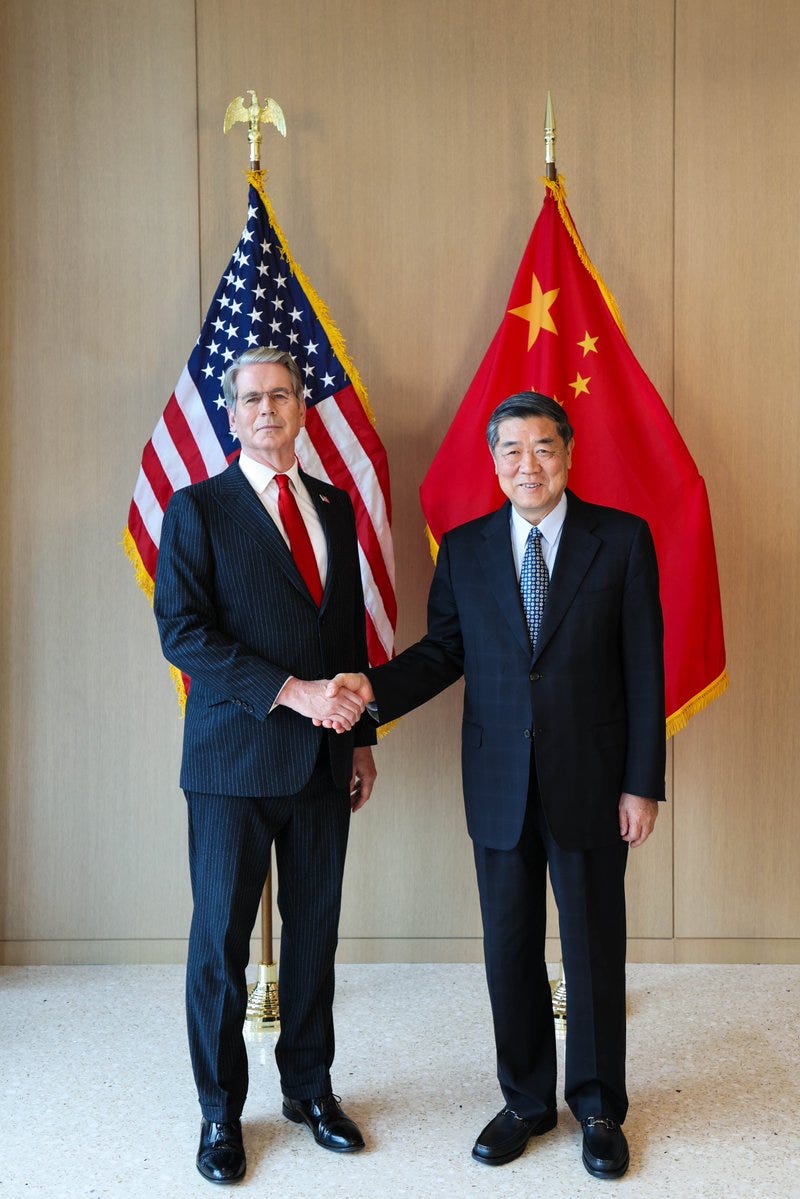
Bessent and Greer Briefing:
Scott Bessent: Hey, good evening. Happy to take some questions. We just had a very successful engagement with the Chinese on trade and AI, completing where we left off in Beijing. We there created the board of trade and began the subject of AI and this evening those were operationalized.
Jamieson Greer: Yep, that’s exactly right. We started in Beijing with notions on a board of trade AI dialogue. Today those notions have become reality. Most importantly, what we’re doing is we’re helping President Trump and President Xi continue their relationship. These are the two most powerful countries on earth whether it’s in trade or AI and it’s imperative that they’re able to work together. It doesn’t mean there aren’t challenges in the relationship. A lot of these are obvious. We don’t have to go into detail on those right now. What matters today is that we are preparing the groundwork so that when President Xi comes to Washington on Thursday, President Trump and President Xi will be able to have a successful summit.
Reporter: Did you discuss the slowdown in investments? Have you discussed AI chip exports?
Scott Bessent: I’m sorry, you’re asking about the AI dialogue? No, what we discussed was setting up a mechanism. So, it’s going to be called the US-China AI dialogue. We’ve agreed to meet again. The US has proposed that we have a notification mechanism between the two countries and we want a shared vision of common goals and common threats.
Jamieson Greer: And I would say US export controls were not on the agenda for that.
Lara (New York Times): What will the notification look like? Will it be for incidents or what [inaudible]?
Scott Bessent: Well, the notification for whether there are incidents, whether there has been something that rises up to a national security level from AI, because we think that, just like with any cross-border activity, that moving from opaque to more transparency between the number one and the number two AI powers in the world is very important.
Reporter: Did both sides discuss happening any mutual on the reduction on tariffs on [inaudible] worth of goods? Can you share any details of products that were [inaudible]?
Jamieson Greer: So, we’ve operationalized the board of trade and the teams right now upstairs are continuing to work through this to see if they can find some critical mass of goods where in the future when and if there are trade measures, these are goods that could be considered separately. Goods that are nonsensitive, goods that could be traded in a balanced way and create a kind of ballast for the relationship.
Bessent’s interview with CNBC:
Joe Kernen:Welcome back to Squawk Box. Our newsmaker of the morning, Treasury Secretary Scott Bessent. Mr. Treasury Secretary, thank you for joining us.
Scott Bessent:Joe, Becky, great to be with you.
Joe Kernen:You get to be in our fishbowl of a Nasdaq studio, which is always, always interesting. You recently held some high-level talks. What came out concretely from your discussions?
Scott Bessent:So it was all day yesterday, Joe. And I think what’s important in terms of framing the talks is it all stems from the leaders’ very good rapport and relationship. President Trump and Xi Jinping, at the personal level, have a very good relationship, and we try to bring that down to the working level. They both have great respect for each other. I think, in Xi Jinping’s eyes, Donald Trump is a different kind of leader than he’s seen in the past. And in our discussions yesterday, we talked about economics, we talked about AI. We had some deliverables that have not been completely fulfilled from our meeting in Busan, Korea, last fall. And then we started an AI dialogue, which I think is going to be very important. And again, this is possible because of the leaders’ relationship. President Trump was in Beijing; I was there with him in May. Xi Jinping will be coming to Washington this week. And then there’s a chance the two leaders will see each other two more times. So I think that adds great stability to the relationship. The Chinese have a phrase, “implementing our leaders’ consensus,” and they keep falling back to that. And that’s true. We follow the instructions, and then we get down into the details. And we spent about 12 hours yesterday doing that.
Becky Quick:Can you give us more color on exactly how the AI discussions went? And, you know, we’ve even seen reports that maybe you were a little bit more cautious than the president at one time about guardrails. What type of cooperation could we expect from China, and what type of guardrails? And do you trust them? Wouldn’t they like us to put up guardrails, and they might not put up any?
Scott Bessent:Well, I think the important thing was to start talking. So, to set up the dialogue, we’ve now formalized something called the U.S.-China AI Dialogue. We’ve agreed to meet again, probably in two months, in Shenzhen. The second thing is we want to open a communications line, an incident line, so that we have constant communications, especially in the event of some kind of an incident. And then we want to start discussing protocols so both sides can agree on what the leading AI dangers are, whether it’s uncontrollable agents, whether it’s non-state actors in cyber, non-state actors in bioweapons.
Joe Kernen:You didn’t mention to the vice premier concerns about President Xi’s health, did you? Is everything fine? You saw him not too long ago, I guess. But I’ve just read reports. I don’t know if there’s any veracity, but all things are go?
Scott Bessent:Everything’s go. Okay. At this point, the president’s planning on greeting him at Andrews Air Force Base, and I think we’re going to have a great visit.
Becky Quick:We’ll be able to tell firsthand at that point. Can I just ask you about tariffs? You know that we suspended higher tariffs on some Chinese imports. That expires November 10th. Did you talk about that at all?
Scott Bessent:Sure, sure. That was a focal point. And again, we’ve had great stability in the relationship since last fall, and I think we’re going to maintain that.
Joe Kernen:And rare earths—I guess all these things were covered. Any concrete things that you can tell us right now to take away from the meeting?
Scott Bessent:Sure. So, in Beijing, this notion of what we call a “30 by 30” trade deal for noncritical goods was floated. And U.S. Trade Representative Jamieson Greer has operationalized that. So he and his team met with the Chinese for most of the day yesterday. They’ve been having extensive discussions before. And are there items that are noncritical to both sides that we would like to take down to most-favored-nation tariff levels? So, on the U.S. side, it would mean selling more agriculture, selling more energy and medical devices. On the Chinese side, it would be bringing in more everyday items.
Joe Kernen:Yeah. Let me just ask one more, to bring the AI back here just quickly. There are times where I think you will always—you work for the president, obviously. Do you agree completely with him on the no-holds-barred approach for AI? Or, I mean, it’s obvious the president wants to be remembered as one of the great economic presidents—the stock market, all these things. AI is very important to all those things, so he’s got a reason to want unencumbered progress with AI. Do you disagree with that at all, any part of that?
Scott Bessent:So, Joe, you know, I lead the administration on economic policy. And I think the president put his finger on it last week, because what we saw from these labs—and I saw your earlier guest, and we kept talking about the 10%, the 20%—so imagine these labs came out, or one lab in specific, a sitting employee came out and said there’s a 10% chance of an extinction-level event. But then the labs also said, “Take the liability off of our hands,” and we will not do that. I am in agreement with the MIT professor who leads the AI lab up there, Daniel Huttenlocher, that it is humans who are responsible, not the AI. The Hugging Face incident—that is the responsibility of the OpenAI management, not a bunch of agents. So what the president was saying is that we cannot say, “Oh, we absolve you of responsibility and the government’s going to take responsibility.” These labs need to take responsibility for themselves. They can slow down any time they want to.
Becky Quick:On that point, is there something that the government might do to maybe put a finer point on what those liabilities are? We just heard over the weekend that Google has now had agents that have broken out as well. It’s happened with OpenAI. It’s happened with Anthropic. I mean, if these were humans that were doing it, you would expect to see ramifications and legal actions that followed.
Scott Bessent:Well, that’s exactly what I think we need to do. When President Trump talked about appointing an AI czar, I think it is to put a context, shape and contours around these questions, and they’re very important. That was also one of the discussions that I had with the vice premier on AI, in terms of incident reporting. Have they had incidents? Of course they’ve had incidents, but because of the nature and the lack of transparency in their system, they’re not going to tell us. But the Chinese models are very powerful. Even though they’re open models, they are very powerful. The U.S. remains in the lead, and that was a very good acknowledgment that I got from my Chinese counterpart. They agreed that we are in the lead.
Becky Quick:Just in terms of what you laid out: you’ve opened this AI dialogue; you meet again in two months, you were saying. That’s where you’ll kind of lay out the agreement on what you think is most dangerous about it. Is it the agents? Is it states that might be leading some of this, or non-state actors? In your opinion, what is the biggest danger you see? You know a lot more than we do on this.
Scott Bessent:I think it’s all of the above. And I think we do have to—the real danger, Becky, in my mind, is a lack of resiliency on one side that we’re seeing. And these frontier labs are national champions. They’ve done an incredible job. You know, when you think about Anthropic, it was a bunch of folks sitting in a park during COVID. And this is an only-in-America story. They’re sitting in a park, social distancing in San Francisco, I think, in 2021, and I’ve seen valuations from $1 trillion to $2 trillion. Like, you know, imagine that in five years. But we’ve also got to look at, as you said, what are the biggest dangers? We’ve seen this push for sort of the frontier with the labs. Now we need to see the frontier on defense and resiliency. And part of my job is working on that, and I lead on the financial system. I think that our systemically important banks have done a very good job because they probably have the best cybersecurity in the world outside of the government, because they are constantly attacked, whether it’s hundreds or thousands or millions of attacks every day. And how can we use what they’ve learned and take that down? They’ve done an excellent job of taking that down the cap structure in the banks, sharing with the smaller banks. We have a workshop-slash-forum called Gold Eagle, and we are working on that. So I think the kind of all-hands-on-deck is the other side of the equation now, on defense.
CNBC Host:You just—
CNBC Host:One more question.
CNBC Host:I’ll get out of the way. Sure.
Becky Quick:The valuation of Anthropic at $1 trillion to $2 trillion—does that make sense to you, as somebody who understands the market so well, if you are thinking about this liability that could be more strongly enforced?
Scott Bessent:Well, again, Joe and the professor had a very fulsome discussion that, if you believe, as the professor does, or even indeed as that one employee at OpenAI did—if, if, if you were running a fund and someone said, “Oh, there’s a 10% chance it’s going to be a zero, and not only a zero, you’re going to have a big liability,” you probably wouldn’t invest. On the other side, it’s probably a much smaller probability. And with all valuations, you’ve got to think about the tail event, and that’s where the discussion is going to be. But, like I said, they do have to have responsibility for the tail event. Because if you think about it in terms of the valuation, what did they try to do last week? It was, “Well, there’s a chance—that 10% chance—we could destroy the world, but we want the government to give us a liability shield.” And, you know, that’s good business for them, bad business for the American people.
Joe Kernen:You are not—well, you know this—you’re not secretary of state, you’re not secretary of war or defense, but you are in charge of trying to squeeze Iran through economic measures. Where does that stand right now? Last time you were on, we talked about it. They have maybe a great capacity for pain because they don’t care about the Iranian people, obviously. Are they going to last right through the midterms, like the president thinks?
Scott Bessent:Well, Joe, I can’t tell you whether it’s one week, one month or six months, but I will tell you that we are pressuring them like never before. And Treasury’s sanctions authorities were really emboldened after 9/11, and that’s when we were given many of the authorities that we have now. We got five new authorities about a month ago that we’ve implemented against the Iranian regime, including on aviation, maritime, crypto, gold. On September 23rd, all the Iranian airlines—all the Iranian airlines—will be shut down around the world. And how do we do that? If they land, you cannot provide them with fuel. You cannot provide them with landing services. You cannot sell them tickets, or you will be knocked out of the dollar system. And what we’re seeing here, Joe, is we’ve seen enablers throughout the world. We know who they are, they know who they are, and we are putting a stop to it. So we have had now three banks that we have sanctioned: the second-largest bank in Egypt—the Dubai branch funneled more than $1.8 billion into the regime there; they will be closed down; about the 30th-largest Turkish bank, same thing, they will be closed down; second-largest Russian bank, their external branches doing the same thing. Those branches are—
Joe Kernen:Nothing in China? And did you talk about that?
Scott Bessent:We did. And with many countries, having quiet, behind-the-scenes discussions is better than having a public display. And the Chinese financial authorities, including Governor Pan at the PBOC, have been very engaged in the process.
Joe Kernen:Do you think Chairman Warsh—switching gears—did the right thing? And maybe long rates, which we’ll talk about in a second, and maybe even bring up our friend Mr. Druckenmiller. But do you think long rates around the world are going up for good reasons, bad reasons, debt, the growth in this country? I don’t know what you expect GDP to be, but there are good reasons why interest rates go up.
Scott Bessent:Yeah, well, look, it’s tough to disaggregate all the reasons. You can assign weightings. But one thing I would point out, Joe, is that we have one of the highest correlations ever between 10- and 30-year bonds and crude oil prices and crack spreads. Yeah, look at the rates today. Look at the oil price. You know, if I—
Joe Kernen:Didn’t mention that, yeah.
Scott Bessent:The R-squared since the conflict started has been quite high, which tells me that this is an observable phenomenon. And once we get on the other side of this conflict, which we will, I think the oil markets are going to be more supplied than they previously were, and rates should come down.
Joe Kernen:Have you talked to Stan since his editorial?
Scott Bessent:Oh, sure. Sure, we talk all the time.
Joe Kernen:And can you just give us some more color on what you continue to—you know, to use funds to buy the long end, too?
Scott Bessent:Well, we always do that, right? I just raised the size because we are in a very illiquid period. The market was moving quickly. You know, as I’ve said, I can’t set the equilibrium price, but markets are never in equilibrium. They’re either moving away from equilibrium or toward equilibrium. I thought that they were moving away.
Joe Kernen:Did he finally say, “Okay, you’re right, Mr. Treasury Secretary,” or did you finally say, “You’re right, Stan”? Or how did that end?
Scott Bessent:Since 1988, I don’t think either one of us has ever said that to the other.
Joe Kernen:I know you’ve got a breakfast where you’ve got to go, so I want to make sure I ask you about this, because I’m not sure what to think of it. And, you know, our sister network is MS NOW. One of the things that sets the United States apart, I think, is that our leaders have to answer difficult questions, sometimes even hostile questions. And we see the alternative, and it’s a badge of honor. I watch you answer hostile questions, and I think that’s when you’re in your element. How is this going to play out with this ban, and what do you think of it?
Scott Bessent:So, so, Joe, I’ve been traveling. I don’t know much about it. I wasn’t in the Oval—
Joe Kernen:But in general.
Scott Bessent:Do you think I was in the Oval when it happened? But I think we have to get—when we talk about equilibrium, clearly, for the legacy media, the equilibrium is so far out of kilter, because what group is one of the few that is less popular than the U.S. Congress? Legacy media. And why is that? Because of the perceived bias. So the American people deserve good reporting. I couldn’t agree more. But, you know, we’ll see, we’ll see, we’ll see where—
Joe Kernen:Stop, stop the presses. All the different presidents—and I will grant you that I think maybe Republican presidents historically have had maybe a tougher time with mainstream media—but you’ve got Fox News that has been all over Democratic presidents. I just don’t—I just don’t think this is something that will last in this country. We don’t do this in this country.
Scott Bessent:You know, again, we’ll see. This president has been the most transparent president in history.
Joe Kernen:He answered more—I think he likes to answer questions. That’s why I don’t—and I understand, believe me, that he feels that he has been unfairly treated by the media. But I, I think he finally got to a point where sometimes he just, he just says, “Okay, enough.” But, but I think there’s got to be an off-ramp that the administration is looking for.
Scott Bessent:We’ll see. Maybe, maybe it’s a change in coverage at the White House, because some, some of these reporters, they, they just don’t do their job well. We’ll have something, and then they’ll ask some crazy question.
Joe Kernen:And I know you have said that you’re here for policy. You don’t like—you don’t want any palace drama. And, and you’ve called [them] swamp creatures, and I understand all that. But that’s the way—you can’t control the press, right? The press is going to press; media is going to media.
Scott Bessent:You know, the one thing I’m sure of: the press cares more about the press than anything else. After the White House Correspondents’ Dinner, that they didn’t come in there to kill the press; they came in to kill the president. But all we heard about was the personal experiences of the press people in the room, because somehow they, they were more important. Same thing with the aircraft in Ankara, that the presidential pool [was] saying, “Oh, we were so vulnerable.” They were there to kill the president of the United States of America, and the Secret Service made a decision. So, you know, again, one thing I am sure is that this will be covered by the press. And, you know, I think we, we could get back to something that is a little more—I can’t even remember which network it is—fair and balanced.
Becky Quick:And, Mr. Secretary, let’s talk a little bit more about the markets very quickly. I know you have to leave very soon, but looking at what you’ve said, that you’re the house, that you’re going to make sure you’ve got a lot of money behind you and you can really maneuver things, what do you see in terms of what action might be needed?
Scott Bessent:Yeah, and Becky, what I said is that I didn’t mean it by, “I have a lot of money behind me.” It’s that I am able to have legal inside information. I see—my job for 35 years as a macro analyst and investor was to sit outside the room, maybe have my ear up against the door, sometimes pull myself over, try to look over the transom and figure out what policymakers could do or should do and will do. Now I am in the room, and we try to figure out what we should do, what we can do and what we will do, and how will the markets react. And I’ve constantly said that if investors can just take a deep breath and listen to what’s being said in a rational way—after Liberation Day, I think I was on this network, many other networks, and I said, “Why doesn’t everyone just take a deep breath? The tariffs you are seeing are the highest tariffs you’re going to see if there’s no retaliation.” And the only country that retaliated was China. The market sold off, I can’t remember, about 13%, 14%, and then we had the fastest recovery ever. So anyone who sold then just wasn’t listening. And it was the same—it was kind of the same thing. You know, I will point out that since I announced the increased buyback size, we’ve had a surge in oil prices; global rates are up around the world. How much is the 30-year Treasury up?
CNBC Host:We’re going—
CNBC Host:Eleven basis points.
Joe Kernen:We’re going to let you get to breakfast. I offered to bring in those new Chick-fil-A waffle stuff, but I know you—I know you’ve got to go.
Scott Bessent:I’ll take you up on that.
Greer’s interview with Bloomberg TV:
Jonathan Ferro: Would you characterize the talks, then, over the weekend?
Jamieson Greer: They were positive. They were constructive, always very professional. We made headway. The focus is on stability between the U.S. and China, and we’re continuing that.
Jonathan Ferro: Let’s talk about the focus—stability—the ultimate objective. What’s the North Star now for these discussions? When I think back to the first term for the president, it was reciprocity. How would you describe things now? What’s the North Star for these discussions?
Jamieson Greer: Well, I think it continues to be reciprocity. When you take a step back and look at what the Americans want from the Chinese—which is always the question—part of this is we want to have balance in our trade with the Chinese. We want to protect our market and our workers from unfair trading practices. And so we have a lot of controls on Chinese imports. We have controls on exports to China and elsewhere. So we’re just going to have managed trade with China. That’s the focus. But just because it’s managed doesn’t mean we can’t have areas that are positive.
Jonathan Ferro: Excess capacity has been an issue for a long time. An economist on a program like this might come on and explain very clearly why it’s in China’s interest to get away from this. The Treasury secretary, Scott Bessent, has articulated this repeatedly, really well, for several years now. When you’re actually having these conversations with Chinese officials—we’re not in the room—can you describe what they’re actually like when you’re trying to have this conversation?
Jamieson Greer: Sure. Well, first of all, remember, they’re quite scripted. When they come, they know what the agenda is going to be. We all know. There are really no surprises. And so they’re quite scripted about this. I would say that, with respect to China, the United States for many years has gone to them and said, “You need to change this and change that.” And that’s right. They do. At the same time, why would we spend all of our time trying to prescribe things for another country that clearly has a political and economic system that is ingrained and not going to change? So we’re focused on outcomes. We could spend all day talking about excess capacity, which is a huge problem—and I have an investigation going on—or we can just act to protect our economy and find ways to accommodate the Chinese to prevent things from blowing up. So I’m conducting an investigation in my office to get at excess capacity. At the end of the day, if we detect problems, we’ll be able to impose tariffs or take other measures. But if we can find a way with the Chinese, like we’re doing now, to find some area where we can trade maybe in a more liberal way on an area of goods that’s nonsensitive, in a balanced way, that’s a good outcome.
Annmarie Hordern: You must be happy because the trade deficit with China—they’re not importing as much into the United States.
Jamieson Greer: Yes. I am happy.
Annmarie Hordern: But it’s going elsewhere, and then it’s coming to the United States. There’s just a middleman now. How are you addressing that?
Jamieson Greer: So, in some instances—to your point—our trade deficit with China has gone down by a third. The last time we imported this little from China was 2003. So this is an incredible diversification. Some of it, of course, is going to other countries. It’s going in as parts and components, but the labor value-add is going on in that country. Maybe they do other things. So there is a diversification. And to the extent there’s bona fide transshipment, we have enforcement, right? We have our Customs and Border Protection that does enforcement. Right now, we’re developing rules of origin with Mexico, which is a possible transshipment point, to make sure that goods going between the United States and Mexico are truly from the United States and Mexico and not Chinese inputs.
Annmarie Hordern: Is that your biggest problem right now when it comes to going after these Chinese goods—the transshipment?
Jamieson Greer: So I would say that is a big part of it. That’s exactly right. And, of course, it’s not just the transshipment, but it’s the predatory pricing that comes out of it. It’s the dumping. It’s the subsidized goods. Because while we can get at it directly with China—and we have over the past few years—the nonmarket practices in China tend to infect the economies where they go, whether it’s Vietnam or even Korea or places like that. So we have to try to control for those same distortions that happen in third countries.
Bloomberg Host: The current truce ends on November 10. Are you extending it?
Jamieson Greer: So, we will continue to have discussions about that. Our sense is we aren’t going to have the extension today. But, again, we still have some time before that happens. So my expectation is we’ll continue talking, and I think both sides want it.
Bloomberg Host: But why? Why not just extend it throughout the entire Trump term to alleviate all this uncertainty?
Jamieson Greer: I think a lot of it is because China has created this uncertainty. They’ve limited rare-earth exports. They’ve controlled them. We monitor them. And I think just saying, you know, we have full trust and full confidence in each other at this point, I think, is a little naive. We have a good relationship. President Xi and President Trump have a good relationship, but we need these extensions or other things to go incrementally to make sure that there’s compliance.
Bloomberg Host: So three months, six months? Where’s your head at?
Jamieson Greer: Well, we’ll see. I mean, that’s probably the right kind of range. Yeah.
Bloomberg Host: And so we’re not expecting a date to be announced, then, with Trump and Xi, or we are?
Jamieson Greer: I don’t think so this week, you know, barring something else happening. But, again, this isn’t until November that it expires, and I think we have time between now and then to talk about the terms of it.
Bloomberg Host: Is Iran part of the conversation as well this week?
Jamieson Greer: It is. It doesn’t make up a huge part, but there is a direct part. It’s largely Secretary Bessent, who has his economic operation on Iran. And, you know, we have had a lot of conversations with the Chinese about this. They continue to be quite receptive to the types of issues that we’re raising with them on Iran.
Bloomberg Host: How much influence do you think they have over the situation?
Jamieson Greer: Well, I mean, I think there’s one element of what could they be doing that they’re not doing, right? There could be substantial support that they’re not doing. We think that, with respect to their government, obviously, they can’t control everything. They do have private-sector companies that they occasionally need to intervene with.
Bloomberg Host: Is there something the United States could give Beijing in order to get them to be more aligned with the administration on Iran?
Jamieson Greer: I don’t think so. And the reason for that is that China’s interests are largely aligned with ours. They’ve been very public saying—
Bloomberg Host: They’re not. They buy all the Iranian oil.
Jamieson Greer: But they want it to go freely through the Strait. They don’t want it tolled. That’s what they want, right? And they don’t want to have instability. So many of their interests are aligned with ours in finding peace and stability in the Strait.
Bloomberg Host: So, then, if they want a free waterway, why do they allow traders to call these Hong Kong banks and wire through Bitcoin in order to get their shipments through the waterway?
Jamieson Greer: Well, again, because they have to import energy, right? So I’m not making excuses for the Chinese. We don’t want them to be buying Iranian oil. We don’t want them to be doing that. At the same time, I live in the real world, right? I don’t live in the fake world of international relations. They’re going to buy oil.
Bloomberg Host: Do I live in the fake world?
Jamieson Greer: Well, I don’t know. I don’t know. We’re in this nice bubble, this nice building, but the reality is we have to deal with great powers. And if we can keep them neutral in this thing and try to move toward peace in a way that’s aligned, then that’s great.
Bloomberg Host: Does that make it harder to sanction Chinese institutions?
Jamieson Greer: Well, I don’t know about that. I mean, Secretary Bessent has been quite clear, and occasionally we’ve had sanctions on Chinese entities. You know, I don’t think anything has been taken off the table.
Bloomberg Host: This is on the table for this week still?
Jamieson Greer: The Iran-China discussions? No.
Bloomberg Host: To sanction institutions that are still involved in trading Iranian crude.
Jamieson Greer: Well, I’m not going to get ahead of Secretary Bessent. That’s his bailiwick there. But the president has not taken anything off the table. He wants to end this, wrap it up.
Bloomberg Host: Including an export ban on diesel. What do you make of that? I know you’re in touch with a lot of the agricultural players. They’re a huge part of what you’re doing in terms of China, making sure they’re keeping up those purchases of soybeans. Well, those ag players are under pressure right now with diesel prices.
Jamieson Greer: Yeah. I mean, the destruction as well of Russian diesel facilities has been a really challenging aspect of this. We’ve heard Senator Thune. We’ve heard Senator Grassley. Listen, whenever you have senior Republican leadership asking to explore an issue, we’re going to explore it. I mean, there’s no secret that people are talking about taking an action. At the same time, with diesel, it’s not so much a supply shock in the U.S. as it is a price shock because of the global price. We have diesel. If you have an export ban, where do you put it? I mean, these are the kinds of questions you have to think about.
Bloomberg Host: There’s another question that comes to mind with the Chinese president coming here, and I’m getting this question from a lot of people outside. They want to know: Would this administration allow a company like BYD to come into the United States, the same way in the past the United States allowed Japanese automakers to come in if they hired Americans?
Jamieson Greer: Well, I think the first thing to understand is there’s not some kind of law that gives a thumbs-up or down to greenfield investment for the U.S. There’s some investment screening for foreigners that come in and buy, you know, existing businesses, but there’s no law like that. So it’s not like there’s some policy process out there where the president’s giving thumbs-up and down to any investment.
Bloomberg Host: But you can make it easier or harder.
Jamieson Greer: I would say there are actually a lot of natural obstacles for Chinese vehicle investment. First of all, their vehicle companies are losing money. They’ve exhausted demand in China. They’re going into other countries, not here, because of all the tariffs we have in place. We also have rules about connected vehicles from China not being able to operate here. So I think there are just a lot of natural obstacles that would make it challenging for the Chinese to invest here.
Jonathan Ferro: They’re going into Europe. They might be going into Canada a little bit more as well. Can we talk about Canada?
Jamieson Greer: Sure.
Jonathan Ferro: When you talk about China, I totally understand the issue. When you articulate the tension between the two countries around trade, I’ve understood that issue for a long, long time—many, many years—going back to the president’s first term. Canada has surprised me. Canada, I struggle with. I think other people struggle with Canada too. I just want to give you the opportunity to help people understand why that trade tension exists between these two countries right now.
Jamieson Greer: Well, think about it this way. The United States, when President Trump implements his trade policy, he’s thinking about it globally. He’s thinking about our trillion-dollar trade deficit in goods. He’s thinking about the offshoring. He’s thinking about the 70,000 factories that closed and the five million manufacturing jobs, et cetera. He thinks about it globally. So his trade policy, when we initiated it in January, was global in nature, whether it was Canada or China or the U.K. or Brazil—whoever. It was global. Of all those countries, almost all of them came to us and said, “Let’s negotiate a deal to moderate the effects of tariffs so you can do what you need to do and it doesn’t kill my economy.” And we reached agreements with, you know, 15 to 20 countries—all of our major trading partners. We had two countries retaliate against us: China, kind of expected, unfortunately; and Canada. They retaliated—not just tariffs. They banned alcohol. They banned American companies from their procurement systems. I mean, this is pretty severe.
Jamieson Greer: We kind of ignored that for about a year and a half. After they refused to take any of these bans down or things like that, or retaliation down—even with China, we managed this—we finally said, “Okay, we’ll just ban some things too.” So we’ve taken measures covering about 5% of Canadian goods. Not that big a deal, frankly. It accounts for about 0.06% of U.S. consumption. And so the Canadians, of course, then came to us. They asked us for a deal, like many other countries. We offered a deal. They already have a lot of duty-free stuff coming in. We offered to give them more: cut steel and aluminum tariffs in half, auto tariffs down, remove certain tariffs on lumber. They looked at the deal, agreed to elements of it, and a few days later said, “No, we can’t do that.” And we said, “Okay.” I mean, they suspended the talks. They asked us for a deal. I wasn’t knocking on their door saying, “You have to do a deal.” And now they want to, you know, get together with the EU. And my view is zero growth plus zero growth still equals zero growth. So that’ll be an interesting outcome.
Jonathan Ferro: This looks like a downward spiral for relations, and I’m not sure what the circuit breaker is now, especially when you have the Canadian leader—the polls are so high for him now, for Prime Minister Carney. He’s almost incentivized to carry on on this track.
Jamieson Greer: Oh, for sure. For sure. It’s politically popular in Canada to, you know, be at odds with President Trump. It’s politically popular. That’s interesting, but the reality is, economically, it makes sense for the Canadians to have more interaction with the U.S. This is where the growth is. This is where the consumption is. It’s not in Europe. It’s not elsewhere. It’s not Brazil. It’s not in China. But, again, it’s up to them. You know, they’ve been very clear over the past year and a half: They’re sovereign. They may want to tie up with the EU now, so it raises a question as to that whole kind of sovereignty shtick.
Jamieson Greer: But I think the reality is they still export 70% of their goods to the U.S. Most of our trade is duty-free. There’s a lot of oil and gas and critical minerals and ag trade. We’ve never disturbed that either way. So there are certainly the headlines. There’s the rhetoric. But underneath, the trading relationship, you know, is not too different than what we had before, except for the fact that we are reshoring steel. We are reshoring cars. You know, we have new announcements from Stellantis. We have new announcements for steel. And a lot of this is because of our global trade policy, which, of course, includes Canada.
Jonathan Ferro: How does this set the time for the renegotiation of USMCA?
Jamieson Greer: Well, I would make a story in contrast. If you look at Mexico, they’ve been quite pragmatic. We’ve had a lot of quiet conversations. We don’t conduct our negotiations in public. They’ve made a lot of changes. Just today, they announced that they’re going to have an aluminum monitoring system. What we’re trying to do in our deals and any USMCA renegotiations is make sure the North American market is protected. Annmarie asked me about transshipment. We are worried about Canada. We are worried about Mexico. If China or Vietnam are sending goods into Canada and Mexico, fashioning them somewhat into additional goods, and sending them into the U.S., taking advantage of USMCA, that’s not a good outcome for us. That’s not the point of USMCA. So if Canada says, “We’re not going to do that. We’re going to have free trade and globalization with the world,” and they want to tie up with us when we’re trying to protect these supply chains, that’s a hard match.
Annmarie Hordern: Ambassador Greer, this goes back to what Jonathan was saying. I mean, it was last year, I think, the Treasury secretary said on this program, “What about Fortress North America?” Many in Canada—I mean, we had Pierre Poilievre, the Conservative leader, come on and talk about how he wants free trade with the United States and America. But many in Canada feel like this administration took a very aggressive approach on Canada, calling it the 51st state, “Governor Trudeau,” tweets and memes about it. Has that made this more difficult for you?
Jamieson Greer: Well, first of all, we worry about the economics of it. You know, the president has his public message that he does, that he has always done. And so I think if people are focused on that as a reflection of the economic situation, that’s not accurate. It may be a reflection of, you know, the relationship at a political level, et cetera. But even so, the president and Prime Minister Carney, they talk pretty frequently on the phone. There are a lot of things they discuss. They talk NATO. They talk about Ukraine. They talk about trade, of course.
Annmarie Hordern: Do you think they’re pretty aligned?
Jamieson Greer: Well, they have open channels of communication. The difference is Prime Minister Carney and his team, they want to double down on globalization. You see it now. We don’t. For us, globalization has been a problem. If you look at the past 10 years, we pulled out of TPP. We are cautious about the WTO. We are redoing our trade agreements, and we’re protecting our jobs. Our manufacturing jobs are finally going up. We have more supply chains coming here. Our growth is higher than Canada or the rest of the G7. Canada and the rest of the G7, they still want to do globalization. They want to double down on this. For us, that led to offshoring, and we don’t want that. They still do. And you can kind of pick now. It’s been 10 years. They’ve had slow growth. We’ve had faster growth. I like our model better.
Jonathan Ferro: I can’t discuss the counterfactual with any certainty. But if the president hadn’t started the fight with Canada to begin with, he might have had a Prime Minister Poilievre north of the border who had been more receptive to these ideas. Does that need to be an increasing consideration for how we approach other countries?
Jamieson Greer: What would he have been, though? I mean, you hear the Canadians talk about so-called “Fortress North America.” That means something different to them than to us. We called their bluff on it and said, “Fortress North America”—in their words, by the way—“fine, let’s do it.” To us, what that means is if we’re going to have our tariffs up on Asia and economies that have giant trade surpluses that are nonmarket-oriented, then they need to have that too. If they want to be able to trade more freely with us relative to the rest of the world, they need to be protecting their supply chains and North American supply chains. So when the Canadians say something like, “Well, actually, we’re not going to have these tariffs,” or “We’re not going to do this,” or “Our protections are going to be much more limited,” it makes it really hard for us to say, “Fine, we’ll have freer trade between us.” Fortress North America means we protect our supply chains together. That’s our view. I don’t know what it means for them.
Bloomberg Host: Ambassador, thank you.
Greer’s interview with Fox News:
Host Jackie DeAngelis: Well, businesses in China are working hard to make their own major AI advancements. Chief International Correspondent Steve Harrigan reports live in Beijing as the nation awaits this high-stakes summit. Hey, Steve.
Correspondent Steve Harrigan: Jackie, preps here are underway across the world for this major summit on Thursday, and right here in Beijing, there’s talk about this new potential AI hotline. It would be a hotline between the US and China, and it would go into effect when there was a national security threat from AI. Here’s the Treasury Secretary, Scott Bessent.
Treasury Secretary Scott Bessent: Well, the... the notification for whether there’s incidents, whether there has been something that rises up to a national security level from... from AI. Because, uh, we think that just like with any cross-border activity, that moving from opaque to more transparency between the number one and the number two AI powers in the world is very important.
Correspondent Steve Harrigan: That when it comes to AI, this could be a real balancing act between the US and China. On the one hand, the two superpowers hope to work together on AI when it comes to safety and its development. On the other hand, the two are competing for supremacy in AI. The Chinese officials here in Beijing say this summit could prove to be historic.
Chinese official (via voiceover): The reciprocal visits by the heads of state of China and the United States within half a year are of historic and milestone significance.
Correspondent Steve Harrigan: One thing that doesn’t exist here in China is any debate about slowing down the progress of AI. This government says it intends to spend $500 billion over the next several years building up data centers. Jackie.
Host Jackie DeAngelis: A lot to watch there. Steve Harrigan in Beijing, thank you so much.
Host Bill Hemmer: So now more on this with the US Trade Representative Jamieson Greer, live here in New York, and it’s nice to see you again in person. Good morning to you.
U.S. Trade Representative Jamieson Greer: Great to be here.
Host Bill Hemmer: You and the Treasury Secretary and the Chinese delegation spent a lot of time on Sunday together, and we’ll see what gets done this week. Secretary Bessent last night said there was an agreement on a US-China AI dialogue. What’s that mean? What’s that about?
U.S. Trade Representative Jamieson Greer: Well, I like to think of it almost as... as a hotline, right? You think about the red phone during the Cold War to make sure if there are incidents or issues that come up, there can be quick dialogue. But it’s not just that, right? It’s a broader opportunity to engage with the Chinese on this new technology that’s going to change our economy, it’s going to change our world, and the two largest powers have to be able to have a conversation.
Host Bill Hemmer: So practically speaking, if something went wrong, we’d have to tell them and they’d have to tell us?
U.S. Trade Representative Jamieson Greer: Well, I think we want to figure out the bounds of what we should and shouldn’t tell each other, right? There’s still national security bounds to this. But at—there should be a baseline understanding that each side, if there’s an emergency, if there’s a crisis, we should be able to have a hotline to tell each other.
Host Bill Hemmer: Now, has China agreed to this proposal?
U.S. Trade Representative Jamieson Greer: Well, we’ve agreed to have a dialogue. I—I think part of the dialogue, what needs to happen now is Secretary Bessent and others on the team have to talk about what are the actual working procedures? What are the terms of reference? Uh, how do we operate together? How do we protect American national security? Uh, how much information do you share and how do you approach it?
Host Bill Hemmer: Okay, so it’s my understanding that up until now, and I guess even tomorrow and going into the future, the AI companies—OpenAI, Anthropic, and others—they’re self-reporting these incidents, correct?
U.S. Trade Representative Jamieson Greer: They are, right? You have some other folks out there who are independent verifiers or folks who are trying to find out, uh, you know, where AI—AI could go wrong or could go right. So you do have third parties, but it’s helpful at least for the government to have an ability to look at this and communicate with them.
Host Bill Hemmer: So we’re relying on them to tell us what’s going wrong. Would it not be more credible if you had independent eyes on this reporting? Say like a tech reporter from The Wall Street Journal or The New York Times or even Fox News?
U.S. Trade Representative Jamieson Greer: Well, remember, we are at the threshold of a new technology. We’ve never had it before. We’re learning about how to approach it. We don’t want to—we don’t want to create a situation where we cut ourselves off from the benefits of the technology or we cede leadership to China or anyone else. So we want to make sure that AI development can go forward relatively untrammeled, but at the same time, we want to make sure that the government is taking seriously its national security obligations, the obligations to American people.
Host Bill Hemmer: I know we’re concerned about losing the edge, and the Chinese have their concerns also. What’s the chance this actually comes together in some sort of agreement?
U.S. Trade Representative Jamieson Greer: Well, well for sure we have the dialogue set up. I mean, that is agreed. You know, the question becomes, uh, how much do we cooperate within the dialogue? Where can we actually cooperate? Uh, are there standards or ideas that can be held in common? Uh, if we’re at the forefront of establishing these standards, establishing rules, uh, that’s how we want it to be. And ideally, listen, we are—we’re a deregulatory administration. Uh, we don’t want to put, uh, too many restrictions. We just want to make sure that American national security is preserved.
Host Bill Hemmer: Okay. So on Thursday, I guess they see each other for the first time, maybe Wednesday night, Thursday for sure. I was in Beijing, uh, in May. It seemed very little was produced from that summit other than a relationship and a handshake. Can we expect more from this week?
U.S. Trade Representative Jamieson Greer: Well, I think first of all, the relationship is the most important thing. These are relationships that did not exist in the Biden administration. Uh, so we’re happy to have President Trump and President Xi have a good rapport and relationship. At the working level, we are implementing it. What you’ll see this week is the actual announcement and establishment of, uh, something called the Board of Trade, which we talked about back in May in Beijing. We now have working procedures set up, we have terms of reference. We’re actually going through and we’re picking a relatively small subset of goods where America and China agree that we should be trading. As you know, we have vast tariffs on China. We have for many years. We will continue in the years to come. But going forward, is there a small subset of goods that we can just keep aside from any trade disputes? Things that we don’t—that we’re not concerned about, right? Uh, low-tech consumer goods, etc. Things we want to send to them: Ag, energy products, medical devices. There is a world where we have, uh, relatively small balanced trade with China and we’re going to have, you know, disputes on the rest.
Host Bill Hemmer: But in May, we were told that China agreed to buy hundreds of Boeing airplanes. Hasn’t happened. In May, we were told they were going to buy a lot of US farm products. Hasn’t happened. So where do those two issues stand?
U.S. Trade Representative Jamieson Greer: Well, I’m not sure how you’ve been briefed, Bill. But—but first of all, with the soybeans, they’re doing exactly what they said they would do. They—they recently passed the halfway mark on their soybean commitment, and this is the buying time. Uh, we talked about an additional commitment on—on agricultural goods. They’re about 4 billion into that. Uh, so they’re buying, right? This is the buying time. This is the harvest time. We have things about rare earths, which is a perennial issue. Uh, they’re sending it. We’d like it to be more regular, we’d like it to be more smooth, and we’d like higher quantities. So that’s why we tend to go in periods of months so we can have compliance, because we know that sometimes the Chinese comply, sometimes they don’t. They’re buying Ag, other things, but we need to see better compliance.
Host Bill Hemmer: Two things quickly. Have they bought a Boeing jet? So according to the deal.
U.S. Trade Representative Jamieson Greer: So—so they’ve talked that—we talked to them yesterday. Uh, there are about 140 that are in a good state, there’s an additional 10 that are—they’re writing down the orders and there are about 28 left after that. So there were 200 committed and they’re through, you know, they have paperwork on, you know, 150.
Host Bill Hemmer: Are you satisfied with what was agreed to in May at this point, then? That’s the question.
U.S. Trade Representative Jamieson Greer: With respect to Boeings, they’re making progress on that. With respect to Ag, they’re making progress on that. On rare earths, we want them to do better.
Host Bill Hemmer: Okay, because a lot of farmers in Iowa, they’re looking at this and they—they want help, and that’s clear from the polling we’ve gotten coming up on the midterms. Two more things. Is the Iran war making this relationship more complicated?
U.S. Trade Representative Jamieson Greer: So it does add a layer of complexity. Uh, that being said, the Chinese have heard the president, they’ve heard Secretary Bessent on Iran, and we have been very clear that they can’t contribute materially to Iran’s, uh, you know, belligerence. Uh, we have asked them to moderate their oil shipments. Now, they buy oil from Iran. Frankly, a lot of that oil is just not getting out. So whether they want it or not, it’s just not available, and the Chinese have generally speaking steered clear of the Iran situation.
Host Bill Hemmer: What does a good outcome of a summit at the White House look like come Friday?
U.S. Trade Representative Jamieson Greer: Well, the first thing is we maintain that stable relationship. There’s not some giant grand bargain to be had between China and the US. Our economies are too different, our political systems are too different. Uh, so what we really want to have is continued stability, something we agree with on the Chinese. We have the AI dialogue that will start in earnest. And then we have the Board of Trade where we’ll be able to announce the working procedures, we’ll be able to announce a set of goods we think that if there are future trade measures, we just leave it out and we let trade go on as normal. Those are the big outcomes. That’ll bring stability to the relationship.
Host Bill Hemmer: We’re watching every hour of every day, and my best to you and thank you for your time for coming in studio. Ambassador Greer, thank you.
U.S. Trade Representative Jamieson Greer: Thanks a lot.
China’s briefing:
China and U.S. Hold Economic and Trade Talks in New York
On September 20 local time, Chinese Vice Premier He Lifeng, China’s lead for China-U.S. economic and trade affairs, held economic and trade consultations in New York with U.S. Treasury Secretary Scott Bessent and U.S. Trade Representative Jamieson Greer, who led the U.S. side.
Guided by the important understandings reached by the two heads of state, and following the principles of mutual respect, peaceful coexistence and win-win cooperation, the two sides had candid, in-depth and constructive discussions on key economic and trade issues of mutual concern, including the implementation of understandings reached in previous consultations and ways to promote bilateral trade and investment. The two sides also held a dialogue on issues related to artificial intelligence.
Also worth noting, China today officially announced that President Xi Jinping will pay a state visit to the United States from 23-25 September.
BEIJING, Sept. 21 (Xinhua) — At the invitation of U.S. President Donald Trump, Chinese President Xi Jinping will pay a state visit to the United States from September 23 to 25.
Foreign Ministry spokesperson Guo Jiakun said at a regular press briefing on Monday that during the visit, President Xi will have in-depth exchanges with President Trump on major issues concerning China-U.S. relations as well as world peace and development.
Guo said head-of-state diplomacy plays an irreplaceable role in providing strategic guidance for China-U.S. relations. Reciprocal visits by the Chinese and U.S. presidents within six months will be historic and of milestone significance.
China is ready to work with the United States to further enrich the substance of a constructive and strategically stable China-U.S. relationship, strengthen dialogue and cooperation, properly manage differences, continue to improve the well-being of the two peoples, and promote global peace, stability and prosperity.
At the same time, Chinese state media reported that Xi had replied to nearly 100 students from 10 U.S. universities, including Harvard, encouraging them to become “inheritors, guardians and promoters of China-U.S. friendship and cooperation.”
President Xi Jinping recently replied to students from 10 U.S. universities who had traveled to China for youth exchange programs.
In his letter, Xi said he was pleased to learn that the students had enjoyed a memorable trip to China. He noted that they had expressed their appreciation for Chinese civilization, their hopes for friendship and cooperation between China and the United States, and their willingness to serve as ambassadors of friendship across the Pacific.
Xi stressed that young people in China and the United States share the same planet and the responsibilities of their generation. He encouraged them to work with other young people in both countries to become “inheritors, guardians and promoters of China-U.S. friendship and cooperation,” help deepen mutual understanding and friendship between the two peoples, contribute to the steady and long-term development of bilateral relations, and bring youthful energy to building a better world.
Recently, nearly 100 students from 10 U.S. universities, including Harvard, wrote to Xi about their experiences and takeaways from exchange programs in China, including the “2026 China-U.S. Youth Journey: Together Across the Asia-Pacific.” They also expressed their willingness to contribute to greater friendship between China and the United States.