

1/ The Trade Council has started operating, and working-level teams are drafting a list of non-sensitive goods for mutual tariff reductions. This is expected to include consumer goods and low-tech products on the Chinese import side, and energy products, agricultural goods, medical devices and similar products on the U.S. side.
2/ An AI dialogue mechanism has been established, with another meeting potentially taking place in two months. The U.S. side proposed setting up a notification mechanism for national security incidents involving AI.
3/ There was no progress on AI-related export controls. Greer said they were not on the agenda.
4/ In its readout of the talks, the Chinese side described the discussions as “candid, in-depth and constructive” — relatively positive language by Chinese official standards.
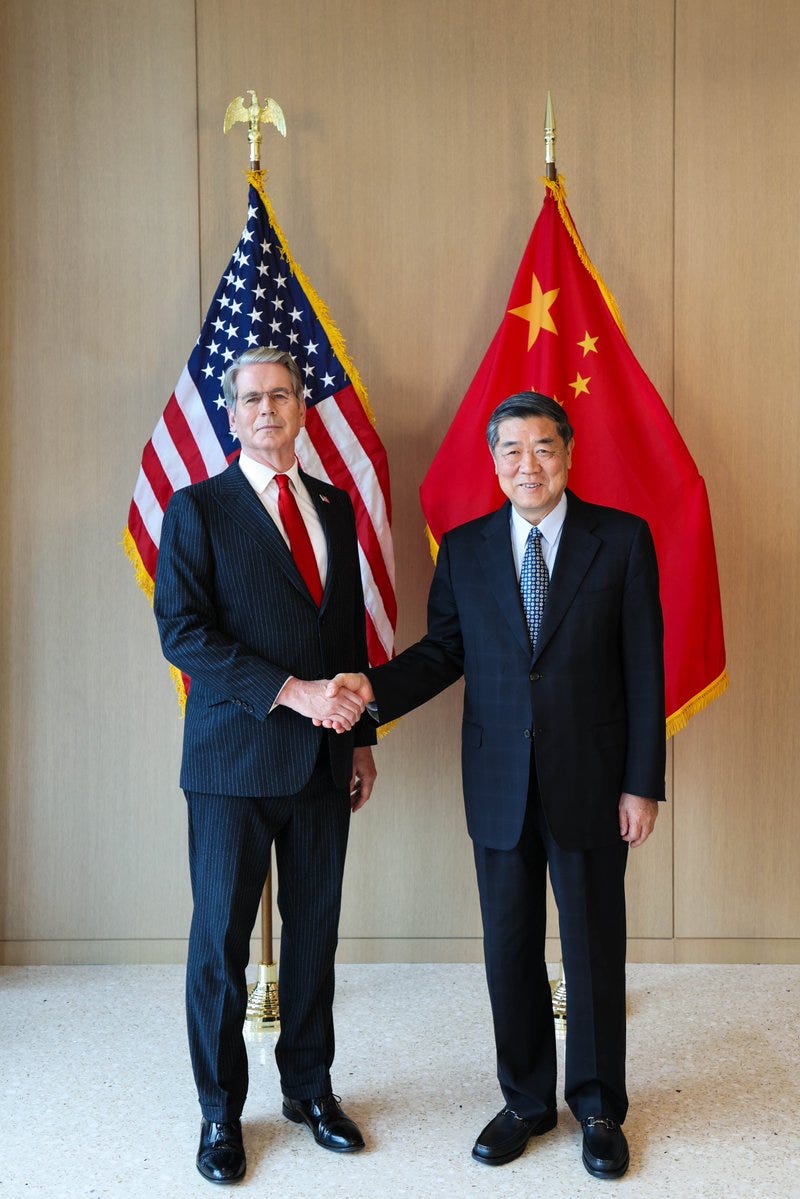
Bessent and Greer Briefing:
Scott Bessent: Hey, good evening. Happy to take some questions. We just had a very successful engagement with the Chinese on trade and AI, completing where we left off in Beijing. We there created the board of trade and began the subject of AI and this evening those were operationalized.
Jamieson Greer: Yep, that’s exactly right. We started in Beijing with notions on a board of trade AI dialogue. Today those notions have become reality. Most importantly, what we’re doing is we’re helping President Trump and President Xi continue their relationship. These are the two most powerful countries on earth whether it’s in trade or AI and it’s imperative that they’re able to work together. It doesn’t mean there aren’t challenges in the relationship. A lot of these are obvious. We don’t have to go into detail on those right now. What matters today is that we are preparing the groundwork so that when President Xi comes to Washington on Thursday, President Trump and President Xi will be able to have a successful summit.
Reporter: Did you discuss the slowdown in investments? Have you discussed AI chip exports?
Scott Bessent: I’m sorry, you’re asking about the AI dialogue? No, what we discussed was setting up a mechanism. So, it’s going to be called the US-China AI dialogue. We’ve agreed to meet again. The US has proposed that we have a notification mechanism between the two countries and we want a shared vision of common goals and common threats.
Jamieson Greer: And I would say US export controls were not on the agenda for that.
Lara (New York Times): What will the notification look like? Will it be for incidents or what [inaudible]?
Scott Bessent: Well, the notification for whether there are incidents, whether there has been something that rises up to a national security level from AI, because we think that, just like with any cross-border activity, that moving from opaque to more transparency between the number one and the number two AI powers in the world is very important.
Reporter: Did both sides discuss happening any mutual on the reduction on tariffs on [inaudible] worth of goods? Can you share any details of products that were [inaudible]?
Jamieson Greer: So, we’ve operationalized the board of trade and the teams right now upstairs are continuing to work through this to see if they can find some critical mass of goods where in the future when and if there are trade measures, these are goods that could be considered separately. Goods that are nonsensitive, goods that could be traded in a balanced way and create a kind of ballast for the relationship.
China and U.S. Hold Economic and Trade Talks in New York
On September 20 local time, Chinese Vice Premier He Lifeng, China’s lead for China-U.S. economic and trade affairs, held economic and trade consultations in New York with U.S. Treasury Secretary Scott Bessent and U.S. Trade Representative Jamieson Greer, who led the U.S. side.
Guided by the important understandings reached by the two heads of state, and following the principles of mutual respect, peaceful coexistence and win-win cooperation, the two sides had candid, in-depth and constructive discussions on key economic and trade issues of mutual concern, including the implementation of understandings reached in previous consultations and ways to promote bilateral trade and investment. The two sides also held a dialogue on issues related to artificial intelligence.
Also worth noting, China today officially announced that President Xi Jinping will pay a state visit to the United States from 23-25 September.
BEIJING, Sept. 21 (Xinhua) — At the invitation of U.S. President Donald Trump, Chinese President Xi Jinping will pay a state visit to the United States from September 23 to 25.
Foreign Ministry spokesperson Guo Jiakun said at a regular press briefing on Monday that during the visit, President Xi will have in-depth exchanges with President Trump on major issues concerning China-U.S. relations as well as world peace and development.
Guo said head-of-state diplomacy plays an irreplaceable role in providing strategic guidance for China-U.S. relations. Reciprocal visits by the Chinese and U.S. presidents within six months will be historic and of milestone significance.
China is ready to work with the United States to further enrich the substance of a constructive and strategically stable China-U.S. relationship, strengthen dialogue and cooperation, properly manage differences, continue to improve the well-being of the two peoples, and promote global peace, stability and prosperity.
At the same time, Chinese state media reported that Xi had replied to nearly 100 students from 10 U.S. universities, including Harvard, encouraging them to become “inheritors, guardians and promoters of China-U.S. friendship and cooperation.”
President Xi Jinping recently replied to students from 10 U.S. universities who had traveled to China for youth exchange programs.
In his letter, Xi said he was pleased to learn that the students had enjoyed a memorable trip to China. He noted that they had expressed their appreciation for Chinese civilization, their hopes for friendship and cooperation between China and the United States, and their willingness to serve as ambassadors of friendship across the Pacific.
Xi stressed that young people in China and the United States share the same planet and the responsibilities of their generation. He encouraged them to work with other young people in both countries to become “inheritors, guardians and promoters of China-U.S. friendship and cooperation,” help deepen mutual understanding and friendship between the two peoples, contribute to the steady and long-term development of bilateral relations, and bring youthful energy to building a better world.
Recently, nearly 100 students from 10 U.S. universities, including Harvard, wrote to Xi about their experiences and takeaways from exchange programs in China, including the “2026 China-U.S. Youth Journey: Together Across the Asia-Pacific.” They also expressed their willingness to contribute to greater friendship between China and the United States.