

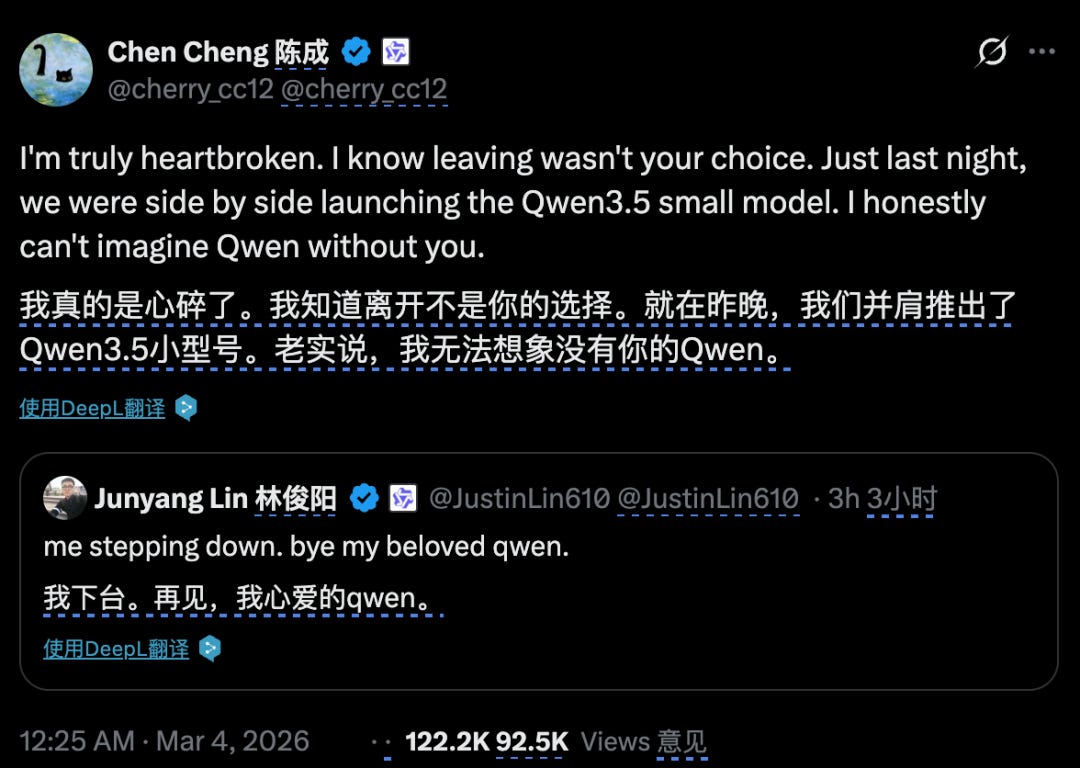
In the early hours of March 4, 2026, Lin Junyang, the technical lead of Alibaba’s Tongyi Qwen large-model team, posted a brief message on social media:

It was later confirmed that he had formally submitted his resignation to Alibaba on the afternoon of March 3. The news was subsequently shared within a small circle inside the Qwen team, prompting strong emotional reactions among team members.
The departure came very suddenly and no official explanation was provided, leaving outside observers temporarily uncertain about his next move or even whether he had fully left Alibaba.
At the same time, several other key members of the Qwen team also departed:
Yu Bowen, head of post-training, left on the same day.
Huibin, head of Qwen Code, had already joined Meta in January 2026.
These developments have been widely interpreted as an important signal of a wave of senior-level departures within the Qwen team.
An exclusive report by LatePost has revealed some behind-the-scenes details of the incident.
In the early hours of Wednesday, March 4, Lin Junyang, the technical lead of Alibaba’s Qwen team, suddenly posted a message on social media: “me stepping down. bye my beloved qwen.”
It was later confirmed that Lin had formally submitted his resignation to Alibaba on the afternoon of March 3. Shortly afterward, the Qwen team shared the news internally within a small circle. According to people familiar with the matter, some members of the Qwen team were deeply emotional upon hearing that he would be leaving—one colleague was even said to have “broken down in tears.”
As of 4:00 a.m. Beijing time, Lin Junyang’s social media post had received more than 5,000 likes and over 700 comments, most of them expressing appreciation for the contributions of the Qwen team and the open-source large model community.
On the same day, Yu Bowen, who had been responsible for post-training at Qwen, also formally departed. His role will be taken over by Zhou Hao, a former Senior Staff Researcher at DeepMind who joined Alibaba’s Tongyi Lab earlier this year. Zhou Hao reports to Alibaba Cloud CTO and Tongyi Lab head Zhou Jingren.
We have also learned that Huibin, the head of Qwen Code, had already left Alibaba in January 2026 to join Meta. Lin Junyang subsequently took over responsibility for Qwen Code, and as recently as last week he was still sharing recruitment posts on social media related to the Qwen Coding Agent.
Several people close to the matter told us that Lin’s departure came as a surprise. “There’s a sense of regret,” one said. “It’s bittersweet. He really loved Qwen.”
Lin’s decision to leave likely has something to do with the organizational restructuring currently underway within the Qwen team.
The Qwen (Tongyi Qwen) team directly overseen by Lin Junyang sits within Tongyi Lab, which is led by Alibaba Cloud CTO Zhou Jingren. Recently, Tongyi Lab has planned to split the Qwen team apart—moving away from a vertically integrated structure covering different training pipelines and modalities toward a horizontally structured system with separate teams for pre-training, post-training, text, multimodal, and other functions. These teams will remain under Tongyi Lab, but Lin’s management scope has been reduced.
This move to break up and redistribute the model teams also runs counter to Lin Junyang’s own view of where the technology is heading. Over the past year, Lin has repeatedly argued that pre-training, post-training, infrastructure, and training teams should be more tightly integrated and communicate more closely. LatePost previously reported that the Qwen model team began building its own infrastructure team from mid-last year; previously this work had largely been handled by Alibaba Cloud’s AI platform PAI, which supports infrastructure needs for multiple teams within Tongyi Lab.
Over the past one to two years, several major Chinese tech companies have carried out multiple rounds of adjustments to the organization of their model teams, with Alibaba making comparatively fewer changes. In comparison with other Chinese companies’ AI structures: ByteDance’s Seed division internally runs a “horse-race” system where different teams work on the same direction and modality; the Doubao main model series is organized around the workflow stages of pre-training and post-training; and Tencent, following adjustments last year, has become more integrated, with both model training and infrastructure teams under the management of Yao Shunyu.
Given Qwen’s reputation and achievements in recent years, Lin Junyang is unlikely to lack opportunities. Several investors and major companies had already been in contact with him, some hoping he would start a company of his own, while others had extended job offers.
Prior to this change, the Qwen team had already been facing subtle internal tensions within Alibaba.
On the one hand, Qwen enjoys strong support in the global open-source community. Its wide range of model sizes has made it popular among smaller startups, and a number of well-known companies—such as Cursor—fine-tune and post-train their products on top of Qwen models. Qwen’s open-source multimodal models have also become the base models of choice for many Chinese embodied-AI companies.
At the same time, Qwen and Lin Junyang have continued expanding the boundaries of the team’s capabilities, creating overlaps with other parallel teams inside Tongyi Lab. For example, Qwen has been developing VLA embodied models, while another team in Tongyi Lab led by Xu Zhuhong is working on similar efforts. Qwen has also been building text-to-image models (Qwen-image) and speech models, areas that overlap with Tongyi Lab’s Tongyi Wanxiang (focused on multimodal generation) and Bailin (focused on speech models). As Qwen also began building its own infrastructure teams, it gradually started to resemble a fully fledged “full-stack AI lab.”
On the other hand, Alibaba internally has been continuously evaluating Qwen’s results and value.
Some questions have been raised about the commercialization efficiency of open-source models: although Qwen enjoys strong reputation, open sourcing may affect Alibaba’s ability to generate direct revenue through selling model APIs.
There have also been internal assessments of specific Qwen outputs. We understand that some Alibaba executives were not fully satisfied with Qwen-3.5, which was unveiled on Lunar New Year’s Eve, describing it as a “half-finished product.”
From Alibaba’s broader perspective, technological influence and contributions to the open-source community are not ends in themselves, but rather means to achieve strategic and commercial goals such as AI cloud and a “super AI app.” In the AI cloud market, Alibaba Cloud is facing aggressive competition from ByteDance’s Volcano Engine, while ByteDance has adopted a closed-source model strategy. On the super-app front, during the recently concluded Lunar New Year subsidy battle, the Qwen app did not significantly narrow the gap with Doubao.
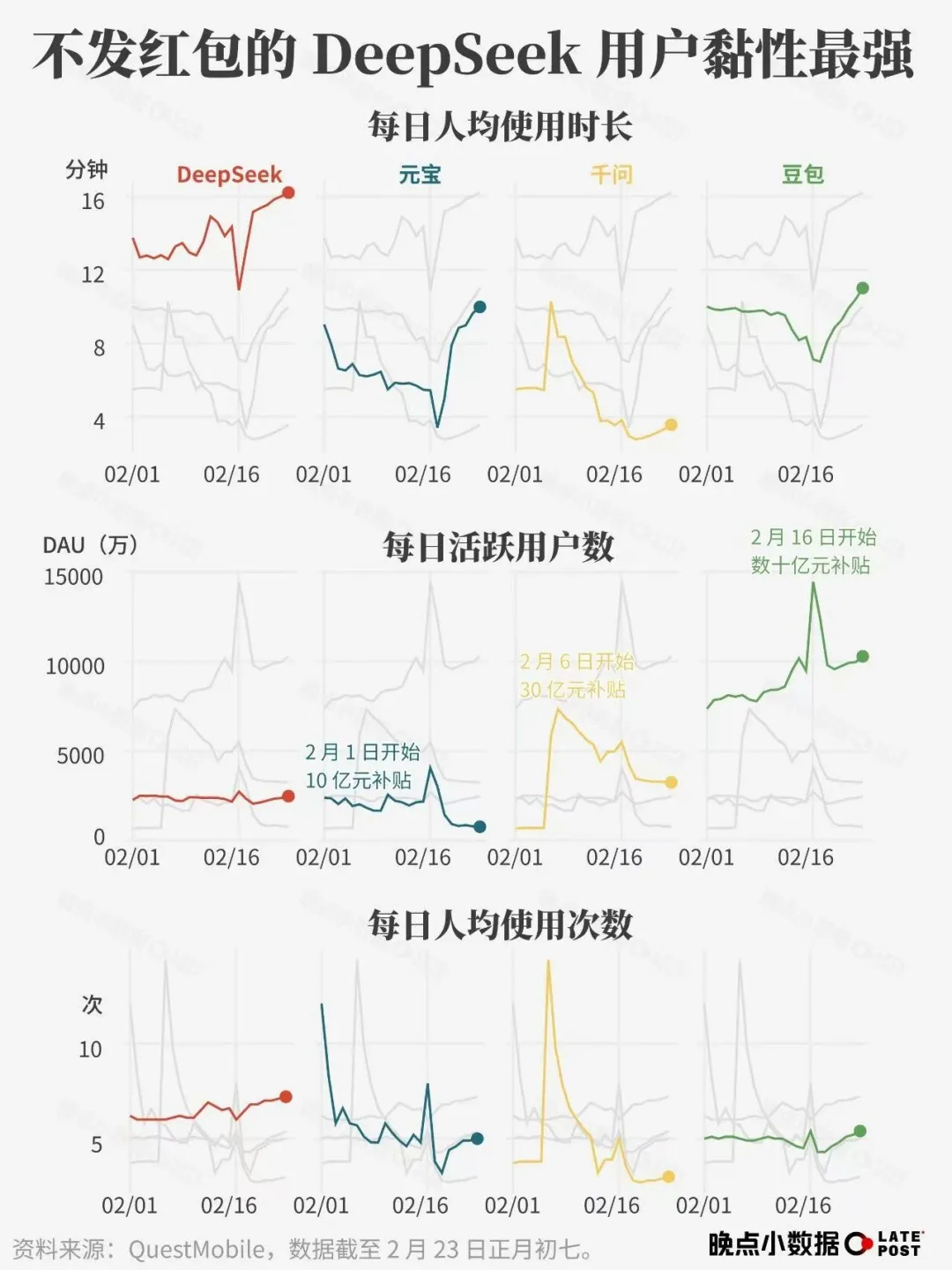
The commercial objectives and technological goals were not fully aligned. The tension between top-down strategic planning and division of responsibilities on the one hand, and the independent exploration of smaller internal teams on the other, reflects a deeper issue between the Qwen team and the broader environment within Alibaba.
Notably, Lin Junyang, Yu Bowen, and Huibin—who have all recently left the company—started their careers at Alibaba as fresh graduates and were trained within the company. Lin Junyang joined Alibaba DAMO Academy in 2019 after earning a master’s degree in Linguistics and Applied Linguistics from Peking University. Yu Bowen joined DAMO Academy in 2022 after completing his PhD at the Institute of Information Engineering of the Chinese Academy of Sciences and was one of Alibaba’s “Alibaba Stars” that year. Huibin, born in 1999, formally joined Alibaba DAMO Academy in 2022 after obtaining a master’s degree from Tianjin University. All three were involved in the early training of the Qwen model.
Lin Junyang has an interdisciplinary background spanning computational linguistics and AI. Unlike many high-profile AI leaders, he is not an overseas-returned PhD but a technologist who rose within China’s domestic research environment while building international influence. In 2025, Lin—born in 1993 and then 32 years old—became Alibaba’s youngest P10.
Zhou Hao, who recently joined Alibaba, received his PhD from the University of Wisconsin–Madison in 2019. According to his LinkedIn profile, he was a key contributor to projects including Gemini 3.0, Al Mode, DeepResearch, and Gemini 1.0, and led multi-step reinforcement learning work for Gemini 3.0.
Lin Junyang’s departure has sparked extensive discussion within the AI community. Many of his colleagues and practitioners in the field expressed regret and appreciation for his work on social media.
Based on accounts from several people close to Lin, his management style emphasized supporting team members and encouraging both self-motivation and cohesion. He believed an ideal manager should be a “reasonable person” who operates with logic. For leaders of smaller teams, he often said the most important responsibility is to recruit people better than themselves—otherwise it is “a failure.” Behind this philosophy, he believed leaders must keep their ego small, not assume they are invincible or capable of doing everything themselves.

A member of Tongyi Lab once told us that before the AI boom of 2023, the Qwen team—already developing large models at the time—had grown in a relatively unnoticed corner of the organization. With fewer interruptions or competing pressures, the team was able to focus its energy on iterating and improving the model itself.
But once AI became an all-or-nothing “total war” among major tech companies, the core model research teams at each company began facing far more organizational changes. Such changes are often triggered when R&D efforts encounter clear setbacks, yet Alibaba’s latest adjustment came at a time when both external evaluations and internal morale were relatively strong.
Lin Junyang’s decision to resign also came as a surprise to Alibaba. From the company’s perspective, however, the needs of the organization ultimately take precedence over the preferences of any individual.
Later today, 36Kr revealed details about an emergency all-hands meeting Alibaba held following Lin’s resignation.
“I should have known about this earlier.”
At around 13:00 Beijing time on March 4, Tongyi Lab convened an emergency All Hands meeting. Alibaba Group CEO Eddie Wu spoke candidly to employees of the Qwen team.
Twelve hours earlier (00:11 a.m. Beijing time on March 4), Lin Junyang, the technical lead of Alibaba’s Qwen large model, had suddenly announced his resignation on X. Lin is widely regarded as a central driving force behind Alibaba’s open-source AI models and one of the youngest P10 technical leaders at the company. As the news spread across the industry, some members of the Qwen team themselves struggled to accept the abrupt departure of such a pivotal figure.
“Given that we achieved today’s results with far fewer resources than our competitors, Junyang’s leadership was one of the key factors,” more than one Qwen team member told Intelligent Emergence.
During the meeting, several Qwen members—represented by Liu Dayiheng, the Qwen RL (reinforcement learning) lead—raised a series of questions to Alibaba’s senior leadership. These concerns touched on topics such as the planned team restructuring, the arrival of new member Zhou Hao, the direction of model development, and the allocation of resources.
Participants in the meeting included several Alibaba executives, members of the Qwen team, and staff from other teams within Tongyi Lab. Addressing issues related to organizational changes and strategic direction, Alibaba CEO Eddie Wu, Alibaba Chief Talent Officer Jiang Fang, and Alibaba Cloud CTO Zhou Jingren responded to multiple questions.
According to Alibaba’s leadership, the core characterization of the recent changes is that Qwen is not being downsized. Instead, they described the move as an expansion of the team, unrelated to any political infighting, and one that would require additional resources.
“We are growing rapidly. This adjustment is meant to bring in more talent and provide more resources,” said Alibaba Chief Talent Officer Jiang Fang. She also acknowledged shortcomings in communication: “We didn’t communicate this organizational change well enough. Bringing in new people will inevitably change the formation of the team, and expansion always involves adjustments. We may not have handled this properly.”
There had been speculation that Zhou Hao would directly lead Lin Junyang and his related teams. However, according to Intelligent Emergence, Zhou Hao’s exact role and reporting lines are still under discussion.
During the meeting, Alibaba executives repeatedly emphasized that the Qwen foundational model is currently the most important priority for the entire group. The competition in large models, they stressed, is not just a matter for the Qwen team but for the whole Alibaba organization. Both foundational model development and underlying infrastructure will be coordinated at the group level—“we must surpass the competition.”
Alibaba Cloud CTO Zhou Jingren also addressed several pointed questions, including issues around hiring quotas and shortages of computing power. Some team members asked why external clients—such as startup companies building large models—appear able to purchase Alibaba Cloud computing resources smoothly, while internal teams struggle with limited computing capacity and restricted hiring quotas.
Zhou responded that the team is currently operating under tight resource constraints, noting that the differences between internal and external allocation stem from a variety of historical reasons. He added that broader planning is underway but did not elaborate further.
As for Lin Junyang’s next move, no definitive update was given during the meeting. However, around 2 p.m. that afternoon, Lin posted another message on his social media feed, saying: “Qwen brothers, just keep working as planned. Everything’s fine.” He did not clarify whether he would be returning.
Just days earlier, Alibaba had completed a new round of updates to its AI strategy, unifying the umbrella name and core brand for its AI efforts under Qwen. Organizationally, the company also introduced another round of internal restructuring.
According to Intelligent Emergence, the Qwen team previously maintained its own pre-training, post-training, and infrastructure teams. In terms of model modalities, the team also covered several directions, including language models, multimodal models, and code models.
In the past, training single-modality models had been the industry norm. However, as demand for visual understanding continued to grow, vision–language models (VLMs) emerged, making deep integration across modalities a major trend in the field.
A person familiar with the situation told Intelligent Emergence that starting in 2025, Lin Junyang had been exploring ways to bring together employees working on language, image, video, and code models within Qwen, with the goal of improving training efficiency. At one point, the Qwen team proposed merging with the Wanxiang team, but the plan did not materialize; instead, the Qwen team eventually developed its own Qwen-image model.
In the latest round of restructuring, however, Tongyi Lab planned to split the Qwen team along functional lines such as pre-training, post-training, vision understanding, and image generation, merging these units with corresponding teams within Tongyi Lab—such as Tongyi Wanxiang and Tongyi Bailin—to work together. But with insufficient communication around the changes, tensions ultimately surfaced.
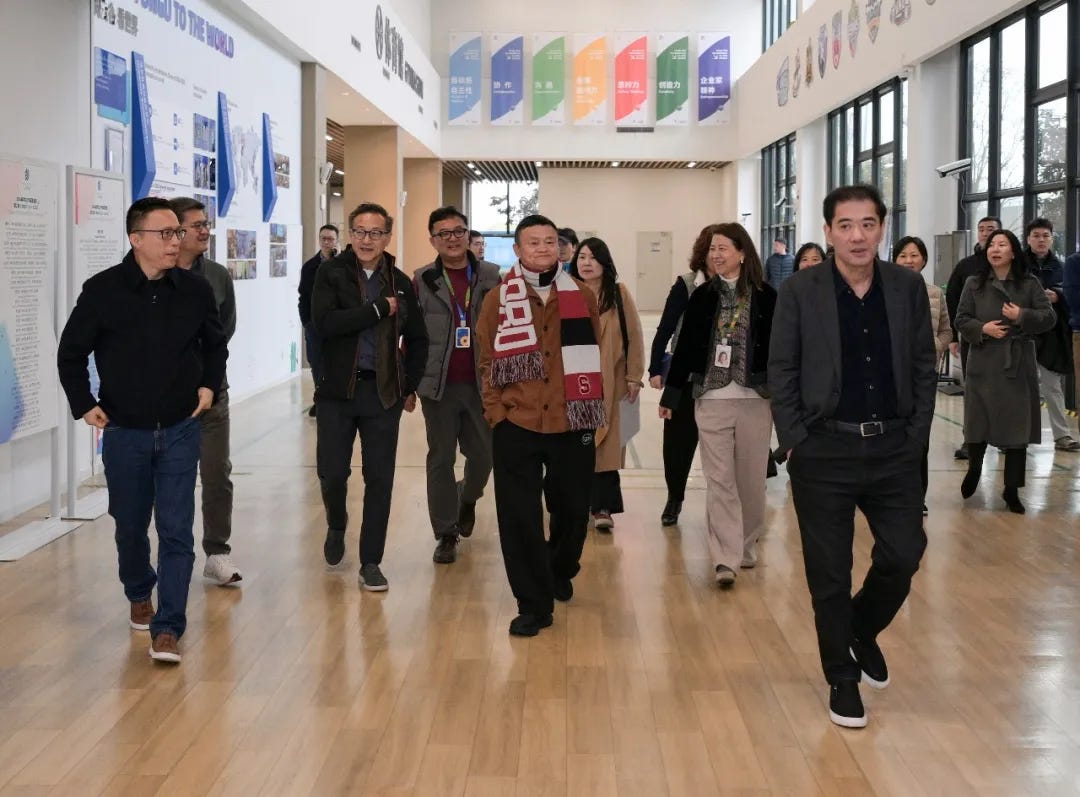
One day before the incident took place, Jack Ma unexpectedly appeared at a school in Hangzhou. What was particularly notable was that this time nearly all of Alibaba’s core executives were present, including Joe Tsai, Eddie Wu, Shao Xiaofeng, and Jiang Fan from Alibaba, as well as Eric Jing and Han Xinyi from Ant Group.
Together with them, Jack Ma spent more than an hour speaking with the school’s principal and teachers, discussing the challenges and opportunities brought about by AI.
Below is the official statement released by the school, which reveals many additional details.
On the day before the start of the new school term, the core leadership teams of Alibaba and Ant Group visited Yungu School.
Joe Tsai, Eddie Wu, Shao Xiaofeng, and Jiang Fan from Alibaba, together with Eric Jing and Han Xinyi from Ant Group, joined Mr. Ma in a discussion with the school’s principal and teachers that lasted for more than an hour. They exchanged views on the challenges and opportunities brought by artificial intelligence.
Mr. Ma told the group that the era of AI has already arrived rapidly, and its impact on society may exceed expectations. None of us, he said, is fully prepared for it. But for teenagers, the opportunities for change are the greatest. The purpose of this visit to Yungu was therefore to share Alibaba’s increasingly clear insights into AI with the educators.
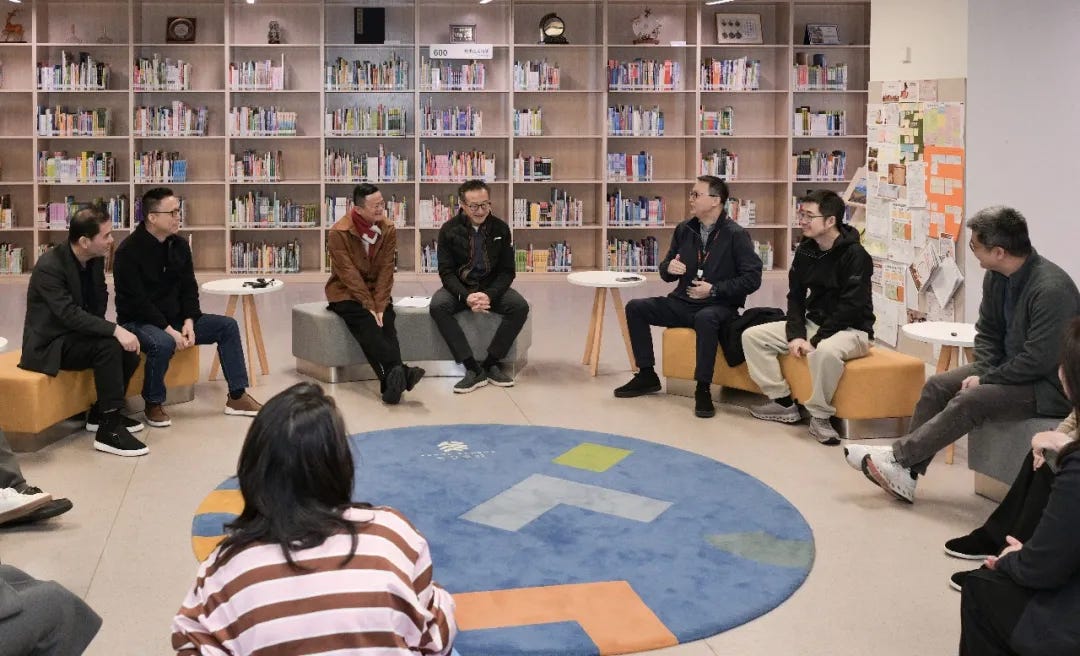
During the discussion, participants noted that AI is evolving on a weekly cycle, with its capabilities continuing to grow. This technological revolution will bring historic changes to productivity and many aspects of society. Material wealth in the future could increase dramatically. People may no longer need to work eight hours a day, but many of the professions familiar today may disappear. Mr. Ma explained that the reason they came together to Yungu was to emphasize that this transformation will come very quickly, and education must adapt rapidly to help children learn to coexist with AI and adjust to this profound shift.
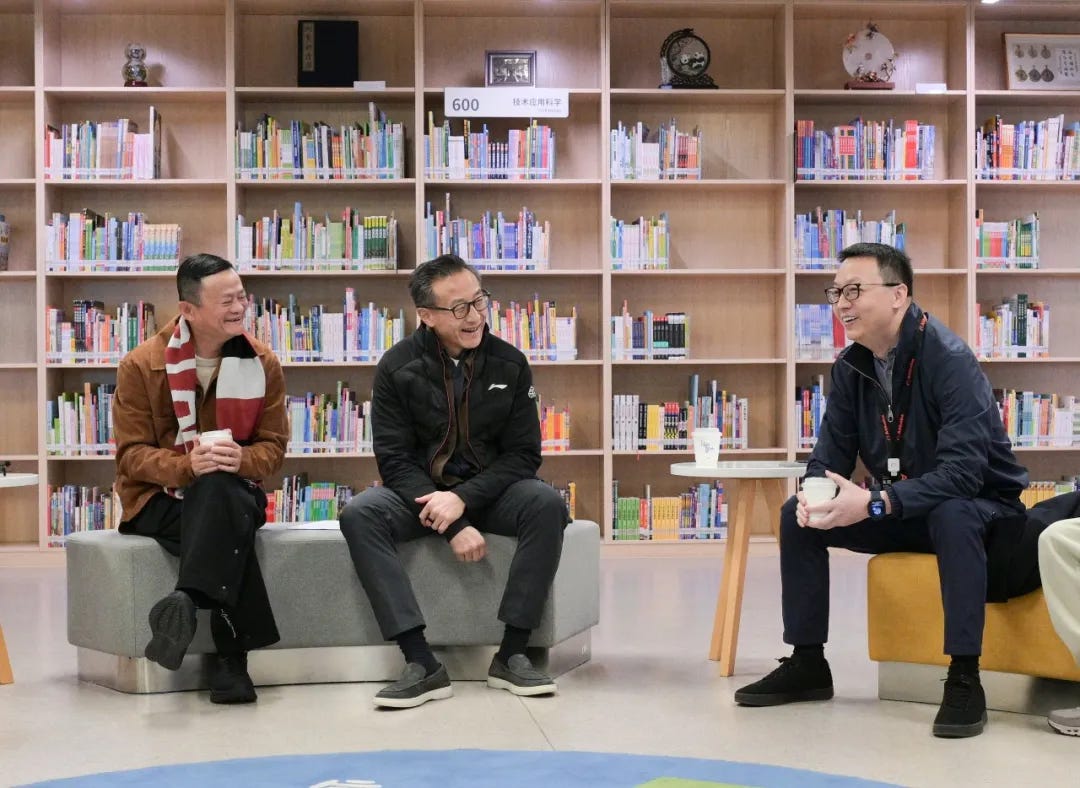
Joe Tsai, Chairman of Alibaba Group, remarked that in the AI era, critical thinking will become increasingly important. Critical thinking is not simply about asking questions, but about asking the right questions. In the future, machines may be able to perform many tasks, but communication—both between humans and machines and among people themselves—could become one of the most important capabilities.
Alibaba CEO Eddie Wu said that the key differences between humans and machines in the future lie in three qualities: curiosity, empathy, and physical capability. Curiosity drives people to explore and act voluntarily, whereas machines are passive. Empathy reflects the ability to understand others. And when intellectual tasks are increasingly handled by AI, physical ability will become more important, meaning sports and physical education will gain greater significance.
Eric Jing, Chairman of Ant Group, said that AI should be used to handle repetitive and tedious work so that people have more time to develop their unique human qualities, including aesthetic sense, creativity, and imagination. At the same time, while making good use of AI, we should avoid letting it become a crutch we cannot discard, and must preserve the ability to think independently.
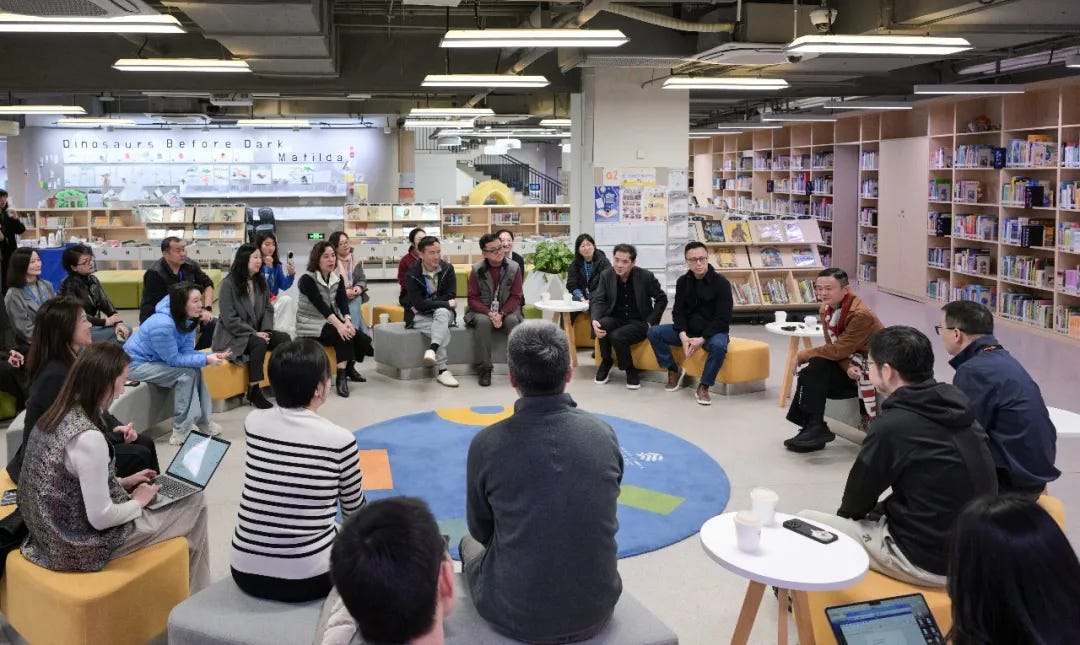
Jack Ma added that while AI brings tremendous disruption, it also creates enormous opportunities—especially the opportunity for education to return to its true essence. Time previously spent on rote memorization and endless test practice can be freed up and redirected toward nurturing creativity and imagination. Children will have more time to play, to learn music, painting, and sports, and through these experiences they can learn to share, to feel and experience the world, to listen, and to understand others.
Participants also discussed how Yungu School might adapt to these changes in the future. Mr. Ma noted that whether a school belongs to the AI era should not be judged by how many AI servers it has or how strong its AI technical capabilities are. AI possesses “chips,” but humans possess hearts. The greatest change AI will bring to education is that teachers can fully embrace their role as “engineers of the soul,” rather than mere transmitters of knowledge. The goal is not for children to compete with AI in computation or memory, but to remain curious, develop empathy and responsibility, and cultivate a sense of lived experience. Curiosity, imagination, creativity, judgment, and aesthetic sensibility are the true abilities that education must foster in children in the age of AI.
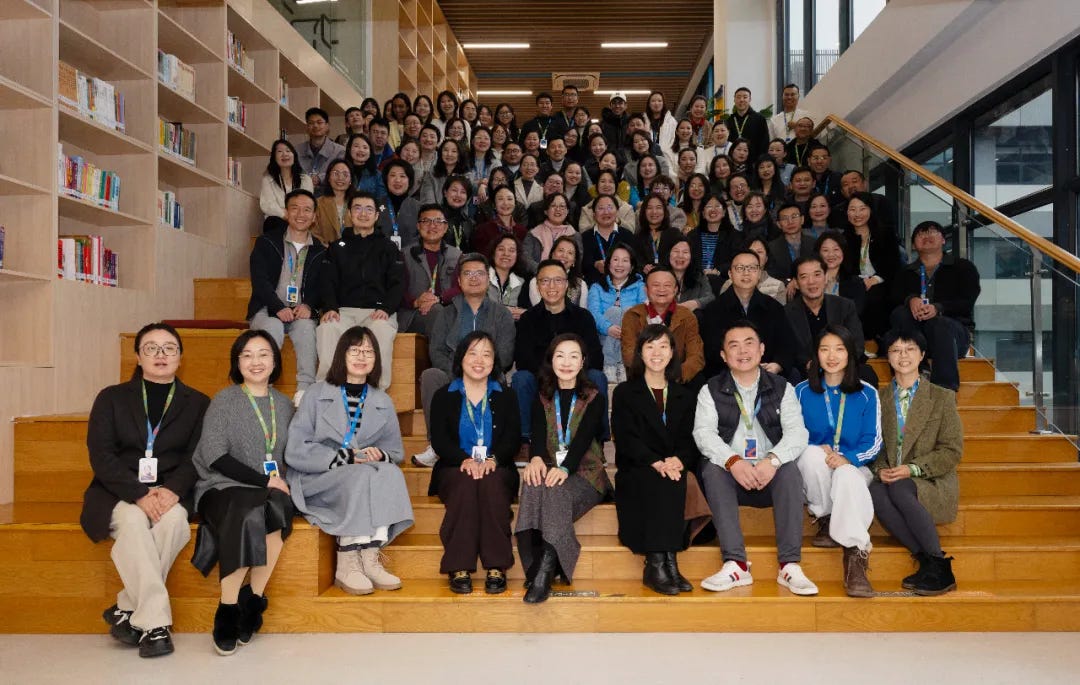
Thanks for sharing