

During HUAWEI CONNECT on September 17, 2026, Eric Xu (Huawei’s Rotating Chairman) and Dr. Liao Heng (Chief Scientist of HiSilicon) had a Q&A session with journalists of media outlets to discuss Huawei’s Peerium Computing Architecture for the AI era as well as UnifiedBus (UB).
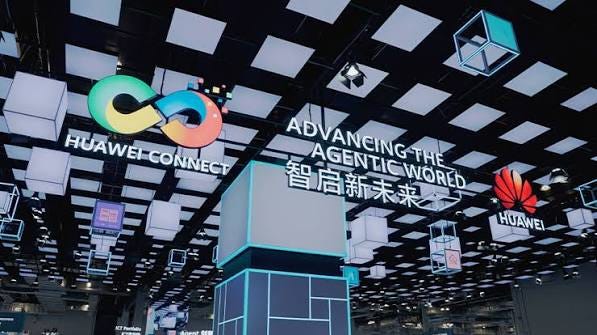
At last year’s HUAWEI CONNECT, Eric Xu gave a keynote speech and released Ascend chips and their roadmap (including the 950, 960, 970, and SuperPoDs and SuperClusters). He also announced the open release of the UnifiedBus protocol.
At this year’s HUAWEI CONNECT, Huawei announced the Ascend 950 and the Atlas 950 SuperPoD. While the industry is talking about SuperPoDs or supernodes, the ways of making these products differ hugely. The key of SuperPoDs is about allowing several thousand or even tens of thousands of processors to work as one computer.
There are five points from the interview that I think are particularly worth highlighting:
First, Huawei says Ascend has already overtaken Nvidia in China in terms of market share, and the biggest constraint now is supply, not demand. According to Eric Xu, the Ascend 950DT, designed for AI training, is currently being tested and is expected to enter large-scale supply by the end of this year or early next year. Tests with Chinese model developers have produced “quite good” results, and Xu expects a large amount of AI model training in China to run on 950DT-based SuperPoDs starting next year. In other words, the question is no longer how Huawei can persuade Chinese AI companies to use Ascend, but how many chips Huawei can actually produce and supply.
Second, Huawei believes China should still be accelerating AI development rather than talking about slowing it down. Xu argued that leading U.S. AI companies have access to much more compute and are further ahead in model development, which may explain why they have a stronger sense of AI risks. China, in his view, has not yet reached that stage. The implication is quite clear: China’s immediate priority is still to catch up; discussions about the kinds of risks now worrying leading U.S. AI companies may become more relevant once Chinese models reach a similar level of capability. That said, Xu also stressed the need to eventually strike a balance between AI development and risk management, with the bottom line being that AI should be used for good.
Third, Huawei does not plan to expand Ascend aggressively overseas in the near term because it cannot even meet domestic demand. There is strong interest from several overseas markets, and Huawei is conducting tests and providing limited supplies. But its priority remains Chinese customers. Overseas supply will largely be limited to customers that either cannot obtain alternative solutions or specifically want a second supplier.
Fourth, Xu sees China’s push for semiconductor self-sufficiency as irreversible. His logic is that even if Chinese chips are not yet as advanced as the best foreign products, having a secure and reliable supply is more important than having better-performing chips that could be cut off at any time. He therefore believes China will ultimately pursue self-sufficiency not only in AI chips, but across the entire semiconductor value chain—and that achieving this is ultimately a matter of time.
Fifth, the bottleneck for expanding Ascend supply is no longer just advanced chip manufacturing; the entire AI supply chain is constrained. Xu specifically pointed to optical modules and memory, arguing that global AI demand has grown so quickly that the supply chain as a whole was not prepared. He expects global supply and demand to gradually come back into balance around 2029, and potentially even later in China. This point is also worth considering alongside the recent U.S. policy debate over the optical-module supply chain.
Full translation of the Q&A:
Q: Dr. Liao, your paper mentioned a SuperPoD that’s made up of 256,000 cards. Is that the upper limit of your technology? Can you tell us more about market demand for your products?
Liao Heng: 256,000 or roughly 200k, this number is not an arbitrary number.
First of all, the purpose of these large clusters is for training. It has a hardware infrastructure that can support the training of foundation models, which today are already in the 5T parameter range.
Over the next two years, there will be roughly 6 or 7 frontier AI labs in China, and all will aim at training foundation language models of sizes ranging from 10 to 40 trillion parameters. These numbers kind of match up to the memory capacity and the size of the SuperPoD. So you need such a scale of infrastructure to train these models.
The second thing is that in China, most data centers have a national plan on this power grid. So 200,000 is a relatively conservative number, given the design of the power delivery system in a single autonomous zone and single data center campus.
As I said, everybody must be quite familiar with the AI model race that’s happening across the globe. And in China, there are at least 3 or 4 tier-1 players that are already well recognized and have achieved tier-1 status.
Q: What are your plans to encourage Chinese model providers to use Ascend chips for training?
Eric Xu: For the Ascend 950, we first launched the 950PR to the market. It’s primarily used for AI inference, and currently the total volume of supply available in the market is not very big. The SuperPoDs based upon the Ascend 950DT are mainly used for AI training. Right now, they are under testing, and their large-scale supply will start at the end of this year or early next year. We are having extensive dialogues and discussions with AI model providers. The testing result of using the Ascend 950DT for training is pretty good. I believe that starting from next year, a lot of AI model training will be based upon SuperPoDs that use the Ascend 950DT. I think at the end of the day, it’s not about how hard we are going to push model providers, but about how much supply capacity we will have. We can only supply based on how much that’s produced. And we hope the value chain will expand its capacity faster to increase supply.
Q: What is Huawei’s take on recent calls by leading AI model providers in the US to slow down AI development?
Eric Xu: We need to look at the level and cadence of AI development in China and the US. AI models in China are largely open-source models and their progress is relatively transparent. If we look at the mainstream model providers in the US, they have more computing power, so maybe only they themselves know where they are in terms of the level of sophistication of their models. The market feeling about AI risks might be weaker in China than in the US. Model providers in China need to speed up their pace to reach a level where they could also feel the risks from AI development. And then, maybe they will feel the same as the leading US model providers. But I always believe that we need to strike a balance between driving AI development and managing AI risks. At the very least, the bottom line is we need to ensure AI for good, not AI for evil.
Q: Does Huawei have plans to bring the Atlas 950 SuperPoD to other markets outside China? If yes, which markets are you going to target? Can you share with us data about your market share in China? What is your take on China’s push for chip self-sufficiency?
Eric Xu: Since we don’t have enough capacity to even satisfy the demand in China, we don’t have plans to expand to the international market in a fully-fledged way. But indeed, there are several countries that have very strong demand. We are doing some testing, and we are providing some supply to those countries, but the volume is quite limited.
Right now, it’s pretty hard to collect data about the market share of NVIDIA in China. But based on the data we have collected, Ascend has surpassed NVIDIA.
China’s push for chip self-sufficiency is an inevitable path forward. China is a country of 1.4 billion people and it’s an industrial powerhouse, so the way people work and live is closely tied to chips. Chinese people have a keen sense of urgency, and will not accept a future in which others decide whether or not we can have access to certain products. Even though our chips may be less advanced, at least their supply is assured, so that you don’t have to worry about chip supply day in and day out. I think that’s certainly the path forward. For the Chinese government, for the domestic industry, and for Huawei, the path forward is undoubtedly to push for full self-sufficiency in terms of chips and the entire semiconductor value chain. We also believe this will become a reality sooner or later.
Q: Your UnifiedBus interconnect technology is derived from your long-term strengths in computing and communications. How much of UnifiedBus comes from your networking department?
Eric Xu: UnifiedBus is not just derived from the networking part of our business. We have integrated different interconnect protocols to develop one unified protocol. Networking relates more to the IP protocol, and its latency is much higher. When we look at computing interconnect, it’s different from traditional networking, and it relates more to the bus, which should deliver low latency and high speed. When we made the decision to work on the product itself, our idea was to put it within the computing department, not the traditional networking department. We think it’s a better option if we want to deliver UnifiedBus with high speed, low latency, and a unified protocol.
Liao Heng: If you think of UnifiedBus as a brainchild of a group of people, it was conceived by the computer architects, but it was raised by the networking team.
Q: UnifiedBus works for both scale-out and scale-up, and NVIDIA has NVLink and InfiniBand for these two scenarios separately. So what’s the consideration for Huawei to unify protocols into one UnifiedBus that supports both scale-up and scale-out? What are the advantages of UnifiedBus compared to similar solutions?
Eric Xu: It’s not an issue of whether or not NVIDIA develops a unified technology. It’s an issue of whether they have the capability of developing such a technology. Their latest NVL72 solution has a large intra-rack communications bandwidth of 1.8 TB/s. But once InfiniBand is used for inter-rack communications, the bandwidth drops to 0.2 TB/s. With such a low inter-rack communications bandwidth, there is no way you can make one million processors work as one computer. I think everyone wants to have a super high-speed interconnect for intra-rack, inter-rack, inter-data-center, and even inter-autonomous-zone communications, because that is how we can turn a huge number of processors into one computer. That’s the very value of UnifiedBus. We can use one unified protocol for high-speed interconnects at all layers. Technology-wise, UnifiedBus functions like a bus for the computer, and it does not just support the links. Based on UnifiedBus, we can achieve an inter-rack communications bandwidth of up to 800 GB/s.
After we made the UnifiedBus protocol openly accessible last year, the most downloads took place in Silicon Valley. At the very beginning, NVIDIA might not want to work on an NVL72 solution; they might be aiming for an NVL256 solution. But they ended up with the NVL72 solution, not the NVL256 solution. Huawei, however, has developed a SuperPoD solution with 384 910C processors, and we have shipped more than 1,000 sets of this solution. That’s largely because we have UnifiedBus for this solution. NVIDIA uses NVLink for intra-rack communications, and their inter-rack communications speed is not high enough, which makes it very hard for them to scale as much as they want.
Liao Heng: Part of your question was about why a single protocol is necessary, because clearly NVIDIA and most other vendors have used at least two protocols, in some cases maybe more than two. Imagine if your trip involves airplanes, high-speed railways, and cars, and the transit is quite time-consuming. Massive traffic switching is required inside a supernode. If you make a transit from NVLink to InfiniBand, at least you’re talking about microseconds of transit time from one protocol to the other. With these two separate protocols, it’s hard to meet latency requirements.
With UnifiedBus, we are using a single protocol. That means if you’re moving a packet from a scale-up network to a scale-out network, you would only take maybe 150 nanoseconds. There’s at least one order of magnitude savings on the protocol conversion overhead.
Q: In Atlas 950 SuperPoD with UnifiedBus, how much of scale-up is carried out electronically versus optically? Do you think optics will eventually take over the entire rack? And what are the biggest barriers?
Eric Xu: The Hi-ONE module that Huawei launched this morning is an NPO module that supports a bandwidth of 7.2T and it is only five centimeters away from the main chip. We use copper wires to connect these two and the rest is all optics. So we can say that this SuperPoD is almost a fully-optical SuperPoD. And the light source is also integrated into the Hi-ONE module. I would say that in the next two to three years, no other vendor will be able to produce a similar module. Huawei is able to develop and mass-produce this module because we have many years of experience in photonics.
Liao Heng: Earlier in my career, almost dating back 20 years ago, we were already talking about making chips go optical. Because we all know optical has a short travel distance and very little attenuation, so signals can travel longer distances at a high speed.
But if you look at what is inside Hi-ONE circuit-wise, there aren’t many components. But mass production used to be very difficult for us. Because optics has a lot of physics. If the temperature changes by some degree, then it affects the physical property of the diode, the refraction index, and the waveguide properties, so things don’t work.
I think the biggest adoption barrier is the concern about reliability because things fail. Most other providers have almost predominantly chosen to place a laser outside. Just think about if you have to feed 32 channels of signal using a single light source, the power of the light source has to be multiplied by 32 times. That’s a lot of power that leads to problems at the coupling interface and everywhere else. We chose to integrate the light source into the module. It’s just a purely engineering, pragmatic choice. Hi-ONE is a fantastic compromise after compromise, finally reaching into production status very soon.
Q: You mentioned the limited capacity and supply of Ascend chips in China’s mainland. So what are the largest barriers holding back the increase of capacity in China’s mainland? Until what time will Huawei be able to ensure large-scale and stable supply?
Eric Xu: The bottleneck in China’s mainland is basically the same as the bottleneck around the world. The global industry is not prepared for the AI surge that we are seeing. When we look at providers of optical modules and storage products, they are selling at a very high premium not necessarily because they have very good products, but because of a very severe shortage of supply compared to market demand. Only when we see balance in supply and demand in China’s mainland and throughout the world, can this bottleneck be fully addressed. As I look at it, the supply-demand balance on a global basis will be achieved somewhere around 2029. And in China’s mainland, it’s probably gonna be even slower. As we look at this supply-demand balance, we have to take into account constantly evolving technologies in the AI landscape, such as NPO (near-packaged optics) and CPO (co-packaged optics).
If we look back at the history of Huawei, no matter in the communications business or the IT business, the current volume we supply to the market is already something we can call “supply at scale”. But if we compare our volume of supply to the demand for AI infrastructure, I think it is very little. If we are to supply as much as customers want, that kind of balance will ultimately rely on the supply-demand balance across the whole industry in China.
Q: There have been reports about Malaysia considering Huawei’s Ascend 910C accelerator as the backbone of the country’s sovereign AI initiative. How can you balance the demands of domestic and foreign customers?
Eric Xu: For any customers, their decision to deploy Huawei solutions is made based on considerations about geopolitics and multi-vendor strategies. All companies must look to the long term, and try to ensure their supply security. In that context, Ascend is certainly one choice for a lot of customers, though there might be some gaps with some of the competitors. The balance between satisfying the needs of domestic customers and those of international customers is actually quite easy: We prioritize Chinese customers who are in urgent demand for compute; outside China, we only supply to a very limited number of customers who either have no access to alternative solutions or who want an alternative solution.
Q: When Huawei decided to choose NPO over CPO, what were the most significant opposing opinions within Huawei?
Eric Xu: It seems there was no debate within Huawei on this. Huawei works on optical devices, optical modules, and Ascend chips, so we know which is the best choice for us. So the consensus within Huawei was reached very early-on. We just went for NPO, rather than CPO. On top of that, we think NPO will be the best choice for a long period of time, from several perspectives like engineering implementation, cost, maintainability, and yield.
Industry players have gained a clearer understanding of NPO and CPO over time. That’s perfectly reflected in two recent discussions at the Optical Internetworking Forum (OIF). In the first OIF discussion, a number of members did not support NPO – they were determined to work on CPO. But in the most recent OIF discussion, only a very limited number of participants were still against NPO, and a new NPO project was initiated. NPO still has a copper interconnect of about 5 centimeters, which is longer than CPO’s copper interconnect that is about 5 millimeters. However, compared with CPO, NPO brings down the cost by nearly 40%. And there is another benefit of NPO: If the optical engine goes wrong, the whole AI chip won’t be scrapped together with the optical engine. Of course, CPO and NPO are not a matter of one replacing the other; rather, it’s a choice of balance across factors such as engineering implementation, cost, supply chains, and maintainability. There’s no right or wrong here.
Huawei is fully committed to NPO. We are driving standardization efforts and also helping to develop the whole industry ecosystem, so that there is a technical path for NPO to flourish. We are not saying that CPO is a bad thing. 40 vendors at OIF are now supportive of NPO after seeing the benefits that it can deliver.
Q: What feedback have you received from model providers on the areas and issues for improvement regarding the use of the 950DT for training? What changes have you made to make the pre-training better on Ascend?
Liao Heng: The first barrier encountered by Ascend is actually not hardware itself. It’s primarily the ecosystem barrier, because two years ago, there was still a tremendous software barrier for Ascend, while CUDA clearly had a dominant advantage, because the entire academia grew up together with CUDA. So all the algorithm developers are used to the convenience of PyTorch plus CUDA.
There have been dramatic changes over the last 18 months. First of all, there’s a tremendous change in sophistication of the model mathematics, and the programming complexity has increased accordingly. Secondly, the models are getting very fine-grained, meaning you can no longer write a program in PyTorch alone and maintain efficiency at all. So, even for the algorithm developers, they have to move towards this mega kernel style of programming, and they need to adopt a new programming language. So that was already the way of development of the frontier labs.
Now, when new compiler languages come along, these new compilers are replacing and gradually balancing the barrier of CUDA, because CUDA was no longer deemed important by the frontier labs, nowhere near as much as two years ago. This is the dissolution of the software barrier. I think we are getting on par or even closer to balance. The gap is greatly diminished.
Secondly the chip itself, we have our own advantages, as I said, UnifiedBus and the Nested BSP model. It’s not just about programming a single chip, but also about programming a huge number of chips in convenient ways. We are providing those. And inside the chip itself, we have learned our lessons and made a lot of improvements.
Overall, we are closing the gap between NVIDIA and Ascend. I think nowadays, the main difference is just much smaller. When people use these processors for development, they don’t feel as foreign anymore.
Q: Next week, the Chinese leader will be meeting with the US president, and AI would be part of their conversation. As an entrepreneur from China, what kind of expectations for cooperation do you have toward that meeting?
Eric Xu: All entrepreneurs in China may have one shared aspiration, which is peaceful coexistence in market competition without government interference. We previously lived in an era of globalization and full competition, where enterprises relied on innovation and products to win over customers. But with the growing impact of geopolitics, globalization is leaving us. Enterprises want to have access to global markets and win customers through innovation and products, rather than being trapped in a situation where they cannot buy or sell what they want.
For the past 30+ years, Huawei has relied on innovation to win a place in the market. We rely on sustained, heavy R&D investment to improve product competitiveness, so as to win the trust of our customers. Between 2007 and 2025, our cumulative R&D investment was more than 1.8 trillion yuan. We were also committed to allocating 10% of that R&D spend to basic research. It’s exactly because of our heavy R&D investment and our strong focus on innovation that translate into more competitive products. Our innovation-driven approach in a competitive marketplace explains how we have become what we are today.
Friends from the press who have been following the communications industry may know the journey Huawei has gone through over the last several decades. It’s the same for AI. We just take a path that we are good at and that can lead us to build future-oriented competitiveness.
Q: Is UnifiedBus a unique path for China’s mainland, considering its lack of access to advanced process nodes? Or is it something that the whole industry will need sooner or later? Will NVIDIA possibly move in your direction?
Eric Xu: UnifiedBus is a path for innovation and is also a path for the future of AI compute.
Because it is only with the UnifiedBus interconnect technology that you can possibly build a massive computer with one million processors. When one million processors work as one computer, this lays the foundation for better and more efficient AI training and inference. Therefore, I see UnifiedBus as the path for the future AI era. I believe, in the years to come, other players would certainly follow suit.
That’s also the reason why we made the UnifiedBus protocol openly accessible. Because we believe the whole industry will move towards the same direction and we are looking forward to concerted efforts across industry towards artificial general intelligence (AGI). That’s also the reason why Dr. Liao published the paper to introduce our Peerium Computing Architecture, because Peerium is the architecture for the AI era. For the 960, it has pretty much the same specs as the thing I introduced last year, and the only change is its faster pace of market availability. HBM is a part of the 960. Without improvement in HBM, we would not have the improvement of the entire 960.
The UnifiedBus interconnect technology is the foundation for us to implement the Peerium Computing Architecture. Both the UnifiedBus interconnect technology and the Peerium Computing Architecture are the paths to the future AI era.
I’ve said it many times that when we look at a single chip, the issue Huawei faces is not about the design itself, but about the limitations of sophisticated process nodes available on China’s mainland. But if we interconnect a huge number of chips to build a single computer, I think we have achieved global leadership in this respect. That is built upon our innovations on both architecture and the interconnect technology. Efforts in these areas started before the US restrictions, rather than after them. It was at HUAWEI CONNECT 2018 that I announced the first AI chip from Huawei together with our AI strategy. In 2019, we launched SuperPoDs and clusters. Since then, we have held the idea that, in order to support AI training and inference, the industry would need a new architecture and a new interconnect technology. That’s also the time we started to ramp up investment in research and innovation. This has laid the foundation for us to launch the new computing architecture and the UnifiedBus interconnect technology.
I believe the whole industry is faced with the same issue. Once you are in a multi-computing-card or multi-accelerator environment, Model FLOPS Utilization (MFU) is a very critical metric. When you work on large AI model training, once one computing card becomes faulty or its performance deteriorates, it would incur major losses for the whole AI training.
Based on the UnifiedBus interconnect technology and the Peerium Computing Architecture, we have developed SuperPoDs and SuperPoD-based SuperClusters. These solutions can substantially improve MFU, and this is a fact that has already been validated. That’s also what top model providers value most as they use the Ascend 950 to train their AI models. We can also provide original manufacturer services. That can help to further improve MFU, reduce AI training costs, and make AI training iterate faster as well.