

On November 14, Huawei’s boss, Ren Zhengfei, held a discussion with ICPC global winners and their coaches at Huawei’s Lianqiuhu R&D Centre in Shanghai.
The conversation covered a lot of ground, touching on many different issues.
For example, Ren Zhengfei talked about his views on AGI. In his view, the U.S. is pursuing AGI and superintelligence from the angle of “what is a human” and “where is society going,” while China is more focused on using AI to get things done—improving city safety and public services, pushing unmanned operations in high-risk, high-intensity sectors like mining and cement production, and using technology to solve development problems and create real, tangible value.
But unmanned operations will inevitably free up a huge amount of labor, which means China will need massive retraining programs. He suggested converting empty schools and factories into vocational training centers and using “learning vouchers” to help laid-off workers retrain and return to the workforce. As total national wealth grows, the goal is to raise the professional skill level of the entire population at the same time. In software development, for instance, AI can already handle around 30% of a programmer’s workload, and this could reach 60–70% in the future. That’s why automation can’t be pushed too fast—we need to keep social structures stable and seriously think through two questions: how do we distribute the new wealth created, and how do we help people displaced by technology re-enter a new division of labor through retraining?
He also talked about quantum computing. He believes quantum breakthroughs are inevitable and that quantum computers will definitely become a reality, delivering huge advantages in certain types of computation. But research in this area is a mission for humanity and for nation-states—not something a single company like Huawei should or could take on alone. When quantum computers mature, Huawei can simply buy them. And if quantum one day breaks today’s encryption systems, then “we’ll deal with it when it happens.”
He used nuclear fusion as an analogy: fusion will succeed someday, but we don’t know when. That doesn’t mean we should stop building power plants today. The same logic applies here: quantum computing will succeed, and AI will go much further in the future, but we can’t put today’s practical work on hold just because we’re imagining a distant future.
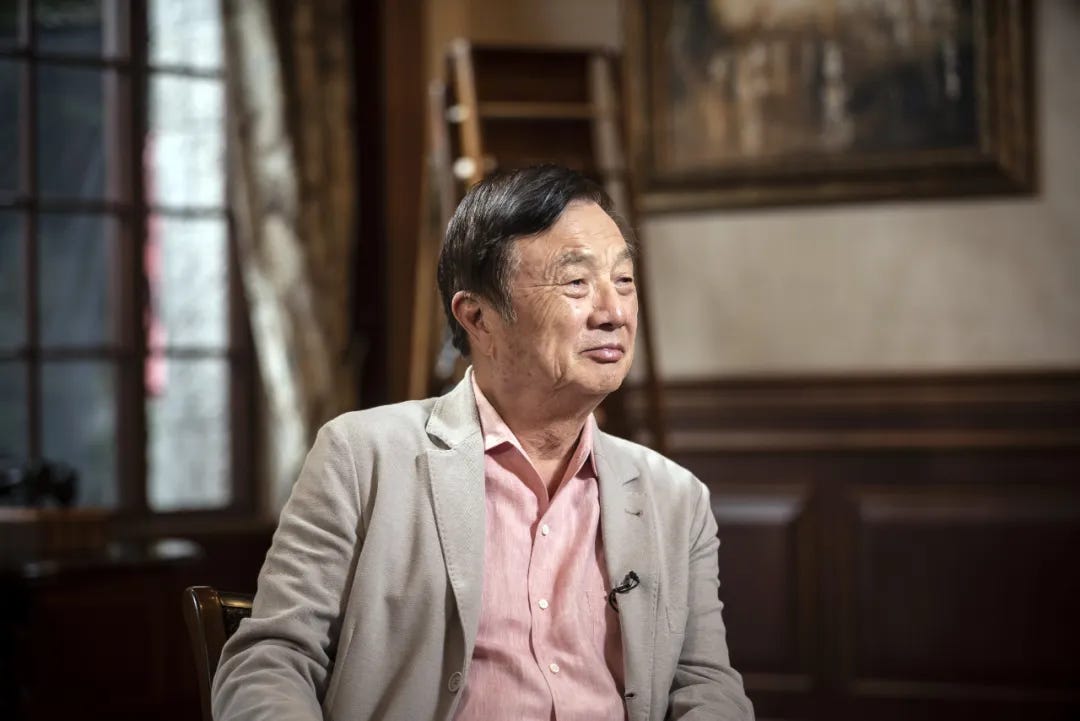
Below is the full translation (unofficial) of the record of the discussion between Mr. Ren and ICPC leaders, coaches and winners:
Conversation at the Shell Library by Lianqiuhu
Veronika Soboleva: Good morning, everyone! First of all, a big thank you to Mr. Ren for bringing the ICPC teams to this beautiful Lianqiuhu campus. It’s a great honor to be here today. All the participants here represent the ICPC community. They’ve worked very hard over the past year, and they come from more than 30 countries and regions. There are over 110 people here, including coaches and winners from all over the world. Some are joining remotely and some are here in person. We’re very happy to be here to share ideas and hear your insights. Many thanks to Huawei for the thoughtful arrangements and for bringing together coaches and contestants from the ICPC community. One of our key goals is to connect academia, universities, and industry, so this is a perfect event. Welcome, everyone!
ICPC President: First, thank you very much for inviting us to this beautiful campus. It’s an impressive place in every respect and a great place to meet friends and gather together. I’d like to express our gratitude for this opportunity. There’s a wonderful word in English—“together.” Being together like this means a lot. Thank you!
Ren Zhengfei: Thank you very much to the ICPC President, to all the coaches, and to all you young world champions. We believe we are living in an era of rapid change, and our hopes lie with the youth. You are shining with the light of youth, you are role models, and the hopes of the times are placed on your shoulders.
In your field, I’m an outsider. I don’t really know in detail how things should be done, and I’m also somewhat confused about this era. Being able to build a channel of communication with you in such a time, to establish a friendly connection, and through that connection feel the pulse of the world and the dreams of young people—that is a great privilege for me. We are all experiencing this era of great leaps together, without really knowing exactly what kind of technological future lies ahead. That’s why we need to work and explore together.
Since I don’t know you well, I can’t give a very systematic, prepared speech. Instead, I’d prefer to have a conversation, to listen to your views and questions.
Veronika Soboleva: Thank you very much, Mr. Ren. Over the past three days, everyone has taken part in many workshops at Huawei, raised many questions, and solved many challenges. I know that people here have a lot they’d like to discuss with you about AI. This year’s ICPC challenge also focuses on AI as the main theme. I’m sure there will also be questions about education, and about differences and challenges around the world, because conditions and levels vary greatly from country to country.
1. On AI and its challenges
Veronika Soboleva: From our discussions yesterday, one question kept coming up. We’ve clearly entered the era of AI and are facing all kinds of AI-related challenges. How does Huawei see this? Not just for the ICPC community, but for the global community: how should we address these challenges? We have a lot of ideas, but what should we actually do? We’d like to hear how you think about the future of AI—what problems we need to solve and how we can work together to tackle them.
Ren Zhengfei: When it comes to AI, I’m really an outsider. In my mind, the relationship between AI and human beings can be thought of in stages. If we’re talking about 20 years from now all the way to the next thousand years, that’s something for sociologists and anthropologists to study. Yuval Harari is one representative of that kind of thinker. In books like Homo Deus, he explores how AI might bring deep changes to social structures and human existence. With the evolution of big data and large models, whether what he predicts is accurate or not is something you, as young people, might be able to truly judge in 20 years’ time.
If we talk about 10 to 20 years into the future, that timeframe probably belongs to visionary thinkers and great scientists, who are imagining what the structure of a future technological society might look like.
As a company, our research is focused on the next three to five years—how large models, big data, and massive computing power can be applied in industry, agriculture, and technology. For example, take a blast furnace in steelmaking: large models can help analyze temperature layers in the furnace, optimize fuel and ore mix, lower furnace temperatures appropriately, and predict what the silicon content in the molten iron will be two hours later. Based on that prediction, we can adjust the ratio of fuel and ore, and improve furnace efficiency by 1%.
In China, we can now mine coal at depths of 500 to 700 meters—and even deeper—using unmanned methods. Why is that possible? Because all the narrow underground tunnels are captured through sensors and stitched together into a real-time 3D “video” environment. Operators can sit on the surface—or even thousands of kilometers away—and remotely control mining machines, predicting gas explosions, water inrush, and collapses, and protecting miners’ safety. When coal comes to the surface, AI models can improve the precision of washing and sorting by 0.1%, meaning more high-quality coal.
In open-pit mines, excavation and loading can be fully unmanned. Hundreds of dump trucks and excavators can operate autonomously. Ports can be fully automated in loading, stacking, and customs clearance—like Tianjin Port, or Chancay Port in Peru. These are the kinds of scenarios we’re focusing on.
Then there’s healthcare. You may have heard of pathology slides. At Ruijin Hospital, large pathology models are already being used at scale. They help doctors analyze tissue slices more accurately and improve diagnoses. Zhongshan Medical University developed an ophthalmology model that can diagnose eye conditions using images taken by a smartphone or a specialized device, helping doctors in remote areas improve their diagnostic capabilities.
You’re also familiar with autonomous driving models in passenger cars, and voice assistants like Xiaoyi in car cabins or on phones. These are the kinds of areas we’re focusing on: using large models to solve concrete problems in production and everyday life. There’s still huge room for improvement and we still have a lot to learn.
2. On education, IOI, and helping less-developed regions
Question: Mr. Ren, I’m from the National University of Singapore and currently also serve as chair of the International Olympiad in Informatics (IOI). On behalf of IOI, I want to thank Huawei for its support over the years. Earlier you mentioned that some regions have not yet reached the level we see elsewhere. At IOI, our next big goal is to help these regions—not by giving them fish, but by teaching them how to fish. We want to bring coaches from those countries together, give them training materials and platforms, and help them raise their level in IT. If a country can’t even do basic programming well, it’s hard to imagine them doing advanced AI. We hope Huawei can strongly support us in helping these countries improve.
Ren Zhengfei: With advanced networks and infrastructure, society can finally meet exactly the kind of needs you described. In the past, you had to get into a top university and physically sit in a classroom with a famous professor to become a top student. Now, many leading universities have opened their courses online. A student in a remote mountain village can access courses from world-class institutions. The missing piece is often a good tutor to help them understand and apply what they learn. With good mentoring—even if it’s online—they have effectively “attended” a top university.
The internet has opened up all these possibilities. Education used to require physical concentration: everyone in one city, one campus. Now it can be logically distributed: through the network, even remote schools can make huge progress.
These days, seven- or eight-year-old kids sometimes ask teachers questions they can’t answer, because children are reading and watching a lot online and forming their own views. That’s a sign that society is advancing. Courses that once required going to Beijing, New York, Boston, or London can now be studied from a village through the internet. Of course, how deeply you can really understand these courses is another matter—you need good tutors. But even tutoring doesn’t always have to happen face-to-face; it can also happen online.
In short, we’re moving from a physically centralized education model to a logically distributed one. That’s good for human progress. When human society moves forward, the ones who advance the fastest are children—that’s intelligence growing and the times evolving. The hope of the future lies in the young, and young people will carry the responsibility of revitalizing society.
AI will drive big gains in productivity. In three to five years, we’ll really feel it. I don’t know exactly what things will look like in five to ten years or ten to twenty years—the pace of AI development is too fast to predict. But the examples I just gave are things that already exist today. For instance, in Tibet, a herder can have an ultrasound probe strapped around their waist. A scan of the liver is sent over 3,000 kilometers via 5G and optical fiber to a diagnosis center in Shenzhen, where doctors can detect echinococcosis (hydatid disease). There’s no way to equip every village in the plateau with a full ultrasound machine, but a portable probe and a fast network can do the job. That’s low-latency 5G and high-bandwidth optical networking.
The same kind of remote technology can be used for teaching. This is how AI and networks can bring huge progress to human society.
3. On education vs. enterprise, and “zero-to-one” innovation
Question: Mr. Ren, I’m a coach from Shanghai Jiao Tong University. I won the ACM–ICPC world championship three times—in 2002, 2005, and 2010. I later set up an ACM honors class because I wanted to train computer scientists, not just win more medals. Over the last 20 years, this ACM class has gained global influence. Many of our students go abroad for further study, and we hope they’ll eventually come back.
With the AI era upon us, China wants to bring in talent, but we can’t rely solely on attracting people from outside. We need to create our own talent. Only a strong education system can support a strong tech ecosystem. How can China get ahead of the curve in education? Many major tech breakthroughs now come from industry rather than academia. University–industry collaboration alone doesn’t seem to solve China’s education challenges fast enough. How do you see this?
Ren Zhengfei: We’re a company. A company’s nature is to create commercial value. A university’s nature is to explore the future of humanity. Universities do “zero-to-one” research and innovation. If the “zero-to-one” step fails, that’s fine—it still trains a large number of talented people. Those people stand on the theoretical foundations laid by their predecessors and keep climbing, and ultimately they will create a new future. Companies then take the theories universities create and turn them into industrial reality.
Recently I spoke with a great entrepreneur. He said our hydropower turbines are world class—both reaction and impulse types—but the original inventions came from Austria, France, the US, and other Western countries. The same is true for trains, ships, and textile machinery—most of the original inventions came from the West. Calculus and geometry were also developed there. Universities are where “zero-to-one” happens.
China will catch up and produce its own original breakthroughs. Let me give an example. One of the best weather models in the world was created by a 22-year-old engineer at Huawei. He used European weather satellite data to build a model that treats the universe like a wind tunnel and the Earth as an object in that tunnel. I’ve heard that with this model, people can predict grain yields, power generation, typhoon tracks, and more with high accuracy. So China will absolutely have original innovation. Our whole ultra-high-voltage DC transmission system, for example, is an original Chinese achievement. The “Starflash” communication standard we’re working on is also a world-class innovation.
We also have a 22-year-old Russian engineer who invented a new remainder algorithm that could change how we implement multiply–accumulate units in AI chips, significantly improving performance. But we haven’t adopted it yet, because the chip we previously designed took six or seven years and still isn’t in mass production. We can’t just change the architecture again.
So in short: the purpose of education is education itself; the purpose of a company is business. If we confuse the two, both will be worse off.
4. On finding talented students and the role of contests
Question: I’m from Hungary, and John von Neumann was Hungarian too. We take part in many international competitions. From what you said, I have one observation: in the AI era, success depends on finding the most talented students, whether they’re in high school or university. I want to thank Huawei for helping us identify these talented young people, because the ability to pose good questions and solve problems is the most important thing in AI today.
Ren Zhengfei: Hungary is a great country. It has produced many great scientists and also great statesmen. Many American politicians and financiers are originally from Hungary.
China has made a lot of institutional innovations that helped create today’s prosperity. Before reform and opening-up, China was a closed country. After we opened up, we brought in many outstanding achievements of global civilization. Civilizations don’t necessarily clash; more often they reinforce one another and trigger creativity. That’s how China’s economy achieved explosive growth.
Ships, trains, clocks, and many other things were invented in Europe—sometimes in very small countries. Once those inventions reached China, they pushed our development forward.
What we’re doing today—talking to friends from all over the world and to young people like you—is building connections. We just want to be friends and get to know each other. We want to understand the civilizations and cultures of different countries and create things that are useful to people everywhere.
5. On talent, industry–academia cooperation, and “aiming high”
Question: Hello, Mr. Ren. I’m a professor at CUHK (Shenzhen). I’ve taken part in programming contests for about 15 years. In the end, I chose academia over industry because I wanted to contribute to society by training the next generation of contestants and advancing technology. But in my research, I deeply feel that we really need close collaboration between industry and universities, especially when it comes to computing power and data. For example, one of the problems in this year’s competition came directly from industry and from the AI large-model era. The champion happens to be a PhD student from Georgia Tech, who did his undergrad at Zhejiang University. So this contest is a very good example of collaboration between universities and industry. In this new era, for competition talents—especially young people—what kind of support and opportunities do you hope Huawei can provide, to enable deeper exchanges and cooperation so that new breakthroughs keep emerging?
Ren Zhengfei: I think everyone has a different path in life. Some aim high, others aim lower; both contribute to society. Some college graduates work as “workers” in the new sense of the word. Three years ago, we recruited more than 3,000 undergraduates from remote regions in China. After three years of training, we certified them as technicians in our company. They are highly skilled workers in chip production and precision manufacturing. In the future, we’ll probably understand “worker” in a new way—people doing precision industrial work may all need higher education. So yes, college graduates can be “workers.” That’s actually one of the responsibilities of higher education.
Of course, we also need a group who really aim high—up to the world, even into space, and into the future of humanity. People should work hard, but they don’t all have to climb to the very top. Education should be tailored to individuals.
That said, if you’re capable of reaching high, don’t choose to stay low. Don’t just chase commercial goals. Sooner or later you’ll touch real truth. If one day you find that you can’t climb any higher, then you can come back down the “Himalayas.” On the way down, you can “lay eggs everywhere”—farm, herd cattle, raise pigs—whatever you like, and you’ll still be a hero. It’s always easier to come downhill. I encourage today’s young people: if you can reach high, go as high as you can.
Meta has been offering some young people signing bonuses in the hundreds of millions of dollars and annual salaries in the tens of millions. But in China, that doesn’t cause much of a stir online. Why? Because people don’t envy that as much anymore. There’s now a big group of very capable young entrepreneurs here. Seven or eight people can start a company together, or twenty or thirty people can form a founding team. The equity is theirs; if they succeed, they get the full upside. There are countless innovative startups in China, and in the next three to ten years, China will make huge strides.
In robotics, for example, there are hundreds of thousands of young people working in the field, and a lot of capital is investing in training them. Whether these ventures succeed commercially or not, millions of outstanding young people will grow through this process. This is good for the modernization of China’s industry, agriculture, and technology. These young people are the backbone of China’s modernization. They no longer envy others abroad; they focus on themselves and want to build things with their own hands.
Recently, Xpeng’s humanoid robot debuted and walked the runway. People didn’t believe it was real—they thought there was a person inside. Xpeng’s team cut open the “skin” on stage with scissors to show that it was all metal. The robotics industry is making huge progress. These small companies are very capable; they represent the future world. It’s still very hard to make a robot that’s truly like a human being—think about the brain’s energy efficiency or the density of nerves in human skin. But someone has to keep exploring the future. Human society becomes what it is through countless failures. In three to five years, China will make major progress. A stronger China will be good for global prosperity.
6. On planning one’s early career
Question: Hello, Mr. Ren. I’m a contestant from this year’s competition. I did my undergrad at Zhejiang University and I’m now a second-year PhD student at Georgia Tech. I’m the junior of the professor who spoke earlier, and I’d like to follow up on his question about personal development. If you could go back to age 20, how would you plan the first ten years of your career? I know as a business leader you think about how the collective strength of young people should be used. But I’m asking from the perspective of an individual young person: how would you plan your early career if you were 20 again?
Ren Zhengfei: I can’t go back to 20—God didn’t give me that ticket. I can’t really imagine what I’d do at 20. You’re the ones who are 20 now; your task is to ride the wave of the times and dare to be at the very front. Don’t worry too much about money, or whether your youth will be “used up.” Don’t obsess over metrics. What matters is that you do things that truly benefit humanity’s future.
Gregor Mendel discovered genetics, but his work sat in obscurity for over a hundred years before people realized how important genes are. Think about how crucial genetics is today, and how lonely and unappreciated he must have felt then. So don’t worry too much about what others choose, or what your classmates and friends choose. Worry about what suits you. Only you truly know yourself. Pick a path and work hard on it. Even if you don’t “succeed,” that’s okay. Most people in this world are “unsuccessful” in the usual sense, but the path of “not succeeding” is full of knowledge too. When you test and eliminate many hypotheses, that testing itself becomes a huge asset.
7. On criticism, doubt, and pushing through
Question: Hello, Mr. Ren. I’m a junior at Beijing Jiaotong University and I won the world bronze medal in this year’s ICPC World Finals in Baku. Thank you very much to Huawei for its support. I’d like to ask about personal development. We’ve been talking about the AI era and rapid change. I’m about to start a PhD in computer science at Peking University with Professor Xie Tao, and I’ve started doing some research. When you explore the frontier and propose new ideas—like in research papers—you inevitably face a lot of skepticism. In contests, and in life too, there are always doubters and people who look down on you. Huawei has also faced a lot of doubt in its history. How do you see these voices? And how do you keep going and breaking through in those moments?
Ren Zhengfei: It’s perfectly normal to advance in the face of doubt. Many important scientific breakthroughs were initially doubted. For example, Fourier’s idea that any function can be expressed as a sum of trigonometric series wasn’t accepted by the French Academy at first. Peter Higgs’ paper predicting the Higgs boson was rejected. The Copenhagen interpretation of quantum mechanics and the uncertainty principle were strongly opposed by Einstein.
In Huawei’s industrial work, we also faced lots of skepticism: when we pushed Polar codes and Massive MIMO in 5G; when we introduced constellation shaping in optical communications; when we pushed multi-camera smartphone photography… all of these faced resistance at first. To make breakthroughs, you have to be willing to face challenges and dare to innovate.
China State Railway Group is currently testing a new 5G-R wireless dispatch system for high-speed rail. Trains running at 450 km/h use 5G-R to carry dispatch signals. 5G-R coexists with radar to check track safety and monitor wheel and axle safety in real time. That’s a big step forward. China’s heavy-haul freight trains can pull 30,000 tons of coal per train. These trains are dispatched over wireless networks. In the past, we used GSM-R to control spacing between trains. This allowed many 20,000-ton trains to carry coal to ports like Qinhuangdao. In the future, we’ll upgrade to 5G-R to support tens of thousands of high-speed trains at 450 km/h plus 30,000-ton freight trains.
The 12306 ticketing system is led by a woman who started out as a young engineer and is now considered a “figure of the times” in China. She turned 12306 into the world’s largest real-time ticketing platform by traffic and transactions. China’s transport networks are getting more complex: passenger rail, freight rail, logistics. They all need advanced mathematics and AI to solve extremely complex problems. You could consider making these very concrete as a research direction.
China adds over 8,000 km of new rail lines every year. In the future, our total rail mileage will reach hundreds of thousands of kilometers, making it the world’s longest and most complex network. By the time you become a pillar of society, China may have 300,000–400,000 km of mainline rail—not counting suburban and metro lines. Managing the timetables, logistics, loading, and coordination of such a dense network is incredibly complex and will require very strong PhDs in mathematics and computer science.
Questioner: Thank you very much, Mr. Ren. I should clarify—my major is computer science, and I’ll be doing research in AI.
Ren Zhengfei: The day-to-day maintenance and safety of high-speed rail are all multi-modal AI problems. During holidays, the traffic on 12306 turns it into China’s biggest single internet application, and it’s already pushing the limits of capacity. Building and running railways also depends on computer networks. AI is deeply involved in all of that. So even highly “traditional” areas must be made concrete and connected to AI.
8. On AGI, jobs, and choosing majors
Question: Hello, Mr. Ren. I’m a coach from Beijing University of Posts and Telecommunications. I’ve been coaching our best competitive programming students for seven years, and this year I joined Huawei and now work in the datacom department. My question is: in your view, how far are we from achieving artificial general intelligence (AGI)? If AGI is achieved, many jobs and professions will be replaced. How should young people in China choose their majors and career paths? My child will take the college entrance exam next year, so I’m especially keen to hear your advice.
Ren Zhengfei: On AGI, the US and China have somewhat different focuses. The US is pushing toward AGI and even superintelligence (ASI), trying to answer fundamental questions like “What is a human?” and “What is the future of human society?” That’s important, but it also requires a long process of understanding.
China is more focused on how to do things: how to create value and solve development problems. For example, making cities safer, improving public education and healthcare, making mines and cement plants unmanned. Imagine coal miners going to work in suits and ties with rings on their fingers—that’s the reality in some places now. If you imagine dusty mines, extremely cold or hot job sites, or high-altitude factories, and then imagine those operations becoming fully unmanned—that will be quite a sight.
What about workers who are replaced by automation? We’ll need large-scale retraining. For example, we might introduce a voucher system: give laid-off workers education vouchers, repurpose idle schools and factories into vocational training centers, and retrain these workers. Back at the 12th National Congress of the CPC, China already proposed improving the “educational and cultural qualities of the entire population.” Today, we’re at a stage where we need to improve the professional skills of the whole population. In the past, vocational education often meant tracking junior-high students into technical schools. But they were too young to really master information technology. These days, even soldiers in the PLA are increasingly college-educated, because advanced weapons aren’t something you can operate with little formal education.
Large-scale automation will definitely cause some people to lose their jobs in the short term. But from a national perspective, total wealth will increase. If a factory produces 100 units of value with human labor and 120 units with automation, it frees up people. You take these freed-up people, retrain them, and then redeploy them into new roles. So yes, there will be downsizing in many positions. But with a solid re-education program, we can turn these people into talent in other fields. That’s the new challenge AI brings: how to share the extra wealth and how to re-skill people.
People often say software development will always need humans. But with large models and agents, AI-assisted software development has already taken over about 30% of engineers’ workload, and that could reach 60–70% in the future. We can’t push unmanned systems too fast, because social structures must remain stable. So the main benefit of AI is that it increases total wealth. How that wealth is shared, and how people are retrained and redeployed, is the core challenge.
9. On limited compute resources and Huawei under constraints
Question: Hello, Mr. Ren. I’m a PhD student at Princeton, working on large language models. There’s a common problem in academia: computing resources are limited. I know Huawei has also faced restrictions over the past few years on key components. Under such long-term constraints, how do you plan and make strategic choices?
Ren Zhengfei: I actually think that in the future, computing power will be overabundant, not insufficient. It’s perfectly reasonable to build thousands of large models or hundreds of large models. The question is: how big do these models need to be, and how much compute is enough?
At Huawei, when we talk about “super nodes,” we speak of numbers like 950, 960, 970. How many “970s” do we really need? Where will they be deployed? How many servers do we need, and how should we connect these clusters? That’s all linear extrapolation; linearly increasing compute is possible. But the key question is on the demand side: is demand linear? What if demand is non-linear?
So I believe an era of surplus compute is definitely coming. As model builders, you don’t need to worry too much about whether there will be enough compute. You should focus on scientific questions. Whether your models will be commercially deployed in thousands of industries, that’s something for another group of people to worry about—people we might call “industry application engineers.”
People online often say Huawei is not a “science company.” They’re right—we’re a technology company. Our official name is Huawei Technologies, not Huawei Science. Science is your work. We are users of science. We do applied science and engineering. Inside Huawei, we do have some positions we call “scientists,” but that’s just an internal job title, not some external academic benchmark.
So if you’re in theoretical research, walking the path of science, don’t spend all your time worrying whether your theory will be used tomorrow. If you worry too much about application, you’re actually an applied expert, not really a scientist. Doing theory is noble because it’s based on thinking and deduction, which is rare. Think about how hard it was to come up with Fourier transforms, Laplace’s equation, Maxwell’s equations. These were created through mathematical derivation and physical intuition—essentially “daydreams” written down as equations. At the time, how could their creators possibly know how useful they’d be to humanity?
Our job in industry is to implement things and respect original ideas. How to properly respect such originality is one of the big questions in our relationship with Europe and the US.
10. On women in STEM
Question: Hello! I’m from the University of Veracruz in Mexico. As you may know, Mexico—and North America more broadly—has just elected its first woman president. We’re also giving more and more opportunities to female contestants. In our region, about one-quarter to one-third of participants are women now. I’d like to hear your thoughts on women’s participation in STEM. Should we actively encourage it? My own story is related: my grandmother’s generation had hard lives and very little access to education. She taught herself to read and write. Now my daughter is studying engineering. For women, family support is critical. You’re a great entrepreneur—what’s your view?
Ren Zhengfei: Mexico is a great country. Beyond the Maya civilization, crops like corn, tomatoes, chili peppers, and sweet potatoes—all of which came from Mexico—changed China. Without these crops, China couldn’t have supported such a large population centuries ago. So Mexico has made a huge contribution to the world.
In the era of the Maya, women’s social status was relatively low, because life depended on heavy physical labor. Think of the ancient ball games where players used their hips to strike the ball through a stone hoop. Women simply didn’t have the physical advantage for that. But in the computer age, work is mostly about “slim fingers on keyboards.” In this field, women are no weaker than men. In today’s Chinese military, there are many female soldiers, and some of them fly heavy fighter jets—landing on aircraft carriers in their twenties. I have great respect for them.
Wu Jianxiong (Chien-Shiung Wu) was a woman. She proved parity violation experimentally. So in computing, which is not heavy manual labor, there is no fundamental difference between men and women. Where physical strength is decisive, women may be at a disadvantage. But in light physical and cognitive work, there is no essential difference.
So seeing more women in Latin America engage in creative work is wonderful. And Latin America and Africa are among the regions with the richest natural resources, much of which is still untapped. There’s great potential there.
11. On ICPC-style challenges and real-world problems
Question: Hello, Mr. Ren. I’m from Nizhny Novgorod State University in Russia. I want to highlight something about Huawei’s challenges compared with ICPC. Huawei’s problems are extremely close to real industrial use cases, and you let ICPC contestants try to solve them. One of those problems was cracked just two days ago. These kinds of challenge contests are very popular, and you organize them frequently. In the future, will such challenges involve more domain experts and scientists so that the problems become more and more connected to real industrial scenarios? And in the AI era, do you think we might need AI assistance to solve these challenges?
Veronika Soboleva: He’s the coach of a Russian team that won the ICPC world finals.
Ren Zhengfei: Our connection with ICPC actually started by accident. I met Nika (Veronika) by the Moskva River over coffee. At the time she was an ICPC director. Through that meeting, we “snuck” into the ICPC world, and later deepened our cooperation. You gave us a window to understand the world, and we opened another window for you.
Why has Russia produced ICPC champions year after year? Why does Google hire you with salaries six times higher than average? It’s not just Novosibirsk—St. Petersburg University, ITMO, and Nizhny Novgorod also have strong programs. Russia’s theoretical research is very strong. There are many countries good at mathematics—Russia, France, the US, and others. In the US, it’s often immigrant-based math; in France, Louis XIV and Napoleon promoted a “mathematics-first” national strategy; in Russia, Peter the Great and Catherine the Great imported many European scientists. Lots of countries have strong mathematical traditions.
We started to really understand this maybe two or three decades ago. I sent people to Moscow to set up a research institute and asked them to start by solving reliability modeling problems. At first, our engineers complained that Russian hardware was bulky, and I said: reliability isn’t only about hardware. Algorithms and software are mathematics—and math has no weight. That’s how we began to feel the importance of Russia’s theoretical strengths. Over time, we’ve expanded our collaboration in Russia. We respect the talent and technology of every country and have teams in many places working together.
12. On Romania and cooperation
Question: I’m from the University of Bucharest in Romania. We have a very good collaboration with Huawei, but there’s a barrier to expanding it: Huawei doesn’t yet have an engineering office or R&D center in Romania. Will Huawei set up such a presence there? Is that decided at headquarters or locally?
Ren Zhengfei: Romania is a great country. Eastern European countries have been very creative. Romania has a strong tradition in mathematics contests and helped launch the IMO—the International Mathematical Olympiad. Romania also exported petroleum engineering technology to China. In the early days, we learned oil exploration techniques from two countries: Romania and Azerbaijan. Back then, exploration was analog. Romania was one of the birthplaces of modern petroleum industry in Europe, and it developed a strong oil-equipment manufacturing industry out of concerns about depletion. After the 1990s, China started learning digital oil exploration from the US, which has advanced our exploration a lot. But Romania played a huge role in our early industrial development. We still want to deepen cooperation with Romania. As European law allows, we’ll continue expanding our operations in Europe.
13. On Indonesia, application vs. frontier research
Question: I’m an undergrad from Jakarta, Indonesia, now at the University of Toronto. My professors often say that in Indonesia, when it comes to AI, the focus is more on applying existing technologies rather than making fundamental breakthroughs. I might pursue further study, so I’d like to ask: what do you think of this? Do you have any advice for young people from countries like mine who want to go deeper into tech and work in this field?
Ren Zhengfei: I agree with your professor. For Indonesia, the urgent task is not necessarily to compete at the frontier of compute and large models, but to lead in applications. That fits your national context better. Indonesia has a huge number of ports, and intelligent automation of ships and ports is exactly the kind of area where AI can help. You’re already making progress there. Your islands are often only 50–60 kilometers apart, so building complete wireless communication networks is not hard.
China’s Beidou navigation system, combined with Huawei’s technology, can provide centimeter-level positioning on Earth—that’s very suitable for your needs. In ports, for instance, ships used to be docked with ropes and complex procedures. Now they can be gently “pulled in” with electromagnetic systems and moored more easily. AI can play a huge role in Indonesia’s industrial takeoff, including in agriculture. There are parts of China where farming is now largely unmanned; similar applications will surely be possible in your country.
14. On whether there are fields that “don’t need AI”
Question: I’m a professor from Belarus. I’ve worked on several projects and I can imagine that in about five years, some fields might still be without AI. Are there any areas that fundamentally don’t need AI? For example, some students—especially in pure mathematics—might not need AI at all and can do everything on their own.
Ren Zhengfei: Belarus is very strong in thermal engineering and related technologies. You’ve developed advanced heat-pipe solutions and magnetorheological polishing techniques. Those are critical for chip cooling. Heat is the biggest problem in chips—if it can’t be dissipated, the chip can’t deliver its full potential. These are highly advanced scientific and engineering challenges, and Belarus plays an important role there.
So there’s huge opportunity for development in Belarus, and AI will be useful there as well. But again, the focus is on application, not just invention. Inventing AI makes you an IT company. Applying AI can strengthen an entire country. IT companies might only contribute 2% of the value; AI applications across industry could contribute 98%—in driving, mining, steelmaking, hydropower, glass production, medicine, and so on. The value is enormous.
Earlier, I mentioned improving coal washing precision by 0.1%. Multiply that by 4 billion tons of coal—how much value is that? If AI improves blast furnaces by 1% and China produces a billion tons of steel, how much coal and energy are we saving? So I’d say AI will ultimately be everywhere. The main question is: how do we apply it?
15. On quantum computing and Huawei’s role
Question: I was born in Indonesia and now study at the University of Toronto. Max Planck created quantum mechanics, and in many Western countries they talk not only about AI, but also about quantum computing. Quantum is used in cryptography and in quantum chips. Quantum chips can theoretically break all existing encryption. Right now, quantum chips are unstable and don’t provide consistent results, but I think quantum progress is inevitable with enough research. I’m curious: what is China’s view on quantum chips? Is this a field Huawei cares about? Does Huawei want to win the race in quantum chips?
Ren Zhengfei: Thank you. You’re a student of Geoffrey Hinton—that’s impressive. Hinton, a Turing Award winner, is one of the fathers of deep learning. Rich Sutton is another giant. These people have made enormous contributions to AI.
Quantum science will eventually break through. Quantum computers will definitely be realized and may give us huge advantages in certain types of computation. But quantum computing is a human-level and national-level mission. Huawei as a company cannot shoulder that entire responsibility. When quantum computers become practical, we may just buy them.
As for quantum breaking current encryption systems—when that happens, we’ll respond then. “When the soldiers come, we’ll deploy the generals.” The same goes for nuclear fusion. People say fusion will definitely succeed, and I believe that. But who knows when? If fusion succeeds, it will overturn the whole energy system. Should we stop building power plants today just because fusion might work tomorrow? Obviously not. That’s why we’re still investing heavily in traditional power grids.
So yes, quantum computing will succeed; AI will also move on to something we can’t yet foresee. But we can’t put everything on hold today because some future may arrive.
16. On remote vs. in-person interaction
Question: Hello! I’m from Japan. I studied at Tokyo Institute of Technology and now work in industry. Thank you very much for this great opportunity to be here. You mentioned the rapid development of communications technology. During the pandemic, we all worked and studied remotely, relying on telecom networks. Now life has gone back to being more in-person. Clearly, meeting face-to-face is often better than video calls. ICPC is also designed so that people can gather in one place and solve hard problems together, which is great for building human connections.
My question is: over the next ten years, do you think it will stay like this? Does Huawei prefer in-person communication, or do you see a future where advanced technologies—like Huawei’s own—push us back toward remote work and interaction? Which do you personally favor?
Ren Zhengfei: When Alvin Toffler wrote The Third Wave, he talked about telecommuting and remote work. When I first read it as a young man, I wasn’t sure it would really happen. Today, it’s clearly happening. Even if we’re meeting physically now, that’s only a tiny fraction of our time—maybe one in a thousand. Most of the time, we’re communicating over networks. Without network-based work, our company couldn’t function—we don’t have enough physical space.
When we set up a project team, we don’t always care which country its members are in. They get an employee ID and a login, and that login becomes a “group.” Their collaboration follows the sun across time zones. The pandemic accelerated remote work, but physical offices won’t disappear. There will always be times when people gather in person for coffee and conversation. It’s just a question of cost.
Remote work is a long-term trend. We all want more face-to-face interaction, but those opportunities will always be limited. Physical universities will remain important, but the value of online education will become increasingly apparent—especially for gifted students in remote areas in Asia, Africa, and Latin America.
Radio was invented by Popov, and wing theory by Zhukovsky. Russia has many such pioneers, but because of history and politics, their contributions weren’t always publicly recognized. James Watt started as a steam-engine repairman, and Michael Faraday as a bookbinder’s assistant, yet both became giants. In the future, we must “select talent without prejudice.” The spread of knowledge over networks gives many hidden talents a chance to shine.
So yes, networks are crucial, and in-person meetings are also necessary. We will continue supporting opportunities for contest winners to gather—but not necessarily always in Shanghai. Maybe in other places too.
Veronika Soboleva: ICPC is a big family, and of course a big family needs reunions. We run dozens of events around the world every year, and what Huawei is hosting here is one of them. We’re very grateful for that.
17. On AI’s priority within Huawei
Question: Hello! I’m from Germany. Over the past few days, and even before this trip, I’ve seen a lot of news about AI research. I’m also interested in quantum computing and communications. I’d like to know: how high is AI research on Huawei’s priority list? Compared with other areas, how much priority and resources does AI get? Are you shifting resources from other fields into AI?
Ren Zhengfei: The idea of AI goes back to Alan Turing. I’ve met Geoffrey Hinton, who proposed key ideas in the 1980s, but the world didn’t respond much back then. The first practical vision of how to apply AI actually came from Germany’s “Industry 4.0” initiative. Much of what Huawei is focusing on in the next three to five years is similar in spirit to Industry 4.0.
AI is very important at Huawei. But right now, our top priority is still CT—communications technology: wireless, optical, core networks, data communications, and so on. Why? Because the sensing and control enabled by AI will require data to travel thousands of kilometers. That demands advanced networks. For AI to truly create value, the whole of society has to collaborate and play to its strengths. Computing power without networks is an information island, and isolated AI cannot become truly intelligent.
18. On global talent competition and China’s path
Question: I’m a student at the National University of Singapore. Thank you for today’s event and for talking with us. The US attracts top talent from all over the world—sometimes even from very small countries. I agree with the idea of a “power-law distribution” in talent: in computer science and in business, a small number of exceptional people can drive huge progress. So for a company to be the best, it needs to compete hard for those top talents. But these people also have a lot of options. Many of the best students choose finance or hedge funds because they can earn much more there. Do you agree with this view?
First, do you think attracting global talent is essential? What is China’s strategy, and what is Huawei’s? How do you compete for top talent, given that they can go anywhere—and that coming to China means facing language and cultural barriers? What’s the plan for convincing them to come?
Ren Zhengfei: The US is very fertile soil for talent, and it’s a good thing that many talented people go there and grow. That includes young Chinese. They take root in the US and contribute to scientific and technological progress. Google’s founders, for instance, include people of Russian origin. They created Android, and the whole world benefits from it—China included. Apple, Microsoft, Nvidia, Intel—they all contribute value to us. The US only forbids Huawei from using technology with US components. It doesn’t forbid all Chinese companies from using it, nor does it forbid the rest of the world. So the fact that global talent gathers in the US and creates technological civilization is good for human progress.
American technology is not harmful to the world—it’s beneficial. We should support the development of US tech, because if the US developed technology and kept it all to itself, it couldn’t make money. When it sells technology and products to the world, it also helps other countries’ industries advance. Without European civilization, we wouldn’t have cars, trains, ships, and so on.
The US sanctions only Huawei. Most Chinese companies are not sanctioned. They can still use American tools, ecosystems, instruments, chips, and foundries. That’s good for China’s industrial development. We ourselves also want globalization. We want to stand on the shoulders of giants. Our push for self-reliance is something we were forced into.
If we had to do everything ourselves, we couldn’t compete with globalization. In many areas, we’re still a generation behind the chips that domestic companies are using.
China is relatively behind and therefore needs to catch up, which includes attracting talent. Conditions in China today are much better than when we were young. Young people are much more fortunate—more sunshine, more opportunities, more energy. China is gradually becoming fertile ground for talent. Many young people are already starting businesses here. But we’re still slower than the US in some respects.
Huawei as a company can’t absorb everyone—we don’t have the capacity to hire unlimited people, and we may even need to lay people off sometimes. Our interactions with ICPC are not about recruiting everyone. Even if you came to Huawei, we might not be the best platform for you to fully use your talents. Geniuses need the right platform. But I’ll say this: the food in Singapore is fairly similar to ours!
Overall, China must become more open and learn from all civilizations. We shouldn’t close ourselves off. Reform and opening-up let global civilization flow into China. That didn’t create a “clash of civilizations”; instead, adding them together created new value—today’s China. Opening up made China richer. But how rich are we, really? Not enough. Now we must improve the quality of our growth. That’s what the central leadership means by “new quality productive forces”—we need to “build muscle,” make our products better. If our products are high quality, people around the world will welcome them. If low-quality products go abroad, people will say “Made in China isn’t good,” and we’ll lose markets and slow our development.
Huawei used to be a small, closed company. We gradually opened up. A few years ago, I met Nika by the Moskva River in Moscow. Through her, we met hundreds more people around the world. These are the connections—“links” between Huawei and different countries. Mathematics has no borders; theory has no borders. When you publish a paper, we read it and apply it. When we publish a paper, you can read it too. Our exchange platform is the “Huang Danian Tea House” online platform—there, you can call out to someone who shares your ideas, and that person might appear in Iceland. That’s what a global scientific network is.
Veronika Soboleva: Thank you, Mr. Ren, for this inspiring talk, especially on how different civilizations can come together. That’s exactly what ICPC believes in: no matter where you were born, you can be part of the ICPC family. Thank you, everyone.