

On September 20, 2026, China’s State Council announced a new round of appointments and removals of government officials, appointing Li Chenggang as the International Trade Representative of the People’s Republic of China, with ministerial rank.
Previously, Li’s official title had been International Trade Representative of the Ministry of Commerce(商务部国际贸易谈判代表), also with ministerial rank, concurrently serving as vice minister of commerce.
If I remember correctly, this is the first time the Chinese government has formally used the title “International Trade Representative of the People’s Republic of China.”(中华人民共和国国际贸易谈判代表)
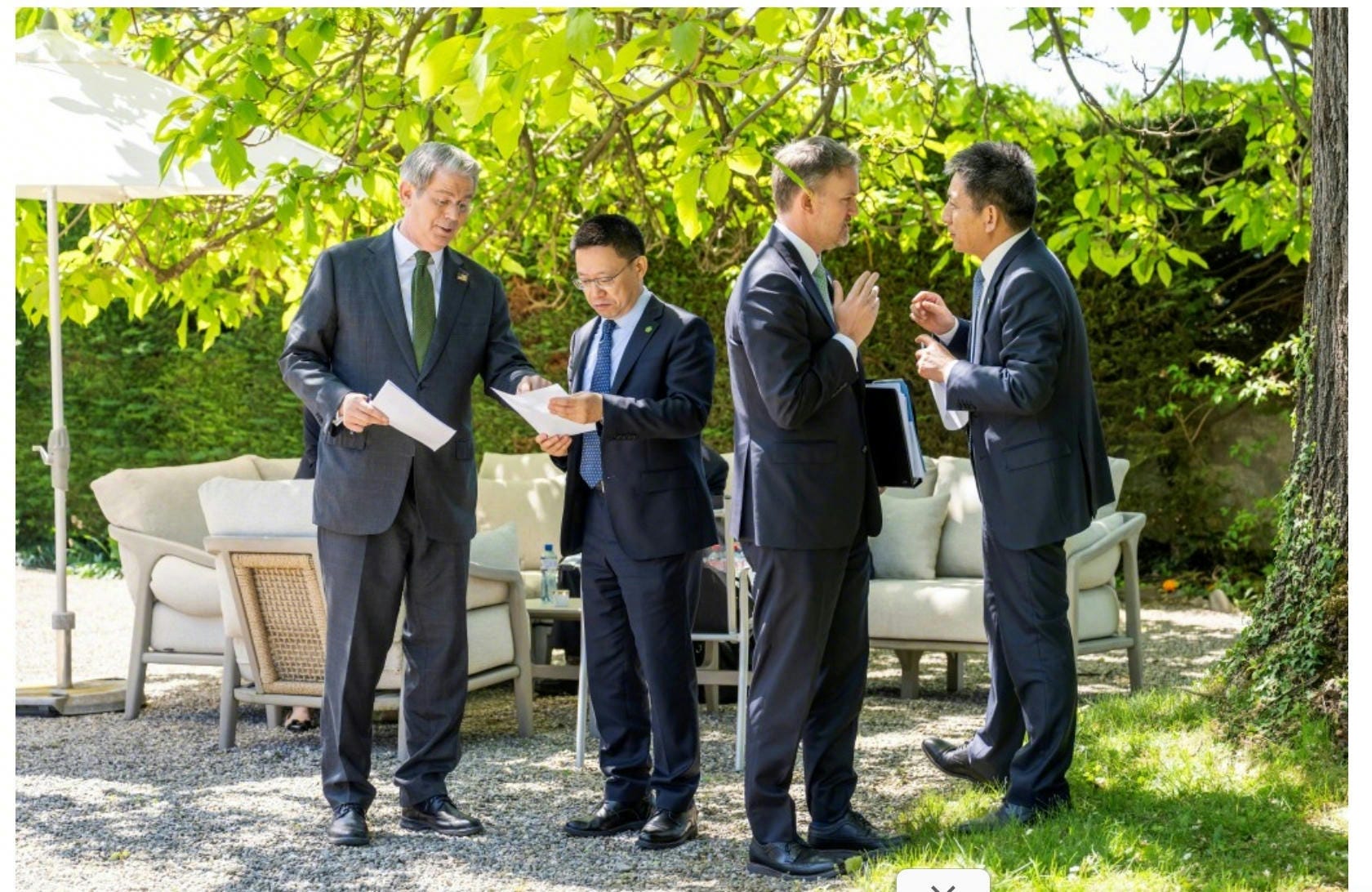
Li Chenggang was talking with USTR Jamieson Greer in Geneva last year
China’s international trade representative mechanism has existed for more than two decades. According to an interview transcript published by the Ministry of Commerce in 2006, the Office of the International Trade Representative was established within the ministry in 2004, with then Vice Minister of Commerce Gao Hucheng concurrently serving as International Trade Representative. Acting under instructions from the State Council or the Ministry of Commerce, the office was responsible for leading and coordinating major and sensitive international economic and trade negotiations, as well as policy research, legal consultation, information management and external liaison.
In 2008, the General Office of the State Council issued regulations governing the Ministry of Commerce’s principal responsibilities, internal structure and staffing. The regulations explicitly provided that the ministry could use the name “Office of the International Trade Representative” when conducting external negotiations and coordinating positions domestically.
In 2010, the mechanism was further formalized in terms of staffing and administrative rank. With the approval of the Communist Party of China Central Committee, the Ministry of Commerce established one minister-level International Trade Representative, who would concurrently serve as a vice minister of commerce, as well as two vice-minister-level Deputy International Trade Representatives, one of whom would concurrently serve as a vice minister. Gao Hucheng became the minister-level International Trade Representative in July that year, and the arrangement was publicly announced in August.
The responsibilities announced at the time included undertaking major multilateral and bilateral economic and trade negotiations under authorization from the State Council, coordinating China’s domestic negotiating positions, and signing relevant documents. In August 2010, Ministry of Commerce spokesperson Yao Jian explained that the arrangement reflected the growing number of international economic and trade activities and free-trade agreement negotiations, as well as the need to protect the overseas trade and investment interests of Chinese companies.
Zhong Shan succeeded Gao in 2013, followed by Fu Ziying in 2017, who remained in the post until 2018. In January 2021, Yu Jianhua became the Ministry of Commerce’s International Trade Representative at ministerial rank, and Wang Shouwen succeeded him in July 2022. Throughout this period, successive officeholders continued to use the title “International Trade Representative of the Ministry of Commerce.”
On April 16, 2025, the State Council appointed Li Chenggang as International Trade Representative of the Ministry of Commerce, with ministerial rank, concurrently serving as vice minister of commerce. He subsequently participated in several rounds of China-U.S. economic and trade talks, with official Chinese reports referring to him as “International Trade Representative and Vice Minister of Commerce.”
As for Li’s personal style, a Reuters profile published on January 12, 2026, drew on interviews with more than a dozen diplomats, businesspeople, and current and former U.S. officials. Interviewees described him as well prepared, highly knowledgeable about trade law, fluent in English, pragmatic and tough. Petter Olberg, Norway’s ambassador to the World Trade Organization, said Li generally listens before speaking and places importance on finding solutions. An unnamed former aide recalled that Li had also lost his temper while pushing negotiations on an investment facilitation agreement. The Reuters profile also noted that he collects Chinese porcelain.
The change in Li’s official title came just hours before China and the United States were due to begin a new round of economic and trade talks at JPMorgan Chase’s headquarters in New York.
U.S. Treasury Secretary Scott Bessent had previously taken the unusual step of publicly criticizing Li. The episode originated with Li’s visit to the United States in August 2025.
According to China’s Ministry of Commerce, Li visited the United States from August 27 to 29 to discuss implementation of the understandings reached during talks between the two countries’ leaders and in previous economic and trade consultations. He also raised objections to U.S. Section 301 restrictions targeting China’s shipbuilding and related industries.
At the end of September, the United States expanded the scope of its export-control Entity List rules. China subsequently announced new rare-earth export-control measures. On October 14, U.S. port-fee measures targeting certain Chinese vessels took effect, while China began imposing special port fees on certain U.S.-linked vessels.
On October 15, Bessent publicly singled out Li for criticism, describing him as “unhinged.” At a press conference that day, Bessent said Li’s remarks on August 28 had been inflammatory and his conduct disrespectful, and even suggested that Li might have been acting on his own authority. According to Bloomberg, Bessent also described Li as a “lower-level” official and accused him of showing up in Washington without an invitation. Bessent further claimed that Li had warned that implementing the port fees would lead China to unleash global chaos.
On October 16, Ministry of Commerce spokesperson He Yongqian responded to a question from Bloomberg by saying that the U.S. remarks “seriously distorted the facts.” She said China had put forward proposals for cooperation while the United States nevertheless proceeded with restrictive measures. China’s countermeasures, she said, were defensive responses, while the U.S. measures had already affected global supply chains and the shipping industry.
On October 20, China announced that Li had been removed from his previous position as China’s Permanent Representative to the World Trade Organization. Reuters noted that his successor, Li Yongjie, had already presented her credentials on September 29.
On October 25 and 26, Li continued to participate in economic and trade consultations in Kuala Lumpur in his capacity as International Trade Representative and Vice Minister of Commerce. After the talks, he told reporters that the two sides had reached preliminary understandings on issues including the Section 301 measures concerning maritime, logistics and shipbuilding sectors, tariffs, counternarcotics cooperation, expansion of trade, and export controls. The next step, he said, would be for each side to complete its respective domestic approval procedures. Li said the Chinese and U.S. teams had treated each other with respect and conducted the negotiations on an equal footing, adding: “The U.S. side was forceful in expressing its positions, while the Chinese side was resolute in defending its interests.”
The Office of the United States Trade Representative has itself undergone several institutional changes over the years. In 1962, the U.S. Congress enacted legislation requiring the president to appoint a Special Representative for Trade Negotiations. In 1963, the Kennedy administration established the Office of the Special Trade Representative within the Executive Office of the President. The Trade Act of 1974 established the office’s statutory responsibilities and elevated the Special Trade Representative to Cabinet-level status. A government reorganization plan in 1979 and an executive order the following year further reshaped its responsibilities, and the agency was renamed the Office of the United States Trade Representative, or USTR.
According to USTR’s own description of its responsibilities, the office is part of the Executive Office of the President and is responsible for developing and coordinating U.S. international trade and related investment policy and conducting negotiations with other countries. The U.S. Trade Representative is a member of the Cabinet and serves as the president’s principal trade adviser, negotiator and spokesperson on trade issues. USTR also coordinates trade-policy positions across the U.S. government through mechanisms including the Trade Policy Review Group and the Trade Policy Staff Committee.
The personnel announcement issued on September 20, 2026, formally gives Li Chenggang a representative title bearing the name of the “People’s Republic of China,” rather than the Ministry of Commerce. It also appears to bring the position into closer institutional parity with that of the U.S. Trade Representative.