

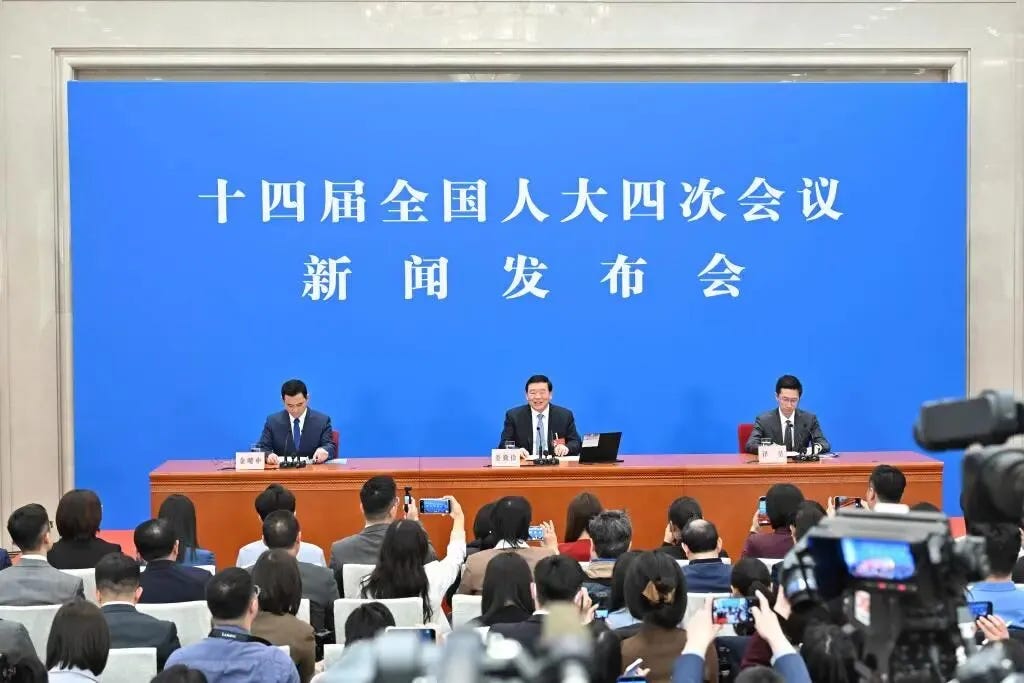
The Fourth Session of the 14th National People’s Congress held a press conference at 12:00 p.m. on Wednesday, 4 March 2026, in the Press Conference Hall of the Great Hall of the People. The spokesperson for the session, Lou Qinjian, answered questions from Chinese and foreign journalists on the agenda of the session and issues related to the work of the NPC. The following is the section concerning foreign affairs and international relations.
Bloomberg Reporter
In light of the situation in Iran and President Trump’s expected visit to China in the near future, how do you view the trajectory of China–U.S. relations? In particular, considering that more leaders’ meetings are scheduled later this year.
Lou Qinjian
Thank you for the question. China has consistently maintained that, as the world’s two major powers, China and the United States should respect each other, coexist peacefully, and pursue win-win cooperation. President Xi Jinping has pointed out that for the two countries to be partners and friends is both a lesson of history and a necessity of reality. The notion that China and the United States can “achieve mutual success and shared prosperity” is a tangible reality.
Head-of-state diplomacy plays an irreplaceable strategic guiding role in China–U.S. relations. Since last year, President Xi Jinping and President Trump have maintained regular communication, helping to steer the great ship of China–U.S. relations on a steady course and inject new momentum into it. Overall, bilateral relations have remained stable and improving, a development widely welcomed by both countries and by the international community. Facts have shown that when China and the United States cooperate, both benefit; when they confront each other, both suffer. As long as both sides faithfully implement the important consensus reached by the two heads of state, uphold equality, mutual respect, and reciprocity, expand the list of cooperation and narrow the list of problems, China–U.S. relations can move forward in a stable manner.
China stands ready to work with the United States to strengthen communication at all levels and through multiple channels, opening broader space for cooperation. At the same time, China has its own principles and bottom lines, and will as always firmly safeguard its sovereignty, security, and development interests. Last year, the National People’s Congress invited a delegation of U.S. House members to visit China, maintained dialogue with U.S. senators, and sent a youth delegation of NPC representatives to the United States. A common sentiment expressed by U.S. lawmakers was that meeting is better than not meeting, and dialogue is better than no dialogue. The National People’s Congress is willing to maintain exchanges with the U.S. Congress and contribute, from the perspective of legislative institutions, to the stable and healthy development of China–U.S. relations. We hope the U.S. Congress will view China and its development objectively and rationally, and do more to promote friendship between the two countries and their peoples. Thank you.
Czech Media Reporter
Last year, political leaders from several European countries and heads of EU institutions visited China. Some observers say Europe is “turning toward China,” while others argue that Europe faces competition and challenges from China in areas such as trade and economics. How do you view this?
Lou Qinjian
Thank you for your question. Last year marked the 50th anniversary of diplomatic relations between China and the European Union, and high-level exchanges between the two sides were frequent. President Xi Jinping met with European leaders many times, reaching important consensus on strengthening the China–EU partnership, deepening mutually beneficial cooperation, and jointly addressing global challenges. Practical cooperation between China and Europe has yielded fruitful results, and people-to-people exchanges have been vibrant. The facts show that Europe needs China, and China also needs Europe.
The essence of China–EU economic and trade relations is complementarity and mutual benefit. Cooperation with China helps Europe develop its economy and improve people’s well-being. For example, the China–Europe Trade and Logistics Cooperation Park in Hungary has created a platform for two-way interaction between Chinese and European companies, further strengthening Hungary’s position as a logistics hub in Europe. The Pelješac Bridge in Croatia, funded by EU funds and built by Chinese companies, has connected north and south, turning a natural barrier into a corridor and fulfilling a long-held aspiration of local residents.
Another example is China’s State Grid investment in Portugal’s national energy network company. By sharing China’s expertise in grid operation management and renewable energy integration, it has supported Portugal’s energy transition and achieved mutual learning and win-win cooperation. PetroChina and Shell jointly invested in Arrow Energy in Australia, combining their strengths to provide innovative, efficient, and environmentally friendly energy solutions for a third country, while also creating local employment and promoting economic growth.
Similarly, European companies investing in China also benefit from China’s high-quality development. For instance, BASF’s integrated base in Zhanjiang is the company’s largest single investment to date, while Sanofi’s insulin raw-material project in Beijing has become its largest insulin injection production base in the Asia-Pacific region. While meeting the needs of the Chinese market, these companies have also significantly enhanced their global competitiveness.
There are no fundamental conflicts of interest or geopolitical contradictions between China and Europe. China is willing to work with Europe to maintain the basic positioning of partnership, properly handle trade differences, expand cooperation agendas, and jointly respond to global challenges. Last year, China and the European Parliament simultaneously lifted restrictions on exchanges, restarting long-suspended institutional communication between legislative bodies. The National People’s Congress is willing to strengthen friendly exchanges with the European Parliament and national parliaments across Europe, deepen understanding, build consensus, expand cooperation, and contribute to the steady and long-term development of China–EU relations. Thank you.
Lianhe Zaobao Reporter (Singapore)
Over the past year, China’s high-level exchanges with neighboring countries have been frequent and regional cooperation has shown positive momentum. However, difficulties and setbacks in China–Japan relations have also drawn attention. In this context, how will China promote the development of relations with neighboring countries, including Japan?
Lou Qinjian
Thank you for your question. Neighboring countries are neighbors that cannot be moved away. How a major power interacts with its neighbors reflects its worldview, its concept of order, and its values. China has always placed its neighborhood at the top of its overall diplomatic agenda and has consistently been committed to promoting regional peace, stability, development, and prosperity. President Xi Jinping has visited almost all neighboring countries, and last year’s major diplomatic events and important visits also focused on the region. As you have seen, under the strategic guidance of head-of-state diplomacy, China and its neighbors have strengthened strategic mutual trust, deepened comprehensive cooperation, and expanded exchanges across various fields, injecting strong momentum into regional stability and development.
Safeguarding national sovereignty, security, and development interests is the starting point and ultimate goal of all foreign relations. The Taiwan question is China’s internal affair and the core of China’s core interests. The Chinese side firmly opposes erroneous remarks by Japanese leaders related to Taiwan. The Chinese people will never allow any external forces to interfere in China’s internal affairs and will resolutely safeguard national sovereignty, unity, and territorial integrity.
At present, maintaining stability, improving governance, and promoting development remain the mainstream aspirations in the region, and the trend toward regional integration is irreversible. China will fully implement the outcomes of the Central Conference on Work Relating to Neighboring Countries, focus on building a community with a shared future with neighboring countries, adhere to the principles of amity, sincerity, mutual benefit, and inclusiveness, and work with neighboring countries to build a peaceful, secure, prosperous, beautiful, and friendly home. The National People’s Congress will continue strengthening bilateral and multilateral exchanges with legislative bodies in neighboring countries, helping China’s modernization and the development of neighboring countries advance together and complement each other.
Reporter, Anadolu Agency (Türkiye)
The United States and Israel recently launched military actions against Iran, resulting in the deaths of its leaders. Not long ago, the world witnessed the president of a sovereign state being arrested in Venezuela. The United States has also long expressed interest in annexing Greenland, which is Danish territory in the Arctic. As unilateralism and the use of force become more prominent in international relations, the international community is increasingly concerned about the collapse of the global governance system and the weakening role of the United Nations. What is your view?
Lou Qinjian
Thank you for the question. China is paying close attention to the situation in Iran. Iran’s national sovereignty, security, and territorial integrity should be respected. China calls for an immediate halt to military actions, avoiding further escalation of tensions, restoring dialogue and negotiations, and safeguarding peace and stability in the Middle East. China stands ready to continue playing the role of a responsible major country.
China has always believed that mutual respect and equality among countries, regardless of size, are requirements of historical progress and the primary principle of the UN Charter. No country has the right to control international affairs, determine the fate of other nations, or monopolize development advantages, still less to act arbitrarily on the world stage.
Over the past year, the evolution of the international landscape has reached an important turning point. Economic globalization has suffered severe shocks, while regional wars and cross-border conflicts have occurred frequently. In the face of a turbulent world, peaceful development, cooperation, and mutual benefit remain the only right path. President Xi Jinping has solemnly put forward initiatives on global governance, emphasizing sovereign equality, respect for international law, the practice of multilateralism, a people-centered approach, and an action-oriented agenda. These proposals present China’s plan for building a fairer and more reasonable global governance system.
Last year marked the 80th anniversary of the victory in the World Anti-Fascist War and also the 80th anniversary of the founding of the United Nations. The devastation of the two world wars prompted the international community to reflect deeply, leading to the creation of the United Nations. More than 80 years of practice has shown that the role of the United Nations must be strengthened, not weakened, and its position must be upheld, not replaced. As a major country and a permanent member of the UN Security Council, China is willing to work with all countries to firmly uphold the authority and status of the United Nations, safeguard the purposes and principles of the UN Charter, practice genuine multilateralism, improve global governance, and contribute more to building a community with a shared future for mankind. Thank you.