

Today, we are officially releasing DeepSeek V4.1 Flash. It is the smallest model in our new family of model architectures and features native multimodal visual understanding.
The new architecture is designed to deliver higher capability ceilings, faster inference, greater throughput, and scalability to models with significantly larger parameter counts.
Asymmetric architecture: big intelligence at lower cost
DeepSeek V4.1 Flash is a 552B-parameter MoE model built on a new Causal-Encoder-Decoder architecture. It uses an asymmetric design between input and output: only 8B activated parameters on the input side and 16B activated parameters on the output side, resulting in significantly lower cost than other known models at a similar scale.
Editor’s note: The official release of V4 Flash on July 31 retained the same model architecture and size as the preview version, with the main changes coming from additional post-training. This design is closely aligned with how AI agents operate. When working with code repositories, long documents, or extensive conversation histories, models often need to process large volumes of input while generating relatively limited outputs, such as decisions, code, or action instructions. Reducing the computational cost of input processing could therefore significantly improve the overall efficiency of these agentic workloads.
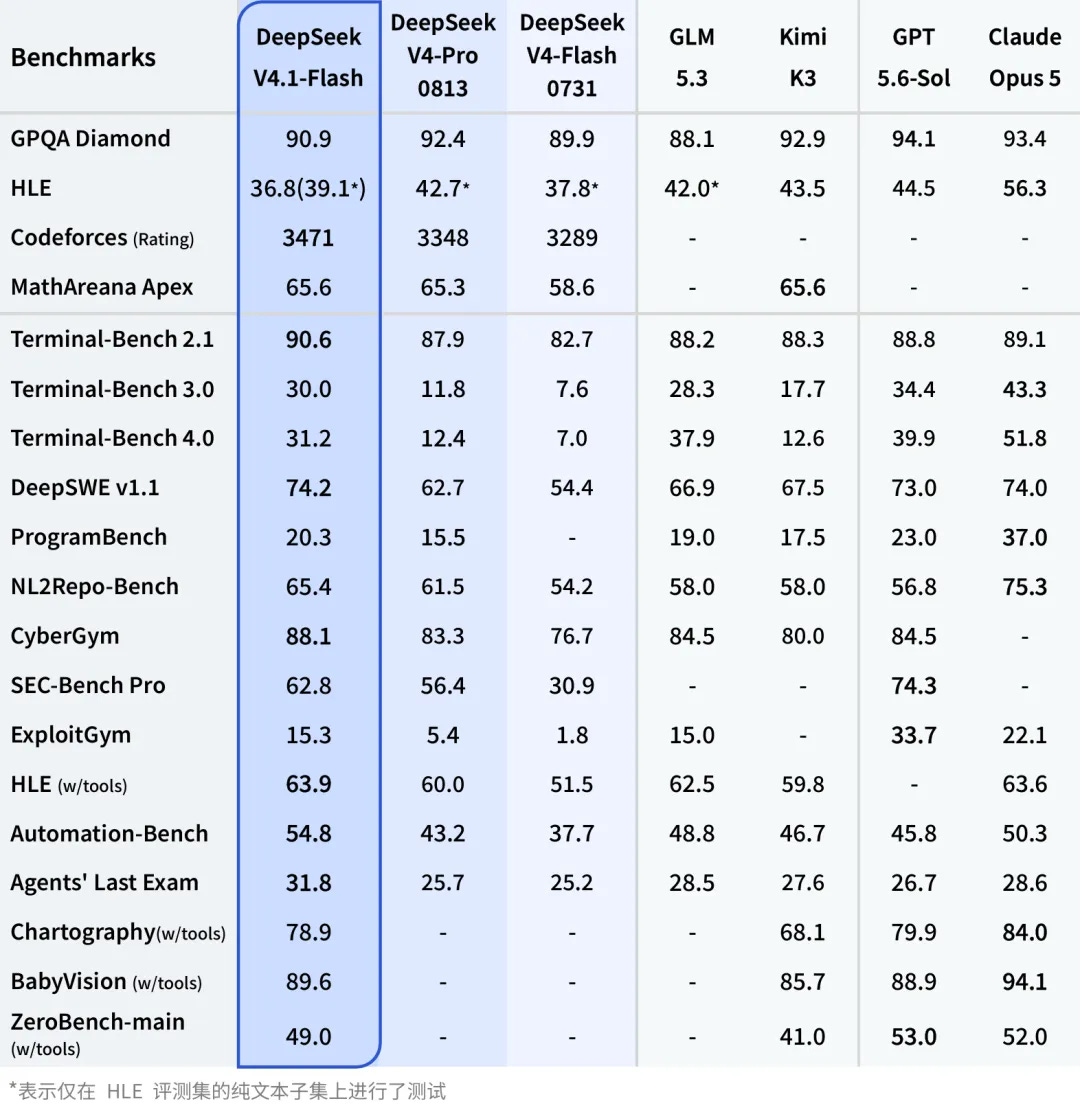
V4.1 Flash also adopts a new pre-training approach and undergoes larger-scale reinforcement learning (post-training). In benchmark evaluations, it surpasses the intelligence level of a number of flagship models, including DeepSeek V4 Pro.
Editor’s note:According to the official benchmark results, V4.1 Flash scored 90.9 on GPQA Diamond, a benchmark for graduate-level scientific reasoning, achieved a Codeforces competitive programming rating of 3,471, and scored 65.6 on MathArena Apex.
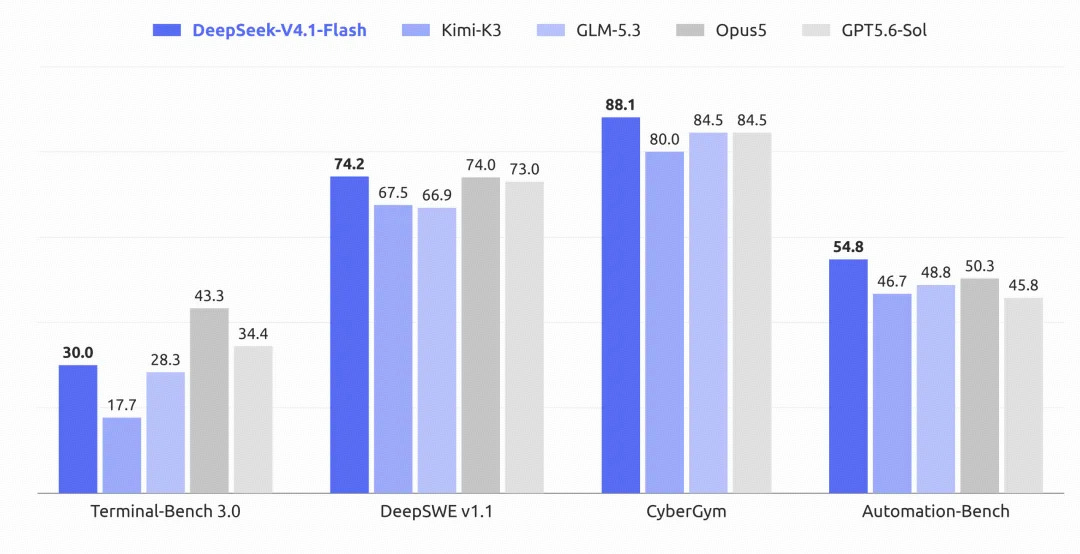
On Terminal-Bench 2.1, which evaluates models’ ability to execute tasks in terminal environments, V4.1 Flash scored 90.6. It also achieved 88.1 on CyberGym, a cybersecurity benchmark. By comparison, the previously released V4 Pro scored 87.9 and 83.3, respectively, on these two benchmarks.
Figure 1. Performance comparison on Agentic Benchmark
Smaller cache, lower cost
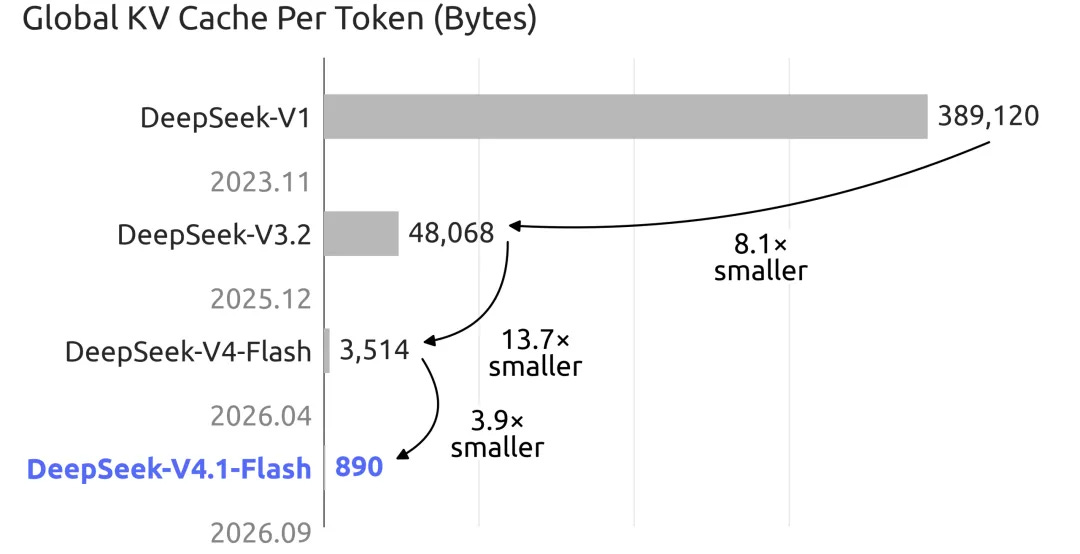
The new-generation architecture substantially reduces the size of the KV cache. Compared with the previous generation, the demand for HBM is reduced to 1/4, and the demand for SSD is reduced to 1/8.
In agent-use scenarios, cache-hit fees often take a meaningful share of total cost. Compressing KV cache therefore significantly reduces the cost of agent-style tasks.
[Missing image] (KV cache size reduction progress figure)
The original post notes that, compared with the first-generation model, the KV cache has already shrunk by 437×.
Editor’s note: Compared with V4 Flash pricing during the same time window, cached input is 60% cheaper, uncached input about 33.3% cheaper, and output about 11.1% cheaper.
The savings are more significant for workloads that repeatedly process large amounts of context. Agents, for example, often need to re-read conversation history, tool instructions, and code across multiple steps. Lower cached-input pricing can substantially reduce these recurring costs. By contrast, workloads dominated by the generation of new output will see more limited savings.
For example, assuming fixed usage of 1 million cached input tokens, 100,000 uncached input tokens, and 10,000 output tokens, the cost of a single task during off-peak hours would fall from RMB 0.245 to RMB 0.16, a reduction of approximately 34.7%. Actual costs will still depend on factors such as reasoning length, the number of tool-call iterations, and failed attempts or retries.
API support
DeepSeek V4.1 Flash is now available on the DeepSeek API, with native multimodal support. To use the latest V4.1 Flash, set the model name to deepseek-flash.
The older models V4 Flash and V4 Flash Vision Exp have been taken offline. For compatibility, requests to deepseek-v4-flash and deepseek-v4-flash-vision-exp will temporarily be routed to V4.1 Flash.
Based on extensive testing, V4.1 Flash outperforms V4 Pro across performance, cost, speed, and end-to-end latency. DeepSeek plans an orderly phase-out of V4 Pro. After 12:00 (Beijing time), Sep 14, 2026 and until V4.1 Pro is released, all requests to deepseek-v4-pro will be routed to V4.1 Flash and billed at the V4.1 Flash price.
Tencent (WorkBuddy, CodeBuddy) and OpenCode, as official partners, have fully integrated DeepSeek V4.1 Flash—welcome to try it.
Editor’s note:Previously, DeepSeek offered experimental vision capabilities through V4 Flash Vision Exp. With the new release, both the previous V4 Flash model and the experimental vision model have been retired. Requests using either of the two former model names are now handled by V4.1 Flash, bringing text and image processing together in a single flagship API model.
According to the latest image-understanding documentation, developers can use the model to describe images, extract text from screenshots, and analyze charts. Images can be provided through publicly accessible URLs, submitted directly in encoded form, or uploaded and referenced through the Files API.
This has practical implications for agents working with real-world materials. Business documents often require models to understand text alongside charts, while software-related tasks may require code to be interpreted together with interface screenshots. A unified model endpoint reduces the need for developers to route tasks between, and switch across, separate text and vision models.
API pricing adjustment
Thanks to architectural innovation, DeepSeek V4.1 Flash can serve more users at lower cost, so its pricing is reduced accordingly. To allocate resources more reasonably, DeepSeek continues to use peak/off-peak pricing: off-peak price is half of peak price, encouraging users to schedule tasks based on their needs. The new pricing takes effect at 12:00 (Beijing time), Sep 10, 2026.
[Missing image] (pricing table/figure in the original post)
Open-sourcing
DeepSeek will fully support the open-source community in adapting inference for this new model architecture and will explore various ways to broaden the deployment footprint. If you have large-scale deployment needs and the required resources (e.g., 2,000 GPUs and a storage cluster), DeepSeek welcomes you to get in touch.
Now here I was just thinking about this. And waiting for someone to write something following the email I got from DS today.