

“Why does DeepSeek choose to open-source its models? Why give away large language models that have taken so much effort to develop?”
At the main forum of the 2026 World Internet Conference Wuzhen Summit, Gao Xi, a research engineer at DeepSeek, offered a systematic explanation of the fundamental reasoning behind the team’s commitment to comprehensive open-sourcing.
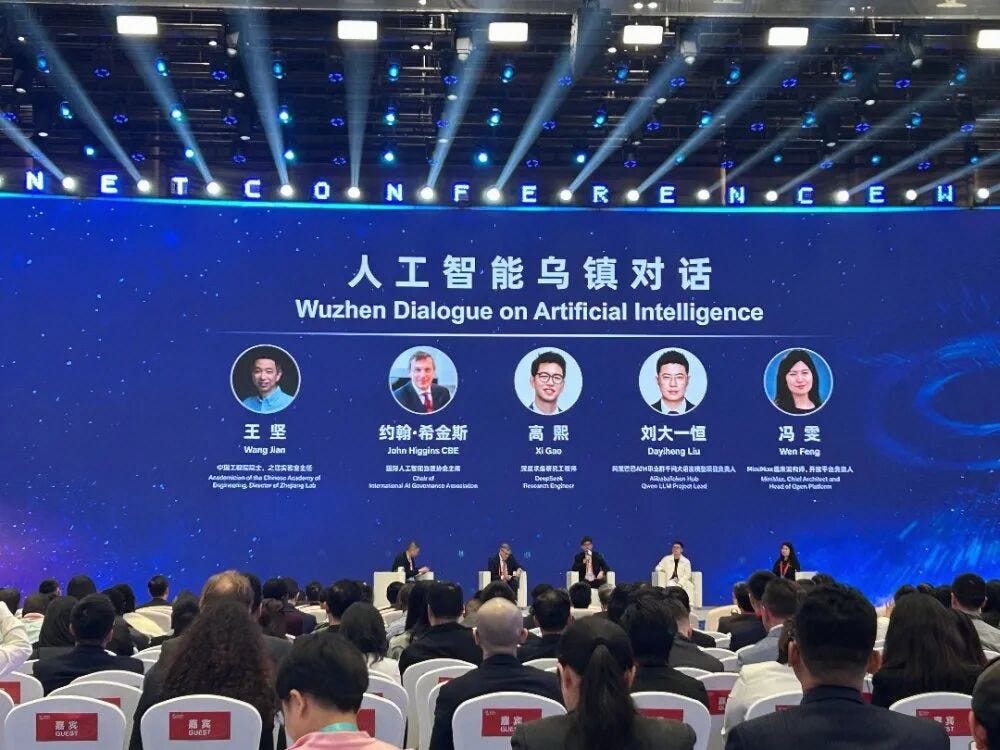
On the afternoon of November 3, the 2026 World Internet Conference Wuzhen Summit officially opened in Wuzhen, Zhejiang Province, under the theme “Open Source, Openness, Joint Development and Shared Benefits — Working Together to Build a Community with a Shared Future in Cyberspace.”
As one of the summit’s highest-profile forums for technical discussion, the main forum featured a special roundtable session titled “Wuzhen Dialogue on Artificial Intelligence.”
The discussion was moderated by Wang Jian, a member of the Chinese Academy of Engineering and director of Zhejiang Lab. Participants included representatives from some of the most closely watched technical teams in the global open-source AI community, alongside an international AI governance expert:
Gao Xi, Research Engineer at DeepSeek
Liu Dayiheng, Head of the Qwen Large Language Model Project at Alibaba’s ATH Business Group
Feng Wen, Chief Architect and Head of the Open Platform at MiniMax
John Higgins, Chair of the International Association for AI Governance
The discussion addressed three fundamental tensions emerging as competition in the large language model industry intensifies: Why has open source become a critical factor in the race to develop advanced AI? How can open-source development balance safety governance with international trust? And as AI reshapes knowledge production, how should the essential capabilities of human professionals be redefined?
Among the various perspectives presented, DeepSeek’s approach to open source attracted particular attention. Known for its technically rigorous approach and commitment to open-sourcing its technology stack, the team offered a distinctive perspective on how openness can accelerate technological progress.
Gao Xi: Why Does DeepSeek Choose Open Source?
During the discussion, Gao began by reflecting on the evolution of AI technology, explaining DeepSeek’s underlying rationale for open-sourcing its models, its understanding of technological competition, and its approach to addressing safety risks.
“Many people ask why DeepSeek would open-source the results of research that took so much hard work. The answer is actually very simple: to bring AGI into existence sooner.”
“If AGI would otherwise take ten years to arrive, we hope it can arrive in one year. If it would otherwise take one year, I hope it arrives tomorrow. From this perspective, open source is the inevitable choice.”
In Gao’s view, regardless of which company or research laboratory ultimately achieves the first major breakthrough in artificial general intelligence (AGI), the resulting leap in productivity would benefit humanity as a whole.
Such advances could fundamentally transform pharmaceutical research, materials synthesis, and general-purpose scientific computing.
Once AI systems with truly general cognitive capabilities become available, users will neither care nor need to care which commercial company developed them. What matters is how quickly these capabilities can become widely accessible.
Addressing the increasingly intense competition among AI developers in China and internationally, Gao challenged the conventional view of competition as a contest between companies.
“When we talk about the technological transformation and scientific progress that AGI will bring, we do not care which company it comes from, because it will benefit all humanity. In the AI race, time is perhaps the hardest competitor to beat. We must race against the clock to bring AGI into our lives.”
From this perspective, open source represents a better way to address the challenge.
Gao offered an example from the research process. When a team discovers a new method, such as a lower-cost training technique or a more efficient model architecture, the fastest way to advance the field may be to publish the method so that more researchers can discuss, test, and validate it.
“If others solve a problem, we should quickly incorporate their techniques into our models. If we solve a problem ourselves, we should share the solution to help advance the entire field.”
Gao explained that regardless of which model developer makes a breakthrough, the broader research community is collectively working toward AGI.
He argued that technological innovation requires open discussion, validation, and testing.
Keeping research closed to prevent competitors from accessing it may preserve a temporary competitive advantage. Over the longer term, however, it can delay the benefits that society as a whole could otherwise obtain from technological progress.
At the same time, Gao did not shy away from the potential safety risks associated with open models.
“Open source may indeed amplify certain AI-related safety risks. But keeping models closed does not eliminate safety problems either. Whether we are talking about text-generation or image-generation models, these systems inherently carry safety risks. Such risks, whether arising from malicious human misuse or from AI systems themselves, cannot be completely avoided.”
DeepSeek is currently researching potential approaches to these challenges.
“My colleagues are now working on ways to address these safety issues, including approaches such as model tiering.”
Different Perspectives on Open Source and AI Safety
Other technical leaders and international experts participating in the roundtable offered additional perspectives, drawing on their own experiences with open-source development, safety governance, and commercial deployment.
Alibaba Qwen — Liu Dayiheng: The Irreversibility of Open Source and Transparent Defenses
Liu Dayiheng identified two distinctive safety governance challenges associated with open-source models compared with proprietary systems.
1. Irreversibility
Once an open-source model has been released and widely downloaded and distributed around the world, any subsequently discovered safety vulnerabilities are extremely difficult to address comprehensively.
Unlike proprietary cloud-hosted models, which can be updated centrally on the service provider’s servers, open-source models cannot be universally patched or recalled after distribution.
2. The ease of removing safety guardrails
The safety of open-source models depends heavily on safeguards embedded within the models themselves.
Once developers obtain the model weights, they may use post-training or fine-tuning techniques to bypass or remove the original safety alignment mechanisms.
Nevertheless, Liu emphasized that open source does not necessarily lead to weaker safety.
On the contrary, the transparency of open-source models enables a much larger global community of security researchers to examine their vulnerabilities, attack mechanisms, and defensive capabilities.
This process can generate valuable insights that strengthen the broader AI safety ecosystem.
Open source and safety should therefore not be treated as mutually exclusive. Effective model governance requires a coordinated approach involving talent development, laws and regulations, industry standards, and supporting infrastructure.
MiniMax — Feng Wen: Open-Source Models as a Foundation for Enterprise Autonomy and Control
Feng Wen approached the discussion from the perspective of industrial applications, emphasizing the practical value of open-source models for enterprise adoption.
1. Customization for proprietary business environments
When deploying AI in specialized industries, enterprises often possess sensitive proprietary data and highly customized business processes.
Open-source models allow these organizations to conduct additional training, fine-tune model parameters, and deploy systems locally or within private clouds.
This enables enterprises to adapt general-purpose models into domain-specific systems tailored to their operational requirements.
2. New challenges for industry-wide collaboration
As AI models become increasingly embedded in industrial applications and end-user systems, ensuring the security of privately deployed models is becoming a more important challenge.
Coordinating the various participants across upstream and downstream supply chains also requires further exploration and collective solutions.
International Association for AI Governance — John Higgins: Building Global Trust Through Sharing
John Higgins emphasized that open-source development substantially expands opportunities for global participation and collaborative improvement.
However, he argued that sharing technological achievements must be accompanied by efforts to establish broadly recognized frameworks of trust.
The open-source community should work together to develop standardized testing procedures, evaluation methodologies, and governance principles.
Such efforts would help establish a more mature framework for international cooperation on AI development and safety.
What Should Humans Do in the Age of AI?
Toward the end of the roundtable, moderator Wang Jian shifted the discussion toward a more fundamental question:
As foundation models continue to advance, how will the skills required of human beings change, and how might AI reshape the way people live?
Liu Dayiheng: Redefining Professional Capabilities and Expanding Opportunities in Education and Everyday Life
Liu shared observations across three areas: work, education, and everyday life.
1. Work: Redefining professional productivity
Traditionally, individual productivity has been assessed primarily through professional expertise, execution capabilities, industry experience, and working hours.
In the AI era, however, a new criterion will become increasingly important: the ability to use AI effectively and coordinate AI systems to improve overall productivity.
This will require stronger capabilities in problem definition, tool orchestration, information filtering, and critical judgment.
2. Education: Making high-quality knowledge more accessible
AI is significantly reducing the cost of accessing high-quality educational resources, enabling students in remote areas to engage with advanced knowledge at relatively low cost.
Liu shared an example from his family.
When his child became interested in astronomy, family members used an AI model to generate a teaching PowerPoint presentation and a black-hole simulation program within a short period.
These tools made complex scientific concepts substantially easier to understand through visual demonstrations.
3. Everyday life: Creating more time for human pursuits
Liu compared the potential impact of AI to that of a new industrial revolution.
By increasing the efficiency of material production, AI could give people more time to explore personal interests, pursue their aspirations, and devote greater attention to family relationships and emotional connections.
Feng Wen: Open-Source Ecosystems Enable Unexpected Collective Innovation
Feng illustrated the creative potential of open-source ecosystems through MiniMax’s own experience.
After the company open-sourced a video-generation model, chip manufacturers, independent developers, and content creators voluntarily joined efforts to adapt and improve the technology.
Community members contributed fine-tuning tools, engineering improvements, and other technical resources.
Some teams subsequently conducted additional training and optimized inference performance, eventually achieving the ability to generate a five-second video in under two seconds.
These innovations and applications went far beyond what the original development team had anticipated.
For Feng, the experience demonstrated the distinctive ability of open source to stimulate collective creativity and expand the boundaries of technological applications.
Gao Xi’s Closing Message: Stay True to Your Original Aspirations
When asked what advice he would offer young professionals working amid the rapid transformation of the AI industry, Gao concluded with a traditional Chinese saying:
“Stay true to your original aspirations, and you will ultimately achieve your goals.”
He emphasized that AI technology is advancing at an extraordinary pace.
For young people working at the center of this technological transformation, the most important thing is to remain committed to the ideals and technical objectives that originally inspired them.
Above all, they should find something meaningful enough to dedicate their entire professional lives to pursuing.