

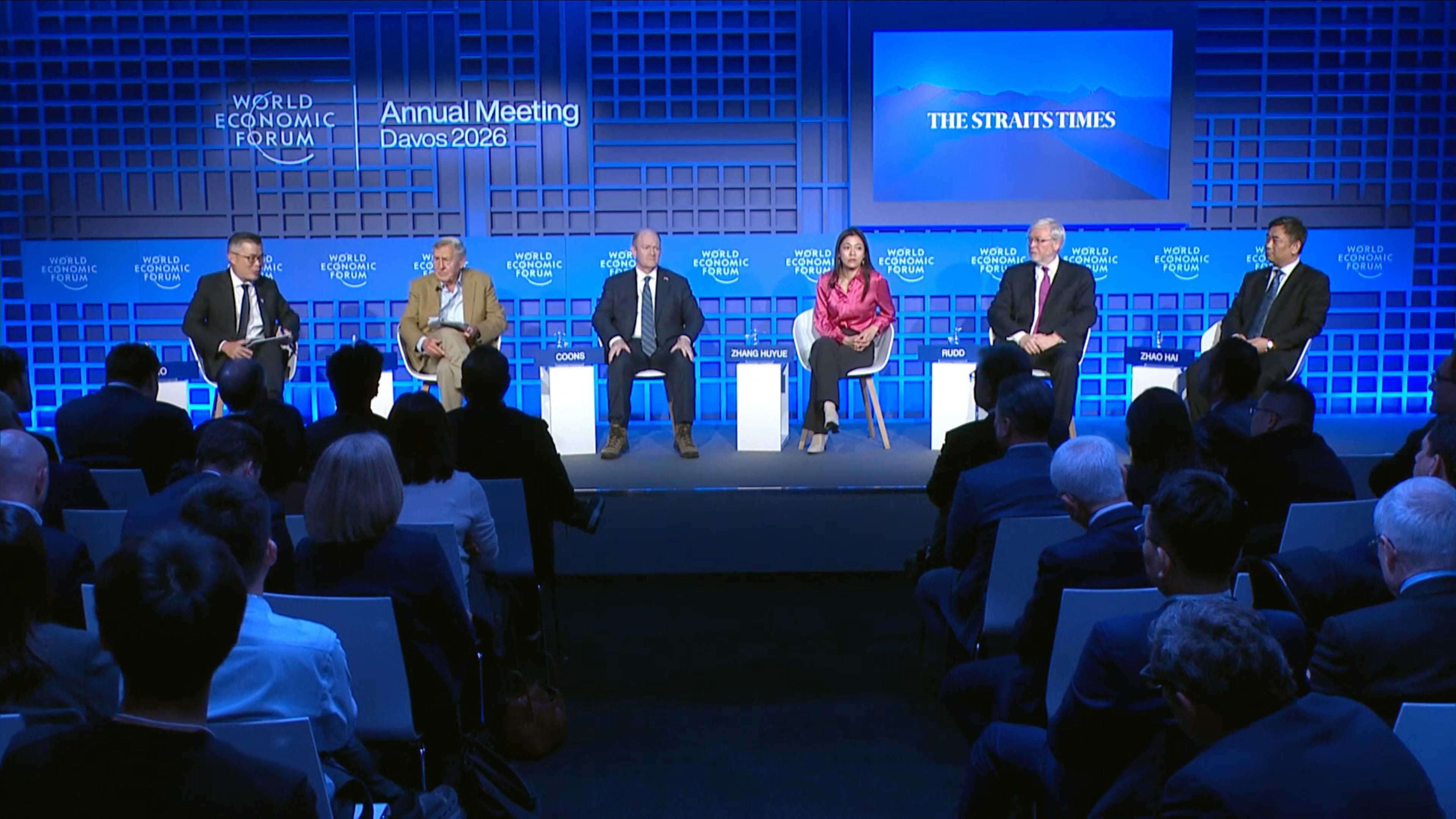
During Davos, the only panel that really focused on U.S.–China relations was moderated by Jaimie Ho from The Straits Times. The lineup was strong:
Harvard professor Graham Allison (author of Destined for War and the “Thucydides Trap” concept),U.S. Senator Christopher Coons, Australia’s ambassador to the U.S. Kevin Rudd, China’s U.S. watcher Zhao Hai, and Huyue Zhang, a professor at USC Gould School of Law.
Allison used the Thucydides Trap framework to describe the structural reality of the past nine years: as China rises and the U.S. tries to maintain its primacy, the shifting balance of power amplifies mistrust and miscalculation—small incidents can spiral into major crises. The “good news,” in his view, is that both sides understand the catastrophic cost of war, especially nuclear war, so they have no choice but to find a way to coexist within competition.
On Taiwan, Allison suggested that when Xi and Trump meet in April, both may see Lai Ching-te and “incremental independence” moves as a destabilizing threat. He even floated the possibility of a “fourth U.S.–China communiqué”, where the two sides might try to lock in more binding understandings on Taiwan—though he acknowledged the outcome would depend on high-level political creativity and bargaining.
Coons argued that there’s still broad bipartisan agreement in Washington on the basics—engage China with clear eyes, back allies and partners in the Indo-Pacific, and protect U.S. security—but he warned that Trump’s approach risks weakening America’s biggest strategic asset: its alliance network and institutional soft power. Unpredictable tariff moves, he said, don’t just hit allies; they also create openings for others as the U.S. steps back from global leadership. For Coons, the most urgent shared issue is AI: whether in military or commercial use, it needs more sober communication and guardrails to reduce risk.
Zhao Hai pushed back from the Chinese side, arguing the deeper problems—U.S. misperceptions about China and a persistent zero-sum mindset—haven’t been resolved. In his view, Trump keeps talking about having a great relationship with Xi, but there’s still no workable cooperation agenda. Zhao called for clearer guiding principles, a more explicit cooperation framework, and more “doable” deliverables for April—things like fentanyl, expanding U.S. exports, investment treatment, and more institutionalized channels for communication.
Rudd framed the choice starkly as managed strategic competition versus unmanaged competition that drifts toward crisis and conflict. He thought both sides have reasons to stabilize ties in the near term, but the hard part is building real crisis-management and sustained dialogue around the three biggest flashpoints: tariffs, technology, and Taiwan.
Huyue Zhang emphasized how hard it is to make any U.S.–China “grand deal” stick in practice—there’s no neutral enforcer, and shocks can derail commitments overnight. She also pointed out the irony that U.S. tech restrictions have, in some cases, pushed Chinese firms to innovate faster, meaning relative strengths in the tech race can shift more than many assume.
Taken together, the panel’s shared takeaway was that a sweeping, once-and-for-all US-China framework agreement is unlikely in the short run. The more realistic path is to keep the relationship stable through smaller, lower-bar “deliverables”—and to rebuild quiet, trusted backchannels below the leaders’ level to reduce miscalculation when crises inevitably arise.
Below is the full transcript of the panel:
Jaimie Ho
I am going to maybe make professor Allison just give us a big cake i’ m sure everyone wants a big cake on that and then i’ ll go to each thereafter questions as well after everyone’ s finished with the first round of responses to the questions, i will see where and time and。 Is possible. I should have been around. Right. So Professor Allison, if you could just give us a quick take, everyone likes quick takes these days, on the president’s speech just now and maybe how it applies to US China relations as you saw it.
Graham Allison
Well, it went off in many different directions as he’s inclined to do. And, but. There was one big message for the Europeans in particular, but for all of us, which is that after having threaten to do whatever was required to acquire Greenland, including using military force and even using mafioso language, that we can either do this the hard way or the easy way.
He took the gun off the table and said, we’re not gonna use military force to commerce Greenland or Denmark. Now, again, it’s a pretty straight. Strange world at which an ally has been threatening to use military force against another alliance. So that world we’re already in, that fact has already occurred. But the fact that he took it off the table, I think it’s a big and significant factor.
Second point, he made them clear over and over, he is really serious about acquiring Greenland. And so he says, we know there’s just a big chunk of ice, it’s relevant for the US and not particularly relevant for Denmark are for the Greenlanders. It’s, he says, need. For American national security myself, I don’t know the. I cannot see the argument for that. But that’s his claim. And that the Europeans have never been grateful to the US for all the things that we’ve done for him.
And then he has a litany about the fact, which is roughly correct, that the US has essentially been the defensive shield for Europe ever since World War 2, and the Europeans have been free writers to some considerable extent. So they owe us something. So they should remember all the good things we did for them. And what they can do for us is give us green one. And then he said, I’m still thinking this gonna work out okay. And if the Europeans find a way to fulfill my demand, I’ll be grateful. And then he said, but if they don’t, I’ll remember that.
Jaimie Ho
Well. The thing that struck me, I’m sure it struck you as well, and this will segue back into our topic to for this evening, which is US China relations and where two countries or land is how far he mention. Or didn’t mention China throughout their speech. In any case, let’s get back to the topic.
Graham Allison
Yeah, I think for those, especially since of China, so he only referred to three or four leaders in the whole speech. In the case of the Europeans, for both Macron and for the Canadian, Carney, he had very negative things to say. Basically, the meaning in effect. But when he said she, his eyes light up a little bit and he says, I have a great. relationship with Xi. I greatly respect Xi. He’s brilliant. So he was off on that track. So he clearly distinguishes between Xi and his relationship with that a country and a leader that happens to be our neighbor, Canada or France, which was the country that came to our rescue in the revolution. So I would say that’s interesting, just as we’re trying to grade or gauge him. Yeah. On his relationship with other leaders.
Jaimie Ho
We look to what will happen this year, 2026 as far as we can and maybe a little bit beyond. It’s quite stuck that it’s now sort of nine years since your book under facilities trap. And maybe if we frame how things have evolved since then, the first Trump administration and then the Biden administration and now the second. The first year of the Trump administration is, how have you seen the US China sort of dynamic evolve in that time that will give. You some sense of where we’re headed in 2026?
Graham Allison
Have a difficulty with professors cuz they stop talking, as one of my colleagues said, 50 minute sound bites. So let me just be very, I would say Thucydides nailed it, okay?
If we’re trying to think about the relationship between the US and China, lucidities insight is the central starting point. And that insight is that a rapidly rising China that seriously threatens America’s. A colossal ruling us and it’s positioned at the top of every pecking order. This basically shift, rapid shift in the seesaw of power is discombobulating the entire relationship and actually the international order that was reflected before that. And in ways as stupid synergies explained very well, that make, that magnify misweb. Understandings and mo multiply miscalculations and amplify incidents or accidents that will otherwise be unconsequential, that often ended a word.
So I would say his pictures still right. These are structural realities that she now and Trump have to grapple with. Any promising thing in this context is that Trump understands war is terrible. No, again, that’s a good thing for. Person to understand. And nuclear war is really bad. And that’s a good thing for a person to understand. So that’s basically coming into a world in which two parties who can’t have a war that might destroy themselves will have to find some other way. And I would say that’s a promising start.
Jaime Ho
The thing is so much has changed. Even if you talk about it at a structural level in the last 10,15 years. And this is where I wanna bring in Senator Coons. You’ve been in the Senate since 2010. You’ve seen how the relationship has evolved in the last 10,15 years. Give us a sense too of where, where, how you yourself have seen that and where you think the road lies ahead. You spoken about, you know, the need for both parties to coexist. To come. Pete, at the same time, but also to cooperate. Are you still optimistic that is possible? And do you think, you know, in the US Senate and you administration and beyond, there is hope of a bipartisan sort of support for the three things that you spoke about.
Senator Christopher Coon
Well, thank you. There is actually bipartisan support for a clear eyed engagement with China, strong support for our regional allies and partners in the Indo Pacific and for taking this step. Steps needed to further secure the United States and its position in the region.
Unfortunately, I think President Trump’s remarks tonight, his general approach in his conduct of the last year pulls in a different direction. The National Security Strategy does not correctly or clearly see China as it stands in relation to us in the world. And President Trump made clear tonight, as he’s made clear in the last year, he doesn’t have a fundamental appreciation that what has kept the United States. Strong and prosperous and secure and what has largely kept the peace in Europe for 75 years is a remarkable global network of allies who share core values and who are committed to building out a global order based on territorial respect, self determination, freedom of navigation, rules of law, that sort of thing.
President Trump last year on Liberation Day announced a chaotic mishmash of tariffs of wildly varying. Right. Rights on all sorts of countries. I was in Taiwan not long before that and the Philippines, and I’ve also visited with leaders and Korea and Japan right around that time, many of them making major investments in the United States in manufacturing. Many of them doing their best to demonstrate to the Trump administration their interest in a closer alignment. And yet they were hit with 30 or 40 or 50% tariffs and had trouble understanding why and how in processing it. I think we need more predictable, more clear policy.
President Trump believes strongly in national defense. He recently announced he intends to try and add another 500 billion to our defense budget and that he thinks having the strongest military in the world is the thing that will help keep the peace.
I do think a robust military is important, but I think the soft power side of things, if I could quote a great professor, is also important. And when we hand away what has been a 50 year advantage in our global leadership in public health, in education, in combating climate change and protecting against pandemics.
When we say no, we’re gonna shut down USA ID, we’re gonna cancel a lot of our core relationships, we create opportunities. So I do think that there are opportunities for us to establish a framework to work with China.
I do think the most pressing issue for all of us is AI. I and how AI will be used, both in a military context and in business. And understanding each other in a mature, balanced and clear eyed way is a critical part of our advancing our security as well as the regions in the world.
Jaime Ho
I’ll get back to the point about both countries being able to sort of cooperate on a tactical and issue specific basis. But let’s get back to that. Maybe I’ll jump to Professor Zhao now and maybe make you do a few things. Firstly, your own take on the speech just now and. No, but also, how do you think the Chinese government has, is increasingly evolving its own thinking about President Trump’s approach? Not just from this evening but also on what’s happened with Venezuela, with the Greenland. And bearing in mind also, April, the meeting in April this year. What do you think, bearing all that in mind, is a reasonable outcome that we can all expect in April?
Zhao Hai
Let’s allow to unpack. Thank you first. I think, I don’t wanna comment generally on President Trump’s speech. I wanna focus on the part where he mentioned China. Basically, there are three times he mentioned China and you can see that. So that’s generally the problem between US and China. The first time he mentioned China, he said there’s no wind farm in China, which is totally false. It’s a, it’s, but you can, you know, take that as a symbol. There’s a general misperception of China in the United States. There’s a less people traveled, less knowledge about China, particularly contemporary China. Second time when President Trump mentioned China, basically he said he wants to dominate AI and also crypto, leaving China sort of outside the game or keep China down. So that’s the second problem. We’re China believing win cooperation in the United States only believe in zero sum. And the third problem, of course, if you look at positively president Trump. Praise President Xi and said he has good relationship with pregnancy. But the question was in which part US and China can cooperate. He stopped short of mentioning specifics. So that means other than personal sort of close relationship claims, there’s no concrete agenda of cooperating with China. So I would appreciate Senators Kun’s suggestion that we should establish a framework. And that’s presidency suggestion that from the very beginning, we need to have guidelines, we need to have framework, but we also have. Needs to have mechanisms on every level to, you know, in improve cooperation between the two countries.
So back to your final question, which is what about April? Of course, the world is focusing on the April visits. And I think behind the scenes, there are multiple connections. And just yesterday, the two economic teams had another talk with each other. So they’re preparing for April, and hopefully there will be concrete deliverables out of that meeting.
But right now from China’s perspective is that the President Trump is very much focused on his domestic issues and basically expand its domestic issues into global issues like the Western Hemisphere on drug, immigration and all kinds of issues. And for China, his demand is on fentanyl. And China is willing to help but don’t know exactly where is the boundary. Like how can China provide more assistance? So, and also he demands China’s purchase more. But when China wants to invest in the US, there’s still no parameter exactly how China can, like other countries, invest in the US. So there are many issues still on the table. There still needs to be ironed out exactly what to do next. But I think people’s hopes are up and because next year, other than April, there will be other opportunities for President Xi to visit the US and also G20 APAC. So hopefully this continuous dialogue. Between the two top leaders will maintain at least the stability of the bilateral relationship. And on top of that, we can improve our strategic reassurance and having more trust between the two countries.
Jaime Ho
You know, the gentleman next you, ambassador, right? You have one of the most intriguing and varied experiences as far as the US and China are concerned and US China relations. Even sitting from where you are now and by April, you probably be be case you don’t know, be observing things from a different perch. So as far as you are able, can you give us your perspective of what you think would be a realistic outcome from April?
Kevin Rudd
Like to go to the points made by my Chinese colleague and by Graham Allison and Chris before me. The key, the core challenge, is there a bilateral relationship management mechanism possible? And what is its framework? Either a. You have what I’ve called for a long time, managed strategic competition, accepting the reality of that competition, however uncomfortable politically sometimes that sounds in domestic audiences, be unmanaged strategic competition which can end in crisis, conflict and war. We’ll see. You ultimately just stand back and wait for Graham’s Thucydian logic to unpop unfold with all of its problematic consequences. So I mean, looking therefore at those general possibilities, what I sense, and this is me as a private scholar, not as ambassador in Washington, just thinking it through.
One, both sides at this stage exhibit an interest in stabilizing the relationship for different but partly overlapping reasons for the year ahead. I don’t think you can project beyond that, and each has different reasons. To doing that 2. That therefore, brings us down to the core terrain. Well, how could you manage this and on what issues which are real? There are the 3 TS, tariffs, technology and Taiwan. If you were to go to the core of where these interests actually intersect and or run into each other, what is possible on those core 3, I do not know. And in, and the United States side, I’m sure the Chinese side, including here in Davos, are working their way through at least the first two of those.
The attitude from Beijing, because this is the sound of two hands clapping. It’s not the sound of one hand clapping is of itself obviously relevant. What I see underneath the Chinese posture towards not only the April summit, but more generally in the status of US China relations.
Unprecedented levels of Chinese self confidence, this is palpable when you read the internal Chinese literature. It’s transparent when you read your People’s Daily. It’s transparent when you read the theoretical literature, which the party engages in its own code language communications with itself, that dongshuang xijiang, that the rise of the east and the decline of the west, which is a euphemism for the rise of China and the decline of the United States. So whereas China is in search. Of a stabilization arrangement. It actually, in its own internal political literature, believes it’s prevailing in this competition at present. So where does this land given those overall dynamics? That is to be determined by a combination of Hurley Fung and Scott Besant, who actually will be charged with the prep bombs. But that, I think, is the terrain for the discussion and the options which are available.
Jaime Ho
But Angela, then to close us off, at least for now, do you think we are in. And maybe I’ll ask a question of my other four colleagues as well. Do you think we’re at the stage where there can be at least an agreement to come to a sort of a guiding framework for relations, or is it just a case of being able to work on it a very tactical level, whether it’s on issues like TikTok, for example, on a case by case basis. And on that basis, I think we email a little bit as well offline, that there may be some space for some. Like optimism that at least those issues can be taken care of. But what’s your take on that.
Huyue Zhang
Right? I mean, I’m a law professor, so when you mention the word agreements. No, I have the natural instinct and reaction to it, right? So when you look at the potential deal that could be struck between two superpower, it’s very different from a basic contract that you see in a business dealings, right? It will be a, you know, this kind of framework by me. Whether you want it to be very broad or very vague or very detail or concrete.
It’s very difficult to write this contract in the first place. Even you may recall back in the first trade war during the first Trump administration, the negotiation broke down precisely because the two side does not agree, did not agree on how to write a contract, right? Not to mention, even if you have a framework, how do you realistically enforce that contract? There’s nobody above them to a third party. Neutral operator that could adjudicate that contract, so if you will have to count on the parties themselves to sell in force that they will commit to this contract, right? And that commitment is extremely difficult for a superpower, right? Because there are all sorts of unforeseen contingencies that can arise along the way. So that commitment is very fragile. In this instance.
However, I, I am, despite what I said, I am optimistic and I agree with. Kevin, that at least in this year, we should expect more stability between these two countries than a year ago. Okay. And my optimism stress on three things. First, I think Washington has started to gradually realize that the containment policy, this kind of maximum pressure on China did hasn’t worked very well, right? I mean, from the first term ministration in 2,017 till now. When you look at it, I mean, America’s plan to slow down China hasn’t really worked as expected. China have called up very quickly. The technological gap has narrow, right? If anything, it seems like the containment efforts have accelerated China’s rise. Okay, that’s the first thing. And second thing is that thanks to the trade war and economic turmoil we have last year, the two countries now map out each other’s top point. They understand each bottom better, right? And that you mean? Is crucial because that eliminate a lot of the uncertainty and eliminate miscalculation, right? They understand their own vulnerability as well as the other side strength, right? And that eliminate this, that contribute to stability.
And lastly, and I agree with Kevin on that point, is I don’t see either side have an appetite for, you know, instability because they have very strong incentive. Compare the. Stability between them, right? They, both sides want stability in a relationship. America is dealing with the midterm election. All eyes are on the affordability, fighting inflation. China still struggling with economic slowdown, want to address deflation. So one side want cheaper imports, the other side want more exports. So you definitely see room to for cooperation there.
Jaime Ho
So before I go to questions, then, it would seem and maybe. I’ll get everyone else’s view on this, is that the prospects of sort of a longer term landing point, which is the topic that we’re talking about, is not necessarily realistic. But what we may have is a series of small landing points of lowest hanging fruit in terms of maintaining a degree of stability, not just this year but beyond, is that approach that you think that both administrations, both governments will take for at least of short term, Professor Allison and lesson itself.
Graham Allison
And in the world. I think, yes. So I think Lending Point as if we. And a permanent place to land is not likely, but I think I agree completely with my colleague that if you look at 26 and you look at cheese agenda and Trump’s agenda and you look at the experiences that they had in 25 where Trump basically tried to crush China with 145% tariffs. So again, bully somebody that you can and it turned out that Xi was not prepare. To be bullied. And Xi tightened control of the supply line for rare earth products, threatening basically the American economy. And the two parties recognize we’re entangled in a way that we’re gonna have to find a way to work together, and that’s in the other realms of strategy would be called mutual deterrence. Yeah, a mutual deterrence in which each of us can do significant harm to each other has a certain stabilizing effect. Remember, it’s because. Each are threatening to do something pretty horrible. So it’s not a desirable state. It’s more desirable than having confrontations and certainly reflects, I think, in this instance, the, some more realism in Washington about China. Now that’s essentially a full scale economic peer. And you can hear this criticism for people that don’t wanna wake up to that, criticizing Trump for being chickening out. So taco became a. Even a favorite acronym. Trump always chickens out. Trump doesn’t always check it out. The only chickens out when confronting a stone wall or an equally serious opponent who can do as much damage to him as he can do to them. Now, I’d say what’s the difference between the way he treats the Chinese and the way he strictly the Europeans.
Jaime Ho
Do you have a view?
Senator Christopher Coon
I think it’s important to stay. I’m clear, I, that there are a significant number of attentions in the underlying relationship. Yes, we are economically very closely. Why? More so than we’ve been with any other adversary, but increasingly aggressive PRC actions against and around the South China Sea, really compromising sovereignty of regional partners of ours, more and more aggressive actions towards Taiwan, crossing the middle line.
I’m deploying all the way around, sending an entire Armada all the way around Australia, unprecedented infiltration of our systems, our communication systems, the use of surveillance and other technologies to compromise security, cyber attacks, the fentanyl that was mentioned earlier.
There’s a whole range of things that are irritants in the relationship. We could stabilize it if there were actions to reduce the irritance. I didn’t even mention decades of intellectual property effect.
We have had a tense and difficult relationship, partly because we have fundamentally different political systems and partly because we’ve been at different stages of development. We’re now economic peers and increasingly, security peers. I’m always mindful that Xi Jinping has directed the PLA to be ready to take Taiwan by force if necessary next year. The United States has invested a huge amount in modernizing military platforms that are specifically relevant to.
Conflict in the Pacific. PRC is engaged in massive modernization across every possible domain, from space to nuclear to air to naval, and we need to do more to avoid that conflict. I don’t think we’ve de conflicted the possibility of accidents. When I was last flying over the South China Sea with Senator Ricketts on a bipartisan trip.
It is clear that there is constant tension and risk for misunderstandings and mistakes, and there aren’t enough lines of communicate. Between our militaries, there aren’t enough lines of understanding. Between our political leadership, there is widespread grievance on the part of Americans about the economic consequences for our middle class of globalization. Some of this is China’s fault, much of it is not. But it nonetheless drives a political narrative here in the United States. That means we are investing heavily in both trying to bring manufacturing back to the United States and being able to be clear that if there is a conflict to come, that we wanna be prepared to win it. So we’ve got a lot of challenges, if we’re going to try and find clear eyed accommodation, lines of communication, the one that is most currently pressing is in the area that Kevin mentioned. We’ve talked about tariffs, we’ve talked about Taiwan a bit, but technology AI is fundamentally changing how our world is, how work is. And if we’ve had a political earthquake in the United States because of globalization and the loss of middle class jobs that is produced political anger. AI. Is gonna accelerate that. Dramatically. So China has the advantages of energy, data and skill, talent that make them at least appear competitor in AI. We have chip design and chip manufacturing. This makes Taiwan doubly important. But as we race towards a world where AI is critical for everything from commercial productivity to defense and intelligence and surveillance, I support actions that restrict the speed with which China can take advantage of new AI. Models and technologies in order to threaten the United States and its core interests.
Therein lies a very difficult thing to manage with the PRC. And if President Trump hands away the partnerships that we have built over decades with our allies and partners, I think we will live to regret it as a country.
Jaime Ho
Professor, I was gonna ask you. Yeah, you, I would you like to respond to several things that he said?
Zhao Hai
Yeah, I would like to. Let me say, with all due respect, I wanted to talk about the whole story because maybe from San. Center your American perspective. China is aggressive, assertive, but in many ways, China has been challenged. As you know, you just recently visited Taiwan. Taiwan’s domestic political environment is worsening and their repression of freedom of speech and arresting of people who’s who dare to spoke against the current ruling party in within Taiwan. And also China’s response is always after when the pro independence leadership in Taiwan trying to push forward with. Very radical agenda, which a threat to both US and China security. So I think for both of us, we can reach certain, you know, create certain mechanism, reach certain strategic reassurance to maintain peace and stability in the region. But the precondition is that we need to also keep an eye on what they’re doing within the island and trying to upset that possible agreement between two of us. And also, in terms of Philippines, we had agreement with the previous government, the new government base. Basically tear up the agreement. And that’s why China has been moving forward, trying to deter further aggression.
And also for other things you mentioned, I think in particular, I wanted to mention AI, which is again, this is not a zero sum game for me. This is on the one hand may be a strategic competition like the investor mentioned, but I think this is a common challenge with the progress, with the fast leap forward of AI. And particularly with President Trump mentioned the establishment or the. Construction of data centers, there will be an AI that will threaten the common security of humankind, not just leaving us outside or China outside. So I think at this particular moment, we should reestablish government, govern and also, you know, people to people talks on how to regulate an AI, how to minimize its negative impact on both of our societies and how to move forward with a constructive power of AI. And you know, track controller.
Jaime Ho
Kevin, before I turn the floor to questions, I’m sure. So you’ve got responses and reactions to what you’ve heard so far?
Kevin Rudd
No, we Australians are naturally quiet and conservative. The, a few quick observations. 1, I think we become obsessed in the collective west with endpoints as opposed to management mechanisms on the way through. It’s a problem of Cartesian logic. I think we drawn towards canty and idealist solutions as opposed to how we manage the pragmatic.
World on the way through. That’s the first point. The second is, if we look therefore at what we’re dealing with in the reality of US China relations at the moment. We cannot mask the underlying fundamental differences in national interests which are here in the real world.
I mean, No. 1, due difference to Zhaohai Xi Jinping is not a status quo politician. He’s not a bagheti and Chuang. But I, you know, look at a domestic. They look at internationally, he wants to change the game.
Number two, in terms of US China relations, what he wants in the Indo Pacific is for China to have a balance of power in the Indo Pacific, which advantages China rather than the current arrangements, which advantage the United States.
No. 3, he does want to take Taiwan. That’s clear. It’s in the party’s doctrines and offense, in the political literature. It’s every day and every week in the People’s Daily and everyone.
House No. 4, he wants to win the technology race in relation United States. You read the internal literature. It’s very clear on that, in particular on the five to 10 enabling technologies of which the crown jewels is artificial intelligence. And on top of that, he would like to prevail in the foreign policy narrative across the world as being the responsible and force for globalization, both in the global south, but also more broadly the United States with the exception of the last one perhaps. Disagrees with each of those propositions under administrations of both persuasions. Therefore, that’s the strategic reality we’re dealing with. So I go back to my proposition endpoints in a trying to achieve a magical consensus about those will not happen.
You can either have a management mechanism which reduces the risk of crisis, conflict and war on the way through, anchored in deterrence. And as Graham said, from the Chinese lens, mutual deterrence perhaps, but certainly from the US and allied. Perspective deterrence in order to preserve the strategic status quo. Management mechanisms around core interest, South China Sea, use China Sea and Taiwan plus, as well as working out where you can collaborate and have no holes barred competition in the rest. And a mechanism, a machinery perhaps between Hurley Fung and Scott Besson and perhaps adding that national security officials who have comparable status in both systems to manage issues as they arise. Otherwise, it’s like rolling the dice each morning and hoping it turns out okay by.
Jaime Ho
Midnight. Once upon a time, there’s a thing called strategic economic dialogue. Angela, see what happened there? Angela?
Kevin Rudd
No, I’m not talking about that because that became complete . The, it’s just true. I mean, it just became. So it was bigger than Ben Hur for these things to work in Kissinger’s day, who many of us knew, these things were done narrowly with a core group of officials who were strategically that hurt capable of affecting. Decisions two or three in each side. That is not a 10,000 strong strategic and economic dialogue which goes on. Fraternity.
Graham Allison
Let me just underline one point and Kevin’s. So if you look at the, as I try to study this over the period, if you look at the period, and it’s an essential element that the two leaders have enough of an understanding of each other about the rivalry and about the constraints on the rivalry. But that’s not sufficient. There need to be there at least one or two levels of their assistance who are in continuous, candid, private conversations about potential misunderstandings.
Let me give a very good example. In the Biden administration, Jake Sullivan, the national security advisor, and the foreign minister, Wang Yi, came to have a good enough communication network that whenever something was about to happen, they would talk about it. And talk about it in advance, so they’re not surprising each other. And they even talk about how it could be managed. So if you look at the difference between the Pelosi visit to Taiwan, which was a reckless action, in my view by Speaker Pelosi, and in any case, then produce a year of very bad relationship between the US and the alternative example, which was the transit arrangement for President Lai.In the second case, the two governments privately talked in advance about how this could be disturbing to the two big guys, understanding that for them, President Lai and Taiwan is a threat to a producer incident that would produce something that they don’t want. So that’s called diplomacy in a world that works well. And unfortunately, that has been slowed developing in the current relationship.
Huyue Zhang
Yeah, I just have a very quick reaction to the other speakers here. What I observe in the US China power dynamics is that extremely fluid, right? So one country’s strength can become its weakness and the other country’s weakness can become its strength.
Take an example of the chip band, right? I mean, so because of the chip band, the Chinese firm were not able to, you know, have access to abundant chips to train the models. But then that actually also for some. To become more innovative and more efficient in training the AI models, right? Hence, there is emergence of deep seed that can quickly change the technological landscape in China. And, you know, so that bring back a lot of confidence for the Chinese economy, right. And very recently, the Trump administration decided to relax control of the H200 to China. And despite a lot of criticisms in Washington, DC, thinking, look, I mean, you’re selling nuclear weapon to the Chinese. Right? I mean, however. Look at how the Chinese respond. The Chinese doesn’t seem very keen to buy these chips anymore, right? So could you imagine one day there is a scenario that America actually want China to buy a chip, just like how we want it to buy soybeans. It’s not a joke.
Senator Christopher Coon
But they are okay. We haven’t, in terms of their strategic content.
Jaime Ho
We have a lot of food for thought. So yeah, can I open up to questions and when the might come? So you just identify yourselves, please, and then I address your questions. Be there first and then the next one in front.
Audience
Thank you very sure. Thank you very much. I’m the journalist from China’s social media. And in today’s delegation, today’s panel, we’ve mentioned Taiwan so many times, but tonight to in this afternoon, I think the focus in the Congress hall is actually the Greenland. So my question is that to what extent the potential transfer of control or sovereignty of Greenland can have a potential collateral or chain effect to the.
Audience
Potential solution of the Taiwan issues or just following the perfect, Allison has said that if the two big countries and two troops do not have the voluntary intention to have a direct clash with each other. Would it be possible for join the remaining three years of Trump’s presidency? Would it pop up? Would it be possible for Beijing and Washington to reach some diplomatic tested on Taiwan? One to say Beijing will not block risk effort to transplant at least 40% of the and manufacturing of the. As the trips to the US are locally, but the US will give Beijing an ultimate say on Taiwan’s political future, or at least to late, Beijing could be able to establish some guardrail for Taiwan’s political choice.
Jaime Ho
Who would you like to answer the question? Otherwise, I’ll maybe I’ll get Professor Chao first.
Audience
And Ambassador Roddy and professor.
Jaime Ho
Well, I would say maybe professor name.
Graham Allison
One thing for certain at least for me so far. I have a game with. One of my colleagues of this. There’s almost nothing that you can say that you come to me and you say President Trump said this, and I say it’s impossible. So inconceivable. This couldn’t have happened. So he’s very unpredictable and erratic. So, and the spectrum goes, I think, for the floor to the sky. Okay. So what he could do.Secondly, I think that both he and Xi appreciate that Taiwan is a potential flashpoint for something that matters for the US and China. And that’s been a subject of conversation in the first term about which they had some understanding, and I think it’ll be a subject to this and say going forward. I think they will see Lai and his efforts to be as independent as he can be as a threat about them. And talk about it in something almost like those terms, so I could see before we’re done here with the fourth communique, that would be much more constraining. Now, what then would be a potential outcome? I don’t know. I think that’s a area for creative work by people in the de, in the world of diplomacy.
Jaime Ho
Professor May, a quick response so we can get another. Actually, Professor.
Zhao Hai
Allison just mentioned what I want to mention. Maybe good best case scenario is a force communicate. But other than that. I wanna talk about, I wanna set the record straight. Taiwan is part of China. So it’s not up to whether China, oh, go out there and take Taiwan. It’s whether the pro people wanted to separate Taiwan out of China. And that’s the precondition for China to use force. That’s the only reason and the only thing that could initiate the use of anti secession law in China.
Zhao Hai
And all the documents, historical documents point to and guarantee that. Taiwan’s part of China in terms of unified sovereignty, so I just want to say that, so because of that, whether previously when people wanted to use the president of US kidnapping the president of Maduro or from Venezuela or the transfer of a sovereignty of Greenland whatsoever cannot, it’s not parable to the Taiwan issue because again, this is not a separates entity, separate, a separate sovereignty issue.
Jaime Ho
We actually have run out of time, so I’m gonna ask you to ask the last question, but make it such that each one of them can respond to your question. Cuz that will be the recap. That’s, that will be the summarizing because we only got three minutes left. So please go ahead very quickly.
Audience
Namashka. And good evening. I’m Shankar Singh from the Global Shapers New Delhi hub. As a 22 year old student of economics interested in the tucidity strap, Professor Allison’s city strap and the grand strategy. My question is. With regards to the 19th century, there were two powers which had the opportunity to be seen as peers to Britain, and there was only the US remaining after the war. So my question is, how do you see the analogy to the US in context of the 19th century, the analogy today? And what, and if you see where I’m coming from, what is your position on India with, in the context of the 2047 target and 20. 49 target of China. And this is a question for all of you, but I think we’re not.
Jaime Ho
Unfortunately, each one of them probably has 30 seconds. So Professor Allison.
Graham Allison
Is a great subject in a long period. I think it would be extremely interesting if India emerged as a serious third power, and that’s certainly conceivable. And if we’re to do so over the next decade or two, this would change the dynamics in interesting fashion. Similarly, if Europe emerged as a. You a powerful actor. This would again change the chessboard in interesting ways. And I think the reality that we’ve seen, especially as President Trump’s behaved as he has, is that the chessboard that we build accustomed to is no longer gonna be the, you know, the space for the future. So if we go back to the 19th century, that’s an interesting case to try to think about the rivalry between Great Britain and Germany. But we’re at the same time Russia. Is an extremely relevant power. So I think it’s a good question and be a good question for somebody who is 22 years old to think through because there’s a lot of space for work on that.
Kevin Rudd
Kevin, there’s a lot of talk. This builds on the question which has been asked about spheres of influence, and it derives from 19th century logic. All I would say is for those who are somehow implicitly assuming that the United States under administrations of either political persuasions are walking away. Way from the, for example, the Indo Pacific, read carefully the National Security Strategy. That’s the consensus position internally of the Trump administration. It is clear cut from that document that the United States intends to remain the dominant power in the Indo Pacific by extension of that, one of the first meetings which the Trump administration had after the inauguration 12 months ago was a quad foreign minister’s meeting. I was there. India and Japan, Australia, the United States, because this is. Seen as a core element in sustaining overall strategic balance in the wider region. And furthermore, in terms of India’s long term role, its role within the quad, notwithstanding the bilateral tariff issues which exist between when Delhi and Washington at prison is of sustained strategic significance.
Kevin Rudd
And very finally, on Taiwan, on the secession law, can I just add one point? The secession law. Yes. Is about and independence at one level. But its language says, also says if insufficient measures are taken by Taiwan towards reunification, the military force is justifiable. That’s a subjective equation, not an objective declaration of a Udi, which brings you back to deterrence. The way to sustain ultimate strategic stability in Indo Pacific, uncomfortable as it is in the years of many, is to sustain the logic of deterrence in the reality of it, including on the Taiwan question into the. 21st century. And as Deng Xiaoping once said, allow these questions to be resolved in the fullness of time.
Jaime Ho
Zhao Hai, if I could again, that you conclude by maybe answering the question or not. And then first of all, and then set as a clues.
Zhao Hai
First, please, ambassador, complete the sentence because the sentence says, when all piece, all peaceful hopes are depleted, that’s when we wanna use the military.
Kevin Rudd
Yeah, but on my point is, it’s not simply a statement which says if Taiwan does a udi, it’s actually gonna.
Zhao Hai
Other clothes. I didn’t say them all, but I want us turn back to India. I want, first of all, India’s rise is assured with today’s world and that again, the Dongsheng Xijiang rise of the east include India and many other developing countries, not just refer to China. So when India is rising, becoming a responsible major power in the world again, I agree with the professor, that will change the power structure of the work. World for the better because brick countries, when we collectively rising and speak, you know, representing the whole global south, I think that will change the global order and make it a better, fairer and more inclusive order. And that’s both, I think, Indian China, the wishes.
Huyue Zhang
Angela, Professor, I would be very brave because we’re running out of time. Professor Grant Allison, the book in 2017 has a provocative title called Destin for War. I. I would change that to summarize the theme of today’s talk, destined for peace in 2026.
Jaime Ho
Thank you very much. 7, two, 7. You’re gonna have to talk about that.
Senator Christopher Coon
I’ll briefly agree that the rise of India is a critical part of the strategic landscape of this century. And I’ll agree that one area where there is urgency to the United States, China and many other countries coming up with a set of guardrails and plans. Is how to manage AI in a way that reduces the threats to all of humanity and that unlocks its potential.
We need to find ways to stabilize our relationship and ensure peace and security, in my view, that’s been delivered for 75 years by a system and a set of rules. I do think Xi Jinping has pushed against those rules. And that’s to really hard, and we have challenging work to do to restore some of those clear expectations about what contributes most to peace.
Jaime Ho
Graham, Senator Coons, Angela, Kevin, Sawi, thank you so much for the time.