

On September 7, 2026, China’s Supreme People’s Court (SPC) issued the Opinions of the Supreme People’s Court on the Lawful Adjudication of Artificial Intelligence-Related Disputes (the “Opinions”).
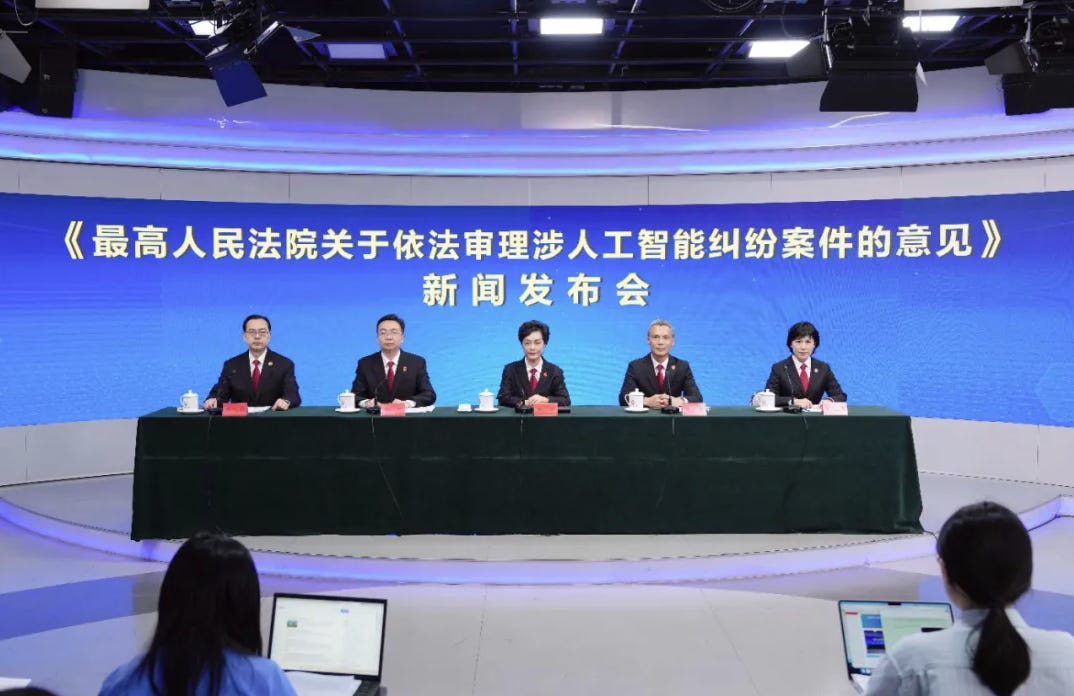
The Opinions contain 24 provisions covering AI-enabled face swapping, voice cloning, virtual avatars, personal information, infringement involving AI-generated content, discriminatory pricing, autonomous driving, training data, open-source software, and AI-generated evidence.
The primary purpose of the Opinions is to provide courts with a more consistent framework for adjudicating AI-related disputes under China’s existing civil law regime. In particular, they address how liability should be allocated among developers, service providers and users, and how courts should assess duties of care, fault, causation and burdens of proof.
It is important to clarify at the outset that the Opinions do not constitute new AI legislation, nor are they a judicial interpretation. They are issued under the document designation “Fa Fa” (法发) and constitute judicial policy and adjudicatory guidance issued by the SPC. In its accompanying Q&A, the SPC expressly noted that China has not yet enacted a dedicated AI law. AI-related disputes must therefore continue to be adjudicated under existing laws, including the Civil Code, Copyright Law, Personal Information Protection Law, Anti-Unfair Competition Law, Consumer Rights Protection Law, Product Quality Law and Civil Procedure Law. The Opinions themselves therefore cannot create new categories of civil rights or liabilities.
Nevertheless, their practical significance is considerable. The Opinions call for cases that may establish important rules or require greater consistency in the application of law to be heard at a higher level where appropriate, while promoting greater consistency through the People’s Courts Case Database and judicial supervision. Standards developed through future landmark AI cases may therefore have a broader impact on companies’ product design, data governance and risk controls.
On the allocation of liability, the Opinions generally retain a fault-based approach. They do not impose strict liability on model developers or service providers for all AI outputs, but nor do they allow companies to avoid liability simply by invoking “technology neutrality” or arguing that the content was generated automatically by a machine. Courts will assess liability in light of the particular use case, the degree of system autonomy, potential risks and their scope of impact, as well as each party’s ability to foresee and control those risks.
This approach both limits and potentially strengthens platform liability. On the one hand, the Opinions do not categorically treat purely online models or applications as “products” for purposes of the Product Quality Law. Strict product liability therefore remains primarily relevant to AI products with a physical form, such as robots and autonomous vehicles. On the other hand, a platform may still be found at fault if it could reasonably foresee a particular type of harm and had the ability to mitigate that risk but failed to take proportionate measures.
Infringement of personality rights illustrates this framework. The Opinions distinguish between infringing content generated by a model itself and content deliberately induced by users through malicious prompts. Users are responsible for their own intentional infringing conduct, while platform liability depends on factors including foreseeability, technical control and the measures already implemented. Where a rights holder provides verified identity information and prima facie evidence of infringement, a platform that fails to take necessary measures—such as preventing the relevant generation, restricting particular instructions or taking action against an account—may also bear liability for additional harm occurring after notification.
Unlike conventional online platforms, where an infringing article, image or hyperlink can simply be removed, a generative model may reproduce similar content following relatively minor changes to a prompt. An important issue for future cases will therefore be how courts determine whether filtering, prompt restrictions, account measures or model updates constitute reasonable and necessary responses. The Opinions do not prescribe a uniform technical standard, leaving this assessment to the circumstances of individual cases.
The evidentiary rules may have the most immediate practical implications for AI companies. In cases involving copyright infringement by generated content, a rights holder generally remains responsible for producing prima facie evidence that the disputed content was generated by the model in question and is substantially similar to the protected work. Courts may then, where necessary, require the model developer or service provider to explain the sources of its training data, the training process, the operation of the model and the relevant scientific basis.
This does not amount to a wholesale reversal of the burden of proof. Rather, evidentiary burdens are allocated according to access to information: rights holders establish external facts reasonably accessible to them, while parties controlling the model, training materials and operational records may be required to provide reasonable explanations concerning internal facts. Where a party controlling documentary or electronic evidence refuses to produce it without justification, the court may draw adverse factual inferences.
As a result, information concerning training-data provenance, model versions, prompt records, retrieval-augmented generation (RAG) materials, filtering rules, risk testing and complaint handling may evolve from internal R&D records into important litigation evidence for determining infringement, fault and causation. AI compliance is therefore increasingly moving from the question of whether an obligation was fulfilled to whether the company can demonstrate that it was fulfilled.
Companies will accordingly need more traceable data and model governance systems. This may include preserving key records concerning data provenance and licensing, model versions and testing, as well as necessary generation and complaint-handling logs. At the same time, evidence retention must continue to comply with requirements concerning personal information, trade secrets, data security and cross-border transfers. Potential litigation does not justify indefinite retention of all information.
Compared with its relatively detailed rules on liability and evidence, the SPC has taken a notably cautious approach to copyright issues at the training stage. In its accompanying Q&A, the SPC explained that significant disagreement arose during the drafting process over whether AI-generated content can qualify as a copyrighted work and how the unauthorized use of copyrighted works for model training should be characterized. The Opinions therefore do not establish uniform rules on either issue. This means that while the Opinions provide some guidance on liability arising from AI outputs, they do not resolve the more fundamental industry question of whether foundation-model training is lawful, when such use might constitute fair use, or when authorization from rights holders may be required.
Previous Chinese cases have indicated that copyright protection for AI-generated content may depend on the extent of human intellectual contribution to the particular generation process and the evidence demonstrating that contribution. In the Beijing Internet Court’s 2023 “Spring Breeze Brings Tenderness” case, the court found that the user had demonstrated original intellectual input by designing prompts, setting parameters and making individualized choices concerning visual elements and composition. The resulting image was therefore eligible for copyright protection. By contrast, in the “Phantom Wings Transparent Art Chair” case, the court found that the plaintiff had entered relatively simple prompts and had failed to provide complete records of the generation process, making it difficult to establish a sufficient level of original intellectual contribution. The contrast between the two cases suggests that the central issue is not necessarily whether AI was used, but whether the human contribution satisfies the originality threshold under copyright law and whether that contribution can be demonstrated.
Existing cases concerning generative AI platform liability have also adopted different analytical approaches. Courts in Guangzhou and Hangzhou, in disputes involving AI-generated images of well-known film and television characters, have examined factors including the degree of platform control over the final output and whether conduct at different stages—including user uploads, training and generation—constituted direct or contributory infringement. The multi-factor approach adopted by the Opinions is broadly consistent with this emerging case law, but it does not elevate the approach taken in any individual case into an absolute rule applicable to all models and business models.
From a broader policy perspective, the SPC’s decision to address output liability first while postponing a uniform standard for training-related copyright avoids establishing a definitive rule while significant questions remain concerning technical mechanisms, market substitution and licensing arrangements. Whether an output is substantially similar to a pre-existing work, whether a user intended to infringe and whether a platform acted after receiving notice can generally be assessed by reference to specific content and conduct. By contrast, determining whether unauthorized use of copyrighted works for model training constitutes reproduction or qualifies as fair use implicates the technical operation of models, methods of data acquisition, potential market substitution, licensing transaction costs and the conditions necessary for the development of the foundation-model industry.
Any uniform rule in this area would directly affect the allocation of costs and benefits among model developers, content industries and rights holders. The SPC has not further explained the policy considerations behind its decision not to establish such a rule. The more cautious conclusion at this stage is therefore that these issues will continue to develop through individual cases, industry practice and future legislation.
Personal-information rules must also be distinguished from copyright rules governing training data. Article 6 of the Opinions leaves some room for using lawfully public personal information for model training within a reasonable scope. Where an individual has not expressly objected and the processing does not have a material impact on that person’s rights and interests, such processing will generally not be regarded as an infringement of personal-information rights.
However, permission to process publicly available personal information does not mean that copyrighted expression contained in the same material may automatically be used for training without authorization. A publicly accessible article, for example, may simultaneously contain personal information and copyright-protected expression. Compliance with personal-information rules does not eliminate copyright, contractual or unfair-competition risks. Conversely, obtaining copyright permission does not mean that sensitive personal information contained in the relevant material may be processed without restriction. Public accessibility does not itself amount to a copyright licence or authorization for other uses.
The Opinions take a comparatively innovation-friendly approach to open-source software. In assessing the liability of open-source software developers and providers, courts may consider licence terms, restrictions on rights, security measures and risk disclosures. Developers that provide certain code modules free of charge and adequately disclose their functions and risks may, depending on the circumstances, be found not liable for downstream infringement.
However, this provision concerns open-source software and code modules and should not be broadly interpreted as creating a safe harbour for all open-weight AI models. Model code, weights, training data and downstream applications may each be governed by different licences and legal rules. Making model weights openly available does not mean that the underlying training data may be freely used. Companies deploying open-weight models therefore still need to review separately the applicable conditions governing code, weights, training data and commercial applications.
Beyond intellectual property, the Opinions provide guidance on areas including discriminatory pricing and autonomous driving. “Big data price discrimination” continues to be assessed primarily through consumers’ rights to information, choice and fair dealing. Liability for autonomous-driving accidents will depend on factors such as driver fault, vehicle defects, sales representations and the causal contribution of each factor. A party controlling autonomous-driving event data may also face adverse consequences if it refuses to produce relevant records.
From a corporate compliance perspective, the most important implication of the Opinions is not the creation of a new AI compliance checklist, but the growing importance of “demonstrable compliance.” Companies need not only to conduct data-provenance reviews, risk testing, model-version management and rights-notification handling, but also to ensure that these measures can be demonstrated if a dispute subsequently arises.
At the model pre-training and fine-tuning stages, companies should prioritize records concerning data provenance, licensing status, supplier responsibilities and key cleaning and annotation processes. Significant model and product updates should be accompanied by records of material version changes, testing and risk assessments. Providers of public-facing generative AI services should establish effective rights-notification, internal escalation and remediation mechanisms, and should be able to reconstruct the relevant model version and response process when a dispute arises. When using open-source software or open-weight models, companies should separately review licence terms, model cards, redistribution restrictions, training-data disclosures and restrictions on commercial use.
Not all of these measures constitute new legal obligations created by the Opinions. Some derive from existing legislation and administrative regulation; others are risk-management measures that may help companies demonstrate that they exercised reasonable care within a fault-based liability framework. As case law develops, practices that currently remain partly voluntary—such as data traceability, model-version records, red-team testing, risk disclosure and complaint handling—may increasingly become relevant factual benchmarks for determining whether an AI company exercised reasonable care.
From an international comparative perspective, China is developing a dual-track AI governance framework combining administrative regulation with judicial liability. The EU AI Act primarily establishes ex ante obligations through risk classification. The United States still lacks an equivalent comprehensive federal AI statute, and many boundaries continue to develop through copyright, product-liability and consumer-protection litigation and administrative enforcement. In China, administrative authorities address matters such as filings, security assessments, content labelling, platform governance and personal-information protection, while courts apply existing civil, intellectual-property and procedural laws to actual harm and the allocation of liability.
Overall, the Opinions do not represent a wholesale expansion of liability for AI companies. Fault remains the basic liability framework, and purely digital model services are not categorically brought within strict product liability. The more significant development is that courts will increasingly focus on whether companies could foresee and control particular risks, what measures they actually took, and whether they can demonstrate that those measures were genuinely implemented.
At the same time, the most consequential copyright questions remain unresolved. The Opinions do not establish a uniform standard for when AI-generated content qualifies as a copyrighted work, nor do they determine when the use of copyright-protected material to train foundation models requires authorization or may qualify as fair use. These questions will continue to evolve through future legislation, individual cases and industry practice.