

On August 5, after a few quiet days, the Chinese government moved again, taking countermeasures against the United States’ recent “economic and trade restrictive measures.”
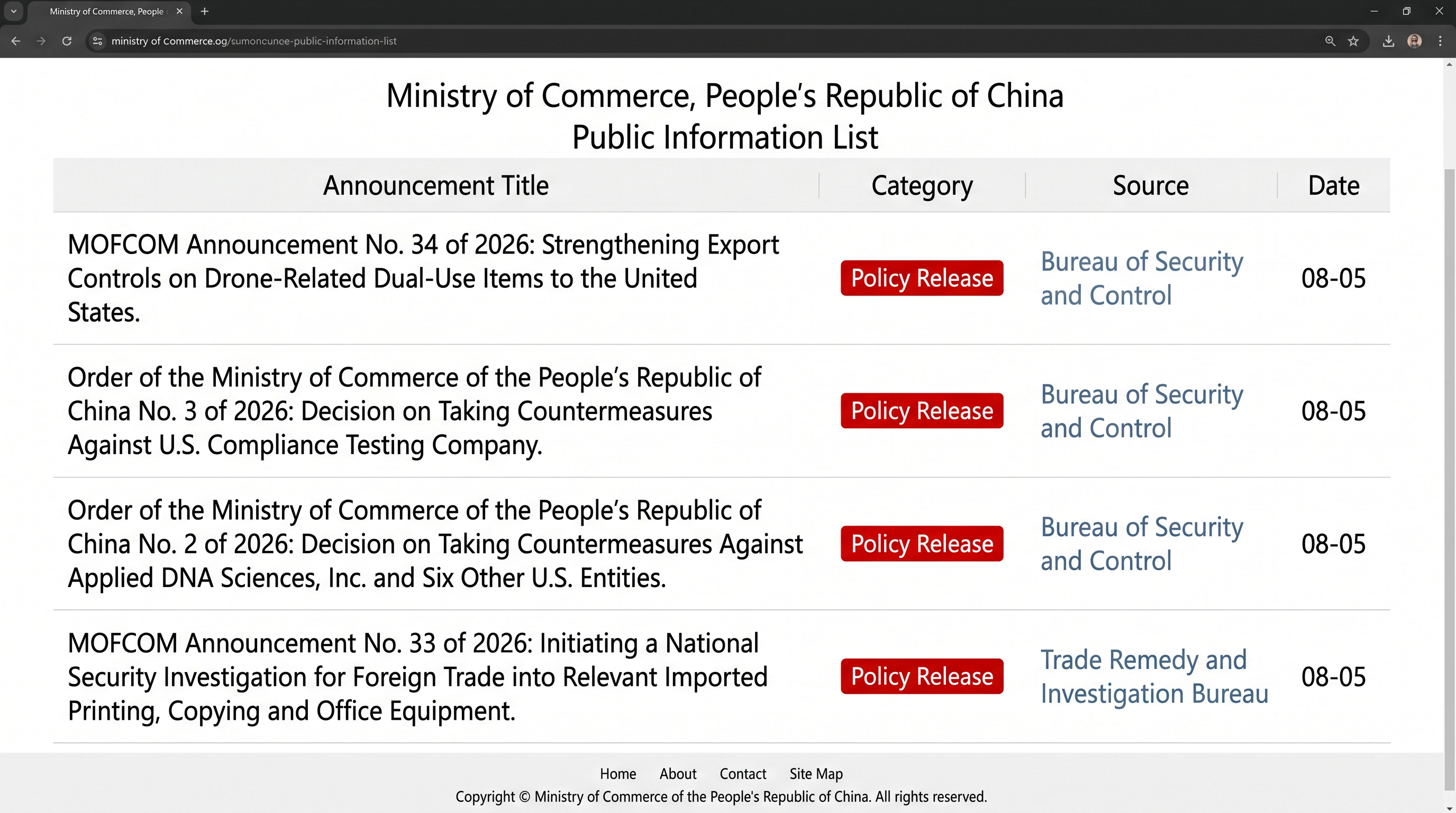
The countermeasures announced this time mainly include several items.
First, China will strengthen export controls on drones, their key components, and related technologies to the United States.
From now on, drones, key components, and technologies that have already been included in China’s export control list of dual-use items will be subject to strict case-by-case review if exported to the United States, and exporters will no longer be allowed to use license facilitation measures.
Second, China will suspend part of China-U.S. product certification cooperation.
Designated bodies for China Compulsory Certification will suspend entrusting U.S. certification bodies with follow-up inspections of U.S. factories.
Third, China will add seven U.S. entities to its countermeasure list.
Six of them are accused of assisting and supporting the United States in imposing Xinjiang-related sanctions. The other, a U.S. compliance testing company, is accused of assisting the FCC in introducing restrictive measures against Chinese companies and testing laboratories. Organizations and individuals within China will no longer be allowed to conduct relevant transactions, cooperation, and other activities with these seven entities.
Fourth, China will launch a national security investigation into imported printing and copying office equipment installed with foreign system software.
The investigation covers imported office equipment that is installed with foreign driver software and embedded software and has both printing and copying functions.
For the detailed content of these announcements,Inside China has published a full English translation.
Taken together, this is indeed a carefully designed package of countermeasures. The FCC restricted Chinese testing laboratories, drones, routers, submarine cables, robots, and power inverters; China is responding item by item from several directions, including certification, components, software security, and supply chain compliance.
In an accompanying press briefing, China’s Ministry of Commerce (MOFCOM) made no attempt to downplay the rationale behind the latest measures.
According to the spokesperson, since the Trump–Xi summit in Busan, the U.S. Federal Communications Commission (FCC) has repeatedly ignored China’s strong objections as well as calls from industry in both countries, while continuously expanding the concept of national security to justify a growing number of restrictive measures against China. These measures have covered a wide range of sectors, including telecommunications operators, testing laboratories, drones, consumer routers, submarine cables, and, most recently, advanced robotics and power inverters.
The spokesperson also highlighted that, despite repeated diplomatic representations from China, the United States added more than 40 Chinese entities to the Uyghur Forced Labor Prevention Act (UFLPA) Entity List on July 31, just one day after the July 30 video call between the Chinese and U.S. lead officials on economic and trade affairs. China said it was “strongly dissatisfied with and firmly opposed” to this decision.
According to MOFCOM, these U.S. actions seriously violate the important consensus reached by the two heads of state and undermine China’s legitimate rights and interests, leaving China no choice but to adopt necessary countermeasures.
At the same time, the spokesperson stressed that China’s response remains restrained. China values the hard-won stability in bilateral economic and trade relations and hopes the United States will work with China in the same direction. China urged Washington to immediately revoke the relevant measures, abandon what it described as its “erroneous practices,” and return to resolving differences through dialogue and cooperation in order to preserve constructive strategic stability between the two countries.
The spokesperson added that if the United States proceeds with additional restrictive measures against China, China will take further countermeasures in response.
The actual force of these measures is not exactly the same. Some have already taken effect immediately and will directly cut off relevant companies’ business with China. These include strengthening export controls on drones, their key components, and related technologies to the United States; suspending part of China-U.S. product certification cooperation; and adding seven U.S. entities to the countermeasure list. Others are only investigations for now and remain some distance away from actual import restrictions. One example is the national security investigation into imported printing and copying office equipment installed with foreign system software. This is also the first time China has launched a foreign trade national security investigation under Article 41 of the Foreign Trade Law.
Among all these measures, inclusion on the countermeasure list carries the most serious consequences. Most of the U.S. entities listed this time are not household-name large companies, but they share one feature: they are all located in the implementation layer of U.S. Xinjiang-related supply chain enforcement and product safety regulation.
For example, Applied DNA Sciences and Stratum Reservoir mainly provide services such as DNA tagging and stable isotope analysis, which can be used to determine the origin of cotton, agricultural products, and other raw materials. After the United States implemented the Uyghur Forced Labor Prevention Act, importers needed to prove that their products and raw materials had no connection to Xinjiang. Traditional contracts, invoices, and supplier declarations were sometimes not enough to satisfy U.S. Customs, so DNA and isotope testing came to be used as supporting evidence.
Applied DNA Sciences is a listed company. In 2025, it changed its name to BNB Plus Corp., and its stock ticker changed from APDN to BNBX. The company previously operated cotton DNA tagging and origin tracing businesses, and it once publicly stated that U.S. implementation of the UFLPA helped drive demand for its business. Since then, however, the company has undergone major business changes. Its main strategy has now shifted to holding BNB digital assets and generating returns through the Binance ecosystem. Its original DNA supply chain tagging and security business is being exited, and its molecular diagnostics business has also been discontinued. The remaining industrial business is mainly nucleic acid production technology for the biopharmaceutical and diagnostics industries. The Ministry of Commerce’s move this time is more about the company’s past participation in UFLPA supply chain tracing than its current core business.
Altana Technologies operates a supply chain data platform. It uses customs, shipping, corporate, and trade data to map supply chain networks from raw materials to final products. In 2025, U.S. Customs and Border Protection selected Altana’s “product passport” system, allowing importers to prove product origin and supply chain compliance to customs in advance. Altana’s core strength is mapping global supply chain networks, and China is one of the most important nodes in global manufacturing and trade networks. If Chinese companies cannot directly provide data to Altana, purchase its services, or participate in product passport cooperation, Altana can still rely on U.S. customs data, shipping data, and overseas customers to continue analyzing Chinese supply chains, but the completeness of its data and its verification capacity will clearly be affected. For a company whose core selling point is end-to-end supply chain visibility, this impact may be greater than the direct loss of China revenue.
The Responsible Business Alliance, or RBA, is a very important industry organization in global electronics, automotive, and consumer goods supply chains. It develops supply chain codes of conduct and provides factory audits, forced labor-specific assessments, risk questionnaires, training, and corrective action tools. Many multinational companies require suppliers to accept RBA standards or audits. Many of RBA’s activities take place at the level of Chinese factories and suppliers. Now that it has been placed on the list, organizations and individuals within China, in principle, can no longer conduct relevant transactions and cooperation with it. This may affect its membership fees, factory audits, training, data submissions, and supplier assessments. In reality, however, many RBA services are purchased centrally by multinational headquarters, which then require their Chinese subsidiaries and suppliers to implement them. How regulators will define such intra-group arrangements in the future, and whether contracts signed overseas will be treated as extending to audit activities inside China, remains to be seen.
It is worth noting that the RBA is one of the world’s most widely adopted supply chain compliance frameworks. Many multinational companies—including Apple, Dell, HP, Intel, Tesla, and Bosch—are RBA members and require their suppliers to comply with its standards. If RBA is no longer able to conduct audits in China as a result of its designation on China’s countermeasures list, many Chinese suppliers may be unable to obtain new RBA certifications or renew existing ones. Overseas customers may then require Chinese companies to adopt alternative certification schemes or conduct supplier audits themselves. This could have a meaningful impact on sectors such as electronics, automotive, new energy, semiconductors, and EMS manufacturing. Much will depend on how the countermeasures are implemented in practice. If the restrictions were to materially affect Chinese companies’ ability to meet supply chain compliance requirements, the exemption mechanism under China’s Anti-Foreign Sanctions Law could potentially be used to waive the relevant restrictions.
Verité has long worked on labor rights, forced labor, and supply chain due diligence, providing research, training, and consulting to governments, companies, and international organizations. Being placed on the countermeasure list may cause it to lose some China-related projects, clients, and sample sources, but these organizations have not publicly disclosed their China revenue, so it is difficult to judge the actual amount involved.
Human Rights in China mainly engages in human rights research and policy advocacy. Its commercial attributes are relatively weak, and it has no obvious commercial activities inside China. Its inclusion on the countermeasure list is therefore more political and symbolic.
For UFLPA listings, the Department of Homeland Security’s publication of a list is only the first step. Actual enforcement still requires origin testing, supply chain data, factory audits, labor investigations, and policy research. The Chinese side is targeting precisely the technology and service providers behind this enforcement system. The signal is already very clear: if foreign organizations help the U.S. government investigate, identify, and sanction Chinese companies, they may face risks under Chinese law even if they are not government agencies themselves.
The other company separately added to the countermeasure list is Compliance Testing LLC, based in Arizona. It is an FCC-recognized U.S. testing laboratory and telecommunications certification body that can help electronic products complete FCC testing, obtain FCC IDs, and enter the U.S. market. On the one hand, the company has long provided FCC certification services to Chinese manufacturers, and its website clearly states that it “frequently works with Chinese clients.” On the other hand, its executives have long lobbied the FCC to prohibit Chinese laboratories from testing products exported to the United States, arguing that this business should be moved back to the United States. So its inclusion on the list is not exactly undeserved. After being placed on the countermeasure list, Chinese manufacturers, in principle, can no longer directly entrust this company with testing and certification. Ongoing projects may also need to be transferred to other FCC-recognized bodies, which may bring Compliance Testing relatively direct losses of Chinese clients. However, after the United States restricts Chinese laboratories, some testing that was previously conducted in China may flow to U.S. laboratories. Compliance Testing may lose Chinese clients, but it may also benefit from the return of testing business to the United States. The final net impact is therefore hard to judge.
The drone-related countermeasure is to apply strict case-by-case review to exports to the United States of drones, key components, and related technologies included in the dual-use item list, while canceling license facilitation. It does not prohibit all drones and components from being exported to the United States. The existing list mainly covers drones with certain technical parameters and military uses, as well as aircraft engines, communications equipment, infrared imaging equipment, synthetic aperture radar, lasers, high-precision inertial measurement equipment, and counter-drone systems. Ordinary consumer-grade products and general components, if they do not meet the parameters in the list, should not be automatically banned from export because of this announcement.
Major U.S. military drone companies were already reducing their use of key Chinese components. Companies such as AeroVironment, Red Cat, and Skydio serve the U.S. defense and public safety markets and usually need to meet NDAA or Blue UAS supply chain requirements. U.S. law has already restricted the Department of Defense from procuring drones that use key components produced in China, such as flight control systems, communications equipment, cameras, gimbals, operating software, and other parts. As a result, large U.S. military drone companies are already less directly dependent on key Chinese components than ordinary commercial drone companies. Compared with drone companies themselves, this measure is more likely to affect two types of companies. One group consists of small and medium-sized drone companies that still procure motors, batteries, magnets, sensors, and general electronic components from China. The other consists of companies that need high-performance thermal imaging, inertial measurement, lasers, communications equipment, or counter-drone components.
One new tool that has attracted attention this time is China’s first use of the foreign trade national security investigation authority under Article 41 of the Foreign Trade Law to launch a national security investigation into imported printing and copying office equipment. The investigation targets imported printing and copying equipment installed with foreign driver software or embedded software. The Ministry of Commerce will assess the impact of these devices on national security, domestic industries, import dependence, and domestic supply capacity.
But it should be emphasized that this is currently only an investigation, not a ban. The Ministry of Commerce has not prohibited the import of any brand, has not imposed additional tariffs, and has not named HP, Xerox, Canon, Ricoh, or any other company. Judging from the market structure, the U.S. companies that may be affected are mainly HP and Xerox. But China’s office printing market also includes many Japanese brands, such as Canon, Ricoh, Konica Minolta, Kyocera, Brother, and Epson. Therefore, if the investigation eventually turns into substantive restrictions, the companies most affected may not necessarily be American; they could instead be Japanese manufacturers.
Another key issue is that the investigation targets only “imported equipment.” If the relevant printers are produced inside China, then even if the brand and software are controlled by a foreign company, they may not fall within the scope of this investigation. Therefore, to assess a company’s risk, it is not enough to look only at whether it is a foreign brand. One also needs to look at where the specific product is manufactured and how it enters China.
The investigation may eventually lead to several possible outcomes: foreign companies may be required to provide more detailed explanations of software and data security; restrictions may be imposed on remote updates, telemetry, cloud printing, and device management functions; companies may be required to establish software maintenance and vulnerability response capabilities inside China; government departments, state-owned enterprises, or critical infrastructure operators may be restricted from procuring certain imported devices; some products may face import restrictions.
HP’s printing business remains an important source of profit, but the company does not separately disclose revenue from its China printing business, so outsiders cannot accurately calculate its dependence on the Chinese market. If the final result is only a requirement to submit security materials or adjust some software functions, the impact on HP’s overall revenue would be very small. Only if China restricts imported equipment or government procurement would there be a more visible financial impact.
Xerox’s situation is somewhat different. In 2025, the company acquired Lexmark. Lexmark had previously been controlled by investors including China’s Ninestar and has some manufacturing and supply chain foundations in China. Some products, if manufactured inside China, may not themselves qualify as “imported equipment.” But if the investigation is further extended to foreign-controlled embedded software, cloud printing, and remote management services, Xerox and Lexmark may still be affected. Considering that Xerox is currently also facing high debt, declining demand for traditional printing, and acquisition integration issues, the Chinese investigation is not yet its most important fundamental variable.
The China Chamber of Commerce for Import and Export of Machinery and Electronic Products (CCCME) quickly issued a statement backing the government’s actions on printing devices.
The chamber said it “firmly supports” the Ministry of Commerce’s decision to launch the investigation in accordance with the law, assess the impact of the relevant imports on China’s national security interests in foreign trade, and adopt further measures where necessary.
CCCME also criticized a series of recent China-related measures introduced by the U.S. Federal Communications Commission (FCC) and the U.S. Department of Homeland Security, including multiple restrictions on market access. It further argued that the U.S. government has continuously expanded the concept of national security, even extending Section 232 investigations and tariffs to ordinary products such as timber, and expressed its firm opposition to these actions.
The chamber noted that printing and photocopying equipment, as critical information input and output devices, forms part of the essential infrastructure supporting economic and social activities. It argued that ensuring the security of the domestic printing and copying equipment industry is important for safeguarding China’s national security interests and promoting the healthy development of the industry.
CCCME added that it will actively organize relevant companies to cooperate with the Ministry of Commerce’s investigation and support efforts to safeguard China’s industrial development and national security interests.
The measure suspends China’s designated CCC certification bodies from commissioning U.S. certification bodies to carry out post-certification follow-up factory inspections of U.S. manufacturers. Previously, China generally allowed qualified overseas certification bodies to participate in CCC factory inspections to facilitate international trade. Suspending this arrangement does not ban U.S. products from entering the Chinese market or automatically invalidate existing CCC certificates. However, it will increase the time and cost for U.S. companies to maintain their CCC certification, creating a new procedural barrier for U.S. exports to China. The move is widely seen as a reciprocal response to the United States’ use of mechanisms such as the FCC equipment authorization regime to steadily raise regulatory barriers for Chinese products entering the U.S. market in recent years.
Only China can match US blow by blow! Finally someone who can stand up to the school bully. 👏🏼