

We still need to read this alongside the EU’s readout, but my initial impression is that the negotiations have produced a meaningful, albeit partial, easing of tensions. The risk of a near-term escalation in trade and economic disputes may now be somewhat lower. The most significant developments are the understanding on hybrid vehicles, reciprocal facilitation of export licences, and procedural arrangements for advance notification before adding entities to control lists and for removing them from such lists. These measures address some of the areas where the two sides have recently been most likely to clash.
First, the understanding reached on hybrid vehicles is the most important outcome of these negotiations.
On October 7, the Financial Times, citing two diplomats briefed on the proposal, reported that China had rejected voluntary export restrictions on hybrid vehicles, prompting the European Commission to consider unilateral import safeguard measures. At the time, the main concern in the market was that, if the two sides failed to reach an agreement, the EU might move quickly to impose restrictions, potentially triggering Chinese countermeasures.
The statement now explicitly says that the two sides “reached an understanding following intensive consultations.” This suggests that they have at least found an approach that both sides can accept and publicly acknowledge.
The most significant wording here is “consistent with WTO rules.” On September 18, China publicly opposed voluntary export restraints and stressed that any solution must comply with WTO rules and the domestic laws of both sides. This formulation therefore allows China to maintain its previously stated position while leaving room for the two sides to manage the hybrid vehicle issue.
However, it remains unclear whether the understanding has prevented new import restrictions altogether, or whether the two sides have reached some agreement on the form, scale or implementation of potential restrictions.
Second, the export control provisions show a relatively clear degree of reciprocity.
Paragraph 12 states that China will continue to facilitate export licensing for rare earths and permanent magnets destined for the EU, while the EU, together with its member states, will work to resolve priority cases involving export licences for dual-use items destined for China.
Europe needs continued access to critical raw materials from China, while China wants European technology, equipment and other controlled items to remain legally available for export. The inclusion of both sides’ concerns in the list of outcomes suggests that the negotiations are beginning to identify practical solutions based on their respective industrial needs.
That said, the commitments mainly involve continued facilitation and efforts to resolve individual cases. The green channel for rare earth exports is an extension of an existing arrangement, while the EU has not committed to approving every priority licence application. The explicit reference to working “together with member states” also means that implementation will require the involvement of the relevant national authorities.
Paragraph 13, concerning “structural facilitation measures,” may be even more important over the longer term. If the two sides can eventually move from case-by-case coordination towards more stable and predictable licensing arrangements, the benefits for businesses could be considerably greater.
Third, paragraph 14 may be the most institutionally significant, yet easily overlooked, provision in the entire list.
Advance notification before adding entities to control lists, greater transparency in listing and delisting procedures, and support for initiating delisting procedures in accordance with the law suggest that the two sides are beginning to establish clearer channels for communication and dispute resolution over export controls.
For businesses, the damage caused by being unexpectedly placed on a control list goes beyond the restrictions themselves. Banks, customers and suppliers may immediately suspend their relationships with the affected company.
If advance notification is implemented effectively, it could at least provide time to verify a company’s identity, clarify the nature of its transactions, correct factual misunderstandings and adjust business arrangements. Delisting procedures would also preserve a possible route towards resolving restrictions already imposed on companies.
My interpretation is that both sides are beginning to explore ways to reduce the unpredictability of economic security measures and the risk of disputes spiralling out of control, while retaining their respective rights to use these instruments. This is a development worth taking seriously.
Fourth, the main value of the provisions on the Foreign Subsidies Regulation (FSR) and inverters lies in opening channels for resolving existing disputes.
The formal inclusion of the FSR in technical-level dialogue is significant for companies such as JD.com that are facing EU scrutiny. In the case of JD.com’s acquisition of CECONOMY, there are reports that new commitments offered by JD.com may help resolve the outstanding concerns. The deadline for the decision has now been pushed back to November 4.
On inverters, the EU’s clarification that its financing guidelines are “not directed at any specific country” may help reduce the perception that China is being singled out and lower the level of overt country-specific confrontation. For now, however, this is only a statement of principle, with limited practical significance.
The same applies to the tariff reduction provision, which merely commits the two sides to continuing discussions on possible reductions. The electric vehicle provisions concern the continuation of price undertaking and review procedures, while the medical device procurement matchmaking event, agricultural risk assessments and regulatory consultations provide concrete mechanisms for further engagement.
Looking at what each side has gained, I think this is an arrangement that both can credibly present as having delivered results. It is still too early to determine which side has made greater concessions.
Europe can point to progress on hybrid vehicles, stronger assurances over the supply of critical raw materials, and continued engagement on market access issues in China.
China, meanwhile, can emphasise that the hybrid vehicle issue is being addressed under mutually accepted rules, that the EU has responded to Chinese concerns over dual-use export licences, that the FSR has been brought into technical dialogue, and that listing and delisting procedures are becoming more transparent.
This should help both sides maintain political support for the negotiating process. The statement also establishes clear milestones for follow-up engagement, including a ministerial video conference in January 2027 and a third regular meeting in March, providing opportunities to review implementation.
My overall assessment is that we are now seeing a limited but tangible easing of tensions, supported by concrete outcomes. Both sides still appear to be making a serious effort to avoid a full-scale trade confrontation.
Joint Statement of the Second Meeting of the China-EU Trade and Investment Consultation Mechanism
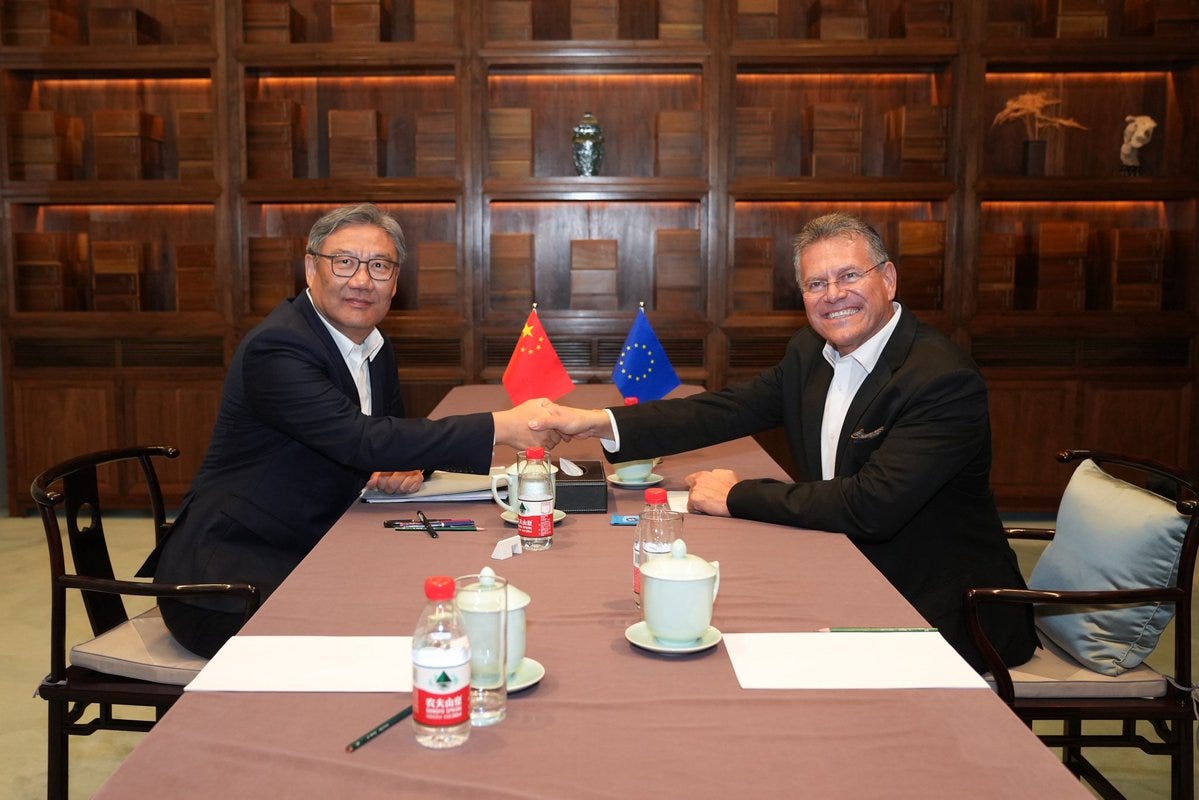
On October 8–9, 2026, China’s Minister of Commerce Wang Wentao and European Commissioner for Trade and Economic Security Maroš Šefčovič held the second meeting of the China-EU Trade and Investment Consultation Mechanism (hereinafter referred to as the “Mechanism”) in Beijing. The two sides held pragmatic and productive discussions and agreed on a list of outcomes and common understandings.
Both sides reaffirmed their commitment, as key trading partners, to properly managing their differences within the framework of World Trade Organization (WTO) rules, and to continuing to stabilise bilateral economic and trade relations while making them more balanced. The two sides agreed to convene the third meeting of the Mechanism in March 2027. In the meantime, they will maintain close communication, including through a ministerial-level video conference in January.
List of Agreed Outcomes and Common Understandings
Trade and Investment Balance
The two sides will continue to explore the possibility of reducing tariffs on certain goods within the framework of WTO rules.
The two sides will continue to strengthen communication and cooperation under the trade monitoring mechanism and further make active use of dialogue mechanisms to enhance mutual understanding.
Following intensive consultations, the two sides reached an understanding on trade in hybrid vehicles in a manner consistent with WTO rules.
The two sides recalled the guidance document on price undertakings in the anti-subsidy investigation concerning electric vehicles and will continue the relevant procedures for company-specific price undertakings and reviews in connection with the investigation.
The two sides will maintain dialogue on market access for medical devices. The EU welcomes the measures taken by China to expand imports of EU medical devices, including the organisation of a procurement matchmaking event during the ninth China International Import Expo (CIIE).
Based on risk assessments, China will accelerate the recognition of the regionalisation principle for eligible EU Member States. The two sides agreed to exchange views on methods and technologies for disease control and jointly explore ways to lift restrictions on imports into China from relevant Member States arising from bluetongue disease.
The two sides agreed to continue technical exchanges on computer reservation systems. They also agreed to hold follow-up consultations on their respective regulatory frameworks for cosmetics and pharmaceuticals, with a view to further addressing existing and emerging market access issues.
The two sides agreed to conduct technical dialogue on the EU Foreign Subsidies Regulation (FSR).
The EU clarified that its financing guidance document concerning inverter projects is not directed at any specific country. The two sides will hold further consultations on this issue.
The two sides agreed to explore investment cooperation to promote their respective economic development and discuss opportunities for future-oriented cooperation.
Export Controls
The two sides reaffirmed the need to further strengthen the China-EU export control dialogue and welcomed enhanced communication and exchanges on their respective export control policies, including through the publication of policy guidance, the organisation of government-business exchanges, and the provision of training.
The two sides recognised the importance of improving the predictability and stability of global industrial and supply chains. China is willing to continue facilitating export licence approvals for rare earths and permanent magnets destined for the EU through a “green channel” mechanism. The EU, together with its Member States, will continue to facilitate the resolution of priority individual licensing cases involving exports of dual-use items to China.
The two sides reaffirmed their commitment to addressing concerns in the area of export controls and discussed the possibility of developing structural facilitation measures to support compliant trade in dual-use items between China and the EU.
The two sides reached an understanding within the framework of the export control dialogue mechanism to provide advance notification before adding entities to control lists, enhance transparency in procedures for removing entities from such lists, and support the initiation of delisting procedures within their respective legal frameworks.
Intellectual Property
China and the EU have begun addressing systemic intellectual property issues and have made progress. The two sides agreed to continue cooperating to resolve relevant issues and to establish interim milestones, focusing on effective and fair intellectual property protection and enforcement, as well as greater transparency and predictability. The two sides agreed to monitor progress through the China-EU Intellectual Property Working Group.
WTO Reform
The two sides agreed to further strengthen bilateral communication and cooperation on WTO reform in an open and constructive manner. Both sides committed to engaging in WTO reform and agreed to discuss all relevant issues with a view to achieving substantive progress.