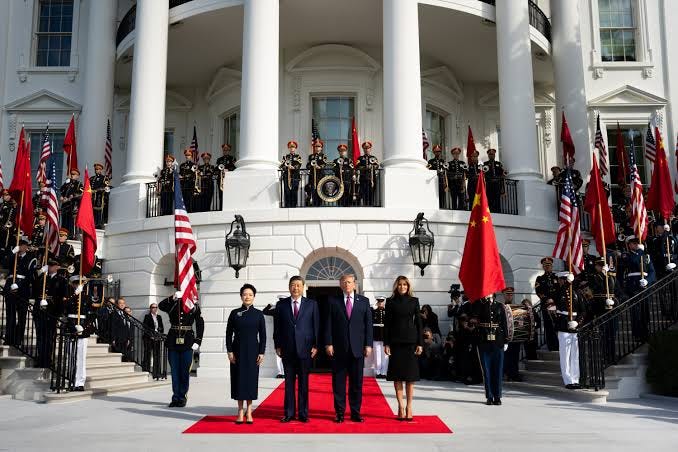
From September 23 to 25 local time, Chinese President Xi Jinping paid a state visit to the United States. During the visit, the two presidents held in-depth discussions on building a constructive and strategically stable China-U.S. relationship, as well as major international and regional issues. They reached consensus on eight key outcomes:
The two sides agreed to build a “constructive and strategically stable China-U.S. relationship based on respect, fairness and reciprocity.”
The two sides agreed to support each other in successfully hosting the APEC Economic Leaders’ Meeting and the G20 Leaders’ Summit. The two presidents intend to attend the meetings hosted by the other side.
The two presidents agreed that Iran should honor its commitment not to develop nuclear weapons and that no country or entity should impose transit fees on international waterways.
The two presidents recalled that China and the United States were allies during World War II and fought side by side to achieve victory.
The two presidents recognized the positive role of the China-U.S. economic and trade consultation mechanism and the outcomes reached by their respective economic and trade teams. These include establishing and advancing mechanisms such as the Trade Council, reaching a reciprocal tariff-reduction arrangement covering US$30 billion in trade, and extending the outcomes of the Kuala Lumpur economic and trade consultations. The two presidents instructed their teams to implement these outcomes.
China-U.S. counternarcotics law-enforcement cooperation has produced tangible results. Recently, the two sides have worked closely together to jointly crack several cases involving new psychoactive substances and precursor chemicals, resulting in the arrest of dozens of suspects in both countries.
The two sides agreed to establish a China-U.S. dialogue on artificial intelligence to exchange views on AI-related risks and benefits. The next dialogue will take place in November this year. They also agreed to establish a communication channel for AI-related incidents.
The United States welcomed the arrival of a pair of giant pandas loaned by China to Zoo Atlanta.
In addition, the Chinese and U.S. militaries agreed to sign a memorandum of understanding as soon as possible to strengthen crisis communication and prevention, and to continue cooperation in searching for the remains of U.S. military personnel missing in China.
On the morning of September 24, 2026 local time, Chinese President Xi Jinping held talks with U.S. President Donald Trump at the White House.
President Xi noted that the Chinese and U.S. presidents had made reciprocal visits in less than six months, something unprecedented in the history of China-U.S. relations. President Trump and I have stayed in communication through various means and worked together to steer the course of China-U.S. relations, Xi said. In May this year, President Trump and I jointly decided to build a constructive and strategically stable China-U.S. relationship. This new characterization reflects the reality of China-U.S. relations as well as expectations for their future, and represents an important step toward finding the right way for the two countries to get along with each other.
Xi said the two sides should translate this vision into action and work toward a relationship in which cooperation remains the mainstay, competition is kept within reasonable bounds, differences are manageable, and peace can be expected, thereby finding the right way for two major countries to coexist. China and the United States should, and are fully capable of, pursuing mutual benefit and win-win outcomes through practical cooperation, bringing out the best in each other through healthy competition, properly managing differences while seeking common ground, and building peace through the accumulation of mutual trust, so that a constructive and strategically stable China-U.S. relationship can better benefit the peoples of both countries and the world.
President Xi stressed that the economic and trade teams of the two countries had held a new round of consultations and reached a new joint arrangement, which is good news for businesses and people in both countries as well as for the global economy. Cooperation is a two-way street. Stabilizing China-U.S. economic and trade relations requires both expanding the list of areas for cooperation and shortening the list of problems. As long as the two sides uphold the principles of equality, respect and mutual benefit, solutions can be found. Xi expressed the hope that the two sides would work toward the same goal, remain committed to mutual benefit and win-win outcomes, and promote the sustained, stable and positive development of China-U.S. economic and trade relations.
President Xi noted that China and the United States are both major powers in artificial intelligence. While there is competition between the two countries, there is even greater scope for cooperation. The two sides should each play to their strengths rather than guard against each other. China and the United States can continue their dialogue on artificial intelligence, exchange views on its risks and benefits, and work together to prevent the misuse and abuse of AI. Humanity must retain control over artificial intelligence technology, uphold a people-centered approach and ensure that AI is developed for good, so that it serves the progress of humanity.
President Xi stressed that China’s position on safeguarding national reunification and territorial integrity is clear. He expressed the hope that the U.S. side would maintain the correct position of opposing “Taiwan independence,” handle the Taiwan question prudently, and thereby lay a solid foundation for China-U.S. strategic cooperation and the development of bilateral relations.
President Trump said that President Xi’s state visit to the United States was a great visit. The United States and China are both major countries, and President Xi and I are good friends and maintain close and in-depth communication, Trump said. Under our leadership, U.S.-China relations will surely be handled well. The latest round of consultations between the two countries’ economic and trade teams has produced new outcomes, and the two sides should continue their dialogue and reach better agreements. Artificial intelligence concerns the future of humanity, and the United States and China should maintain dialogue and strengthen cooperation in this area.
The two presidents also exchanged views on major international and regional issues, including the situation in the Middle East, the Ukraine crisis and the Korean Peninsula.
The two presidents confirmed that China and the United States would support each other in successfully hosting the 2026 APEC Economic Leaders’ Meeting and the G20 Leaders’ Summit.
Cai Qi, Wang Yi, He Lifeng and others attended the meeting.
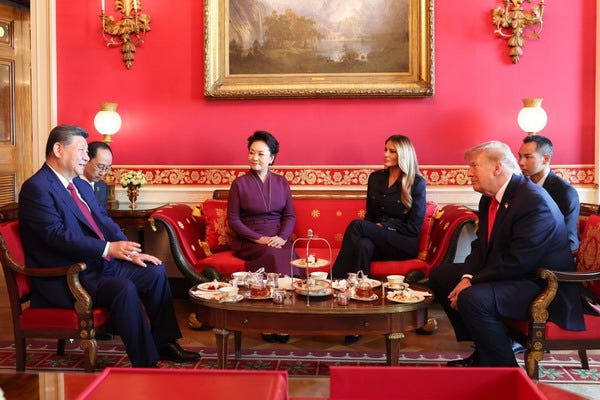
On the morning of September 25, 2026 local time, President Xi Jinping and his wife Peng Liyuan joined President Donald Trump and First Lady Melania Trump for tea at the White House.
The two presidents agreed to further enrich the characterization of China-U.S. relations and jointly build a “constructive and strategically stable relationship based on respect, fairness and reciprocity.”(基于尊重、公平、对等的建设性战略稳定关系)
President Xi noted that this was his first visit to Washington in 11 years and another state visit to the United States. Through this visit, the two sides have further enriched the characterization of China-U.S. relations and agreed to jointly build a “constructive and strategically stable relationship based on respect, fairness and reciprocity.” The two countries have also achieved mutually beneficial outcomes in the economic and trade field, which will be welcomed by the peoples of both countries and the international community.
President Xi stressed that the future of China-U.S. relations is bright, as dictated by the trend of history. At the same time, the road toward that bright future is often winding and will inevitably encounter various difficulties and challenges, which is also consistent with the way things develop. Xi said he was ready to work with President Trump, with a sense of courage and responsibility toward history, to write an important new chapter in the history of China-U.S. relations.
President Trump said that President Xi’s state visit to the United States had been constructive and highly successful. The two sides had engaged in in-depth communication on U.S.-China relations as well as major international and regional issues and achieved many positive outcomes that benefit both countries. He said he looked forward to maintaining close communication with President Xi and jointly guiding the development of U.S.-China relations.
Following the tea gathering, President Xi and Peng Liyuan, accompanied by President Trump and Melania Trump, visited the U.S. National Archives. The two presidential couples entered the Rotunda together and were briefed on the National Archives and its major exhibits.
President Xi said that archives carry the wisdom of previous generations and offer inspiration for the future. Over the past 250 years, the American people have pursued the American Dream and built a prosperous and strong country and a beautiful homeland on the North American continent. The Chinese people, inheriting the 5,000-year cultural tradition of the Chinese nation, have continued to make new achievements on the journey toward realizing the Chinese Dream of national rejuvenation.
China and the United States are two countries with their own distinctive characteristics. Although they differ in history and culture, social systems and development paths, the peoples of both countries share the same aspiration for a better life. By recognizing and respecting each other’s differences, seeking mutual understanding and learning from each other, finding the greatest possible common ground, expanding the list of areas for cooperation, and properly managing differences, the two countries can ensure the steady and sustained development of their relationship.
U.S. Readout:
Fact Sheet: President Donald J. Trump Advances a Fair and Reciprocal Relationship with China While Hosting Historic State Visit
The White House
September 25, 2026
DELIVERING FOR AMERICANS: This week, President Donald J. Trump and First Lady Melania Trump hosted President Xi Jinping and Madame Peng Liyuan of the People’s Republic of China for a reciprocal State Visit. During the visit, President Trump advanced the U.S.-China relationship and put the American people first.
The United States welcomed China’s scheduling of orphines, a class of deadly drugs. The United States also noted China’s new export controls on two fentanyl precursor chemicals, while strongly encouraging the permanent scheduling of these and other substances and chemicals to help stem the flow of illicit precursors to dangerous narcoterrorists in North America.
In August 2026, acting on information from U.S. law enforcement, China arrested 21 Chinese citizens for the manufacture and distribution of precursor chemicals to illicit drug producers in North America. The United States strongly encouraged maximum sentences, including the death penalty where applicable.
President Trump urged President Xi to increase production of refined petroleum products to stabilize global supply.
The United States welcomes the arrival of two giant pandas, leased by China to the Atlanta Zoo.
OPERATIONALIZING THE BOARDS OF TRADE AND INVESTMENT: This week, the two leaders operationalized the cornerstone government-to-government mechanisms of the U.S.-China Board of Trade and the U.S.-China Board of Investment, which were chartered during the May 2026 Summit in Beijing.
Under the Board of Trade, the two countries reached consensus on recommendations for more favorable tariff treatment for $30 billion of non-sensitive goods in each direction. The Board of Trade also launched a working group focused on addressing market access barriers in the agricultural sector.
For U.S. exports, the goods include agricultural goods, fish and seafood, logs and wood products, cosmetics and medical devices.
For U.S. imports, the goods include consumer products such as small appliances, toys, holiday decorations, and children’s car seats.
Following President Trump’s revival of the U.S. coal industry, China will import at least 10 million metric tons of coal from the United States in 2027 and again 2028.
The two countries established the Board of Investment. The mission of the Board of Investment is to discuss potential investment opportunities and investment-related impediments and to provide a structured channel for the two sides to address commercially meaningful investment-related issues.
The United States and China continue to work on U.S. concerns regarding supply chain shortages related to rare earths and other critical minerals, with the goal of ensuring shipment levels return to appropriate levels.
MAKING THE WORLD SAFER FOR AMERICANS: President Trump and President Xi discussed fostering peace and prosperity to enhance confidence for businesses and consumers around the world. The two countries agreed to build a constructive relationship of strategic stability on the basis of respect, fairness, and reciprocity.
The two countries will support each other as respective hosts of G20 and APEC, with both leaders intending to attend each other’s Summit.
The two leaders discussed on-going global concerns, including Russia, North Korea, and Iran. They agreed that Iran can never have a nuclear weapon and that no country or institution can be allowed to impose tolls on international waterways.
The two leaders recalled that United States and China were allies in World War II and fought side by side to win the war.
Since World War II, the United States’ forward military presence has preserved a Free and Open Indo-Pacific contributing to generations of American prosperity.
The President advocated for trilateral arms control negotiations between the United States, Russia, and China.
The two leaders agreed to use the term “super intelligence” rather than “artificial intelligence” to describe the applicable emerging technologies.
The two countries established the U.S.-China Super Intelligence (SI) Dialogue to exchange views on risks and benefits related to SI. The next exchange will occur by November 2026. The United States and China also agreed to establish a bilateral communication channel for SI incidents.