

The U.S. response to the Chinese government’s decision on Manus has been strikingly muted. Neither the White House nor relevant agencies have issued any statements, and Congress has also offered no comment.
This may be because Washington was already uneasy about the deal. The transaction had previously come under scrutiny from both China and the United States—U.S. lawmakers had already moved to prohibit domestic investors from directly investing in Chinese AI companies. In effect, China halted a deal that some within the U.S. national security community also viewed with reservations, making it difficult for Washington to mount a strong protest.
On the Chinese side, there has likewise been no formal official response. However, several state-affiliated media outlets and a number of experts have spoken out, in ways that appear to reflect the government’s broader stance.
One of the latest commentaries came from Yuyuantantian, an account affiliated with CCTV. Its headline makes the position clear: “Blocking the Manus acquisition is not about restricting AI companies from going global.”
In recent years, some Chinese tech firms have explored overseas expansion, establishing subsidiaries in relatively open Southeast Asian economies such as Singapore to serve as international headquarters. Throughout this process, the state has never prohibited outward investment or cross-border transactions. What makes Manus different is the following:
It first incubated using domestic resources, then—driven by U.S. factors—attempted to repackage itself as a Singaporean company, and ultimately sought to sell to foreign capital, thereby circumventing Chinese regulatory requirements. Incubating technology in China, shifting the corporate structure offshore, and then being fully acquired by a global tech giant—this kind of regulatory arbitrage naturally calls for regulatory intervention.
The commentary then cites interviews with a Chinese lawyer and a researcher from the China Academy of Information and Communications Technology (CAICT), emphasizing that the key red line in this case is “actual control.”
Shen Ziying, a lawyer at Jincheng Tongda & Neal with extensive experience in foreign investment security review, explained that Article 4 of China’s Measures for Security Review of Foreign Investment clearly defines the scope of review:
The first category involves national defense security—for example, investments in military-related industries or near military facilities. If a transaction falls into this category, it must be reported regardless of the foreign investor’s shareholding ratio or level of control.
The second category covers key sectors such as important agricultural products, critical infrastructure, as well as—relevant here—important information technology, internet products and services, and key technologies. In these areas, a filing is required if a foreign investor obtains “actual control.”
Manus’s general-purpose AI agent falls squarely within the category of important information technology and key technologies. If Meta were to acquire the company, it would obtain actual control.
Under the law, this filing should have been proactively submitted by the companies themselves. However, it is clear that neither Meta nor Manus did so.
What risks does such a transaction pose? Based on practical experience, Shen outlined three primary areas of concern:
First, technological risk—whether the algorithms and models constitute critical core technologies, and what implications might arise if they are controlled by foreign entities.
Second, talent risk—whether the core R&D team conducted its work primarily within China, and whether personnel mobility would lead to the transfer of technical capabilities.
Third, data risk—the sources of training data and whether user data storage involves sensitive information within China.
Manus’s core assets—its algorithms, data, and talent—all originated in China and were developed by a Chinese team within China’s domestic ecosystem.
Xu Shan, Director of the International Development Department at CAICT’s AI Institute, also highlighted several notable aspects of the Meta–Manus deal:
At the capital and governance level, the company used an offshore structure to transform its identity and shift headquarters and control abroad.
At the technology level, high-value activities such as core algorithm development and model training were increasingly concentrated in Singapore.
At the talent level, the entire core technical team was gradually integrated into the global operations of a major international firm.
If Meta were to acquire Manus and obtain actual control, the core technologies and team would effectively be transferred abroad—necessitating national security review and assessment. This is precisely what triggers the review process.
The commentary further notes that China chose to use the foreign investment security review mechanism because it evaluates the transaction as a whole.
Unlike export controls or data transfer regulations, which target specific elements of a transaction, the security review takes a holistic approach. It also features “look-through review”: even if the transaction is formally structured through a Singaporean entity, if the core technology, talent, and data originate in China, and the deal risks transferring critical capabilities abroad, it will still be treated as foreign investment and subject to unified review. Manus is a typical case.
Finally, the commentary emphasizes that while “certain countries” are using security review mechanisms to hinder the development of other countries’ AI industries, the Manus case is fundamentally about national security rather than ordinary commercial logic. It represents normal regulatory enforcement. China continues to welcome foreign investment; the key objective is to clarify the boundary between compliance and non-compliance. Companies should understand the intent of regulation, engage sincerely with the government, respect red lines, and continue to focus on products and services—financing, global expansion, and international cooperation will not be affected.
In business, some deals succeed while others fail; mergers and acquisitions naturally involve uncertainty. What makes Manus different is that the AI sector is increasingly moving beyond purely commercial logic.
Today, some countries are expanding the scope of security reviews and blurring the definition of “threat,” specifically targeting the development of other countries’ AI industries. This value-driven framing shapes their security narratives—sometimes to the extent of using other countries’ capabilities against them.
This is something we cannot ignore.
Regulation, in this context, is also about enabling better development.
Xu Shan, who has long worked on promoting the internationalization of AI companies, emphasized that China has consistently encouraged AI development and entrepreneurship and will continue to provide greater room for innovation. At the same time, China remains open to foreign investment. This case simply clarifies the boundary between compliance and non-compliance, offering clearer regulatory guidance for foreign investors.
In the face of government regulation, the best approach is not avoidance, but engagement—facing issues directly, communicating sincerely, understanding regulatory objectives, and building consensus.
This is especially true in the AI sector.
Respect the red lines, focus on building strong products and services, and proceed with financing, global expansion, and cooperation as appropriate.
China’s AI development is entering a critical moment.
Earlier today, China Central Television aired an interview titled “What signals does the blocking of the Manus acquisition send?”
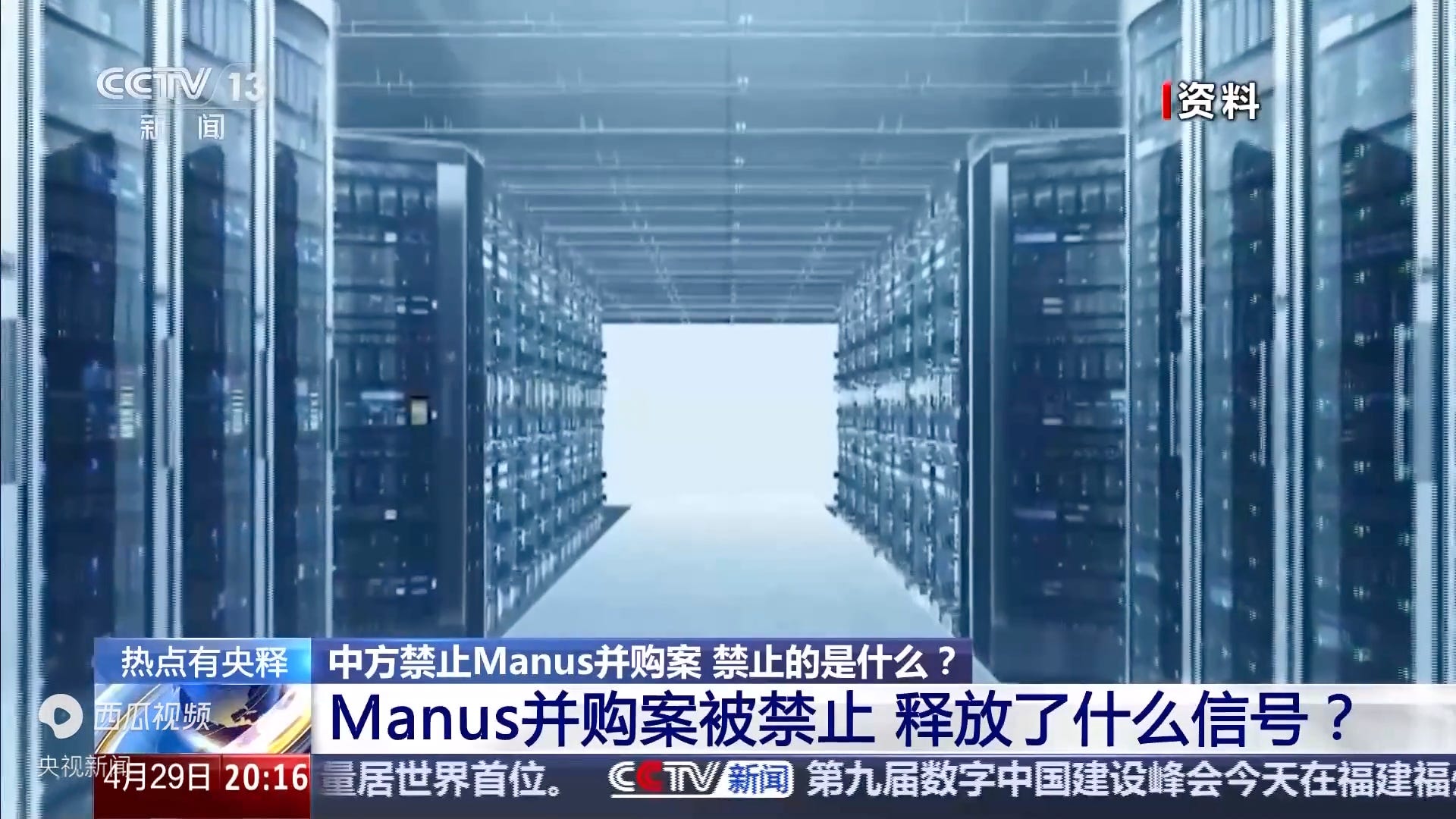
The program featured Zhou Mi, a researcher at the Chinese Academy of International Trade and Economic Cooperation under the Ministry of Commerce, who expressed the following views:
Manus is an AI agent project. While the current wave of “agent” applications has made such systems seem less novel, Manus was an early mover. From the outset, it was designed along a clear roadmap: first, to understand user tasks; second, to break those tasks down and assign them to different large language models to achieve a final objective. In that sense, it functions as an orchestrator or “manager.”
The project has attracted attention because it completed its initial design and core capability development within China, but was then relocated—through capital structuring and corporate transfer—to Singapore, before ultimately being sold to Meta in the United States. This has led many to believe it was intentionally structured to circumvent regulatory oversight. If such practices were left unchecked, more companies might adopt similar approaches—maximizing their own commercial interests while potentially undermining national development priorities and security considerations. The case has drawn significant attention precisely because it is relatively rare and carries strong signaling effects.
The prohibition applies specifically to the original transaction, with the regulatory notice explicitly requiring its cancellation. While implementing such a requirement may be difficult, all parties now need to consider how to comply. As for why this decision was made, Zhou noted that regulators conducted investigations into the transaction, gathered evidence, and engaged in consultations with relevant stakeholders. The final decision was therefore grounded both in legal and regulatory frameworks as well as in factual findings. He also emphasized that China has consistently maintained an open stance toward foreign investment; as the negative list continues to shrink, foreign investors have in fact gained broader opportunities in the Chinese market.
An earlier, quasi-official set of signals came on the same day that the National Development and Reform Commission released its decision on Manus, when both China Central Television and Global Times published commentaries.
The CCTV commentary emphasized that the decision targeted non-compliant “round-tripping-style globalization” practices and the “security risks within openness.”
A well-known industry lawyer told reporters that the Manus deal involved transferring domestic AI business assets overseas and ultimately selling them to Meta. Under China’s Measures for Security Review of Foreign Investment, even if the initial offshore restructuring occurred among founder-controlled affiliated entities, the subsequent transaction would still fall within the scope of foreign investment security review.
Although Manus moved its headquarters to Singapore, its core business initially remained in China. Over time, key personnel, technologies, and other critical assets related to its core operations were gradually transferred abroad, while the domestic entity was stripped of its core functions and retained only residual, non-core operations. This effectively resulted in a wholesale transfer of the Manus group’s core business from China to overseas, triggering compliance risks associated with cross-border investment transactions.
The fundamental purpose of China’s foreign investment security review system is to balance openness with national security—a widely adopted practice globally. To ensure effectiveness, such systems typically rely on “substance-over-form” principles, including look-through review, and allow for proactive regulatory intervention when necessary. China’s system is no exception. Given that Manus’s early R&D was conducted in China, with Chinese engineers and domestically rooted technology and data, the movement of these elements is inherently tied to China’s national interests. Under the regulatory framework, such technology-related investment activities must undergo security review.
The Global Times commentary similarly stressed that halting the Manus deal was intended to clarify security boundaries, not to signal a deterioration in China’s foreign investment environment. Blocking a single sensitive AI acquisition is not inconsistent with encouraging foreign investment in China.
On the contrary, clearly defined security boundaries provide reassurance to compliant investors and strengthen long-term confidence. As China continues to open up—evidenced by the ongoing reduction of the negative list and expanded access in sectors such as services and advanced manufacturing—it becomes even more important to establish clearer rules, sharper boundaries, and more stable expectations. The European Union, the United States, and Japan all maintain similar mechanisms, yet remain among the world’s top investment destinations. As the world’s second-largest recipient of foreign investment, China’s approach—combining lawful security review with continued openness—is both complementary and necessary.
Among many Chinese netizens who are following the case, Meta being forced to walk away from the Manus deal isn’t seen as “overregulation,” but rather as a justified — even necessary — correction. The core idea is pretty simple: AI companies aren’t just ordinary assets that you can move around and sell at will. Even if the company is re-registered in Singapore, the origin of the technology, data, and talent still lies in China — and that’s not something you can just pack up and take with you.
From this perspective, the issue with Manus isn’t just the deal itself, but the path it took — what many see as a deliberate attempt to “de-China-ify” the company before selling it off entirely to a U.S. tech giant like Meta, crossing red lines around “actual control” and the transfer of critical technology.
In that sense, the government’s tough intervention is viewed as a necessary check on treating an AI ecosystem as purely private property — it’s about national security, but also about drawing clear boundaries for similar cases going forward. That said, there’s definitely an emotional layer to this reaction too: some frustration at people trying to game the system, and, in some cases, a bit of schadenfreude at the deal falling apart.