

1. China Is Taking a More Nuanced Approach to Technology Regulation
In the past, one of the concerns frequently raised by China’s technology industry was that regulations targeting emerging technologies and applications sometimes came too quickly. When confronted with new technological risks, regulators occasionally tended to regulate an entire area first and then make adjustments as they gained a better understanding of the situation. There were understandable reasons for this approach, particularly concerns about national security, public interests, and emerging risks. In practice, regulators often made considerable efforts to balance security and development during implementation. Nevertheless, the initial introduction of some policies did create uncertainty in the market and sometimes led to misunderstandings, or even deliberate misrepresentations, abroad.
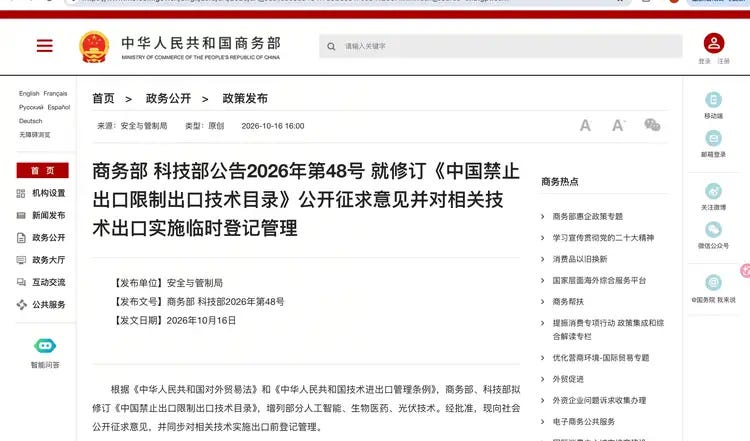
This time, MOFCOM has taken a somewhat different approach: introducing a pre-export registration requirement first, rather than immediately placing the relevant technologies on the prohibited or restricted export lists, while continuing to seek public feedback. Specifically, from October 16, when the announcement was issued, until the revised Catalogue formally takes effect, companies intending to export technologies covered by the announcement must first register the proposed transactions through MOFCOM’s online system. The information required includes the technology being exported, the exporter and recipient, the destination country or region, the intended end use, and the transaction value. Companies are responsible for determining whether their technologies fall within the registration requirements. Even transactions that have already begun must be registered if they have not yet been completed. Importantly, registration is not limited to outright sales of technology. It also covers licensing technology for use overseas, as well as changes that result in the ownership or actual control of domestically held technology being transferred to a foreign entity.
By introducing mandatory pre-export registration, China is effectively establishing a preliminary administrative step ahead of any formal export licensing requirements. Companies can continue conducting legitimate technology exports, while the government gains a clearer picture of what technologies are being exported, where they are going, and what companies actually need in terms of international technology cooperation. This should provide a stronger factual basis for the eventual revision of the Catalogue. At the same time, if a particular transaction raises national security concerns or could affect China’s technological and industrial competitiveness, MOFCOM may seek additional information or, where legally authorized, take further measures, potentially including temporary restrictions.
In its official Q&A, MOFCOM also explained that the government had already conducted extensive assessments with research institutions and industry associations, consulted major companies, and taken into account the development needs of industries both in China and internationally. MOFCOM specifically emphasized that China’s longstanding policy of supporting companies in international business operations and technology cooperation remains unchanged. To me, this approach is somewhat like letting the dust settle before making a final decision: first gather information, understand actual business needs, and listen to stakeholders, then decide which technologies really need to be controlled and how restrictive those controls should be. It reflects an effort to balance security and development while paying greater attention to industry needs and the international competitive environment.
The legal basis for this temporary registration system is also interesting. From my initial reading, the revised Foreign Trade Law, which entered into force on March 1, 2026, added the phrase “or take other necessary measures” to Article 18. This appears to provide a clearer legal basis for regulatory measures beyond outright prohibitions and restrictions. MOFCOM specifically cited Article 18 when explaining the temporary registration requirement. The arrangement also bears some resemblance to the export certificate mechanism under China’s 2024 Regulations on Export Control of Dual-Use Items. Under that system, certain eligible exports can proceed after exporters submit the required information and obtain an export certificate, providing a simplified procedure for lower-risk transactions already subject to export controls. There are somewhat similar precedents in the United States. Around 2010, the US Department of Commerce’s Bureau of Industry and Security (BIS) revised its export procedures for certain encryption products, allowing eligible products to obtain export authorization through simplified electronic registration procedures rather than undergoing the previous technical review process in every case.
2. Chinese open-source AI developers can breathe a little easier
Earlier media reports suggesting that China might introduce export restrictions on open-source AI models had raised concerns about whether Beijing was changing its position on open-source AI. Based on MOFCOM’s announcement, the proposed revisions clarify that releasing model technology as open source can constitute a form of technology export. If the relevant model technology falls into the prohibited category, it generally cannot be released through overseas open-source channels. If it falls into the restricted category, publishing it on an overseas open-source platform would require an export licence. However, MOFCOM has also made clear that open-source releases of restricted technologies will be eligible for simplified procedures, including automatic licensing. In other words, although the new framework may introduce a formal licensing requirement for releasing new versions of certain advanced open-source models, the practical approval process is expected to be relatively quick, with limited compliance costs for companies. For Chinese open-source model developers, this is certainly reassuring news.
MOFCOM has also clarified that technologies already lawfully placed in the public domain through open-source releases, academic publications, or other means will not fall within the scope of these controls. This means that if the relevant technology behind a model has already been lawfully disclosed, the publicly available technology would generally not become subject to new export licensing requirements simply because it meets the technical thresholds in the revised Catalogue. This treatment of publicly available technology is broadly similar to the approach taken under US export control rules, which also provide exclusions for certain published technology and software.
Overall, I think the proposed arrangements for open-source models are largely in line with expectations and consistent with China’s longstanding policy of supporting open-source AI development and broader technology sharing. Chinese AI companies have built considerable international influence through open-source models in recent years, attracting developers around the world and creating new commercial opportunities. As long as the eventual licensing procedures are sufficiently simple, transparent, and predictable, these revisions need not significantly undermine the global development of China’s open-source AI ecosystem.
3. The scope of AI technology export controls is expanding significantly, with more detailed distinctions
One of the most important aspects of the announcement is the proposed expansion of controls on AI technology exports. The technologies covered include foundation models, AI agents, cybersecurity, chip design, and large-scale AI computing clusters. Broadly speaking, the proposal divides them into two categories: prohibited technologies, which generally cannot be transferred overseas, and restricted technologies, which require export licences.
Technologies proposed for export prohibition
There are four main categories.
First, AI models trained on China’s “core data”. The primary consideration here is not how advanced a model is, but whether it has been trained using data classified under Chinese law as core data, which may involve national security or other fundamental national interests.
Second, high-performance AI agents used in highly sensitive sectors. These include advanced AI agents specifically designed for critical national infrastructure, defence and military industries, and core government systems, provided they meet the specified performance thresholds.
Third, AI technologies with advanced offensive cyber capabilities. These include technologies capable of automatically generating malicious code, bypassing antivirus software, adapting attacks to different security environments, or producing large numbers of malware variants that are difficult to detect. Put simply, these are technologies that could make cyberattacks more automated, stealthy, and scalable.
Fourth, certain high-performance AI-generated content detection technologies. These mainly concern technologies used to identify AI-generated or manipulated videos, audio, and images with high accuracy, specifically for preventing and addressing security risks associated with cross-border data transfers from China.
Technologies proposed for export restrictions
The restricted category is broader and covers six main areas.
First, advanced foundation models and their core technologies. This is probably the most important part of the proposal. Under the draft, a model’s core technologies may become subject to export restrictions if it meets any one of three criteria: training compute reaches (10^{26}) floating-point operations (FLOPs), the model has at least 2 trillion parameters, or its capabilities are considered globally leading. The definition of “globally leading” is particularly interesting. The draft uses a top-ten global ranking in publicly available assessments by major domestic or international evaluation institutions as a benchmark. Importantly, this is not limited to overall model performance. It can also include specialized capabilities, such as coding or mathematics, global usage, safety performance, and training efficiency. In other words, even if a model does not rank among the world’s top ten overall, it could still trigger restrictions if it ranks in the top ten in a qualifying assessment category. The technologies covered include model weights, key training checkpoints, underlying source code, architecture design, training optimization, and inference acceleration.
Models trained using China’s legally defined “important data” may also face restrictions. However, the draft provides certain exceptions, including cases involving only a very small amount of important data (0.1%), subject to additional conditions, or data that can lawfully be obtained from public sources. MOFCOM has also explicitly clarified that restricting exports of core model technologies does not mean restricting the provision of AI services to overseas customers. Providing model services through APIs, websites, apps, or SaaS platforms does not fall within the scope of these model technology export controls. However, deploying restricted models overseas may constitute a technology export, although certain deployment arrangements may qualify for automatic licensing.
Second, high-performance AI agent technologies. These provisions target AI systems capable of doing much more than answering questions. They focus on agents that can autonomously plan tasks, use external tools, coordinate with other agents, and complete complex workflows. Examples include systems capable of breaking a complex task into 20 executable steps, coordinating more than 60 agents, or autonomously selecting and using more than 200 external tools. The proposal also covers advanced AI decision-making technologies capable of planning multiple steps ahead, adapting strategies in complex environments, and outperforming 90% of human participants in standardized benchmarks. These thresholds are accompanied by additional accuracy, success-rate, and efficiency requirements. Simply being able to call 200 tools, for example, would not automatically bring a system within the restricted category.
Third, AI chip and advanced memory chip design technologies. These include advanced AI processor architectures, proprietary instruction sets, computing cores, supporting software stacks, advanced packaging, and high-speed interconnect technologies. For example, AI chip design technologies involving manufacturing processes of 14 nanometres or below, advanced packaging, and certain specialized processors for autonomous driving, computer vision, and speech processing may fall within the restricted category. Advanced flash memory and DRAM design technologies are also covered, including high-density storage, advanced manufacturing processes, and multilayer stacking.
Fourth, large-scale AI computing cluster technologies. These provisions mainly target large AI computing clusters containing more than 10,000 AI accelerator cards. The focus is not simply on assembling large numbers of GPUs, but on the technologies that enable them to operate efficiently together. Examples include high-speed data transmission between thousands of chips, reducing communication delays during model training, rapidly recovering from hardware failures, and improving overall cluster efficiency. One particularly interesting area is the coordination of AI chips from different manufacturers. This includes technologies that allow chips from two or more vendors to be managed through a unified scheduling system, different chip architectures to work together on training and inference, or geographically distributed data centres to share computing workloads. Such technologies may be restricted if they meet the specified performance thresholds.
Fifth, AI-assisted cybersecurity technologies. These mainly involve AI systems capable of autonomously discovering software vulnerabilities, assessing whether vulnerabilities can be exploited, and constructing attack chains. For example, technologies that enable AI to discover vulnerabilities far more efficiently than experienced security experts, combine several relatively minor vulnerabilities into a complete attack chain, or identify multiple previously unknown vulnerabilities in major operating systems or open-source projects could be subject to restrictions.
Sixth, speech recognition, translation, and information detection technologies. These include highly accurate voiceprint recognition, technologies for detecting replayed or AI-generated fraudulent audio, and speech recognition systems specifically optimized for China’s ethnic minority languages and regional dialects. The proposal also covers advanced translation technologies for Chinese and ethnic minority languages, as well as technologies for detecting AI-generated content and embedding or extracting hidden information in images and videos.
4. Six broader changes stand out to me
First, the scope is expanding from specific algorithms to the broader core technology stack of the AI industry. When China introduced export restrictions on certain algorithms in 2020, the focus was primarily on specific applications such as personalized recommendation and content distribution. This time, the scope is substantially broader. It covers model weights, source code, architecture design, AI agents, chip design, computing cluster communications, distributed training, and cross-chip coordination. In other words, the focus is shifting from individual AI applications to the underlying technologies that make advanced AI capabilities possible. Model weights, training optimization, and computing cluster management technologies have become increasingly valuable assets for Chinese AI companies competing globally.
Second, foundation model controls now consider both data security and technological sophistication. The proposal effectively introduces two different approaches. One is based on the sensitivity of training data. Technologies associated with models trained on China’s core data may be prohibited from export, while those associated with models trained on important data may be restricted. The other is based on the model’s technical capabilities. Even if a model has not been trained on sensitive data, its weights, source code, and other core technologies may still be restricted if it meets the relevant compute, parameter, or global ranking thresholds. The inclusion of global top-ten rankings is particularly noteworthy. It directly links export controls to how Chinese models perform in international AI competition.
Third, the regulation of AI agents is shifting attention from model capabilities to autonomous action. Traditionally, advanced AI models have been assessed primarily through parameter counts, training compute, and benchmark performance. For AI agents, the proposal places greater emphasis on what the systems can actually do: whether they can independently plan complex tasks, use large numbers of tools, coordinate multiple agents, and make decisions in dynamic environments. This reflects an important technological shift. As AI agents evolve from conversational assistants into systems capable of independently executing tasks, the risks that regulators are concerned about are also changing.
Fourth, the focus is no longer just on chips themselves, but also on how effectively chips can be used. The inclusion of AI computing infrastructure and cross-chip coordination technologies is particularly interesting. The proposal covers not only advanced chip design but also the technologies needed to organize large numbers of chips into efficient computing systems. It establishes thresholds for clusters containing more than 10,000 AI accelerator cards, unified scheduling across different chip vendors, collaborative inference, and geographically distributed computing. This suggests that China increasingly recognizes the strategic and commercial value of system-level engineering capabilities that improve the effective performance of existing AI hardware.
Fifth, the technical thresholds are becoming more specific, making compliance boundaries clearer. The draft provides detailed metrics for many technologies, including training compute, model rankings, agent task success rates, semiconductor manufacturing processes, and cluster communication efficiency. Compared with broadly restricting entire categories of advanced technologies, this approach should make it easier for companies to determine whether their technologies fall within the controlled scope. Of course, AI technologies evolve rapidly. Some thresholds may become outdated relatively quickly, and different evaluation methods may produce different results. These issues will need to be addressed through clearer testing standards and regular updates to the Catalogue. Nevertheless, using measurable technical criteria to define the boundaries of regulation, rather than applying broad restrictions to entire technology sectors, is a notable step forward.
Sixth, regulators are beginning to focus on both cross-border technology transfers and changes in control over technology. The temporary registration requirements cover not only overseas sales and licensing, but also situations where the ownership or actual control of technology held in China changes to a foreign entity. This deserves particular attention. Traditionally, technology exports are often understood as transferring source code, model weights, or technical documentation across borders. Under the proposed registration framework, however, a transaction may trigger registration requirements even if the technology itself never physically leaves China, provided that ownership or actual control passes to a foreign entity. This appears somewhat similar to the concept of “deemed exports” in export control regimes, although the legal concepts are not identical. The potential implications could extend beyond transferring code or model weights to certain technology licensing arrangements, mergers and acquisitions, and corporate restructurings.
5. Several questions are worth discussing during the public consultation
MOFCOM has already clarified quite a few important policy boundaries through its official Q&A, and the consultation process provides an opportunity to address remaining uncertainties. From my initial reading, several questions seem particularly relevant.
1. How exactly will “globally leading capabilities” and “top-ten global rankings” be determined? There are now numerous AI model leaderboards, and their results often differ significantly. Which evaluation institutions will be recognized for regulatory purposes? The draft refers to overall model performance, specialized capabilities, global usage, safety performance, and training efficiency. If a model ranks 20th overall but enters the global top ten in coding performance or usage, would that qualify? And if a model ranks ninth today but drops to 12th next month, how would that affect the application of export restrictions?
2. How will the rules apply to new releases and updates of open-source models? The United States currently does not have a general mandatory pre-release approval system for open-source AI models, relying instead largely on voluntary company-led reviews. Under China’s proposed framework, would Chinese companies need to obtain a licence before releasing every new model that meets the relevant thresholds? This raises broader questions about how a “model export” is defined, an issue only partially addressed in the current announcement and potentially requiring clarification through other regulations. What happens when a model has already been open-sourced but the company subsequently releases updated weights or a new version? And if the weights are public but the training code and methods remain proprietary, should those technologies be treated differently?
3. How will the distinction between overseas deployment and overseas service provision work in practice? Under MOFCOM’s explanation, providing AI services overseas through APIs or apps is not subject to these model technology export controls, while deploying a restricted model overseas may constitute a technology export. Where a Chinese company establishes a subsidiary in Singapore and operates its model through overseas cloud infrastructure under its own control, certain arrangements may qualify for automatic licensing. But what if the model is deployed on AWS or Azure, while the Chinese company retains full control over the model weights? What about private deployments for overseas enterprise customers? Would these arrangements necessarily be excluded from automatic licensing or other simplified procedures, or could they also qualify? These are likely to be important questions for companies expanding internationally.
4. How will “important data” and “core data” be identified in practice? Linking model export controls to important data and core data introduces another layer of complexity. The classification of these data categories remains a significant policy issue involving multiple regulatory authorities. Foundation models are trained on enormous datasets collected from diverse sources, making it difficult for companies to determine whether any of that information qualifies as “important data” or “core data” under Chinese law. The draft provides an exception where only a very small amount of important data (0.1%) has been used, subject to certain conditions. But how exactly should that 0.1% be calculated? Should it be based on the number of data records, total data volume, or training tokens? How can companies demonstrate that the data has not materially improved a model’s capabilities in the relevant domain? Would an independent third-party assessment be required? In practice, companies may need to establish more comprehensive training data inventories, document data provenance, conduct internal data classification reviews, and retain evidence supporting their eligibility for exemptions. For models trained on large and frequently updated datasets, this could become a significant compliance burden, particularly if the regulatory standards remain unclear.
5. How should the technical thresholds for AI agents be assessed?The draft introduces a number of specific performance thresholds for AI agents, such as the ability to break tasks into 20 steps, use 200 tools, or coordinate 60 agents. However, these capabilities often depend on a combination of the underlying model, agent frameworks, external tools, and broader system architecture. For example, if a company builds an agent capable of using 200 tools on top of an existing open-source model, what exactly would be subject to export restrictions: the underlying model, the agent framework, or the complete system? And what testing standards should be used to determine whether an agent meets the relevant thresholds? From a compliance perspective, companies may need to assess export control requirements not only at the foundation model level but also at the application and system levels. This could require additional technical evaluations before releasing new agent capabilities, licensing agent frameworks to overseas partners, or deploying agent-based products internationally. It could also complicate compliance assessments for products whose capabilities evolve through software updates or integration with third-party tools.
6. How convenient will automatic licensing actually be? The practical design of the automatic licensing system will be extremely important. What documents will companies need to submit? How long will the process take? Can exports proceed immediately after registration, or must companies wait for a licence to be issued? Could a single licence cover multiple subsequent model versions or updates? If companies need to repeat the process every time they release a new model version, even a relatively simple procedure could create additional compliance costs and affect normal development and release cycles. Companies may need to build export control checks into their model release processes, establish internal approval procedures for overseas deployments and open-source releases, and maintain records of licensing decisions and technology transfers. For multinational AI companies, this could also require closer coordination between engineering, legal, compliance, and international business teams. For an industry where models can be updated every few weeks, the speed, simplicity, and predictability of the licensing process may ultimately matter just as much as the formal scope of the restrictions.