

On July 31, China’s State Council released the Regulations on Exit and Entry Administration, which will take effect on September 15, 2026. The Regulations establish a new framework covering a wide range of issues, including the departure of Chinese citizens, the entry of foreign nationals, travel document administration, and exit-entry services.
Prior to the issuance of these Regulations, China’s legal framework governing restrictions on the departure of Chinese citizens was primarily based on the Exit and Entry Administration Law, the Passport Law, the Supervision Law, the Counter-Espionage Law, the Tax Collection and Administration Law, and other relevant legislation. Most of these statutes, however, are laws enacted by the National People’s Congress with relatively high-level provisions. They generally lack detailed implementing rules and typically apply only to specific categories of persons or particular circumstances.
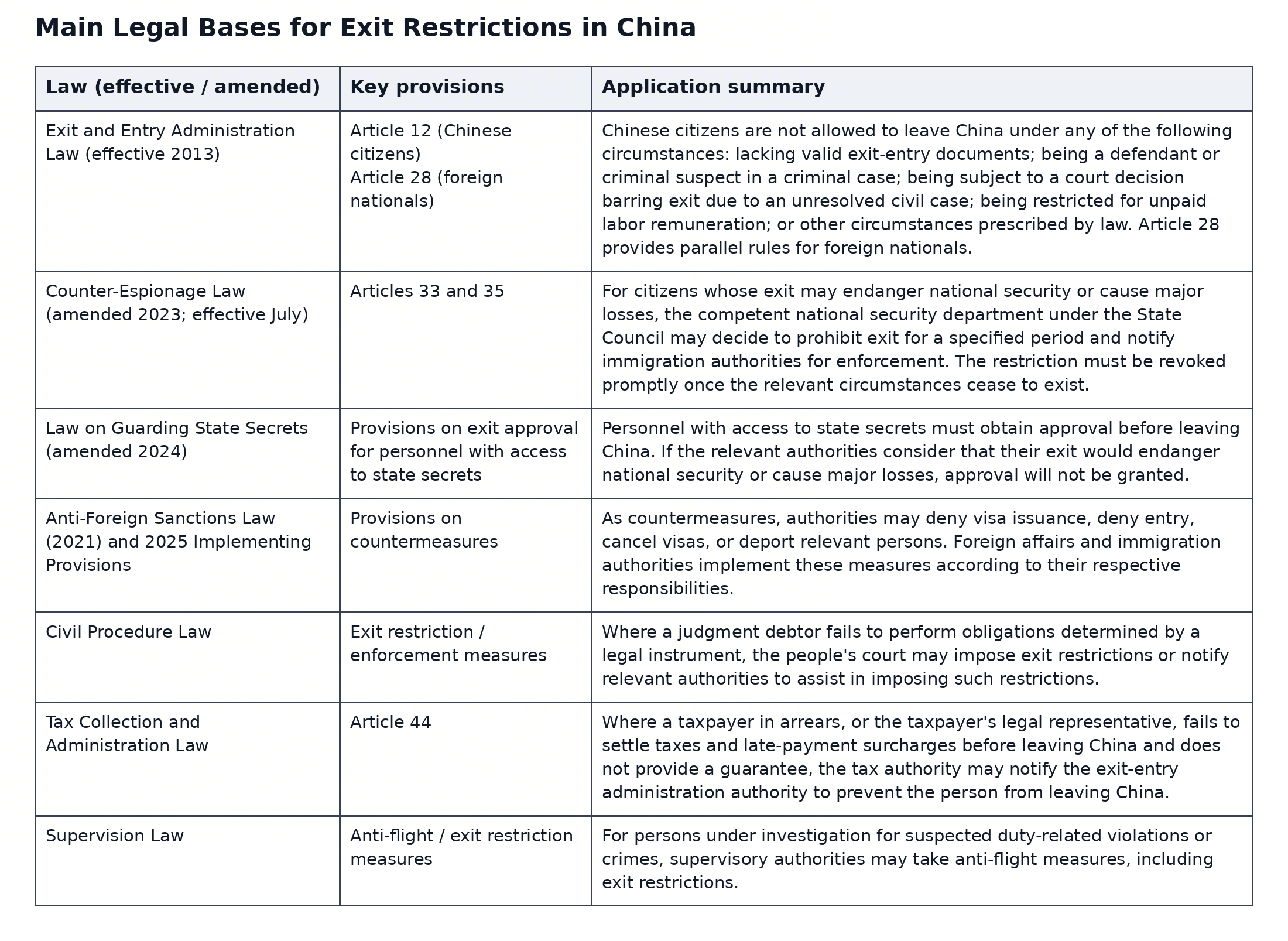
Exit and Entry Administration Law (Article 12)
Chinese citizens may be prohibited from leaving China under any of the following circumstances:
They do not possess valid travel documents or refuse to undergo, or evade, border inspection;
Their criminal sentence has not yet been fully served;
They are defendants or criminal suspects in a criminal case;
They are involved in unresolved civil litigation where a people’s court has ordered an exit ban;
They have been penalized for disrupting border administration or have previously been repatriated for illegal exit, illegal residence, or unauthorized employment and remain within the applicable restriction period;
Their departure is likely to endanger national security or cause significant harm to national interests;
Other circumstances prescribed by laws or administrative regulations.
Supervision Law (Article 33)
To prevent persons under investigation or other relevant individuals from fleeing abroad, supervisory authorities may, with the approval of a supervisory authority at or above the provincial level, impose exit restrictions, which are enforced by the public security authorities.
Counter-Espionage Law (Article 33)
The Ministry of State Security may:
prohibit Chinese citizens from leaving China for a specified period if their departure is likely to endanger national security or cause significant harm to national interests; and
notify immigration authorities to prevent individuals suspected of espionage activities from leaving the country.
Tax Collection and Administration Law (Article 44)
Taxpayers with outstanding tax liabilities, or the legal representatives of enterprises that owe taxes, must settle the outstanding taxes and late-payment surcharges, or provide an acceptable guarantee, before leaving China. Otherwise, the tax authorities may notify the immigration authorities to prevent them from departing the country.
In the accompanying Q&A, the Ministry of Justice, the Ministry of Public Security, and the National Immigration Administration explained the background to the issuance of the Regulations. They noted that, as China continues to advance high-level opening-up, a number of new challenges and issues have emerged in exit and entry administration. It has therefore become urgently necessary to promulgate the Regulations, following the principle of addressing the most pressing needs first, in order to improve and refine the relevant legal framework.
One noteworthy change is that violations of China’s export control regime have, for the first time, been expressly included within the scope of the exit-ban system.
Article 4 provides:
Where a Chinese citizen violates export control regulations, technology import and export administration regulations, or other relevant rules, and such conduct may endanger China’s industrial security or technological security, the competent departments of the State Council, including the Ministry of Commerce, may decide to prohibit that person from leaving China.
The accompanying Q&A further explains that this provision is mainly intended to address situations that have arisen in practice where individuals leave China and subsequently transfer technology overseas illegally, thereby endangering China’s industrial security and technological security. According to the authorities, the provision further refines and improves the existing circumstances under which exit bans may be imposed, pursuant to the authorization provided by the Exit and Entry Administration Law.
Question: What provisions does the Regulations make with respect to the administration of Chinese citizens’ departure from China?
Answer: In recent years, as the number of Chinese citizens travelling abroad has continued to increase, new issues have emerged in practice, including the illegal transfer of technology overseas after individuals leave China, thereby endangering China’s industrial security and technological security. To address these issues, the Regulations provide that where a person violates export control regulations or technology import and export administration regulations, and such conduct may endanger China’s industrial security or technological security, that person may, in accordance with the law, be prohibited from leaving China.
This may indicate that the practical reach of China’s export control enforcement is no longer limited to licensing requirements, controlled items, and cross-border transactions, but may also extend to the exit administration of individuals responsible for export control violations. For companies engaged in sensitive technology research and development, technology cooperation, exports of controlled items, and cross-border technology transfers, greater attention may need to be paid to the personal compliance responsibilities of individuals involved in technology transfer activities, with personnel compliance becoming an integral part of export control compliance programs.
Foreign media have repeatedly reported allegations that China has restricted the overseas travel of individuals involved in sensitive technologies.
For example, the Financial Times reported in March 2026 that two executives from Manus were summoned to Beijing to meet with officials from the National Development and Reform Commission (NDRC), after which they were reportedly informed that they could not leave China while regulatory review of Meta’s proposed acquisition of Manus was ongoing, although they remained free to travel within the country.
On June 25, 2025, The Wall Street Journal reported that China’s Ministry of Commerce had asked certain rare earth companies to submit lists of technical personnel, including information on their areas of expertise, educational background, and research experience. According to the report, some technical staff were also required to hand over their passports to their employers or local authorities in order to prevent unauthorized overseas travel and the disclosure of rare earth processing technology.
Bloomberg further reported in May 2026 that China had required certain senior researchers and professionals working on strategic AI projects at companies including Alibaba and DeepSeek to obtain government approval before traveling abroad.
None of these reports has ever been officially confirmed or denied, and they are better understood as unverified media allegations. Moreover, much of the reporting sought to portray such restrictions as arbitrary exercises of unchecked government authority, implying that the Chinese government could prohibit individuals from leaving the country simply because they possessed important technologies, without any legal basis for doing so. The issuance of the new Regulations by the State Council provides an important clarification in response to such interpretations and misunderstandings.
In addition, the new Regulations also provide that Chinese citizens who engage in illegal or criminal activities overseas may be prohibited from leaving China again, provided that such activities endanger China’s national security or national interests.
Article 4 provides:
Where a Chinese citizen engages in illegal or criminal activities outside China that endanger China’s national security or national interests, the relevant competent departments under the State Council, or the people’s government at the provincial level of the individual’s place of residence within China, upon verification by Chinese diplomatic missions or other relevant authorities abroad, may decide to prohibit that person from leaving China for a period of six months to three years from the date of his or her return to China.
In addition to strengthening national security-related measures, the Regulations also improve procedural safeguards.
Under Article 6, where a decision has been made in accordance with the law to prohibit a person from leaving China, the authority making the decision shall, in principle, notify the individual in writing of the facts, reasons, legal basis, and available avenues for relief.
Article 6 provides:
Where a decision is made in accordance with the law to prohibit a person from leaving China, the authority making the decision shall promptly notify the immigration authorities for implementation in accordance with the relevant provisions, and shall notify the individual in writing of the facts, reasons, legal basis, and available avenues for relief. Where notification to the individual may affect national security, the investigation of criminal cases, or other similar circumstances, the individual may not be notified.
When implementing an exit ban decision, the immigration authorities shall notify the individual in accordance with the contents of the notice received from the authority making the decision.
At the same time, in the accompanying Q&A, the Ministry of Justice, the Ministry of Public Security, and the National Immigration Administration specifically emphasized that, in implementing the Regulations, commercial secrets, personal privacy, and personal information shall be protected in accordance with the law, while balancing the needs of national security with the protection of the lawful rights and interests of the individuals concerned.
Another important feature of the Regulations is that they further clarify the implementation of China’s countermeasures regime in the context of visa issuance and the entry administration of foreign nationals.
Article 5 provides that where a foreign national has been included on a countermeasure list, the Unreliable Entity List, the Malicious Entity List, or has otherwise been made subject to countermeasures or restrictive measures in accordance with the law, and relevant legal measures such as refusing to issue exit-entry documents or denying entry are required, such measures shall be implemented by the visa authorities and immigration authorities in accordance with their respective responsibilities.
Article 5
Where a foreign national, when applying for a Chinese visa outside China or applying for entry at a port of entry, submits false materials or makes false statements, the immigration authorities or visa authorities may decide to prohibit that person from entering China for a period of one to five years.
Where a foreign national has received criminal punishment for disrupting border administration, or administrative penalties for fraudulently obtaining exit-entry documents or for illegal exit or entry, the immigration authorities may, based on the nature of the violation and the need to prevent future violations or crimes, decide to prohibit that person from entering China for a period of one to five years from the date the penalty has been fully served. Where other laws provide otherwise, those provisions shall apply.
Where a foreign national has been included on a countermeasure list, the Unreliable Entity List, the Malicious Entity List, or has otherwise been made subject to countermeasures or restrictive measures, and it is necessary under the law to refuse the issuance of exit-entry documents or deny entry, such measures shall be implemented by the immigration authorities and visa authorities in accordance with their respective responsibilities.
In the accompanying policy interpretation, the Ministry of Justice, the Ministry of Public Security, and the National Immigration Administration explicitly stated that the purpose of these provisions is to “strengthen the implementation of entry-related countermeasures” and to further improve China’s legal framework for countering sanctions, foreign interference, and “long-arm jurisdiction.”
From the perspective of institutional coordination, this means that restrictive measures previously established under the Anti-Foreign Sanctions Law, the Unreliable Entity List regime, and the legal framework for countering the extraterritorial application of foreign laws have now been more clearly integrated with China’s visa administration, border inspection, and entry management systems, providing a clearer implementation pathway for these measures.
Below is the full translation (unofficial) of the regulation and the Q&A:
Provisions of the State Council on the Administration of Exit and Entry
Article 1 These Provisions are formulated in accordance with the Exit and Entry Administration Law of the People’s Republic of China and other laws, for the purposes of regulating exit and entry administration, protecting the lawful rights and interests of persons exiting or entering the country, and safeguarding national sovereignty, security, and development interests.
Article 2 The State shall establish and improve a system for preventing safety and security risks relating to the exit of Chinese citizens from the country.
The competent departments of the State Council for foreign affairs, culture and tourism, and diplomatic missions abroad shall, in light of the security conditions in relevant countries and regions, including wars or armed conflicts, public security conditions, natural disasters, accidents and disasters, and outbreaks of infectious diseases, promptly publish overseas security alerts and safety risk advisories for travel destinations.
Chinese citizens shall pay attention to overseas security alerts and safety risk advisories for travel destinations, and avoid travelling to or staying in high-risk countries or regions.
When accepting and examining applications by Chinese citizens for exit and entry documents and conducting exit border inspection, immigration administration authorities shall, on the basis of notifications from the relevant competent departments of the State Council, remind Chinese citizens who intend to travel to high-risk countries or regions to travel with caution or to closely monitor the local security situation, heighten vigilance, strengthen precautions, and pay attention to safety. Where Chinese citizens intend to travel to countries or regions with the highest risk rating or where cases seriously endangering personal safety occur suddenly and frequently, such citizens shall, where necessary, be dissuaded from travelling there.
Article 3 The grounds on which persons exiting or entering the country apply for exit or entry, or for stay or residence, shall be truthful and lawful.
When verifying the identity of persons exiting or entering the country and the grounds for their applications, immigration administration authorities and visa authorities may inquire into relevant circumstances and require such persons to present or provide relevant documents, materials, electronic data and other information; persons exiting or entering the country shall cooperate accordingly.
Where any entity or individual issues invitation letters or other application materials for persons exiting or entering the country, such entity or individual shall be responsible for the authenticity of the matters invited and the matters certified, and shall cooperate with immigration administration authorities and visa authorities in verifying relevant information.
Where persons exiting or entering the country provide false materials or make false statements, immigration administration authorities and visa authorities shall have the authority to decide not to issue exit or entry documents or not to permit such persons to exit or enter the country.
Article 4 Where a Chinese citizen is subject to an administrative detention penalty for fraudulently obtaining exit or entry documents or for illegally exiting or entering the country, immigration administration authorities may, in light of the circumstances of the violation and the need to prevent violations and crimes, decide not to permit such citizen to exit the country for a period of not less than six months and not more than three years from the date on which execution of the penalty is completed.
Where a Chinese citizen engages in illegal or criminal activities abroad and thereby endangers national security and interests, the relevant competent departments of the State Council may decide, or the provincial people’s government at the place of domicile of such citizen within the territory of China may, after verification by a diplomatic mission abroad or other authority, decide not to permit such citizen to exit the country for a period of not less than six months and not more than three years from the date of return to China.
Where a Chinese citizen violates provisions on export control, technology import and export administration or other provisions, and may endanger national industrial security or technological security, the competent departments of the State Council for commerce and other relevant matters may decide not to permit such citizen to exit the country.
Article 5 Where a foreign national provides false materials or makes false statements when applying for a Chinese visa abroad or applying for entry at a port, immigration administration authorities and visa authorities may decide not to permit such foreign national to enter the country for a period of not less than one year and not more than five years.
Where a foreign national is subject to a criminal penalty for obstructing the administration of national borders, or is subject to an administrative penalty for fraudulently obtaining exit or entry documents or for illegally exiting or entering the country, immigration administration authorities may, in light of the circumstances of the violation and the need to prevent violations and crimes, decide not to permit such foreign national to enter the country for a period of not less than one year and not more than five years from the date on which execution of the penalty is completed. Where laws provide otherwise, such provisions shall prevail.
Where a foreign national is included on a countermeasure list, unreliable entity list, malicious entity list, or is subject to countermeasures, restrictive measures or other measures, and it is necessary to take relevant measures in accordance with law, including refusing to issue exit or entry documents or denying entry, immigration administration authorities and visa authorities shall implement such measures in accordance with their respective functions.
Article 6 With respect to persons against whom a decision not to permit exit from the country has been made in accordance with law, the deciding authority shall, in accordance with provisions, promptly notify immigration administration authorities for enforcement, and shall inform the party concerned in writing of the facts, reasons and basis for the decision not to permit exit, as well as the channels for seeking remedies; where circumstances exist in which such notification may affect national security, criminal case investigations or other matters, the party concerned may not be informed.
When enforcing a decision not to permit exit from the country, immigration administration authorities shall inform the party concerned of the contents notified by the deciding authority.
Article 7 The State shall implement record-filing administration with respect to institutions and personnel that, upon entrustment by persons exiting or entering the country, engage in intermediary services such as consulting on exit and entry policies, agency services for documents, and handling of procedures.
An institution engaging in exit and entry intermediary services shall, within 15 days from the date of its establishment, complete record-filing with the immigration administration authority at the place where it is located. Personnel engaging in exit and entry intermediary services shall have record-filing formalities handled by the institution to which they belong. Those that have already engaged in exit and entry intermediary services before the implementation of these Provisions shall complete record-filing formalities within 90 days from the date on which these Provisions come into force.
Specific measures for the record-filing administration of institutions and personnel engaging in exit and entry intermediary services shall be formulated by the national immigration administration department in conjunction with the competent departments of the State Council for market regulation and other matters.
Article 8 An institution engaging in exit and entry intermediary services shall meet the following conditions:
(1) it is established in accordance with law;
(2) its legal representative or person in charge has not been subject to a criminal penalty for an intentional crime;
(3) it has staff with professional knowledge of laws, regulations, policies and other matters relating to exit and entry, and has funds and premises commensurate with the intermediary service activities in which it engages;
(4) staff who directly provide intermediary services to persons exiting or entering the country have not been subject to a criminal penalty for an intentional crime endangering national security or public security or obstructing the administration of national borders;
(5) it has sound management systems, including systems for personnel management, education and training, retention of materials, data security, and compliance management.
An institution engaging in outbound intermediary services shall also have established cooperative relations with relevant overseas service institutions or signed valid letters of intent for cooperation.
Overseas enterprises and institutions shall not provide exit and entry intermediary services within the territory of China.
Article 9 Immigration administration authorities shall, in conjunction with competent departments at the same level for foreign affairs, education, judicial administration, human resources and social security, commerce, culture and tourism, market regulation and other relevant matters, establish and improve regulatory systems, strengthen supervision and administration of the satisfaction of conditions and business activities of institutions engaging in exit and entry intermediary services in accordance with the division of functions, and publish relevant information on violations of law and adverse records in accordance with law.
Relevant competent departments and their staff shall, in accordance with law, keep confidential any state secrets, work secrets, trade secrets, personal privacy and personal information that they become aware of in the course of performing their duties.
Article 10 An institution engaging in exit and entry intermediary services shall not commit any of the following acts:
(1) publishing false information, or soliciting service recipients by exaggerated publicity, misleading publicity or other means;
(2) providing or assisting in providing false materials, or assisting others in handling visas, stay or residence documents, passports or other exit and entry documents or formalities in violation of provisions;
(3) disclosing, selling or illegally providing trade secrets, personal privacy or personal information learned in the course of intermediary service activities;
(4) engaging in exit and entry intermediary services beyond the scope of record-filing;
(5) organizing or assisting others in engaging in cross-border illegal or criminal activities;
(6) other acts that endanger national security or interests or disrupt the order of exit and entry administration.
Where public officials, military personnel or other persons entrust an institution engaging in exit and entry intermediary services to handle foreign nationality, overseas permanent residence qualifications, overseas residence documents, or other exit and entry documents or formalities in violation of provisions, the institution engaging in exit and entry intermediary services shall not handle such matters, and shall promptly report the matter to the supervisory organs and other authorities.
Article 11 Where any person obtains a visa, stay or residence document, passport or other exit or entry document by fraud through providing false materials, making false statements or other falsification, immigration administration authorities shall impose penalties in accordance with the Exit and Entry Administration Law of the People’s Republic of China and the Passport Law of the People’s Republic of China.
Where an individual issues a false invitation letter or other application materials for another person’s application for exit or entry, or for stay or residence, immigration administration authorities shall impose a fine of not less than RMB 5,000 and not more than RMB 10,000; where there are illegal gains, the illegal gains shall be confiscated. Where an entity commits the aforesaid act, a fine of not less than RMB 10,000 and not more than RMB 50,000 shall be imposed; where there are illegal gains, the illegal gains shall be confiscated; and the directly responsible person in charge and other directly responsible persons shall be fined not less than RMB 5,000 and not more than RMB 10,000. Where laws provide otherwise, such provisions shall prevail.
Article 12 Where an institution engaging in exit and entry intermediary services violates Article 7 or Article 8 of these Provisions, immigration administration authorities shall order it to make corrections within a prescribed time limit; where it refuses to make corrections, a fine of not less than RMB 5,000 and not more than RMB 10,000 shall be imposed, and the relevant competent departments shall be notified to order suspension of relevant business or suspension of business for rectification; where the circumstances are serious, a fine of not less than RMB 10,000 and not more than RMB 50,000 shall be imposed, and the relevant competent departments shall be notified to revoke the relevant business licence or revoke the business licence.
Where an individual engages in exit and entry intermediary services in violation of these Provisions, immigration administration authorities shall order the cessation of the illegal act; where there are illegal gains, the illegal gains shall be confiscated; where the circumstances are serious, a fine of not more than RMB 5,000 may also be imposed.
Article 13 Where an institution engaging in exit and entry intermediary services violates Article 10 of these Provisions and disrupts the order of exit and entry administration, immigration administration authorities shall order it to make corrections within a prescribed time limit; where there are illegal gains, the illegal gains shall be confiscated; where the illegal gains are RMB 20,000 or more, a fine of not less than one time and not more than five times the illegal gains shall also be imposed; where there are no illegal gains or the illegal gains are less than RMB 20,000, a fine of not less than RMB 20,000 and not more than RMB 50,000 shall also be imposed; where it refuses to make corrections or the circumstances are serious, the relevant competent departments shall be notified to order suspension of relevant business, suspension of business for rectification, revocation of the relevant business licence, or revocation of the business licence; and the directly responsible person in charge and other directly responsible persons shall be fined not less than RMB 10,000 and not more than RMB 50,000. Where laws provide otherwise, such provisions shall prevail.
Article 14 Where an exit and entry administration authority of the public security organ of a local people’s government at or above the county level imposes an administrative penalty of a fine exceeding RMB 5,000 or confiscation of illegal gains in accordance with these Provisions, the decision shall be made by the public security organ to which it belongs.
Article 15 The relevant competent departments of the State Council shall strengthen coordination in work relating to the protection of the lawful rights and interests of persons exiting or entering the country, the prevention of safety and security risks relating to the exit of Chinese citizens from the country, and the administration of exit and entry intermediary services.
Article 16 Immigration administration authorities shall maintain unobstructed channels for reporting acts violating exit and entry administration, and shall handle relevant reports promptly in accordance with law. Reports that do not fall within the functions of the authority shall be promptly transferred to the relevant entity for handling in accordance with law.
Article 17 Where any violation of these Provisions constitutes a crime, criminal liability shall be pursued in accordance with law.
Article 18 For the purposes of these Provisions, “immigration administration authorities” means the national immigration administration department, exit and entry border inspection authorities, and exit and entry administration authorities of public security organs of local people’s governments at or above the county level.
For the purposes of these Provisions, “visa authorities” means overseas visa authorities and port visa authorities.
Article 19 These Provisions shall come into force on September 15, 2026.
Officials from the Ministry of Justice, the Ministry of Public Security, and the National Immigration Administration Answer Reporters’ Questions on the State Council Provisions on Exit and Entry Administration
On July 22, 2026, Premier Li Qiang of the State Council signed State Council Decree No. 841, promulgating the State Council Provisions on Exit and Entry Administration (hereinafter referred to as the “Provisions”), which will come into force on September 15, 2026. Officials from the Ministry of Justice, the Ministry of Public Security, and the National Immigration Administration answered reporters’ questions on issues related to the Provisions.Q: Please briefly introduce the background to the formulation of the Provisions.
A: Exit and entry administration concerns the safety and lawful rights and interests of Chinese nationals traveling abroad, as well as China’s sovereignty, security, and development interests. Since the Exit and Entry Administration Law came into force in 2013, it has played an important role in regulating exit and entry administration, safeguarding national sovereignty, security, and social order, and promoting opening-up and exchanges with other countries.
As China continues to advance high-standard opening-up across the board, new challenges and issues have emerged in exit and entry administration. It is therefore urgent to promulgate the Provisions in accordance with the principle of addressing urgent needs first, so as to improve relevant systems.
First, it is necessary to strengthen the prevention of safety risks for Chinese citizens traveling abroad. As China’s international exchanges continue to expand, more and more Chinese citizens travel overseas for tourism, family visits, business, study, and other purposes. In recent years, major emergencies such as wars or armed conflicts, public security incidents, natural disasters, accidents, and infectious disease outbreaks have occurred from time to time in some countries and regions, posing threats to the personal safety of Chinese citizens abroad. It is therefore necessary to promptly improve the system for preventing safety risks faced by citizens traveling overseas.
Second, it is necessary to regulate the entry administration of foreigners. As China continues to deepen its opening-up, the number of foreign nationals entering China has continued to grow. In practice, there have also been cases in which a small number of individuals provided false materials or fraudulently obtained exit and entry documents when applying for entry. It is therefore necessary to improve measures such as entry examination and denial of entry.
Third, it is necessary to regulate exit and entry intermediary services. After the access licensing requirement for private exit and entry intermediary service agencies was abolished in 2018, the number of such agencies grew rapidly. While they have provided convenience for exit and entry personnel, problems have also emerged, including unclear overall information about intermediary agencies, unlawful or non-compliant business practices by some agencies, and harm to the lawful rights and interests of exit and entry personnel. It is therefore necessary to improve the management system for intermediary service agencies.Q: What provisions does the Provisions contain regarding the prevention of safety risks for Chinese citizens traveling abroad and the protection of their personal safety?
A: In order to more effectively prevent safety risks faced by Chinese citizens after they travel abroad and to protect their personal safety, the Provisions adhere to the principle of prioritizing prevention and adopting comprehensive measures. The main provisions are as follows.
On the one hand, overseas safety risk alerts and reminders must be issued in a timely manner. The foreign affairs, culture, and tourism departments of the State Council, as well as diplomatic missions abroad, are required to promptly publish overseas safety alerts and safety risk reminders for tourist destinations based on the security situation in relevant countries and regions, including wars or armed conflicts, public security conditions, natural disasters, accidents, infectious disease outbreaks, and other factors.
On the other hand, the safety risk prevention system at the exit stage is improved. Immigration administration authorities are required, when accepting and approving applications for exit and entry documents and conducting exit border inspections, to remind citizens to exercise caution when traveling to high-risk countries or regions. For those who indeed need to travel to such destinations, the authorities should remind them to pay attention to the local security situation and strengthen safety precautions. When necessary, the authorities should dissuade them from traveling to countries or regions with the highest risk level or where incidents seriously endangering personal safety are occurring suddenly or frequently.Q: What provisions does the Provisions contain regarding the regulation of exit administration for Chinese citizens?
A: In recent years, as the number of Chinese citizens traveling abroad has continued to increase, some problems have arisen in practice. These include individuals being deceived into leaving the country, or fabricating reasons to illegally exit the country to engage in illegal activities such as cross-border gambling and telecom and online fraud, seriously endangering the lives and property of the public. There have also been cases in which individuals illegally transferred technology abroad after leaving the country in violation of regulations, endangering national industrial security and technological security.
In response to these issues, the Provisions strengthen exit administration on the one hand. They require that the reasons given by exit applicants must be truthful and lawful, and that applicants cooperate with immigration administration authorities in verifying their identity and the reasons for their application. They also provide that entities and individuals issuing invitation letters shall be responsible for the truthfulness of the invitation content. Where false materials are provided or false statements are made, immigration administration authorities have the right to decide not to issue exit and entry documents or not to permit the applicant to leave the country.
On the other hand, pursuant to the authorization under the Exit and Entry Administration Law, the Provisions improve the circumstances under which exit may be denied. In accordance with the law, exit shall be denied to persons who have been subject to administrative detention for fraudulently obtaining exit and entry documents or for illegally exiting or entering the country; persons who engage in illegal or criminal activities abroad that endanger national security and interests; and persons who may endanger national industrial security or technological security by violating regulations on export control, technology import and export administration, and other related rules.Q: What provisions does the Provisions contain regarding the regulation of entry administration for foreigners?
A: To further regulate the entry administration of foreigners, the Provisions mainly contain the following provisions.
First, entry administration is strengthened. The Provisions require that the reasons given by entry applicants for entry, stay, or residence must be truthful and lawful, and that applicants cooperate with immigration administration authorities and visa authorities in verifying their identity and the reasons for their application. They also provide that entities and individuals issuing invitation letters shall be responsible for the truthfulness of the invitation content.
Second, the circumstances under which entry may be denied are improved. Pursuant to the authorization under the Exit and Entry Administration Law, the Provisions specify that foreign nationals who provide false materials or make false statements when applying for a Chinese visa abroad or applying for entry at a port, who have been subject to criminal punishment for obstructing the administration of national border control, or who have been subject to administrative penalties for fraudulently obtaining exit and entry documents or for illegally exiting or entering the country, shall be denied entry in accordance with the law.
Third, the implementation of entry-related countermeasures is strengthened. To strengthen the rule-of-law response to counter-sanctions, anti-interference, and opposition to “long-arm jurisdiction,” the Provisions stipulate that where foreign nationals are included on a countermeasure list, the unreliable entity list, or the malicious entity list, or are subject to countermeasures and restrictive measures, and where relevant measures such as refusing to issue exit and entry documents or denying entry need to be taken in accordance with the law, immigration administration authorities and visa authorities shall implement such measures according to their respective duties.Q: Please briefly introduce the main considerations behind the establishment of the filing-based management system for exit and entry intermediary service agencies under the Provisions.
A: In recent years, the number of agencies in China engaged in exit and entry intermediary services has grown rapidly. While they have provided convenience for exit and entry personnel, problems have also emerged, including unclear overall information about such agencies, unlawful or non-compliant business practices by some agencies, and harm to the lawful rights and interests of exit and entry personnel. These issues affect the standardized and healthy development of the industry and endanger the national order of exit and entry administration. It is therefore urgent to improve relevant systems and rules.
The Provisions adopt a problem-oriented approach and improve the management system for intermediary service agencies in a targeted manner.
First, a filing-based management system is established. The Provisions specify that agencies and personnel entrusted by exit and entry personnel to provide intermediary services such as exit and entry policy consultation, document application agency services, and procedure handling shall be subject to filing-based management. Intermediary service agencies are required to file with the local immigration administration authority within 15 days from the date of establishment. Personnel engaged in exit and entry intermediary services shall complete filing procedures through their agencies. Agencies that were already engaged in intermediary services before the Provisions come into force shall complete filing procedures within 90 days from the date on which the Provisions come into force. Non-profit activities such as policy consultation and information inquiries do not fall within the scope of “exit and entry intermediary services” as referred to in the Provisions.
Second, the conditions that intermediary service agencies must meet are clarified. To ensure the quality of intermediary services and improve service standards, agencies engaged in exit and entry intermediary services are required to have staff with relevant professional knowledge, as well as premises and financial support commensurate with the intermediary service activities they conduct. At the same time, the Provisions clarify that overseas enterprises and institutions may not provide exit and entry intermediary services within China. Foreign-invested enterprises and institutions, as well as enterprises and institutions funded by investors from Hong Kong, Macao, or Taiwan, that are lawfully established within China may engage in exit and entry intermediary services in accordance with the law.
Third, intermediary service practices are regulated. To effectively protect the lawful rights and interests of exit and entry personnel and promote the standardized and healthy development of the industry, the Provisions stipulate that agencies engaged in exit and entry intermediary services shall not publish false information, solicit clients through exaggerated or misleading publicity, provide or assist in providing false materials, or assist others in improperly handling visas, stay or residence permits, passports, or other exit and entry documents or procedures.Q: What provisions does the Provisions contain regarding the strengthening of protection for the lawful rights and interests of exit and entry personnel?
A: To better protect the lawful rights and interests of exit and entry personnel, the Provisions, while strengthening the protection of the personal safety of outbound travelers, also strengthen protection in the following respects.
On the one hand, protection of personal privacy and personal information is strengthened. The Provisions emphasize that relevant competent departments and their staff shall keep confidential, in accordance with the law, any trade secrets, personal privacy, and personal information that they become aware of in the course of performing their duties. They also provide that exit and entry intermediary service agencies shall not disclose, sell, or illegally provide trade secrets, personal privacy, or personal information.
On the other hand, the Provisions clarify that authorities making decisions to deny exit shall, in accordance with the law, inform the parties concerned in writing of the facts, reasons, legal basis, and remedies relating to the denial of exit. When immigration administration authorities enforce a decision to deny exit, they shall notify the parties concerned in accordance with the notice from the decision-making authority, so as to effectively strengthen protection of the parties’ lawful rights and interests regarding exit.