

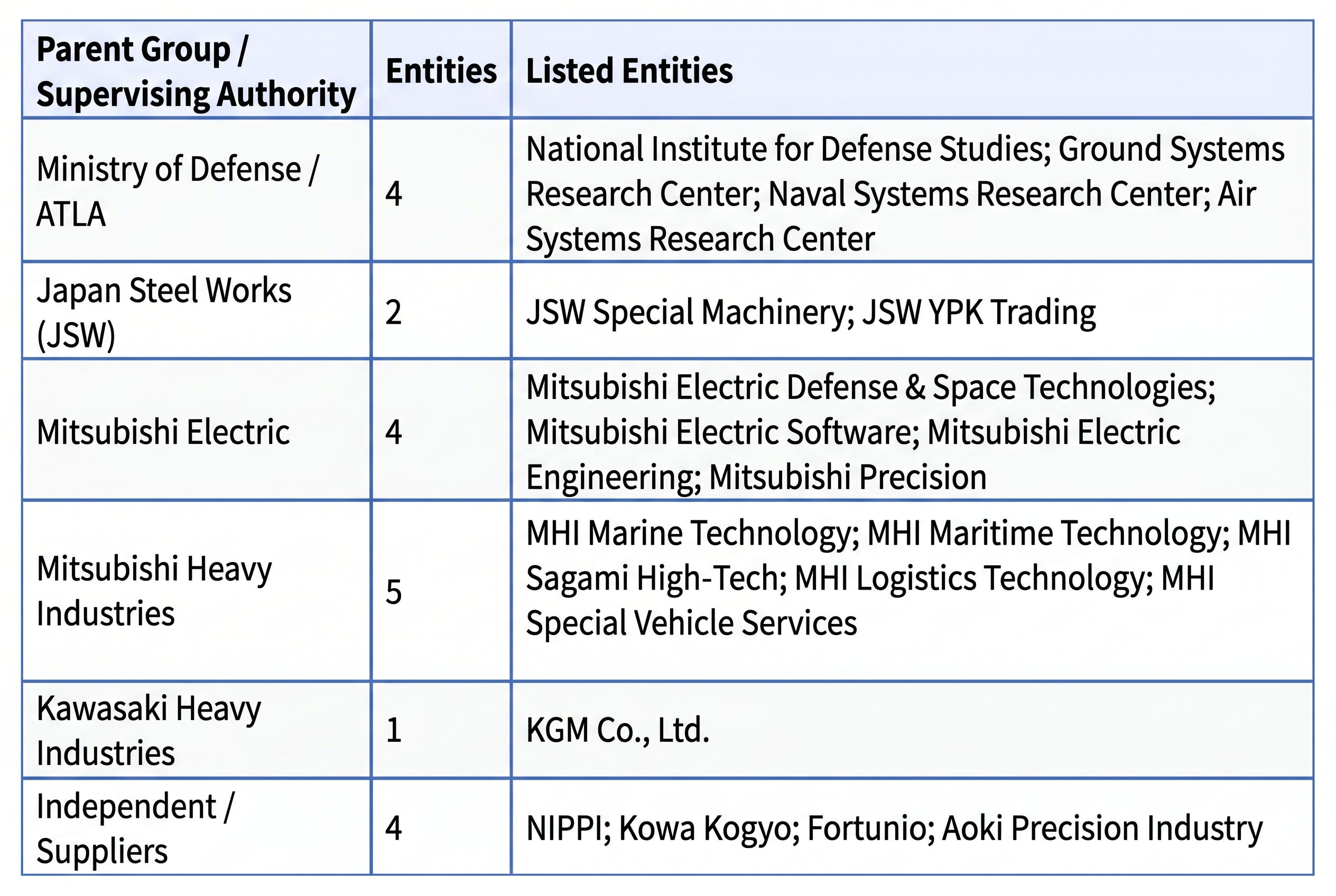
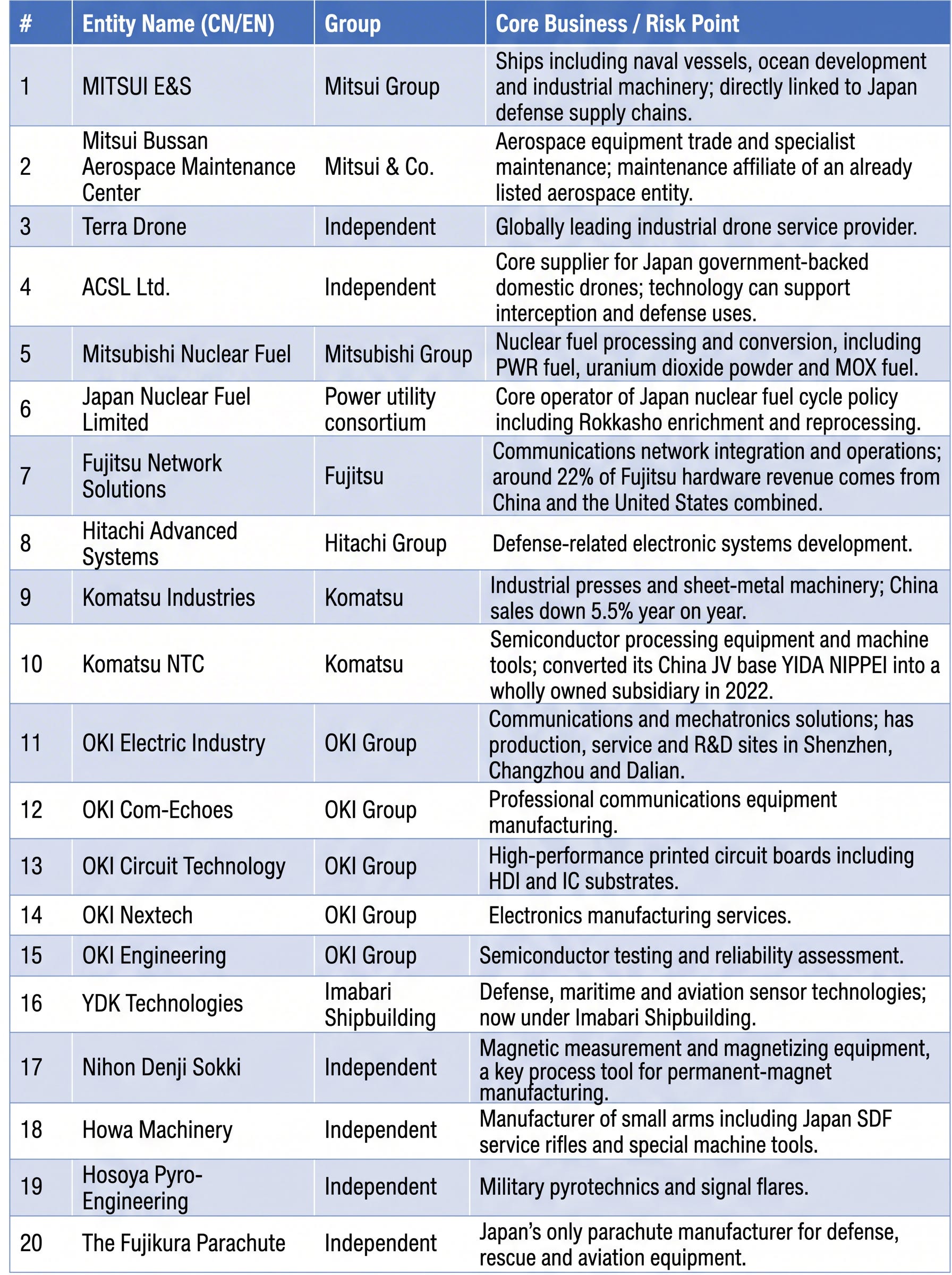
June 29, 2026 — China’s Ministry of Commerce issued Announcements No. 27 and No. 28, pursuant to the Export Control Law and the Regulations on Export Control of Dual-Use Items. The measures add 20 Japanese entities, including the National Institute for Defense Studies (NIDS), to the Export Control List, and another 20 Japanese entities, including Mitsui E&S, to the Watch List.
MOFCOM also clarified that exports of dual-use items to entities on the Watch List will be subject to enhanced end-user and end-use reviews.
Newly Added Entities to the Export Control List:
Newly Added Entities to the Watch List:
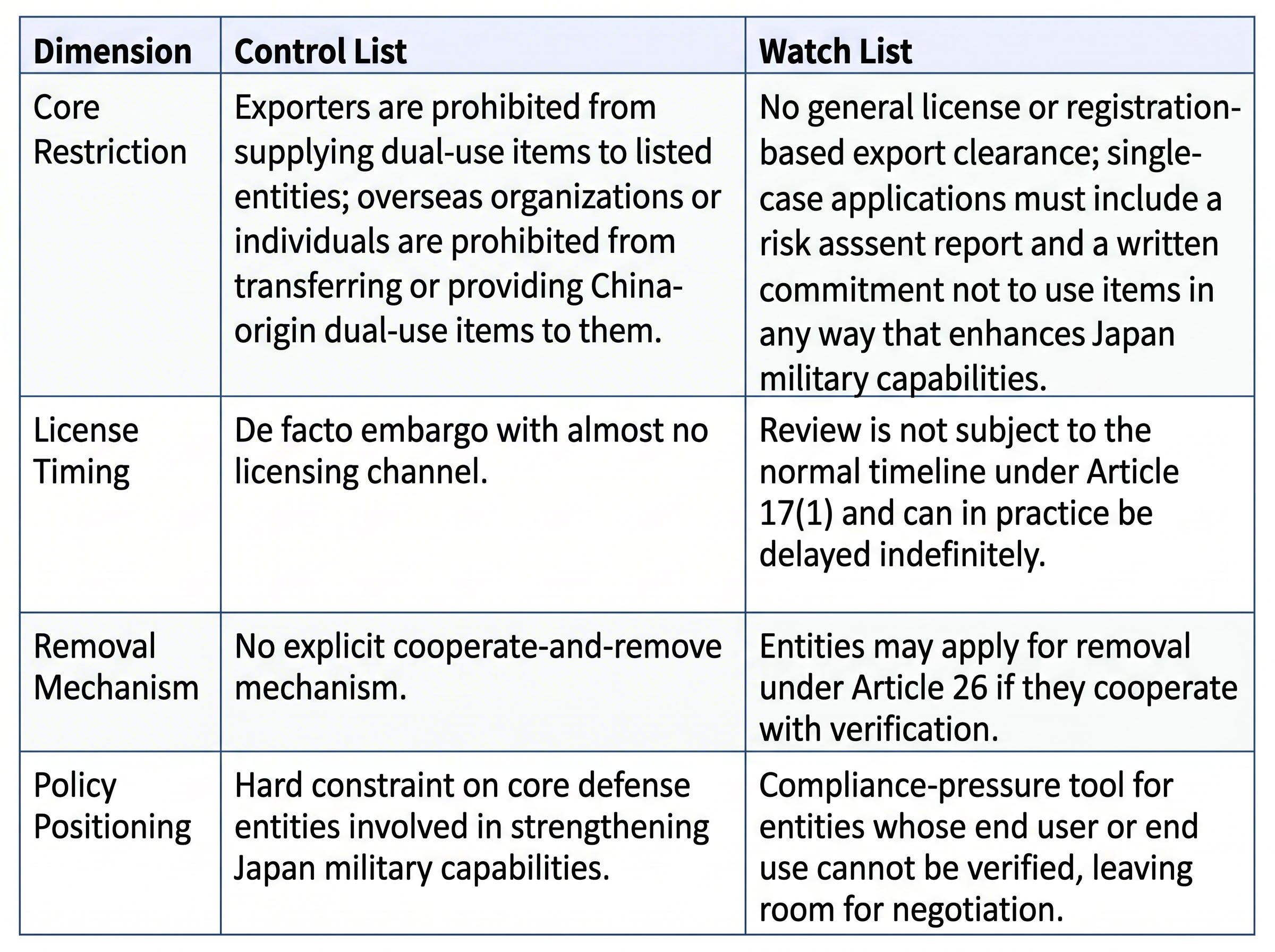
Implications for Entities Added to the Watch List
Entities placed on the Watch List will no longer be eligible for General Licenses or the Registration Filing Pass. Applications for individual export licenses must be accompanied by a written non-military end-use commitment, significantly increasing compliance costs. In addition, license reviews are not subject to the statutory review timeline under Article 17 of the Regulations, meaning approvals can, in practice, be delayed indefinitely.
As a result, entities involved in the nuclear sector (e.g., Mitsubishi Nuclear Fuel and Japan Nuclear Fuel Limited), the defense sector (e.g., Howa Machinery, Hosoya Pyro-Engineering, Fujikura Parachute, and YDK), and the drone sector (e.g., ACSL and Terra Drone) are likely to face persistent uncertainty in contract execution, deliveries, and overseas maintenance and support.
However, compared with entities on the Export Control List, those on the Watch List retain access to a potential export channel because they may still apply for individual export licenses. They may also apply for removal from the Watch List after fulfilling the required verification and compliance obligations. Moreover, the routine civilian operations of non-defense subsidiaries within the same corporate group are, in principle, not directly restricted by the listing.
Notably, several of the newly listed entities have existing operations or commercial ties in China.
For the OKI group, five affiliated entities were listed at the same time. OKI also maintains manufacturing, service, and software delivery sites in Shenzhen, Changzhou, and Dalian. This round of listings could therefore create direct compliance pressure on its internal flow of goods and technology under a “Japan headquarters receives the order → China-based production/R&D supports delivery” model.
For the Komatsu group, sales in China declined by 5.5% year on year, but its subsidiary Komatsu NTC only converted its China base into a wholly owned operation in 2022, suggesting that China remains an important production node for the Asian market. The listing will raise the compliance threshold for any China-origin components needed for semiconductor equipment that are supplied back to the Japanese parent.
For the drone sector, including ACSL and Terra Drone, there was already a precedent in early 2026 where imports were stalled because China-made motors were treated as drone-related components. Following their addition to the Watch List, supply-chain substitution pressure for Japan’s domestically produced industrial drones is likely to move further upstream.
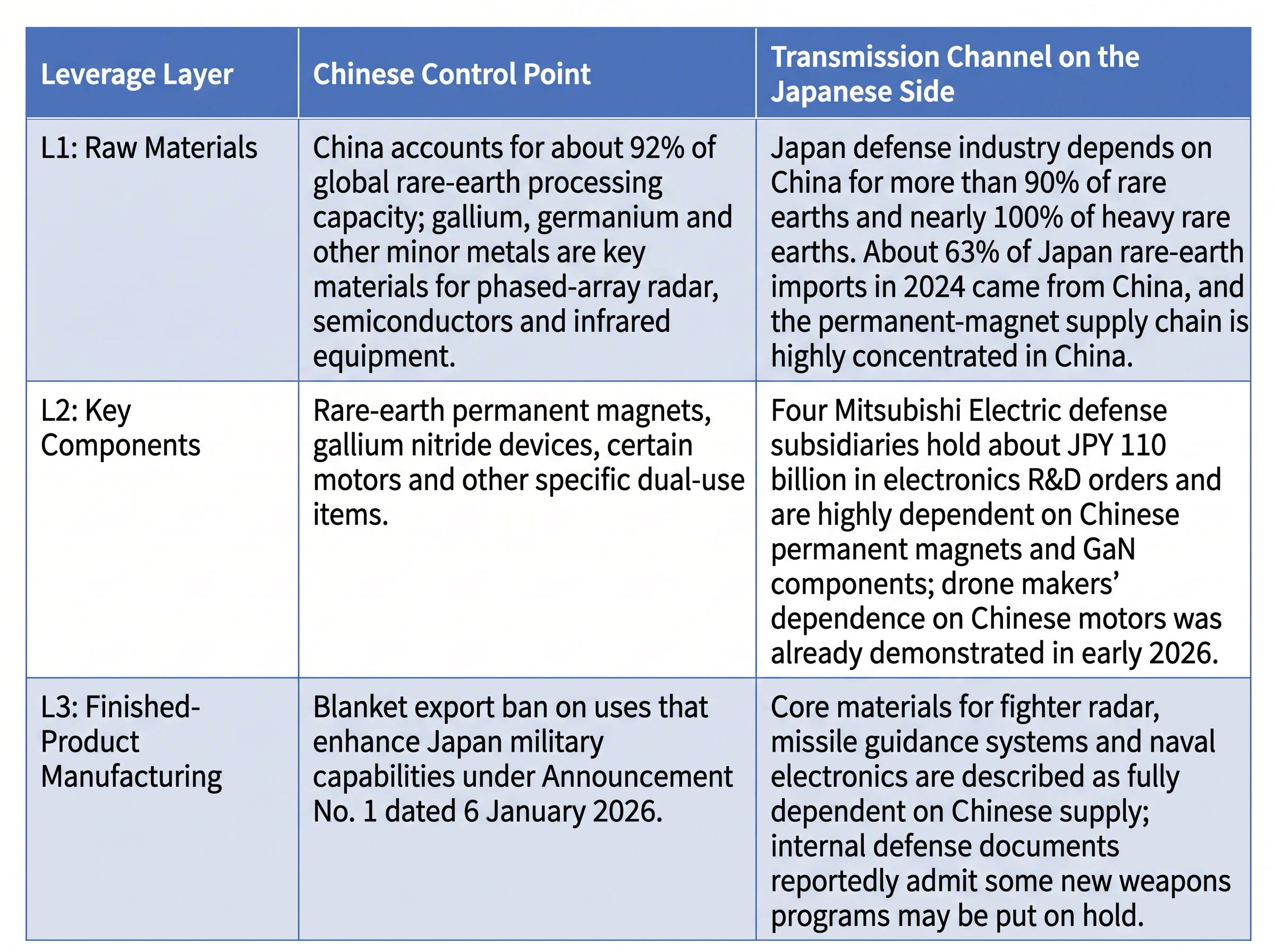
Where China’s leverage lies: the transmission mechanism through rare earths and dual-use items:
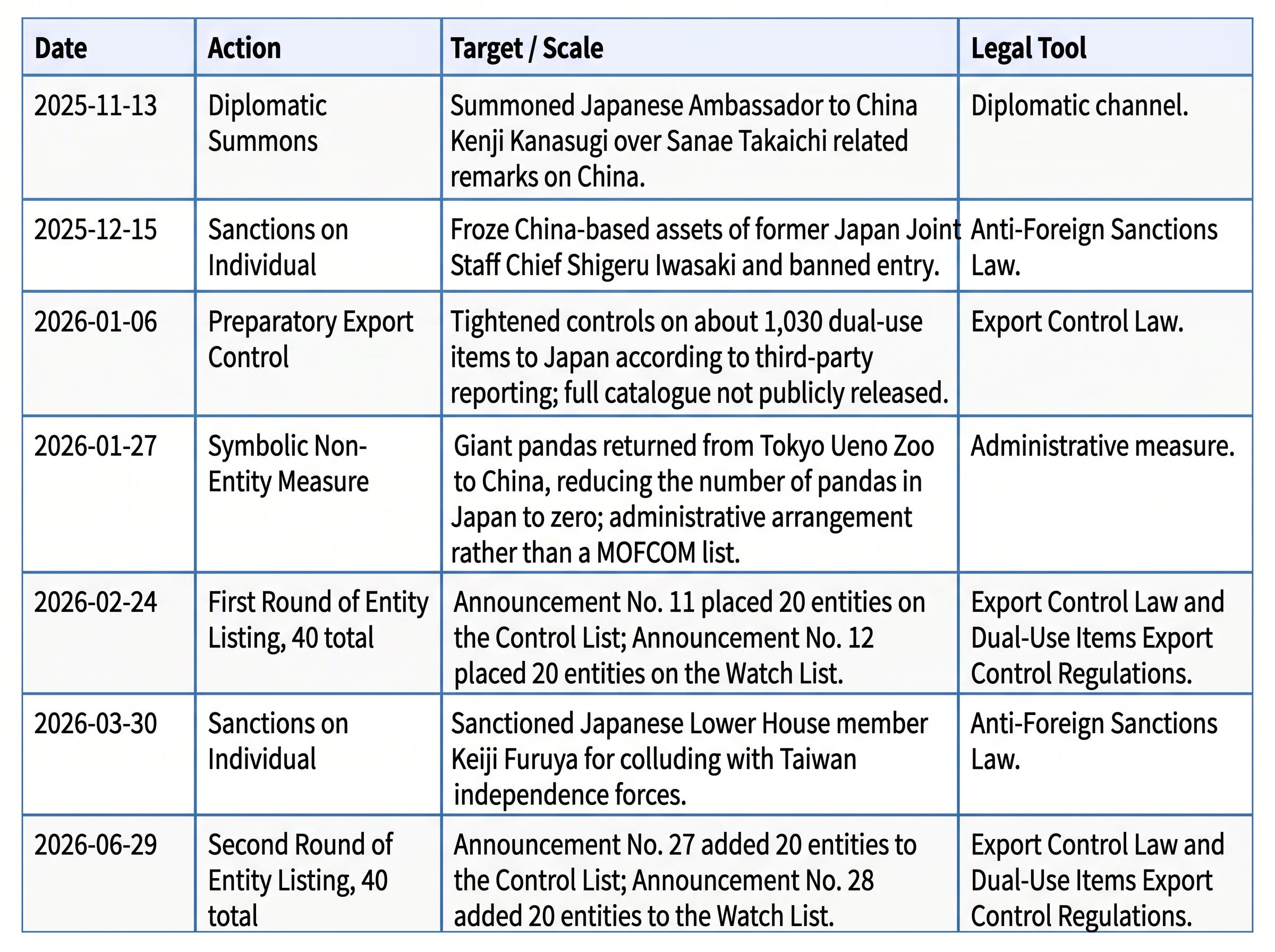
Timeline of China’s Sanctions Measures Since Takaichi’s Remarks
On November 7, 2025, Japanese Prime Minister Sanae Takaichi stated during a Diet session that, if mainland China were to use force against Taiwan, it could constitute a “survival-threatening situation” under Japanese law, implying that the Self-Defense Forces could exercise the right of collective self-defense and intervene.
Six days later, on the evening of November 13, Chinese Vice Foreign Minister Sun Weidong, acting on instructions, summoned Japanese Ambassador to China Kenji Kanasugi and lodged solemn representations over Japan’s erroneous remarks and actions concerning China. This marked the point at which the issue formally entered a phase of bilateral diplomatic confrontation.
Following the escalation of tensions, China first used stricter export controls on dual-use items to Japan as a preparatory measure. On January 6, 2026, MOFCOM issued Announcement No. 1 of 2026, prohibiting the export of all dual-use items to Japanese military end-users, for military end-uses, and for “any other end-users or end-uses that contribute to enhancing Japan’s military capabilities.” Third-party reports said this round covered approximately 1,030 controlled items.
On February 24, 2026, pursuant to the Export Control Law and the Regulations on Export Control of Dual-Use Items, MOFCOM issued Announcements No. 11 and No. 12, respectively adding 20 entities, including Mitsubishi Shipbuilding, to the Export Control List, and another 20 entities, including Subaru, to the Watch List. MOFCOM stated that the purpose was to safeguard national security and interests and fulfill international obligations such as non-proliferation.
The June 29 listings represent China’s latest action following the two earlier rounds of sanctions.
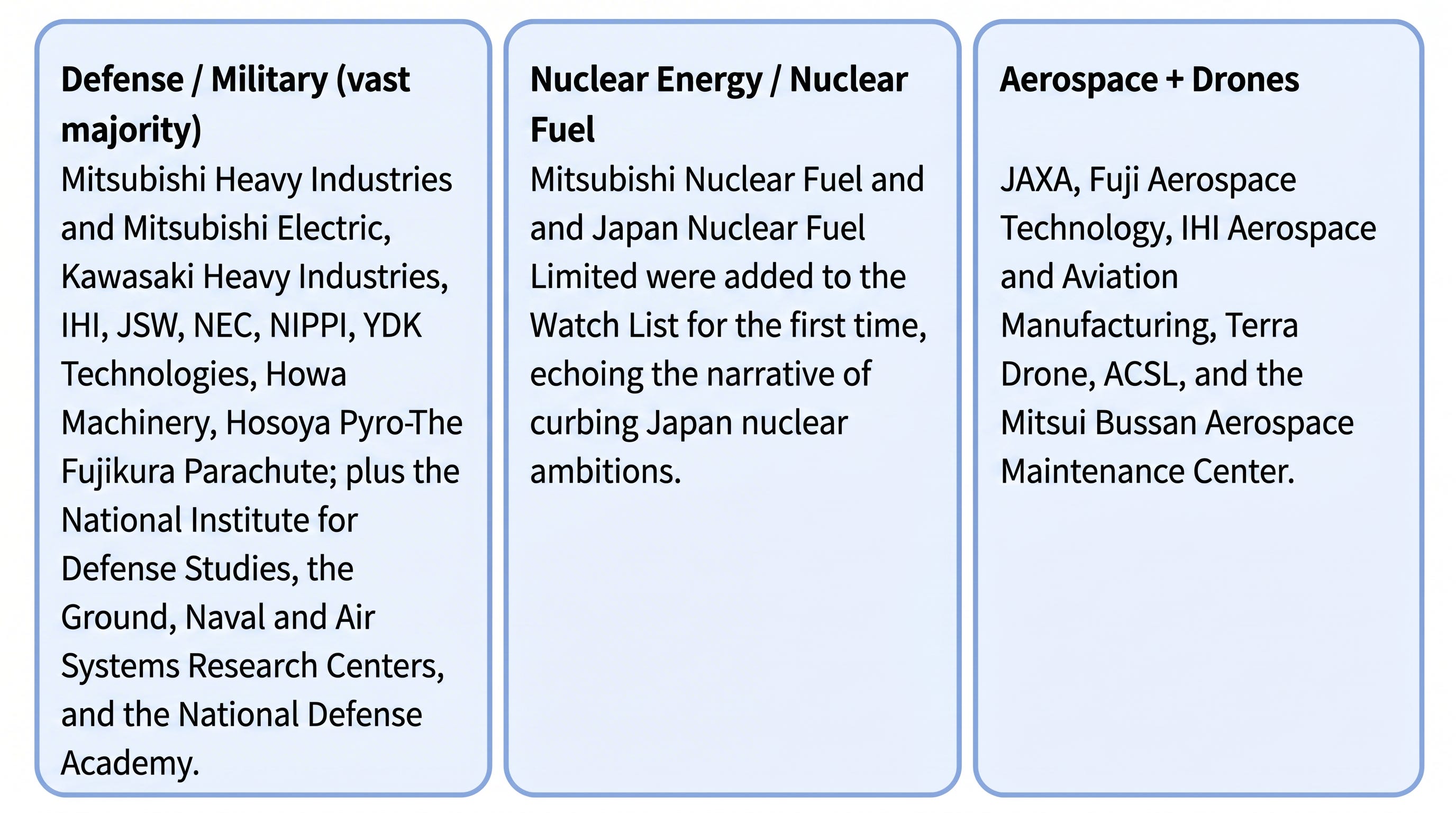
The 80 Japanese entities sanctioned to date fall almost entirely into three clusters:
Defense and aerospace
Including Mitsubishi Heavy Industries affiliates, Kawasaki Heavy Industries affiliates, IHI affiliates, JAXA, the National Defense Academy, the National Institute for Defense Studies, Mitsubishi Electric defense/space units, Japan Aircraft, and related defense contractors.Shipbuilding, engines, heavy machinery and semiconductor equipment
Including Mitsubishi Shipbuilding, Japan Marine United, JMU Defense Systems, Mitsui E&S, Komatsu Industries, Komatsu NTC, and related industrial machinery entities.Dual-use components, drones, nuclear and advanced materials
Including Subaru, TDK, Mitsubishi Materials, Nitto Denko, NOF, Terra Drone, ACSL, Mitsubishi Nuclear Fuel, Japan Nuclear Fuel, Howa Machinery, Hosoya Pyro-Engineering, and Fujikura Parachute.
Another noteworthy development occurred on the night of June 22–23, when numerous Chinese self-media accounts simultaneously circulated claims that Japan had halted exports of photoresists to China.
A large number of Chinese-language articles used nearly identical wording, specifically naming the four leading Japanese photoresist suppliers—Tokyo Ohka Kogyo (TOK), JSR, Shin-Etsu Chemical, and Fujifilm Electronic Materials—and claiming that they had already implemented the following measures:
stopped accepting all new ArF and EUV photoresist orders;
significantly reduced new KrF photoresist orders;
withdrawn all resident field engineers from customer sites; and
extended delivery times for existing photoresist contracts from 1–2 months to 6–8 months.
However, neither the Japanese government nor any of the four companies issued an official announcement to that effect. Moreover, no reports appeared in major media outlets, including Nikkei, Kyodo News, Bloomberg, or Reuters. Within a few hours, most of the articles were either taken down or their links became inaccessible.