

The draft Financial Law of the People’s Republic of China was submitted for its second reading at the 25th Session of the Standing Committee of the 14th National People’s Congress on November 2, 2026. This marks an important legislative development following its first reading in June. Notably, the second-reading draft further strengthens provisions on financial counter-sanctions and measures to block the improper extraterritorial application of foreign laws.
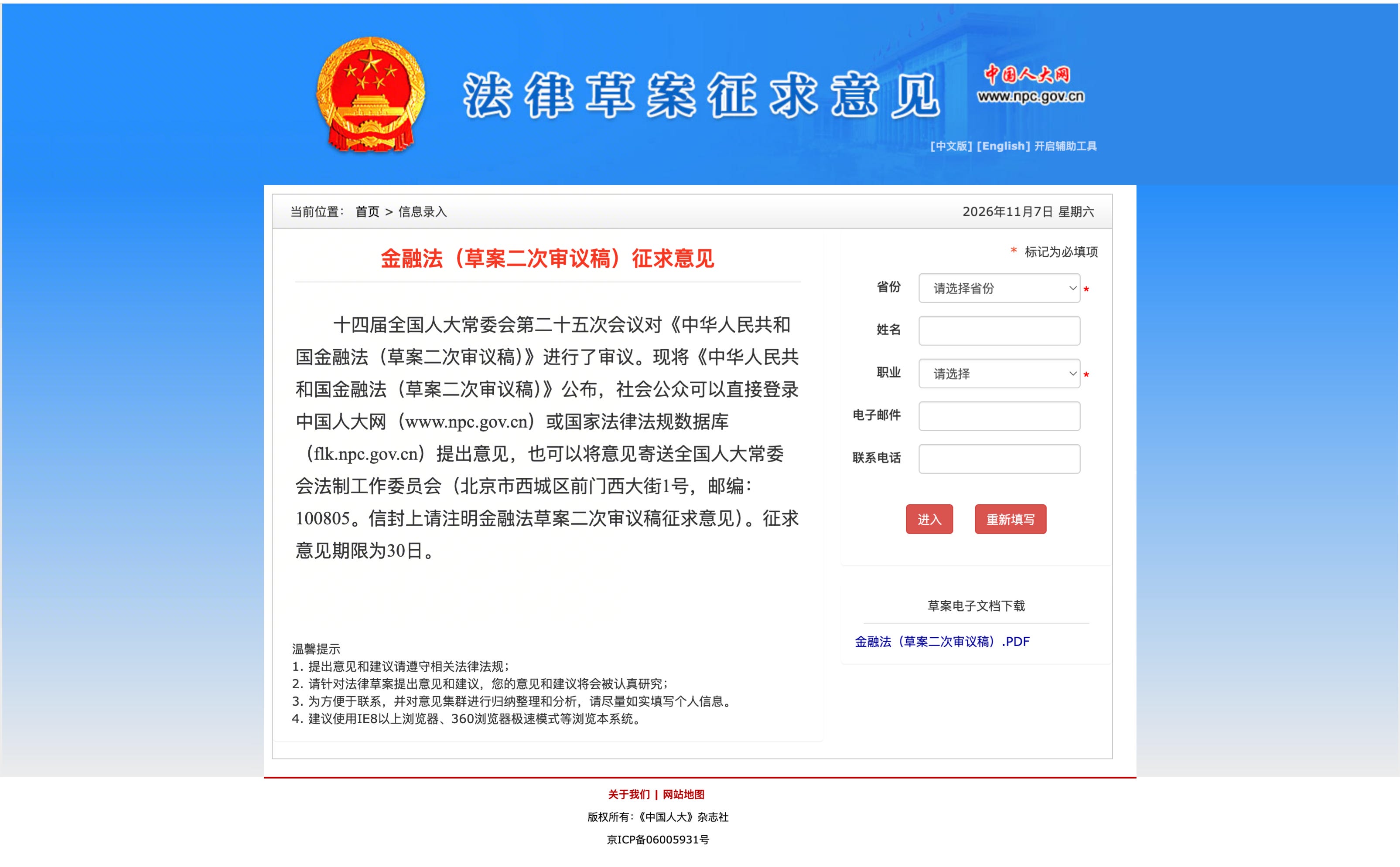
In the draft released for public consultation on March 20 this year, the relevant provisions on financial counter-sanctions and blocking the improper extraterritorial application of foreign laws were contained in Article 85. In the second-reading draft, they appear in Article 87. A comparison of the two versions shows that Article 87 adds “international organizations” to its first and second paragraphs. The fourth paragraph also expands the scope of entities whose discriminatory measures must not be implemented or assisted in their implementation to include “foreign states, regions, or international organizations,” making the provision’s scope more explicit.
Article 87 Where any country, region, or international organization, in violation of international law and the basic norms of international relations, imposes discriminatory prohibitions, restrictions, or other similar measures in the financial sector against citizens or organizations of China, China shall have the right to take corresponding countermeasures.
Where any country, region, or international organization, in violation of international law and the basic norms of international relations, endangers China’s financial security, China shall have the right to impose sanctions against that country, region, or international organization.
Where the extraterritorial application of foreign laws and measures violates international law and the basic norms of international relations and improperly prohibits or restricts citizens or organizations of China from conducting normal financial activities with countries or regions outside that foreign country and their citizens or organizations, China shall have the right to take measures in accordance with law to block the improper extraterritorial application of foreign laws and measures.
No organization or individual may implement or assist in implementing discriminatory measures imposed in the financial sector by a foreign country, region, or international organization against citizens or organizations of China, or carry out, assist, or support acts in financial activities that endanger China’s sovereignty, security, or development interests.
Following the second reading, the draft will still need to undergo further deliberation and revision in accordance with China’s legislative procedures before being put to a vote by the NPC Standing Committee. Draft laws are generally submitted for a vote after three readings, although the procedure may be adjusted depending on the circumstances.
To understand Article 87, consider a practical scenario. A Chinese company is conducting business with a customer in a third country. The contract has been signed and the goods are ready for delivery, but the bank handling the transaction suddenly informs the company that it can no longer process payments because of foreign sanctions requirements. Article 87 seeks to address precisely this type of situation: when foreign restrictions affect the normal operations of Chinese businesses through banking, payment, insurance, or other financial services, what measures can China take, and what obligations should the financial institutions involved have?
One reason financial sanctions can be so effective is that they do not necessarily need to prohibit a trade transaction directly. Instead, they can exert pressure by restricting access to the financial services on which that transaction depends. The US Treasury Department has explicitly explained, in the context of certain Russia-related sanctions, that foreign financial institutions engaging in specified transactions may face restrictions on their correspondent accounts in the United States or even become subject to blocking sanctions themselves. As a result, banks are not merely intermediaries processing transactions; they also become both targets of sanctions pressure and channels through which that pressure is transmitted.
For example, a bank may decide to stop providing services to certain companies to avoid being sanctioned itself. To reduce the cost of screening individual transactions, it may even extend restrictions to activities that are not explicitly prohibited under the relevant foreign laws. For Chinese companies, the practical consequences can include greater difficulty opening bank accounts, blocked payments, and disrupted financing.
However, this is not the first time China has established financial countermeasures or prohibited companies from assisting in the implementation of discriminatory foreign restrictions. The Anti-Foreign Sanctions Law, adopted in 2021, already contains relevant provisions and allows affected Chinese citizens and organizations to bring legal proceedings seeking cessation of the infringement and compensation for losses. The Rules on Counteracting Unjustified Extraterritorial Application of Foreign Legislation and Other Measures, introduced in the same year, also established reporting, assessment, and prohibition-order mechanisms to address improper restrictions on normal economic and trade activities between Chinese entities and third countries.
These mechanisms have subsequently been refined. Implementing regulations issued in 2025 clarified that property subject to countermeasures may include bank deposits, securities, fund units, and equity interests. They also provide that competent authorities may summon entities that implement or assist in implementing discriminatory foreign restrictions for regulatory discussions, order them to rectify their conduct, and take other appropriate measures. The significance of the draft Financial Law, therefore, lies in further incorporating existing counter-sanctions and anti-extraterritorial jurisdiction mechanisms into the fundamental legal framework governing the financial sector.
This approach is closely related to the intended role of the Financial Law itself. According to the publicly released explanatory materials, the law is not designed as sector-specific legislation for any single part of the financial industry. Instead, it is intended to establish foundational and overarching rules for the financial system as a whole. Including counter-sanctions requirements in this law sends a clear signal that such matters are not solely the responsibility of foreign affairs or trade authorities. They should also become a fundamental consideration in the operations and regulation of financial institutions. The specific allocation of responsibilities for identifying relevant measures, making decisions, and enforcing them will still need to be coordinated with existing institutional arrangements and interagency mechanisms.
Turning to Article 87 itself, its four paragraphs build on one another.
The first paragraph primarily addresses situations in which Chinese citizens or organizations are subjected to discriminatory financial measures. It provides that where a foreign state, region, or international organization violates international law and the basic norms governing international relations by imposing prohibitions, restrictions, or similar measures on Chinese companies or individuals in the financial sector, China has the right to take corresponding countermeasures. The emphasis is on protecting affected Chinese entities while providing a legal basis for state action. However, the right to take countermeasures does not mean that individual banks can independently decide to freeze the assets of foreign customers, nor does it mean that China must respond to every restriction with strictly equivalent measures.
The second paragraph broadens the focus from individual companies and citizens to national financial security. Certain foreign measures may have consequences extending beyond a single company’s inability to make payments, potentially affecting wider payment and clearing systems, financial assets, or financial services arrangements. Judging from the structure of the provision, this paragraph preserves legal authority to respond to such risks. However, it also requires that the relevant conduct violate international law and the basic norms governing international relations. It does not mean that China can impose sanctions simply because a foreign policy has an adverse impact on its financial markets.
The third paragraph addresses a more conventional form of long-arm jurisdiction. For example, a Chinese company may be conducting financial transactions with a company in another country, only to find those activities restricted by the laws of a third country. The central question is not whether countries can regulate cross-border transactions at all, but whether a country can use its domestic laws to improperly restrict normal activities between entities in other jurisdictions. The key concept in this paragraph is therefore not merely “extraterritorial application,” but “improper extraterritorial application.” China’s 2026 Regulations on Counteracting Improper Extraterritorial Jurisdiction by Foreign States likewise require consideration of whether there is an appropriate connection between the conduct being regulated and the country asserting jurisdiction.
There have already been concrete policy responses to such situations. On May 2, 2026, China’s Ministry of Commerce issued a blocking order in response to US sanctions imposed on five Chinese companies, including Hengli Petrochemical, over their alleged involvement in Iranian oil transactions. The order prohibited the recognition, implementation of, or compliance with the specified US measures. This case demonstrates that China’s blocking framework is not merely a statement of principle; it can also be activated in response to specific foreign measures.
For banks and companies, the fourth paragraph is the most directly relevant and perhaps the most important to understand. While the first three paragraphs primarily establish what measures the state may take, the fourth specifies what organizations and individuals must not do. It prohibits not only the implementation of, or assistance in implementing, the relevant discriminatory financial measures, but also conduct in financial activities that implements, assists, or supports actions harmful to China’s sovereignty, security, or development interests. Based on the wording, the latter prohibition does not necessarily depend on the existence of a specific foreign sanctions measure, making clarification of its scope particularly important.
Consider how this might apply to an international bank. If its global headquarters instructs all branches to stop serving a particular Chinese customer, its operations in China cannot necessarily rely on the explanation that “this is a group-wide policy.” They would also need to assess whether implementing that policy would conflict with Chinese law. In fact, such conflicts can already arise under the existing Anti-Foreign Sanctions Law; they would not emerge for the first time only after the Financial Law is enacted. The draft further clarifies that financial institutions cannot make these decisions solely from the perspective of compliance with foreign sanctions.
At the same time, this should not be interpreted as requiring banks to provide services unconditionally to every customer subject to foreign sanctions. What the provision prohibits is the implementation of, or assistance in implementing, relevant discriminatory measures, as well as other conduct harmful to national interests. It does not prohibit every commercially motivated refusal to transact. A bank declining business because of genuine credit risks, insufficient customer information, or other legitimate reasons is not necessarily in the same position as a bank terminating services to comply with discriminatory foreign restrictions. One of the challenges going forward will be determining the actual basis for such decisions, preventing institutions from using commercial justifications to conceal prohibited conduct while avoiding the treatment of legitimate risk management as unlawful.
For Chinese banks, the provision has implications in both directions. On the one hand, it strengthens the legal basis under Chinese law for responding to demands from foreign counterparties, making clear that foreign sanctions policies are not necessarily the only rules banks must consider. On the other hand, it does not automatically eliminate the risks Chinese banks face in overseas jurisdictions. The US Office of Foreign Assets Control (OFAC), for example, has explicitly explained that certain Russia-related sanctions risks applicable to foreign financial institutions also extend to non-US-dollar transactions. Switching settlement currencies or invoking China’s blocking provisions therefore does not automatically eliminate exposure to foreign sanctions.
In terms of policy impact, the provision may discourage some forms of overcompliance with foreign restrictions. But another outcome is also possible: if the boundaries of the rules are insufficiently clear, financial institutions may become even more cautious in order to avoid violating the laws of either jurisdiction, potentially reducing certain cross-border activities. A framework intended to protect companies’ normal financial operations could therefore also make it harder for some businesses to access financial services.
Ultimately, however, the central purpose of Article 87 is to make clear that when foreign financial restrictions affect Chinese entities, their implementation cannot be determined solely by foreign laws and the internal policies of financial institutions. Chinese law must also impose constraints on that process. The provision preserves the state’s ability to respond to external financial pressure while imposing corresponding obligations on institutions participating in financial activities.
Its ultimate value lies not in forcing banks and companies to choose between two conflicting legal systems, but in establishing clearer rules, coordination mechanisms, and remedies that can protect legitimate financial activities as far as possible and reduce the harm caused by improper foreign restrictions.
Full translation of the draft financial law:
Financial Law of the People’s Republic of China (Draft)
(Second Deliberation)
Chapter I General Provisions
Article 1 This Law is enacted in accordance with the Constitution to improve the quality and efficiency of financial services for the real economy, strengthen financial regulation in all respects, prevent and resolve financial risks, promote high-quality financial development, accelerate the building of a strong financial nation, and provide strong support for advancing the rejuvenation of the Chinese nation on all fronts through Chinese modernization.
Article 2 This Law shall apply to financial activities conducted within the territory of the People’s Republic of China and their regulation.
Article 3 For the purposes of this Law, “financial activities” means monetary and credit activities conducted by natural persons, legal persons, and unincorporated organizations that are directly related to deposits, loans, insurance, securities, futures and derivatives, funds, trusts, payment and settlement, credit reporting, and the like.
For the purposes of this Law, “financial institutions” means institutions established within the territory of the People’s Republic of China, with the approval of the State Council or the financial regulatory authorities under the State Council, to engage in financial business, including financial institutions in the banking, securities, fund and futures, insurance, and trust industries, financial holding companies, non-bank payment institutions, and other institutions engaging in financial business.
For the purposes of this Law, “financial business” means financial activities conducted by financial institutions through the provision of financial products and services, and financial activities conducted by other institutions with the approval of financial regulatory authorities.
Article 4 Financial work shall adhere to the leadership of the Communist Party of China. A highly efficient and authoritative leadership system for financial work under the centralized and unified leadership of the Party Central Committee shall be established. The central decision-making, deliberative and coordinating body for financial work shall be responsible for the top-level design, overall coordination, overall advancement, and supervision of implementation of financial stability and development, and shall study and deliberate on major policies, major issues, and the like in the financial sector.
Article 5 Financial work shall adhere to a people-centered approach, meet the diverse financial needs of the people, and protect their lawful rights and interests.
Article 6 The State shall follow the path of financial development with Chinese characteristics, build a modern financial system with Chinese characteristics, and foster and promote a financial culture with Chinese characteristics.
Article 7 Financial work shall adhere to the pursuit of progress while maintaining stability, adhere to a market-oriented and law-based approach, and follow the principles of legality, fairness, impartiality, efficiency, and security.
Article 8 The State shall bring all financial activities within the scope of regulation, impose strict entry requirements on financial institutions and financial business through administrative licensing, and combat illegal financial activities in accordance with law.
Financial regulation shall adhere to the principles that lawful activities must be regulated and, more importantly, illegal activities must be regulated, and that regulation of an industry must include regulation of its risks, and shall implement management by category and level; institutional regulation, conduct regulation, functional regulation, look-through regulation, and continuous regulation shall be strengthened to achieve full coverage of financial regulation.
The financial regulatory authorities under the State Council and the bodies of local people’s governments at or above the county level responsible for financial administration shall each perform their respective functions, strengthen regulatory coordination, and maintain the lawful and sound operation of the financial industry.
Article 9 Financial work shall adhere to a holistic approach to national security, coordinate development and security, strengthen the prevention and control of financial risks, ensure early identification, early warning, early disclosure, and early disposal, resolve and dispose of financial risks collaboratively and efficiently, and safeguard national financial security.
Article 10 Financial work shall adhere to serving the real economy, deepen financial reform, expand financial opening-up, and achieve high-quality financial development in the course of serving high-quality economic and social development.
Chapter II The Central Bank
Article 11 The People’s Bank of China is the central bank of the People’s Republic of China. The People’s Bank of China shall be responsible for formulating and implementing monetary policy, conducting macroprudential management, and maintaining financial stability.
Article 12 The legal tender of the People’s Republic of China is the renminbi. The renminbi shall be produced and issued exclusively by the People’s Bank of China. The renminbi includes physical and digital forms.
The People’s Bank of China shall administer the circulation of the renminbi in accordance with law. No entity or individual may jeopardize the orderly circulation of the renminbi in any form.
Article 13 The People’s Bank of China shall improve the monetary policy framework, use monetary policy instruments in accordance with law as required for regulation and control, be responsible for the formulation, implementation, and supervision of interest rate policy, maintain the stability of the value of the renminbi, and thereby promote economic growth.
Coordination between monetary policy and fiscal policy shall be strengthened to improve the effectiveness of macroeconomic governance.
The People’s Bank of China shall formulate and implement credit policy, conduct macro-level credit regulation and control, optimize the credit structure, and guide finance to serve the real economy.
Article 14 The People’s Bank of China shall take the lead in establishing a macroprudential policy framework, formulate macroprudential policies in conjunction with the relevant departments under the State Council, monitor and assess the overall soundness of the financial system, conduct macroprudential management, and prevent and dispose of systemic financial risks.
Article 15 The People’s Bank of China shall, in conjunction with the relevant departments under the State Council, conduct macro-level regulation, control, and administration of financial markets, monitor the operation of financial markets, and take measures such as countercyclical and cross-cyclical adjustments as circumstances require, to promote the sound development of financial markets.
Article 16 The People’s Bank of China shall supervise and administer the payment and clearing framework and maintain the normal operation of payment and clearing systems.
Article 17 The People’s Bank of China shall be responsible for foreign exchange administration and shall hold, administer, and manage the State’s foreign exchange reserves and gold reserves.
Article 18 The People’s Bank of China shall be responsible for formulating basic standards for integrated financial industry statistics, organize the compilation of integrated financial industry statistics, and build a national financial basic database in conjunction with the relevant departments under the State Council.
Chapter III Financial Institutions
Article 19 Financial institutions shall establish and improve their organizational bodies and incentive and constraint systems, define the operating mechanisms for decision-making, execution, and supervision, improve their governance structures, and ensure proper operation.
Organizations of the Communist Party of China shall be established and Party activities shall be conducted within financial institutions in accordance with the Constitution of the Communist Party of China and relevant intra-Party regulations. Financial institutions shall provide the necessary conditions for the activities of Party organizations.
Organizations of the Communist Party of China within State-owned financial institutions shall play a leadership role in accordance with the Constitution of the Communist Party of China and relevant intra-Party regulations, fulfill their primary responsibility for exercising full and rigorous Party self-governance, support discipline inspection and supervisory organs in fulfilling their supervisory responsibilities, and support the organizational bodies of financial institutions in exercising their powers in accordance with law.
Article 20 The establishment of financial institutions and their branches, or changes to major matters prescribed by laws and administrative regulations, shall be subject to approval by the State Council or the financial regulatory authorities under the State Council, after which registration of establishment or change shall be carried out with the registration authority in accordance with law.
When handling the registration of establishment or change of an enterprise, the registration authority shall conduct consultations as prescribed where the matter may involve financial attributes but has not been approved by the State Council or the financial regulatory authorities under the State Council.
Article 21 Shareholders and actual controllers of financial institutions shall meet the requirements concerning funds, integrity, and the like prescribed by laws, administrative regulations, and the financial regulatory authorities under the State Council.
The registered capital of financial institutions shall be subject to a paid-in capital system. Shareholders of financial institutions shall make capital contributions with their own funds, except where otherwise provided by the State. Shareholders of financial institutions shall ensure that the sources of their capital contributions are lawful and genuine, and shall not make false capital contributions or withdraw capital contributions through circular capital injections or other means.
Financial institutions shall ensure that their ownership structures are clear. No entity or individual may conceal actual control over equity in a financial institution in any form, or, in violation of applicable provisions, entrust another person to hold equity in a financial institution or accept an entrustment from another person to do so.
Article 22 Non-financial enterprises or natural persons that establish, acquire, or take equity interests in financial institutions shall comply with laws, administrative regulations, and the provisions of the financial regulatory authorities under the State Council, and shall take necessary measures to strengthen risk separation between industrial operations and finance. Obtaining improper benefits through financial institutions is prohibited.
Where non-financial enterprises, natural persons, or recognized legal persons hold controlling interests in or actually control financial institutions under the prescribed circumstances, they shall establish financial holding companies in accordance with law.
Article 23 Actual controllers and shareholders of financial institutions and the actual controllers of such shareholders shall comply with laws, administrative regulations, the provisions of the financial regulatory authorities under the State Council, and the articles of association, and shall exercise shareholder rights and fulfill shareholder obligations in accordance with law. They shall not occupy the assets of financial institutions or their customers’ funds in violation of applicable provisions, shall not pledge equity in financial institutions in violation of applicable provisions, shall not abuse shareholder rights to harm the interests of financial institutions or other shareholders, and shall not interfere in the operation and management of financial institutions in violation of applicable provisions.
Article 24 Directors and senior managers of financial institutions shall possess the operation and management capabilities required for the performance of their duties and shall obtain approval of their qualifications for office from the financial regulatory authorities under the State Council before taking office.
Directors, senior managers, and other operation and management personnel of financial institutions shall owe duties of loyalty and diligence to the financial institutions, shall not abuse their powers of operation and management, and shall not harm the lawful rights and interests of relevant stakeholders.
Where a financial institution has supervisors as prescribed, the provisions of this Law concerning directors and senior managers shall apply to the supervisors.
Article 25 Financial institutions shall enjoy the right to operate autonomously in accordance with law, and their lawful operations shall not be interfered with.
No entity or individual may evade debts owed to financial institutions and harm their interests by concealing or transferring property, fabricating debts, or other means, or assist another person in doing so.
Article 26 Financial institutions shall conduct business activities in accordance with law within the business and geographical scope approved by the State Council or the financial regulatory authorities under the State Council, and shall not operate beyond that scope.
Article 27 Financial institutions shall operate in accordance with law, conduct business activities commensurate with their corporate governance, risk management, compliance management, and other relevant circumstances, strengthen internal controls, continuously satisfy the regulatory requirements prescribed by laws, administrative regulations, and the financial regulatory authorities under the State Council, assume primary responsibility for the prevention of financial risks, and fulfill their obligations to protect financial consumers and investors in accordance with law.
Financial institutions shall strengthen the prevention and control of integrity risks and prevent financial corruption.
Financial institutions shall comply with the financial management system for financial enterprises uniformly formulated by the finance department under the State Council. The relevant departments under the State Council shall rigorously combat falsification of financial accounts by financial institutions in accordance with laws and applicable provisions.
Article 28 Financial institutions shall strengthen the management of related-party transactions and shall not use related-party transactions to transfer benefits improperly or obtain improper benefits.
Financial institutions shall not, in violation of applicable provisions, provide financing or guarantees to their shareholders or actual controllers, or to related parties of their shareholders or actual controllers.
Article 29 Financial institutions and their shareholders, actual controllers, directors, senior managers, and other relevant persons shall disclose or submit information truthfully, accurately, and completely as prescribed.
Article 30 Where a financial institution is dissolved in accordance with law, is closed down, is declared bankrupt, or falls within other exit circumstances prescribed by laws, administrative regulations, and the financial regulatory authorities under the State Council, it shall cease financial business, cancel its financial license, and promptly apply to the registration authority for deregistration after its financial license has been canceled.
Where a financial institution exits, it may, as prescribed, negotiate with relevant stakeholders through market-based means to settle claims and debts and handle outstanding business.
Chapter IV Financial Products and Services
Article 31 For the purposes of this Law, “financial products and services” means products provided for financial activities in accordance with law by financial institutions and other legal persons, unincorporated organizations, and the like through contracts, agreements, instruments, and other means, and services directly related to such products.
The provision of financial products and services shall be subject to approval, registration, recording, or filing with the State Council, the financial regulatory authorities under the State Council, relevant departments authorized by the State Council, or organizations authorized in accordance with law. Without such approval, registration, recording, or filing, no entity or individual may provide financial products and services, whether directly or in disguised form.
Article 32 Financial products and services shall conform to public order and good morals, comply with laws and applicable provisions, have a clearly defined nature and clear rights and obligations, and shall not circumvent laws, administrative regulations, or the provisions of the financial regulatory authorities under the State Council through combination, division, nesting, or any other means.
The provision of asset management products and services shall comply with the business rules and regulatory standards uniformly formulated by the State Council and the financial regulatory authorities under the State Council.
Article 33 Providers of financial products and services shall set fair and reasonable transaction terms and shall not use standard terms to impose unfair or unreasonable provisions that exclude or restrict the rights of financial consumers or investors, reduce or exempt their own liability, increase the liability of financial consumers or investors, or the like.
Article 34 Providers of financial products and services shall, in accordance with laws, administrative regulations, and the provisions of the financial regulatory authorities under the State Council, truthfully disclose information on transaction structures, rights and obligations, distribution of returns, fees and rates, innovative designs, degrees of risk, and the like.
Article 35 The State shall support and guide lawful innovation in financial products and services. Innovation in financial products and services shall not be used, in the name of innovation, to seek improper benefits or circumvent laws, administrative regulations, or the provisions of the financial regulatory authorities under the State Council.
Article 36 Entities marketing financial products and services shall meet the requirements prescribed by the financial regulatory authorities under the State Council.
Entities marketing financial products and services shall strengthen customer suitability management, ascertain customers’ circumstances as prescribed, truthfully explain the contents of financial products and services, fully disclose risks, provide financial products and services suited to customers’ circumstances, and shall not proactively recommend financial products and services whose risk levels exceed customers’ risk tolerance.
Entities marketing financial products and services shall not market financial products and services by fraudulent means, market them against customers’ wishes, or process personal information in violation of laws or applicable provisions.
Article 37 The provision or marketing of financial products and services through the internet shall comply with this Law and relevant laws, administrative regulations, and the provisions of the financial regulatory authorities under the State Council concerning those financial products and services, as well as the special provisions concerning the provision or marketing of financial products and services through the internet.
Financial products and services offered through non-public issuance shall not be advertised, publicly solicited, or solicited in a disguised public manner through the internet or other means.
The provision or marketing of financial products and services through the internet shall also comply with relevant laws and regulations governing the internet.
Article 38 The State shall establish a fair, efficient, and convenient diversified mechanism for resolving financial disputes, and support the settlement of disputes through negotiation, mediation, arbitration, litigation, and other means.
Any entity or individual purchasing financial products or receiving financial services shall act rationally and prudently, enhance awareness of self-protection, and safeguard their own lawful rights and interests in accordance with law, and shall not abuse means of asserting rights to seek improper benefits or disrupt financial market order.
Article 39 Where third-party service providers providing services for financial activities are required, as prescribed, to obtain approval from or make a filing with the competent industry departments under the State Council or the financial regulatory authorities under the State Council, they shall complete the relevant formalities and comply with laws, administrative regulations, and the provisions of the competent industry departments under the State Council and the financial regulatory authorities under the State Council.
Accounting firms and asset appraisal institutions providing services for financial activities shall obtain approval from the competent industry departments under the State Council in conjunction with the financial regulatory authorities under the State Council.
Third-party service providers and their practitioners shall act honestly and in good faith and perform their duties diligently. They shall not issue documents containing false records, misleading statements, or material omissions, or assist or cooperate with relevant parties in issuing such documents, and shall not assist or cooperate in carrying out other acts in violation of laws or applicable provisions.
Chapter V Financial Markets
Article 40 Money markets, foreign exchange markets, stock markets, bond markets, bill markets, gold markets, futures and derivatives markets, and other financial markets shall perform functions such as financing, resource allocation, price discovery, and risk management, and shall remain fair and impartial, reasonably structured, secure, and properly regulated.
Article 41 The organizational forms and methods of trading in financial markets shall be suited to the markets’ functional positioning, the risk tolerance of their participants, and other relevant factors, and shall comply with laws, administrative regulations, and the provisions of the financial regulatory authorities under the State Council.
Financial product trading venues shall provide premises, facilities, and related services for trading in financial products, and organize and supervise trading activities. Without the approval of the State Council or the financial regulatory authorities under the State Council, no entity or individual may establish a financial product trading venue or organize centralized trading in financial products and related activities in any form.
Trading in financial products and related activities outside financial product trading venues shall employ appropriate pricing, trading, and clearing methods according to the nature, positioning, degree of risk, and other characteristics of the products, and shall not violate laws, administrative regulations, or the provisions of the financial regulatory authorities under the State Council.
Article 42 Financial market participants engaging in financial activities shall comply with laws, administrative regulations, and the provisions of the financial regulatory authorities under the State Council, as well as the business rules formulated by financial product trading venues in accordance with law.
Fraud, insider trading, market manipulation, falsification of financial accounts, and other acts prohibited by laws, administrative regulations, and the financial regulatory authorities under the State Council are prohibited.
Article 43 Financial market participants engaging in financial activities shall fulfill their information disclosure obligations in accordance with laws, administrative regulations, and the provisions of the financial regulatory authorities under the State Council. Disclosed information shall be truthful, accurate, complete, concise, clear, and readily understandable, and shall not contain false records, misleading statements, or material omissions.
No entity or individual may fabricate or disseminate false or misleading information to disrupt financial market order.
Article 44 The State shall strengthen the monitoring of financial market risks, establish and improve a rapid-response mechanism for financial market risks, and respond prudently to major risks such as abnormal market fluctuations, market panic, and exhaustion of liquidity.
Article 45 The financial regulatory authorities under the State Council and other relevant departments shall strengthen expectations management and policy coordination, assess the impact of major policies in the financial sector, coordinate the release of major information, and deal with false or misleading information in accordance with law.
Article 46 Enterprises meeting the prescribed requirements may apply to issue shares or depositary receipts and to have them listed and traded on securities exchanges established in accordance with law.
Listed companies shall operate in compliance with laws and applicable provisions and in good faith, and establish and improve corporate governance mechanisms. Controlling shareholders, actual controllers, directors, senior managers, and other relevant persons of listed companies shall not abuse shareholder rights or their position of control, or abuse their powers of operation and management, to harm the lawful rights and interests of listed companies, their shareholders, or other relevant stakeholders.
Where listed companies or their controlling shareholders, actual controllers, directors, senior managers, or other relevant persons make false statements, engage in insider trading or market manipulation, or commit other acts that harm investors’ lawful rights and interests, thereby causing losses to investors, they shall be liable for compensation in accordance with law.
Chapter VI Financial Infrastructure
Article 47 The State shall carry out overall planning for financial infrastructure and unify the rules and systems governing registration and custody, and clearing and settlement, in financial markets.
For the purposes of this Law, “financial infrastructure” means multilateral systems or facilities that comply with laws, administrative regulations, and the provisions of the financial regulatory authorities under the State Council and provide basic public services for financial activities, such as registration, depository services, custody, trading, payment, clearing, and settlement.
Article 48 Financial infrastructure operators shall be established with the approval of the State Council and shall complete registration in accordance with law.
Article 49 Financial infrastructure operators shall give priority to the public interest, formulate articles of association and business rules in accordance with law, improve their governance structures, establish and improve risk management systems, build secure, properly regulated, and efficient technical systems and facilities, strengthen financial information and data security management, and ensure the secure and stable operation of financial infrastructure.
Article 50 Where financial infrastructure acts as a central counterparty, property subject to centralized clearing and settlement shall not be sealed up, frozen, seized, or subjected to compulsory enforcement, and centralized clearing and settlement conducted in accordance with law shall not be suspended, invalidated, or revoked by reason of any participant entering bankruptcy proceedings.
Article 51 No entity or individual may carry out activities involving unlawful intrusion into, interference with, or destruction of financial infrastructure, or jeopardize the security of financial infrastructure.
Chapter VII Financial Regulation
Article 52 The State shall supervise and administer financial activities in accordance with law, and formulate and implement consistent regulatory standards for financial activities of the same type.
Article 53 The financial regulatory authorities under the State Council shall, in accordance with the principle of substance over form and the division of responsibilities, supervise and administer financial activities and conduct industry statistical monitoring in accordance with law. The financial regulatory authorities under the State Council may authorize their dispatched offices and branches to perform regulatory duties in accordance with law.
The bodies of local people’s governments at or above the county level responsible for financial administration shall supervise and administer local financial organizations and related activities in accordance with law, and maintain financial stability within their jurisdictions.
Where financial regulatory responsibilities require further clarification, the financial regulatory authority under the State Council designated by the State shall take the lead in establishing a mechanism for identifying and assigning regulatory responsibilities, and establish and improve a backstop regulatory mechanism.
Article 54 The financial regulatory authorities under the State Council shall formulate rules relating to financial regulation in accordance with laws, administrative regulations, and decisions and orders of the State Council.
Where, for the purposes of financial regulation, it is indeed necessary to subject a matter immediately to administrative licensing and no law or administrative regulation has yet been enacted, the financial regulatory authorities under the State Council may request the State Council to establish administrative licensing for that matter by issuing a decision in accordance with law.
Article 55 The financial regulatory authorities under the State Council shall improve the systems and mechanisms for protecting the rights and interests of financial consumers and investors, strengthen financial consumer and investor education, and enhance protection.
Article 56 The financial regulatory authorities under the State Council shall, in accordance with the division of responsibilities and their statutory powers and procedures, supervise and administer the following entities and individuals and conduct inspections, investigations, and handling as required for supervision and administration:
(1) Financial institutions;
(2) Directors, senior managers, and other staff members of financial institutions;
(3) Actual controllers and shareholders of financial institutions and the actual controllers of such shareholders;
(4) Enterprises actually controlled by financial institutions;
(5) Listed companies and their shareholders, actual controllers, directors, and senior managers, and enterprises actually controlled by listed companies;
(6) Other entities and individuals prescribed by laws and administrative regulations.
The financial regulatory authorities under the State Council shall supervise and administer the provision of services for financial activities by third-party service providers and their relevant personnel, and, as required for supervision and administration, conduct inspections, investigations, and handling in conjunction with the competent industry departments in accordance with their statutory powers and procedures. The competent industry departments under the State Council may also conduct inspections, investigations, and handling with respect to third-party service providers and their relevant personnel in accordance with their statutory powers and procedures.
Article 57 In performing their duties in accordance with law, the financial regulatory authorities under the State Council shall have the power to take the following measures in accordance with statutory procedures:
(1) Enter premises where suspected unlawful acts have occurred to investigate and collect evidence;
(2) Question entities and individuals connected with the matters under inspection or investigation, or require them to submit relevant documents and materials in a specified manner;
(3) Inspect and copy documents and materials connected with the matters under inspection or investigation, and seal or seize documents and materials that may be transferred, concealed, or destroyed;
(4) Inspect and copy documents and materials, such as property rights registrations and communication records, connected with the matters under inspection or investigation;
(5) Inspect systems that use computers to manage business data;
(6) Inquire into information on fund accounts, securities accounts, bank accounts, and other accounts with payment, custody, settlement, or similar functions of entities and individuals connected with the matters under inspection or investigation, and copy relevant documents and materials; where evidence proves that unlawful funds, securities, or other property involved in the case have been or may be transferred or concealed, or that important evidence has been or may be concealed, falsified, or destroyed, impose freezing or sealing-up measures;
(7) Decide to prohibit departure from the territory by persons suspected of unlawful acts, persons in charge of entities suspected of unlawful acts, and other directly responsible persons who have caused financial risks or whose departure may affect the investigation and handling of a case, and notify the immigration administration authorities to enforce the decision in accordance with law;
(8) Other measures prescribed by laws and administrative regulations.
Article 58 The financial regulatory authorities under the State Council may, according to the circumstances and in accordance with statutory procedures, take the following measures against entities and individuals that violate laws, administrative regulations, or the provisions of the financial regulatory authorities under the State Council:
(1) Order rectification;
(2) Restrict or suspend some or all business, cease approving the commencement of new business, cease approving the establishment of additional branches, or temporarily decline to accept administrative licensing applications for a specified period;
(3) Restrict the distribution of dividends or their distribution to relevant shareholders, and restrict the payment of remuneration or provision of benefits to directors, senior managers, and other directly responsible persons;
(4) Restrict transfers of property or assets, major capital expenditures, or the creation of other rights over property;
(5) Restrict or require a reduction in the scale of risk assets;
(6) Restrict the forms or proportions of the use of funds;
(7) Adjust regulatory indicator requirements;
(8) Order the transfer of assets or business;
(9) Order major shareholders to replenish the capital of financial institutions;
(10) Order responsible shareholders to transfer their equity within a specified period or return dividends distributed within a specified period, or restrict their shareholder rights;
(11) Order financial institutions to impose disciplinary sanctions on directly responsible directors, senior managers, and other directly responsible persons;
(12) Determine that responsible shareholders, directors, senior managers, and other directly responsible persons are unfit persons, or revoke their qualifications;
(13) Order changes in directors, senior managers, or other directly responsible persons, restrict their rights, or recover and claw back remuneration and benefits for a specified period;
(14) Commission, or order the selection and engagement of, an accounting firm to conduct a special audit of the financial and operating conditions of a financial institution;
(15) Other measures established by the financial regulatory authorities under the State Council in accordance with laws and administrative regulations.
After completing rectification, the relevant entities and individuals shall submit a report to the financial regulatory authorities under the State Council. The financial regulatory authorities under the State Council shall verify acceptance of the rectification and lift the measures taken against them under the preceding paragraph as prescribed.
Before the shareholders and actual controllers specified in the first paragraph of this Article have rectified their unlawful acts and transferred their equity as required, the financial regulatory authorities under the State Council may restrict their shareholder rights.
Where a crime is suspected, the matter shall be transferred to the public security organs in accordance with law.
Article 59 Where, after the financial regulatory authorities under the State Council have taken regulatory measures or made penalty decisions, shareholders or actual controllers of financial institutions fail to complete equity transfers or return dividends within the prescribed period, or directors, senior managers, or other directly responsible persons fail to return remuneration or benefits within the prescribed period, the financial regulatory authorities under the State Council may apply to a people’s court for compulsory enforcement.
Article 60 The financial regulatory authorities under the State Council and their staff members shall be protected by law when performing their duties in accordance with law. Relevant entities and individuals shall cooperate and truthfully provide relevant documents and materials, and shall not refuse, obstruct, or conceal. Where the acts of the financial regulatory authorities under the State Council or their staff members in performing their duties do not comply with laws, administrative regulations, or the provisions of the financial regulatory authorities under the State Council, relevant entities and individuals shall have the right to refuse.
The financial regulatory authorities under the State Council shall formulate and implement standards for the performance of duties such as routine supervision, inspections, investigations, and administrative penalties in accordance with law, and protect the lawful rights and interests of the parties concerned.
The State shall establish a system for rewarding and protecting whistleblowers. Any entity or individual shall have the right to report suspected acts in violation of financial laws or applicable provisions to the financial regulatory authorities under the State Council.
Article 61 The financial regulatory authorities under the State Council, the competent industry departments under the State Council, and other relevant departments shall strengthen regulatory coordination and information sharing, prevent regulatory arbitrage, and eliminate regulatory gaps.
The competent industry departments under the State Council shall fulfill their responsibility for risk management in their respective industries and sectors and prevent industry risks from giving rise to financial risks.
The financial regulatory authorities under the State Council shall strengthen coordination with supervisory organs, public security organs, State security organs, and the like in the transfer of leads, information sharing, and other work, combat financial violations and crimes in accordance with law, and safeguard national financial security.
Article 62 The State shall establish and improve a mechanism for coordinating financial work between the central and local levels, and coordinate information reporting, risk monitoring, law enforcement cooperation, and other work.
The financial regulatory authorities under the State Council shall uniformly formulate regulatory rules for local financial organizations and strengthen guidance and supervision of the implementation of regulatory rules by the bodies of local people’s governments responsible for financial administration.
Article 63 The State shall strengthen financial regulatory capacity, enhance budgetary support, strengthen the development of a professional regulatory workforce, support the use of information technology to improve regulatory methods, and enhance regulatory efficiency and standards.
Article 64 The State shall strengthen the prevention and punishment of financial corruption, establish and improve systems and mechanisms for oversight of and accountability for financial regulation, pursue responsibility and impose accountability in accordance with law for failure to perform or improper performance of regulatory duties, and strengthen constraints on and supervision of the exercise of power.
Article 65 Financial industry self-regulatory organizations shall conduct self-regulation in their respective industries and sectors in accordance with law, formulate self-regulatory rules in accordance with law, and submit those rules to the financial regulatory authorities under the State Council for approval or filing.
The financial regulatory authorities under the State Council shall strengthen guidance, supervision, and accountability with respect to relevant self-regulatory organizations.
Chapter VIII Financial Risk Disposal
Article 66 Financial risk disposal shall adhere to market-oriented and law-based principles, clarify the division of responsibilities for risk disposal, improve risk disposal measures, strengthen the availability of resources for risk disposal, effectively resolve and dispose of financial risks, and maintain the bottom line of preventing systemic financial risks.
Article 67 Where unlawful operations, disorderly corporate governance, loss of management control, major risks, or other circumstances of a financial institution have endangered or may endanger its continued operation or financial order, the financial regulatory authorities under the State Council may facilitate its restructuring, or decide to subject it to takeover, entrusted management, closure, or other measures in accordance with laws and administrative regulations. Where a financial institution falls within bankruptcy circumstances prescribed by law, the financial regulatory authorities under the State Council may apply to a people’s court for the reorganization or bankruptcy liquidation of that financial institution.
The financial regulatory authorities under the State Council shall establish and improve a mandatory early corrective action system, order relevant financial institutions to complete rectification within a specified period, and may take the measures prescribed in Article 58 of this Law according to the circumstances; where rectification is inadequate, they shall promptly implement risk disposal in accordance with the division of responsibilities prescribed in Article 68 of this Law.
Institutions authorized by laws and administrative regulations may take relevant early corrective measures in accordance with law.
Article 68 The financial regulatory authorities under the State Council shall take the lead in organizing and implementing risk disposal for nationwide banks, securities, fund and futures business institutions, central financial enterprises, and financial institutions in which central financial enterprises hold controlling interests. The provincial people’s government at the place of registration shall take the lead in organizing and implementing risk disposal for local small and medium-sized financial institutions, local financial holding companies, and local financial organizations, and the financial regulatory authorities under the State Council shall strengthen guidance and cross-regional coordination and promote risk resolution according to their responsibilities.
Risk disposal for other financial institutions and private investment fund management institutions not specified in the preceding paragraph shall be organized and implemented by the provincial people’s government at their place of registration in conjunction with the financial regulatory authorities under the State Council.
Where non-financial enterprises are involved in financial risks, the provincial people’s government at their place of registration and the competent industry departments under the State Council shall bear responsibility for disposal, with the cooperation of the financial regulatory authorities under the State Council.
The People’s Bank of China shall take the lead in responsibility for the prevention, resolution, and disposal of systemic financial risks.
The finance department under the State Council shall participate in the disposal of systemic financial risks in accordance with law and perform relevant duties as prescribed.
Article 69 The financial regulatory authorities under the State Council may take the following measures to implement risk disposal according to the circumstances:
(1) The measures prescribed in Article 58 of this Law;
(2) Establish or designate an entrusted manager or takeover organization to exercise the powers of operation and management of the financial institution subject to disposal;
(3) Dispose of assets and liabilities;
(4) Suspend, restrict, or terminate some or all financial transactions;
(5) Revoke business licenses;
(6) Close down branches;
(7) Facilitate the assumption of some or all of the business, assets, and liabilities of the financial institution subject to disposal by a third-party institution, or establish a temporary bridge institution to assume them;
(8) Suspend rights to early termination of contracts under qualified financial transactions for no longer than 48 hours;
(9) Where the financial institution subject to disposal meets the conditions prescribed by the financial regulatory authorities under the State Council, implement write-downs of equity or claims, or debt-to-equity conversion;
(10) Where a circumstance that may give rise to systemic financial risks is discovered in the course of risk disposal, compel the transfer of equity;
(11) Require the financial institution subject to disposal to repatriate overseas assets as prescribed;
(12) When disposing of risks of a systemically important financial institution, require domestic and overseas institutions within its group to provide necessary support to maintain uninterrupted critical financial services and functions;
(13) Other disposal measures prescribed by laws and administrative regulations or approved by the State Council.
When the disposal measures prescribed in the preceding paragraph are taken, exemptions may be granted as prescribed from the application of relevant provisions of laws and administrative regulations concerning approval by shareholders’ meetings or boards of directors, consent of creditors or other third parties, and relevant provisions concerning information disclosure and trading restrictions.
Where a provincial people’s government takes the lead in organizing and implementing risk disposal for local financial organizations, it may take the disposal measures prescribed in the first paragraph of this Article.
Where a provincial people’s government takes the lead in organizing and implementing risk disposal for local small and medium-sized financial institutions or local financial holding companies, or organizes and implements risk disposal for other financial institutions or private investment fund management institutions in conjunction with the financial regulatory authorities under the State Council, it may take the disposal measures prescribed in the first paragraph of this Article as authorized by the financial regulatory authorities under the State Council, or recommend that the financial regulatory authorities under the State Council take the disposal measures prescribed in the first paragraph of this Article.
Relevant entities and individuals shall cooperate with financial risk disposal measures taken in accordance with law, and shall not refuse, obstruct, or conceal.
Article 70 Financial institutions and financial infrastructure operators shall, as prescribed, make contributions to or subscribe to the deposit insurance fund, industry protection funds for insurance, securities, trusts, and other industries, and the financial stability guarantee fund (hereinafter collectively referred to as “financial stability funds”).
The central decision-making, deliberative and coordinating body for financial work shall coordinate the management and use of financial stability funds.
Article 71 Financial risk disposal shall adhere to the principle of internal assistance before external assistance, and the shareholders and actual controllers of relevant institutions must first bear losses in accordance with law. The use of public resources to participate in risk disposal shall comply with laws and applicable provisions. The State shall establish and improve the conditions, standards, and procedures for using public resources to dispose of financial risks, and strengthen supervision.
A financial institution subject to disposal shall assume primary responsibility for risk disposal, exhaust all self-rescue means, and take all necessary measures to settle claims and debts and recover losses. Major shareholders and actual controllers shall replenish capital in accordance with recovery and disposal plans or regulatory commitments; where they are responsible for financial risks, they shall be liable for compensation in accordance with law and return funds occupied or transferred in violation of applicable provisions and dividends distributed.
Where risks endanger regional stability and remain difficult to resolve after market-based means have been exhausted, the provincial people’s government shall coordinate its own resources to respond in accordance with law. The deposit insurance fund management institution and the relevant industry protection fund management institutions shall participate in risk disposal in accordance with law.
Where major financial risks seriously endanger financial stability, the financial stability guarantee fund may be used as prescribed.
The People’s Bank of China shall perform its duties as lender of last resort in accordance with law.
Article 72 Financial risk disposal implemented by the financial regulatory authorities under the State Council shall be coordinated in an orderly manner with judicial disposal procedures.
As required for the implementation of financial risk disposal, the financial regulatory authorities under the State Council may apply to the Supreme People’s Court to designate relevant people’s courts to exercise jurisdiction over civil litigation cases in which the financial institution subject to disposal is the defendant.
As required for the implementation of financial risk disposal, the financial regulatory authorities under the State Council may apply to a people’s court to suspend civil litigation proceedings and civil enforcement proceedings in which the financial institution subject to disposal is the defendant or the party subject to enforcement; the financial institution subject to disposal may apply to an arbitration institution to suspend arbitration proceedings.
Where the financial regulatory authorities under the State Council implement consolidated disposal of a financial institution and its affiliated enterprises, the provisions of the second and third paragraphs of this Article shall apply.
In financial risk disposal procedures, measures such as asset verification, asset appraisal, preservation of assets, registration of claims, and disposition of property that have already been completed in accordance with law shall have their effect recognized by a people’s court in accordance with law after review.
Where financial risk disposal is organized and implemented under the lead of a provincial people’s government or by a provincial people’s government in conjunction with the financial regulatory authorities under the State Council, the provisions of the first through fifth paragraphs of this Article shall apply mutatis mutandis.
Article 73 Illegal financial activities in any form are prohibited.
The financial regulatory authorities under the State Council, the competent industry departments under the State Council, other relevant departments under the State Council, and local authorities shall be responsible for preventing and combating illegal financial activities in accordance with the division of responsibilities and the principle of substance over form.
The financial regulatory authority under the State Council designated by the State shall take the lead in establishing a coordinating mechanism for preventing and combating illegal financial activities, and coordinate and supervise the efforts of relevant departments under the State Council and local authorities to prevent and combat illegal financial activities in accordance with law.
Local people’s governments at or above the county level shall establish and improve working mechanisms for preventing and combating illegal financial activities, and provincial people’s governments shall bear overall responsibility for preventing and combating illegal financial activities within their respective administrative regions.
Article 74 The financial regulatory authorities under the State Council and local authorities shall, in accordance with the division of responsibilities prescribed in Article 73 of this Law and relevant State provisions, strengthen monitoring, early warning, and risk screening, and promptly organize investigation and determination of discovered risk leads concerning illegal financial activities. Where the determination of the nature of an activity is disputed, the matter shall be reported level by level for coordinated determination until it is resolved through coordination by the coordinating mechanism for preventing and combating illegal financial activities.
Article 75 The financial regulatory authorities under the State Council, the competent industry departments under the State Council, other relevant departments under the State Council, and local authorities shall promptly investigate and dispose of illegal financial activities in accordance with law, and transfer matters involving suspected crimes to the public security organs in accordance with law.
Where the financial regulatory authorities under the State Council, the competent industry departments under the State Council, other relevant departments under the State Council, or local authorities inspect or investigate suspected illegal financial activities in accordance with law, relevant entities and individuals shall cooperate and shall not refuse, obstruct, or conceal. When inspecting or investigating suspected illegal financial activities, the financial regulatory authorities under the State Council may take the measures prescribed in Article 57 of this Law in accordance with law.
Chapter IX Financial Development and Security
Article 76 The State shall encourage the development of technology finance, green finance, inclusive finance, pension finance, and digital finance, guide financial resources toward major national strategies, key areas, and weak links, and serve high-quality economic and social development.
Article 77 Policies for financial support for small, medium-sized, and micro enterprises shall be continuously improved, and financial institutions shall be guided to treat all types of business entities equally.
Article 78 Financial institutions shall be guided to optimize their structures, focus on their core businesses, operate in a properly regulated manner, adopt correct approaches to operations, performance, and risks, improve their competitiveness, and enhance their capacity to serve the real economy.
Article 79 A secure, properly regulated, transparent, open, dynamic, and resilient capital market shall be built and improved, coordinated development of investment and financing shall be promoted, medium- and long-term funds shall be supported in entering the market, and the intrinsic stability of the capital market shall be enhanced.
Enterprises meeting the prescribed requirements shall be supported in obtaining listings in accordance with law, supervision and administration of listed companies shall be strengthened, the exit mechanism for listed companies shall be improved, and the quality and structure of listed companies shall be optimized.
Article 80 Coordination between financial policies and fiscal, employment, industrial, and other policies shall be strengthened to improve the overall effectiveness of policies.
Article 81 Credit management systems in the financial sector shall be established and improved, the development of a credit system in the financial sector shall be advanced, and a favorable credit environment shall be fostered.
Article 82 A high-quality and professional financial workforce shall be cultivated, and financial practitioners shall be guided to abide by professional ethics and industry standards.
Article 83 High-standard opening-up of the financial sector shall be promoted, institutional opening-up in the financial sector shall be steadily expanded, the development of international financial centers shall be advanced, integrated administration of domestic and foreign currencies shall be strengthened, facilitation of cross-border trade, investment, and financing shall be enhanced, and a mutually beneficial, diversified and balanced, secure and efficient framework for financial opening-up shall be established.
Article 84 The State shall strengthen bilateral and multilateral exchanges and cooperation in the financial sector, participate in global financial governance, strengthen coordination of macro-financial policies, advance monetary and financial regulatory cooperation, and enhance mutual trust and reciprocal benefits.
Article 85 The State shall enhance its capacity to safeguard financial security under conditions of opening-up.
The lawful and orderly flow of cross-border funds shall be promoted, and risks arising from cross-border flows of funds in violation of laws or applicable provisions shall be prevented and addressed.
A system for protecting the security of overseas financial assets shall be established and improved, security protection capabilities shall be strengthened, and the security of overseas financial assets shall be safeguarded.
Systems for financial cybersecurity protection and for the protection of financial data by category and level shall be established and improved, and financial data processing activities that affect or may affect national security shall be subject to national security review in accordance with law.
Article 86 The State shall improve the anti-money laundering regulatory system, prevent and curb money laundering, embezzlement and bribery, terrorist financing, and related criminal activities, and safeguard national security, the public interest, and financial order.
Article 87 Where any country, region, or international organization, in violation of international law and the basic norms of international relations, imposes discriminatory prohibitions, restrictions, or other similar measures in the financial sector against citizens or organizations of China, China shall have the right to take corresponding countermeasures.
Where any country, region, or international organization, in violation of international law and the basic norms of international relations, endangers China’s financial security, China shall have the right to impose sanctions against that country, region, or international organization.
Where the extraterritorial application of foreign laws and measures violates international law and the basic norms of international relations and improperly prohibits or restricts citizens or organizations of China from conducting normal financial activities with countries or regions outside that foreign country and their citizens or organizations, China shall have the right to take measures in accordance with law to block the improper extraterritorial application of foreign laws and measures.
No organization or individual may implement or assist in implementing discriminatory measures imposed in the financial sector by a foreign country, region, or international organization against citizens or organizations of China, or carry out, assist, or support acts in financial activities that endanger China’s sovereignty, security, or development interests.
Chapter X Legal Liability
Article 88 Staff members of financial regulatory authorities, competent industry departments, and other relevant departments who abuse their powers, neglect their duties, or engage in malpractice for personal gain in performing duties in financial work or duties involving finance-related work shall be given disciplinary sanctions in accordance with law; where a crime is constituted, criminal liability shall be pursued in accordance with law.
Article 89 No entity or individual may obtain benefits from unlawful financial activities. Any unlawful gains shall be confiscated, except for amounts returned or paid as restitution in accordance with law.
Where relevant entities or individuals commit multiple independent financial violations of the same provision of this Law, the amount of penalties may be calculated separately for each financial violation.
Article 90 Where financial activities are conducted in violation of this Law, the financial regulatory authorities under the State Council or other departments prescribed by laws and administrative regulations shall order rectification, confiscate unlawful gains, and impose a fine, and may order the suspension of or prohibit engagement in the relevant business, order suspension of operations for rectification, or revoke the financial license; where the circumstances are particularly serious and the consequences are particularly serious, a fine of up to five percent of the turnover for the preceding year or up to an amount equivalent to the transaction value may be imposed in accordance with this Law. The persons directly in charge and other directly responsible persons shall be given warnings and circulated notices of criticism, and shall also be fined. The specific circumstances and penalty measures shall be prescribed by relevant laws and administrative regulations.
Where a person organizes or instructs others to commit financial violations, or provides assistance or facilitation for others to commit financial violations, the financial regulatory authorities under the State Council or other departments prescribed by laws and administrative regulations shall order rectification and impose penalties, within the types and ranges of penalties prescribed in the preceding paragraph, according to the circumstances of the violations and their harmful consequences.
Where financial activities are conducted in violation of laws or administrative regulations and the circumstances are serious, the financial regulatory authorities under the State Council may revoke the qualifications for office of the relevant responsible persons for a specified period up to life, and prohibit them from entering the corresponding financial industry for a specified period up to life; where the circumstances are particularly serious, they may be prohibited from entering the financial industry for a specified period up to life, or from engaging in specified financial activities for a specified period up to life.
Where an offender fails to pay over unlawful gains or pay fines or late-payment surcharges as prescribed and the circumstances are serious, the offender shall be prohibited from entering the corresponding financial industry for a specified period up to life.
Article 91 Where financial activities conducted in violation of this Law cause harm to others, civil liability shall be borne in accordance with law.
Where civil, administrative, and criminal liability shall be borne for a violation of this Law and the offender’s property is insufficient to meet all liabilities, it shall be used first to satisfy civil liability.
Financial consumers and investors may select representatives to conduct litigation in accordance with relevant laws. Investor protection institutions may, in accordance with relevant laws, bring litigation on behalf of other investors whose subject matter of litigation is of the same type. Judgments and rulings made by people’s courts shall apply in accordance with law to the plaintiffs and all investors they represent, except investors who have expressly stated that they will not participate in or will withdraw from the litigation proceedings.
Article 92 Where financial activities conducted in violation of this Law constitute a violation of public security administration, a public security administration penalty shall be imposed in accordance with law; where a crime is constituted, criminal liability shall be pursued in accordance with law.
Chapter XI Supplementary Provisions
Article 93 The following terms used in this Law shall have the meanings set out below:
(1) “Financial regulatory authorities” includes the financial regulatory authorities under the State Council and the bodies of local people’s governments at or above the county level responsible for financial administration.
(2) “Local small and medium-sized financial institutions” means financial institutions whose financial business is subject to geographical restrictions in accordance with laws, administrative regulations, and the provisions of the financial regulatory authorities under the State Council, excluding financial institutions in which central financial enterprises hold controlling interests.
(3) “Other financial institutions” means financial institutions, other than nationwide banks, securities, fund and futures business institutions, central financial enterprises, and financial institutions in which central financial enterprises hold controlling interests, that conduct financial business nationwide in accordance with laws, administrative regulations, and the provisions of the financial regulatory authorities under the State Council.
(4) “Local financial organizations” means lawfully established microloan companies, financing guarantee companies, regional equity markets, pawnshops, financial leasing companies, commercial factoring companies, local asset management companies, and other organizations engaging in financial business that are prescribed by laws and administrative regulations and subject to supervision and administration by provincial people’s governments as authorized by the State Council.
(5) “Financial industry self-regulatory organizations” means organizations conducting self-regulation in the financial sector, such as industry associations, financial product trading venues, and registration and settlement institutions.
(6) “Major shareholders” means shareholders holding five percent or more of the total capital or total share capital of a financial institution, or holding less than five percent but having a significant influence on its operation and management.
(7) “Actual controller” means a person able to exercise actual control over the conduct of a relevant institution or company through investment relationships, agreements, or other arrangements.
(8) “Third-party service providers” means institutions providing services for financial activities as prescribed by laws, administrative regulations, and the financial regulatory authorities under the State Council, such as accounting firms, law firms, appraisal and rating institutions, and information technology service providers.
(9) “Credit reporting” means activities in the financial sector involving the collection, collation, storage, and processing of credit information on enterprises, public institutions, and other organizations, and credit information on individuals, and the provision of such information to information users.
Article 94 Institutions or individuals outside the territory of the People’s Republic of China shall not provide financial products and services within the territory of the People’s Republic of China without the approval of the financial regulatory authorities under the State Council, except where otherwise provided by the State; those lawfully providing financial products and services within the territory of the People’s Republic of China shall comply with laws, administrative regulations, and the provisions of the financial regulatory authorities under the State Council.
Article 95 Where financial activities conducted outside the territory of the People’s Republic of China endanger the national financial security of the People’s Republic of China, disrupt financial order within its territory, or harm the lawful rights and interests of citizens or organizations of China, legal liability shall be borne in accordance with law.
Article 96 This Law shall apply to foreign-invested financial institutions and branches of foreign financial institutions established within the territory of the People’s Republic of China; where laws or administrative regulations provide otherwise, those provisions shall apply.
This Law shall apply to policy-based financial institutions, private investment fund management institutions, and local financial organizations; where laws or administrative regulations provide otherwise, those provisions shall apply.
The provisions of this Law concerning financial institutions shall not apply to institutions approved to conduct licensed business involving the exchange of domestic and foreign currencies for individuals.
Article 97 Where other laws or administrative regulations in the financial sector are inconsistent with this Law, this Law shall apply. Where this Law contains no provision on a matter, other laws and administrative regulations in the financial sector shall apply.
Article 98 This Law shall enter into force on (year) (month) (day).