

Some comment:
The “mutual trust, interconnection, and interoperability” of intelligent agents, in plain terms, is about whether AI agents built by different companies can recognize each other, communicate with each other, and work together.
The current reality is that OpenAI’s agents, Google’s agents, Microsoft’s agents, and the various Chinese agents all use their own formats and their own interfaces — they largely don’t speak the same language. If you try to get one agent to call another company’s agent, it either fails entirely or requires writing substantial amounts of glue code. The deeper issue is trust: why should one agent believe another agent’s identity, or accept the instructions it passes along? There is no unified answer to this yet.
In the era of single-machine, single-platform software, this wasn’t a major problem. But the entire value proposition of agents is that they can “autonomously complete complex tasks” — and complex tasks almost always require calling multiple tools and crossing multiple systems. If the agent ecosystem remains a collection of isolated islands, the efficiency ceiling of the entire industry gets permanently capped.
Why does agent interoperability matter? The most direct reason is that whoever sets the standard controls who gets to enter the ecosystem. When Wi-Fi, HTTP, and TCP/IP were established, everyone played by those rules and network effects could take off. Agent interoperability standards follow the same logic — once a standard solidifies, the cost of retrofitting systems for newcomers becomes extremely high, and whoever staked out the position first builds a long-term structural advantage.
For developing countries, there is an additional dimension: if interoperability standards are quietly set by a handful of large platforms, smaller countries and businesses have no choice but to passively plug into someone else’s ecosystem, while data, traffic, and profits concentrate at the top. This is what the initiative refers to as the “intelligence divide.”
On the US side, the approach is primarily industry-driven, with no unified national push. A few substantive developments:
MCP (Model Context Protocol): An open protocol proposed by Anthropic in late 2024 that defines how AI models call external tools and data sources. It has already been adopted by a large developer community, with OpenAI and Google subsequently adding support. It is currently the most influential candidate for a de facto standard.
A2A (Agent-to-Agent): Proposed by Google in 2025, specifically targeting communication protocols between multiple agents. Its scope overlaps with MCP; the two currently coexist and have not yet been merged.
NIST: The US National Institute of Standards and Technology is working on an AI safety and interoperability framework, but the pace is slow. It is primarily a reference for government procurement rather than a mandatory standard.
Overall, the US approach is to “let the market sort it out” — whichever open-source protocol gets used the most becomes the de facto standard. Anthropic’s MCP currently has the strongest momentum, but the outcome is not yet settled.
The initiative China published today represents the first time China has systematically articulated its position on this issue. Released at a high-profile international venue like WAIC, it is directed at signatories and audiences among the Global South. The “agent identity identification” and “full lifecycle safety governance framework” proposed in the initiative are designed to complement China’s existing domestic regulatory framework — establish the standard at home first, then extend it outward.
From an industry perspective, Alibaba, Baidu, Huawei, and Tencent are all building their own agent frameworks (Bailian, ERNIE Agent, Pangu, etc.), and the interoperability problem exists among them as well. The initiative carries a domestic market integration intent, not just an outward-facing posture.
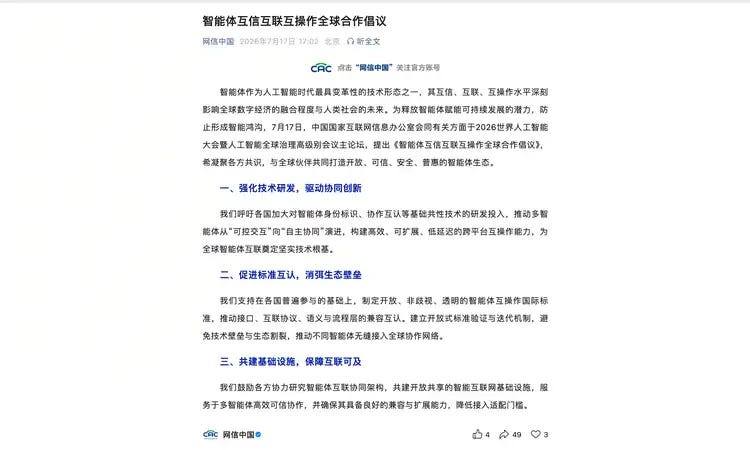
Global Cooperation Initiative on Agent Mutual Trust, Interconnection, and Interoperability
As one of the most transformative technological forms of the AI era, intelligent agents — and the degree to which they can mutually trust, interconnect, and interoperate — will profoundly shape the integration of the global digital economy and the future of human society. To unlock the potential of agents in enabling sustainable development and to prevent the emergence of an intelligence divide, on July 17, the Cyberspace Administration of China, together with relevant parties, put forward this Global Cooperation Initiative on Agent Mutual Trust, Interconnection, and Interoperability at the main forum of the 2026 World Artificial Intelligence Conference and High-Level Meeting on Global AI Governance. We hope to build broad consensus and work with global partners to foster an open, trustworthy, safe, and inclusive agent ecosystem.
I. Strengthen R&D to Drive Collaborative Innovation
We call on all countries to increase investment in foundational and shared technologies — including agent identity identification and collaborative mutual recognition — to drive the evolution of multi-agent systems from “controlled interaction” toward “autonomous collaboration,” and to build efficient, scalable, and low-latency cross-platform interoperability capabilities, laying a solid technological foundation for global agent interconnection.
II. Promote Standards Mutual Recognition to Eliminate Ecosystem Barriers
We support the development of open, non-discriminatory, and transparent international interoperability standards for agents on the basis of broad participation by all countries, advancing compatibility and mutual recognition at the interface, interconnection protocol, semantic, and process layers. We advocate establishing open standards validation and iteration mechanisms to avoid technical barriers and ecosystem fragmentation, enabling different agents to seamlessly join global collaborative networks.
III. Co-Build Infrastructure to Ensure Accessible Interconnection
We encourage all parties to jointly study architectures for agent interconnection and collaboration, to co-build open and shared smart internet infrastructure serving efficient and trustworthy multi-agent collaboration, and to ensure that such infrastructure has strong compatibility and scalability so as to lower the threshold for integration and adaptation.
IV. Jointly Advance Deployment to Accelerate Scenario Demonstrations
We advocate applying the outcomes of agent mutual trust, interconnection, and interoperability broadly to scientific research, industrial development, consumption stimulation, public welfare, and social governance, with priority given to addressing global challenges such as climate change, public health, educational equity, and poverty reduction — ensuring that the benefits accrue to humanity as a whole.
V. Promote Industrial Coordination to Cultivate a Thriving Global Ecosystem
We welcome broad participation from developed and developing countries, large enterprises and small and medium-sized businesses, research institutions and open-source communities in building agent mutual trust, interconnection, and interoperability. We encourage the wide dissemination of knowledge, technology, and best practices globally to form a global agent industrial chain.
VI. Collectively Uphold Safety Baselines and Adhere to Ethical Principles
We call on all parties to maintain a fundamental commitment to responsible innovation, to establish a safety governance framework covering the full lifecycle of agents, and to embed safety and ethical considerations into technology R&D, system deployment, and operation and maintenance. We emphasize the profound implications of agents for cybersecurity, and call for the responsible release and use of agents, ensuring that agent mutual trust, interconnection, and interoperability never crosses the red lines of safety and human dignity.
VII. Facilitate Data Flows While Strengthening Universal Protection
We call on all parties to respect differences in data security and personal information protection regimes across countries and regions, and to advocate for establishing a cross-border data cooperation framework based on openness, inclusiveness, security, cooperation, and non-discrimination, enabling data to flow safely, compliantly, and in an orderly manner throughout agent mutual trust, interconnection, and interoperability processes.
VIII. Enhance Resource Sharing to Bridge the Intelligence Divide
We encourage the provision to developing countries of infrastructure development support, open-source tools, capacity training, and financial and technical assistance needed for agent mutual trust, interconnection, and interoperability. We encourage the adoption of localized adaptation and capacity co-building approaches, and promote the formation of a new “South-South plus North-South” digital cooperation model so that the dividends of the intelligent economy are shared inclusively.
IX. Foster an Inclusive Culture and Respect Diverse Governance
We advocate cross-cultural, cross-linguistic, and interdisciplinary norms for agent collaboration, respect different countries’ governance models and value choices, and oppose unilateral imposition. We encourage broad participation by diverse stakeholders in rule discussions, to foster a global agent collaboration culture that balances efficiency with fairness, and flexibility with order.
X. Enhance Digital Literacy to Ensure Everyone Benefits
We will work together — through capacity building, technical assistance, and the opening of educational resources — to help minors, the elderly, persons with disabilities, and low-skill groups improve their AI literacy, ensuring that the outcomes of agent mutual trust, interconnection, and interoperability benefit all types of actors.
We uphold the principles of extensive consultation, joint contribution, and shared benefits, and sincerely invite all parties who share this vision to join us — with an open and inclusive mindset and prudent, practical action — in jointly advancing the development of the agent ecosystem and contributing wisdom and strength to the building of a community with a shared future in cyberspace.