

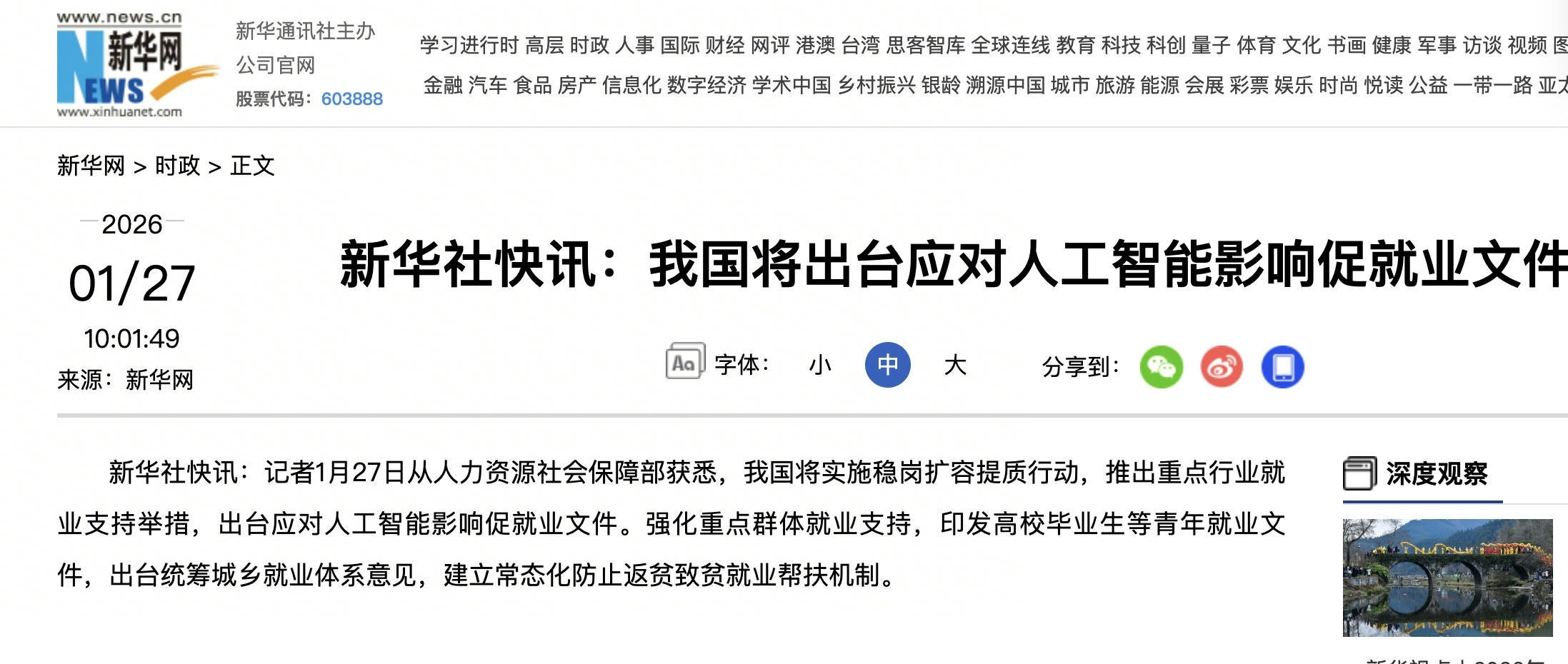
According to a January 2026 report by Xinhua News Agency, China’s Ministry of Human Resources and Social Security (MOHRSS) will release a dedicated policy document on “Responding to the Impact of AI on Employment.” The document will launch a “job stabilization, expansion, and quality enhancement initiative,” and introduce targeted employment support measures for key industries.
Earlier, in August 2025, China’s State Council issued the “Opinions on Deepening the Implementation of the ‘AI+’ Action Plan.” The document emphasized a dual-track approach of “advancing technological development while strengthening social safeguards.” It called for expanded AI skills training, stronger assessment of employment risks arising from AI applications, and guidance to steer innovation resources toward areas with higher job-creation potential in order to mitigate negative employment impacts. It also proposed exploring new organizational models based on human–machine collaboration, creating new forms of employment, and scientifically calibrating the level of automation in manufacturing to enhance employment stability and capacity.
As early as 2020, MOHRSS had already added occupations such as “AI training specialist” to China’s official catalogue of new professions, enabling local governments to implement skills certification and subsidy programs. The ministry has continued to update occupational classifications to reflect new jobs created by AI. For example, in May 2025, MOHRSS released a public consultation on 42 proposed new occupations, including “generative AI system tester” and “generative AI animation producer,” underscoring official recognition of human–AI collaborative roles.
Local governments have also responded actively. Since 2023, more than a dozen provinces and municipalities have issued AI-focused development action plans that explicitly incorporate employment-related responses. Some regions have gone further. In October 2025, Hunan Province released its implementation plan for the State Council’s “AI+” initiative, emphasizing employment risk assessments related to AI applications and guiding innovation resources toward job creation, with the explicit goal of “reducing the impact on employment.”
Meanwhile, Beijing’s 2025 labor arbitration authority published representative cases clarifying that an employer’s introduction of AI technology to replace certain roles does not constitute a “material change in objective circumstances,” thereby reinforcing protections for workers’ labor contract rights.
Against this backdrop, Chinese scholars and media have engaged in vigorous debate in recent years over whether AI will lead to large-scale unemployment and how severe its impact might be. Several distinct schools of thought have emerged:
“Severe and Inevitable Impact” View
Proponents of this view argue that AI-driven unemployment is not alarmist speculation and that its scale and severity require sober assessment and early intervention.
On November 14, Study Times published an article titled “Actively Responding to the Impact of Artificial Intelligence on Employment,” authored by a researcher from the Institute of Economic System and Management at the China Academy of Macroeconomic Research, a national-level think tank under the National Development and Reform Commission. The article stated clearly that AI’s impact on employment is “real and substantial.” It warned that generative AI, with its cognitive capabilities, will increasingly replace mental labor, meaning that not only manual workers but also white-collar professionals face job displacement. Ensuring employment stability, it argued, has become a central challenge for economic and social stability in the AI era.
Some economists have gone further, claiming that AI’s employment shock could be greater than that of the Industrial Revolution or any previous technological upheaval. Cai Fang, former vice president of the Chinese Academy of Social Sciences, has cautioned that what is currently visible may be “only the beginning,” with more intense impacts to come. He described a paradox in which AI, created by humans, generates unforeseen unemployment. Advocates of this view stress the need to take potential structural unemployment and widening inequality very seriously. Media outlets such as Economic Daily have echoed this warning, arguing that while technological progress is unstoppable, fairness and social protection are equally vital, and that “every job must retain its dignity” amid the AI wave.
“Substitution and Creation Coexist” View
This perspective rejects both exaggerated fears of mass job destruction and complacent reliance on market self-adjustment, arguing instead for active policy and training interventions.
Experts affiliated with MOHRSS note that the growth of new AI-related jobs could match or even exceed the number of jobs displaced, although the structure of employment will change. AI-driven industries are generating large numbers of roles in R&D, maintenance, and training, which may offset job losses in traditional sectors. The key issue, they argue, is timing. Historically, technological change has produced a lag between job destruction and job creation, but AI’s ability to accelerate industrial incubation may shorten this gap. With proper policy guidance, a dynamic balance—“break first, then build”—is achievable.
Business leaders have also voiced support for this view. JPMorgan Chase CEO Jamie Dimon has publicly rejected the “AI unemployment thesis,” arguing that AI will boost productivity and create new opportunities rather than cause sharp job losses. Some domestic technology optimists similarly point out that history shows new technologies ultimately expand net employment. They nonetheless acknowledge the need for government intervention to help workers transition smoothly.
“Human–Machine Collaboration and New Opportunities” View
Advocates of this approach argue that instead of worrying about AI taking jobs, societies should focus on training interdisciplinary “AI+” talent so workers who master AI tools can share in productivity gains and higher wages.
This view emphasizes changes in work paradigms, predicting that future jobs will increasingly be collaborative roles rather than purely human or fully automated ones. Scholars and policymakers, including National People’s Congress delegate and education expert Ye Meilan, argue that AI should be treated as an “empowerment tool” rather than a “replacement threat.” In practice, this means redesigning tasks so machines handle what they do best, while humans focus on creativity, judgment, and emotional interaction—achieving a “1+1>2” effect.
Cai Fang has articulated a similar vision: through task reconfiguration, robots take over repetitive work while humans move into more creative and decision-oriented roles; by extending value chains and lowering skill thresholds, more human–AI collaborative jobs can be created. This model—where AI does not replace humans but works alongside them—is widely viewed as an ideal path forward.
Industry observers note that since 2024, many Chinese tech firms have already introduced internal “human + AI” roles. Examples include “AI content editors” in the media sector and frontline manufacturing workers transitioning into “robotics engineering assistants.” Surveys by Time Weekly found that many companies now require job applicants to be proficient with AI tools, signaling a shift from traditional roles toward “AI+X” hybrid positions.
“Guard Against Widening Inequality” View
While opinions differ on AI’s net employment effects, many scholars share concerns that AI could exacerbate labor market polarization and inequality.
One issue is the digital divide. Official analyses warn that unequal access to infrastructure and training is amplifying labor market disparities: well-educated urban workers are more likely to access AI training and high-end jobs, while workers in less-developed regions or with lower education levels face higher risks of displacement, potentially widening income gaps. Another concern is the winner-takes-all effect, in which high-skilled AI specialists command soaring premiums while mid- and low-skilled workers become increasingly vulnerable.
Cai Fang has coined the term “AI divide” to describe the knowledge asymmetry between AI creators and potential users: while technical elites drive rapid advances, many traditional firms and workers struggle to keep pace. This risks concentrating technological dividends among a small minority. In response, policy discussions increasingly focus on ensuring that productivity gains are broadly shared. Proposals include institutional mechanisms to distribute productivity benefits—such as shorter working hours, expanded public service jobs (Baumol-style employment), training subsidies, job-transition funds, and stronger redistribution policies—to ensure that AI’s benefits help compensate those most affected.
Actively Responding to the Impact of Artificial Intelligence on Employment
Source: Study Times, November 14, 2025
Gong Piming (Institute of Economic System and Management, China Academy of Macroeconomic Research)The Fourth Plenary Session of the 20th CPC Central Committee emphasized the need to improve employment impact assessments and monitoring and early-warning mechanisms, and to comprehensively address the effects of changes in the external environment and new technologies on employment. As a strategic technology leading a new round of scientific and technological revolution and industrial transformation, artificial intelligence (AI) has deeply penetrated all areas of economic and social life, and its technological evolution is reshaping the structure of labor markets.
Unlike earlier forms of automation that were limited to standardized tasks, generative AI possesses cognitive capabilities such as understanding and reasoning. As a result, its impact on employment exhibits a dual effect of both substitution and job creation. Employment, as the foundation of people’s livelihoods, is directly linked to economic and social stability and long-term national governance. Therefore, scientifically assessing AI’s dual impact on employment, tapping its job-creation potential, guarding against substitution risks, and building precise and effective policy frameworks have become key issues in promoting high-quality and sufficient employment.
At present, AI technologies are reshaping employment structures across manufacturing, finance, logistics, education, healthcare, retail, and e-commerce with unprecedented depth and breadth, creating a complex landscape in which opportunities and challenges coexist. On the positive side, AI development has led to the rapid emergence of new occupations such as algorithm engineers, data analysts, cloud computing architects, and AI product managers. It has also fostered new forms of employment, including platform-based jobs and digital labor, while upgrading traditional roles in areas such as medical diagnosis and education through human–machine collaboration, significantly improving productivity and workplace safety.
The World Economic Forum’s Future of Jobs Report 2025 projects that by 2030, technological progress and macroeconomic changes will create 170 million jobs globally. This trend is already evident in China. In May 2025, the Ministry of Human Resources and Social Security (MOHRSS) released for public consultation a list of 42 proposed new occupations, including “generative AI system tester” and “generative AI animation producer.” MOHRSS reports that China faces a shortage of more than five million AI professionals, with a supply–demand ratio of 1:10, highlighting the enormous employment opportunities generated by rapid AI development.
At the same time, AI’s substitution effect on employment has begun to emerge locally and is showing signs of diffusion. Occupations with high AI exposure—such as assembly-line workers, software engineers, customer service representatives, clerical assistants, and junior accountants—are among the first to be affected, intensifying structural mismatches between labor supply and demand. The Future of Jobs Report 2025 also predicts that by 2030, up to 92 million jobs worldwide may be displaced. According to the International Federation of Robotics’ World Robotics Report 2025, global installations of industrial robots reached 542,000 units in 2024, more than double the level of a decade earlier.
As the scale and scope of “machine substitution” expand, employed workers face growing uncertainty regarding job adjustments and career prospects, posing significant challenges to employment stability. More concerning is the fact that substitution effects are spreading from low-skilled to mid- and high-skilled occupations. At the same time, unequal access to infrastructure and training resources has widened the digital divide, further amplifying the risk of labor market polarization.
China’s employment system and policy frameworks have lagged behind the rapid pace of AI development, making it difficult to respond proactively and effectively to the systemic reshaping of the employment ecosystem brought about by AI. First, relevant laws and regulations have not kept pace. In the face of new forms of employment such as platform-based work and digital labor, traditional standards for defining labor relations have become blurred, leaving gaps in workers’ protection regarding social security and occupational safety. Moreover, the widespread use of algorithmic management has raised concerns over work intensity and fairness in performance evaluation, yet corresponding legal regulations remain insufficient.
Second, mechanisms for comprehensive employment risk governance remain weak. Systems for monitoring, assessment, early warning, and rapid response to risks such as job displacement and skill obsolescence caused by AI are not yet well established, and cross-departmental coordination mechanisms are incomplete, limiting early intervention in structural unemployment risks. Third, education and training systems are misaligned with the speed of AI technological iteration. Curricula updates are slow, vocational training lacks sufficient coverage and targeting, and lifelong learning systems have yet to be effectively established, leading to mismatches between workers’ skills and market demand.
Notably, the Opinions of the State Council on Deepening the Implementation of the “AI+” Action Plan, issued in August 2025, explicitly called for leveraging AI to create new jobs and empower traditional ones, providing important guidance for improving future policy frameworks. Going forward, it is necessary to balance development and security, seek equilibrium between technological innovation and social tolerance, improve policies addressing AI’s employment impact, and promote coordinated progress between AI development and high-quality employment.
To unleash AI’s job-creation potential, new growth models and drivers for employment should be explored. Priority should be given to fostering emerging industries such as AI and robotics manufacturing through increased investment support, R&D incentives, and tax benefits, thereby stimulating corporate innovation and expanding employment opportunities. The “AI+” action plan should be implemented in depth, advancing innovation in application models and scenarios across industry development, consumption upgrading, and public welfare, while supporting enterprises in developing new products and business formats using AI technologies. Industrial transformation toward human–machine collaboration should be actively guided, and the level of automation in manufacturing should be scientifically calibrated to enhance employment stability and capacity.
Legal and institutional frameworks must also be strengthened to create an employment-friendly development environment. Relevant laws and regulations should be revised to clarify standards for recognizing new forms of labor relations and to strengthen protection of workers’ rights under platform employment and algorithmic management. A sound regulatory framework for AI should be established to prevent issues such as digital divides and algorithmic discrimination. Enterprises should be encouraged to explore more reasonable work systems in the AI era. Labor dispute mediation mechanisms should be improved to resolve conflicts in a timely manner, while social security systems should be optimized to better cover flexible workers. Targeted employment transition assistance programs—including training subsidies and reemployment incentives—should be implemented to support displaced workers.
Finally, employment risk response mechanisms should be improved and better aligned with industrial development strategies. An AI employment impact monitoring platform should be built, with systems for tracking, forecasting, early warning, and cross-departmental coordination. Employment impact indicators should assess effects across regions, industries, and occupations, enabling early identification and mitigation of substitution risks through subsidies, assistance, and training. Education and training systems should be modernized to ensure dynamic talent supply, including curriculum optimization in universities, closer school–enterprise collaboration, expanded vocational training, and the establishment of a national lifelong skills account system with micro-credentials and credit banks to better link learning, certification, and employment.