

In many countries, people are already on their International Workers’ Day holiday. But officials at China’s MOFCOM, are still busy — busy enough to give up part of their break.
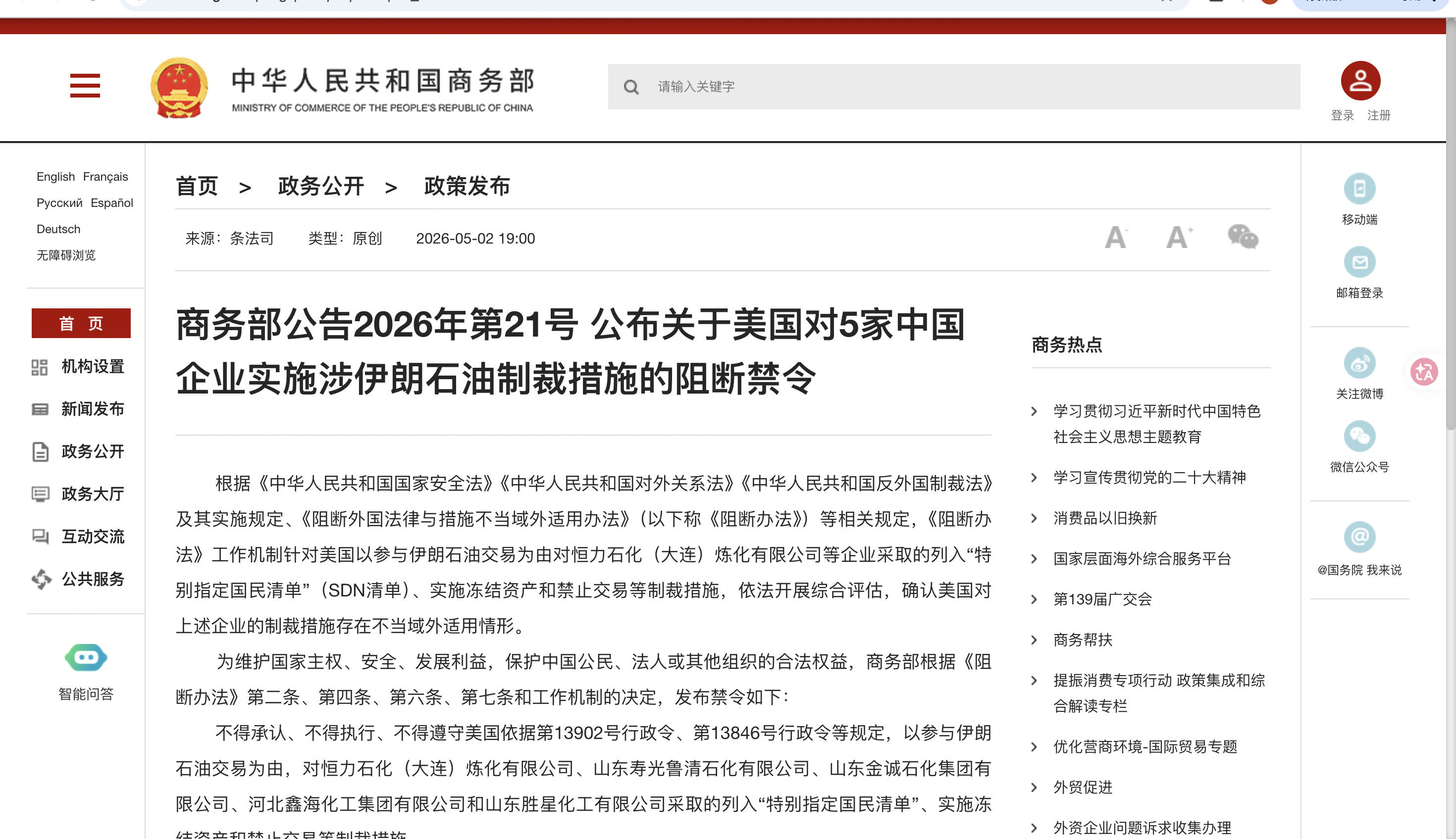
On May 2, MOFCOM issued a prohibition order under China’s Rules on Counteracting Unjustified Extra-territorial Application of Foreign Legislation and Other Measures. The order says that no individual or entity may implement the U.S. Treasury sanctions against Hengli Petrochemical (Dalian) Refining Co., Ltd. and several other Chinese companies.
On April 24, 2026, the U.S. Treasury Department’s Office of Foreign Assets Control, or OFAC, announced that it had added Hengli Petrochemical (Dalian) Refining Co., Ltd. to the SDN List. The Treasury described Hengli as one of China’s “teapot refineries” and a major buyer of Iranian crude oil and petroleum products, allegedly purchasing billions of dollars’ worth of Iranian oil. The U.S. also sanctioned around 40 shipping companies and vessels, saying they were part of Iran’s “shadow fleet” network.
The legal basis for this action was Executive Order 13902, issued in January 2020 during Trump’s first term. That order authorizes sanctions against additional sectors of the Iranian economy, including oil, petrochemicals, metals and construction. OFAC said the move was part of the Trump administration’s “maximum pressure” campaign against Iran, aimed at cutting off Tehran’s oil revenues.
Once Hengli Petrochemical (Dalian) Refining Co., Ltd. was added to the SDN List, the legal consequences under U.S. law were clear: any property or interests in property within the United States, or controlled by U.S. persons, must be blocked; U.S. persons are generally prohibited from dealing with the company; and non-U.S. parties may also face secondary sanctions risks if they continue to engage in significant transactions with it.
OFAC’s SDN update page listed Hengli Petrochemical (Dalian) Refining Co., Ltd.’s name, address, website, date of establishment, registration number and unified social credit code, with the sanctions tag [IRAN-EO13902].
This is also the first time China has actually used the Blocking Rules and issued a concrete prohibition order since the rules were released and came into force on January 9, 2021.
According to the relevant provisions of the National Security Law of the People’s Republic of China, the Law of the People’s Republic of China on Foreign Relations, the Anti-Foreign Sanctions Law of the People’s Republic of China and its implementing provisions, and the Rules on Counteracting Unjustified Extra-territorial Application of Foreign Legislation and Other Measures (hereinafter referred to as the “Blocking Rules”), the working mechanism under the Blocking Rules has conducted a comprehensive assessment, in accordance with the law, of the U.S. sanctions measures imposed on Hengli Petrochemical (Dalian) Refining Co., Ltd. and other enterprises on the grounds of their alleged participation in Iranian oil transactions, including their inclusion on the “Specially Designated Nationals List” (SDN List), asset freezes and transaction prohibitions. The assessment confirms that the U.S. sanctions measures against the above-mentioned enterprises constitute unjustified extra-territorial application.
In order to safeguard national sovereignty, security and development interests, and to protect the legitimate rights and interests of Chinese citizens, legal persons or other organizations, MOFCOM, pursuant to Articles 2, 4, 6 and 7 of the Blocking Rules and the decision of the working mechanism, hereby issues the following prohibition order:
The sanctions measures taken by the United States pursuant to Executive Order 13902, Executive Order 13846 and other provisions, on the grounds of participation in Iranian oil transactions, against Hengli Petrochemical (Dalian) Refining Co., Ltd., Shandong Shouguang Luqing Petrochemical Co., Ltd., Shandong Jincheng Petrochemical Group Co., Ltd., Hebei Xinhai Chemical Group Co., Ltd. and Shandong Shengxing Chemical Co., Ltd., including their inclusion on the “Specially Designated Nationals List,” asset freezes and transaction prohibitions, shall not be recognized, enforced or observed.
This prohibition order shall come into force as of the date of publication.
Ministry of Commerce
May 2, 2026
MOFCOM later also stressed through a spokesperson that it will continue to closely monitor the unjustified extra-territorial application of foreign laws and measures. Where circumstances covered by the Blocking Rules arise, MOFCOM will take relevant actions in accordance with the law.
Question: On May 2, 2026, MOFCOM issued a prohibition order to block the U.S. sanctions imposed on five Chinese companies — Hengli Petrochemical (Dalian) Refining Co., Ltd., Shandong Shouguang Luqing Petrochemical Co., Ltd., Shandong Jincheng Petrochemical Group Co., Ltd., Hebei Xinhai Chemical Group Co., Ltd. and Shandong Shengxing Chemical Co., Ltd. — on the grounds of their participation in Iranian oil transactions, including their inclusion on the “Specially Designated Nationals List” (SDN List), asset freezes and transaction prohibitions. What are the considerations behind this move?
Answer: Since 2025, the United States has, pursuant to its executive orders sanctioning other countries, placed Chinese companies including Hengli Petrochemical (Dalian) Refining Co., Ltd., Shandong Shouguang Luqing Petrochemical Co., Ltd., Shandong Jincheng Petrochemical Group Co., Ltd., Hebei Xinhai Chemical Group Co., Ltd. and Shandong Shengxing Chemical Co., Ltd. on the “Specially Designated Nationals List” (SDN List), and imposed sanctions measures such as asset freezes and transaction prohibitions, on the grounds of their participation in Iranian oil transactions. These measures improperly prohibit or restrict Chinese companies from carrying out normal economic and trade activities and related activities with third countries (regions) and their citizens, legal persons or other organizations, and violate international law and the basic norms governing international relations.
In order to safeguard national sovereignty, security and development interests, and to protect the legitimate rights and interests of Chinese citizens, legal persons or other organizations, MOFCOM, in accordance with the Rules on Counteracting Unjustified Extra-territorial Application of Foreign Legislation and Other Measures and based on the assessment results of the relevant working mechanism, issued a prohibition order providing that the U.S. sanctions measures against the above-mentioned five Chinese companies shall not be recognized, enforced or observed.
The Chinese government has always opposed unilateral sanctions that lack authorization from the United Nations and have no basis in international law. The issuance of this prohibition order is a concrete action to implement the Rules on Counteracting Unjustified Extra-territorial Application of Foreign Legislation and Other Measures in accordance with the law. It does not affect China’s assumption and performance of its international obligations, nor does it affect China’s lawful protection of the legitimate rights and interests of foreign-invested enterprises. MOFCOM will continue to closely monitor the unjustified extra-territorial application of relevant countries’ laws and measures. Where circumstances provided for in the Rules on Counteracting Unjustified Extra-territorial Application of Foreign Legislation and Other Measures arise, relevant work will be carried out in accordance with the law.
The Blocking Rules were issued and came into force on January 9, 2021. The immediate background was the growing use by the United States and some other countries of unilateral sanctions, export controls and long-arm jurisdiction. These measures do not just bind their own companies. Through so-called secondary sanctions, they also pressure companies in third countries to comply.
At the time, MOFCOM’s Department of Treaty and Law explained that some countries not only prohibit their own persons from doing business with certain countries, but also “coerce enterprises and individuals of other countries into stopping economic and trade activities with relevant countries.” In China’s view, this violates principles such as sovereign equality and harms the normal commercial dealings of Chinese companies.
Imagine this: a Chinese company can lawfully do business with Iran, Russia, Cuba or another third-country counterparty, but the U.S. says, “No — if you do that, we will sanction you too.” Or a multinational company operating in China has a contract with a Chinese company, but because it fears U.S. sanctions, it unilaterally stops supplying goods, making payments, providing shipping, insurance or settlement services. China’s view is that this is not just a business choice. It is foreign law improperly interfering with China’s normal economic and trade order.
In terms of design, China drew on the experience of blocking statutes in places such as the European Union. MOFCOM also noted that the United Nations and some countries and regions have long opposed unilateral laws and measures with extra-territorial effect, and have adopted legislation to refuse recognition of such foreign measures.
Article 2 of the Blocking Rules says the rules apply where foreign laws or measures violate international law and basic norms of international relations, and improperly prohibit or restrict Chinese citizens, legal persons or other organizations from conducting normal economic and trade activities with third countries, regions and their parties.
There are several key points here.
First, the target is “foreign laws and measures.” This does not only mean formal statutes. It may also include executive orders, sanctions lists and regulatory measures.
Second, the focus is “unjustified extra-territorial application.” In other words, the foreign country is not simply regulating people and conduct within its own jurisdiction. It is trying to extend the effect of its domestic law to transactions between Chinese parties and third-country parties.
Third, the rules protect the normal commercial activities of “Chinese citizens, legal persons or other organizations.” This can include not only Chinese domestic companies, but also foreign-invested enterprises lawfully established in China.
Fourth, the rules generally do not apply where China is carrying out its obligations under international treaties. If a restriction comes from, for example, a UN Security Council sanctions regime, then it is not the kind of measure the Blocking Rules are meant to block.
The core mechanism of the Blocking Rules can be summarized in five steps.
First, companies must report. If a Chinese citizen, legal person or other organization is prohibited or restricted by a foreign law or measure from carrying out normal business with a third country, it should report the matter to MOFCOM within 30 days. MOFCOM officials are required to keep confidential any matters the reporting party asks to be kept confidential.
Second, the working mechanism conducts an assessment. China has established a working mechanism involving relevant central government departments, led by MOFCOM. MOFCOM and the National Development and Reform Commission, together with other departments, handle the specific work. This mechanism assesses whether the foreign law or measure amounts to unjustified extra-territorial application. The factors include whether it violates international law and basic norms of international relations, whether it affects China’s sovereignty, security and development interests, whether it affects the legitimate rights and interests of Chinese parties, and any other relevant factors.
Third, MOFCOM may issue a prohibition order. If the working mechanism confirms that the foreign law or measure involves unjustified extra-territorial application, it may decide that MOFCOM should issue a prohibition order. The key phrase is that the relevant foreign law or measure must not be recognized, enforced or observed.
This is the most important tool under the Blocking Rules. It is not just a declaration that “China opposes U.S. sanctions.” It creates a legal obligation under Chinese law: companies cannot stop normal transactions with the relevant Chinese companies or third-country parties simply because of an unjustified foreign sanctions measure.
Fourth, parties may apply for an exemption. In practice, companies may face a real compliance conflict: if they do not follow U.S. sanctions, they may be punished by the U.S.; if they do follow U.S. sanctions, they may violate China’s prohibition order. The Blocking Rules therefore allow Chinese parties to apply to MOFCOM for an exemption from compliance with the prohibition order. MOFCOM should generally make a decision within 30 days after accepting the application, or more quickly in urgent cases.
Fifth, injured parties may sue for compensation. If a party follows a foreign law or measure that falls within the scope of a prohibition order and causes losses to a Chinese party, the injured party may bring a lawsuit in a Chinese court and seek compensation. For example, if a multinational company terminates a contract with a Chinese company because of U.S. sanctions, and those sanctions have been blocked by a MOFCOM prohibition order, the injured Chinese company may in theory sue in a Chinese court for damages.
In addition, if a foreign court issues a judgment or ruling based on the blocked foreign law or measure, and this causes losses to a Chinese party, the Chinese party may also sue in a Chinese court for compensation from the party that benefited from that foreign judgment or ruling.
The Blocking Rules are often confused with China’s other counter-sanctions tools, but they work differently.
The Unreliable Entity List is mainly used to blacklist foreign entities that harm the legitimate rights and interests of Chinese companies or endanger China’s sovereignty, security or development interests. The measures may include restrictions on imports and exports, investment restrictions and entry bans. In simple terms, it is about naming and punishing a specific foreign entity.
The Anti-Foreign Sanctions Law mainly targets foreign individuals and organizations that participate in, formulate or implement discriminatory restrictive measures against China. Countermeasures may include asset freezes, transaction bans and entry restrictions. It is more like China’s basic counter-sanctions law.
The focus of the Blocking Rules is not to directly sanction a specific U.S. entity or individual, but to block the transmission of foreign sanctions into China’s legal system. In other words, it primarily targets third parties that comply with foreign sanctions.
For example, when the U.S. sanctions a Chinese company, European brands, international banks, insurers, shipping companies, or downstream firms operating within China’s jurisdiction may stop doing business with it out of fear of U.S. secondary sanctions. Once MOFCOM issues a prohibition order, however, these parties could face legal risks under Chinese law if they continue to comply with the U.S. sanctions.
Even for foreign companies with independent legal personality and no direct jurisdictional link to China, Chinese authorities could, in theory, argue that parent and subsidiary entities—whether onshore or offshore—are subject to unified control or have commingled operations, thereby “piercing the corporate veil.”
In addition, Article 9 of the Blocking Rules provides a right to claim damages but does not explicitly limit eligible defendants to entities within China. Since the place where the harm occurs is in China, Chinese courts could arguably assert jurisdiction over purely foreign entities under the foreign-related provisions of the Civil Procedure Law and initiate proceedings.The broader point of the Blocking Rules is to change the transmission mechanism of U.S. secondary sanctions.
Without a blocking mechanism, U.S. sanctions often create a chilling effect. Even if a sanction does not directly bind a transaction inside China, banks, insurers, logistics providers, customers and suppliers may still cut ties out of fear of U.S. penalties. In that way, the U.S. does not need to punish every company directly. Market fear does the work for it.
The Blocking Rules are meant to tell market players that complying with unjustified U.S. extra-territorial sanctions is not necessarily the “safe” option. It may put them in breach of a Chinese prohibition order and expose them to administrative, civil or even countermeasure risks in China. What used to be a simple compliance question — “Should we follow the U.S. sanctions?” — becomes a much more complicated conflict-of-laws problem between China and the United States.
According to Reuters, the U.S. sanctions on Hengli mark a clear escalation in Washington’s campaign against Iranian oil exports. The reason is that Hengli is not a small refinery or a peripheral logistics node. It operates a roughly 400,000-barrel-per-day refining and petrochemical complex on Changxing Island in Dalian, making it one of the largest Chinese refiners targeted by the U.S. since Washington resumed its crackdown on Iranian oil exports in 2019.
Previously, U.S. sanctions related to China’s Iran oil trade focused more on smaller independent refineries, import terminals, logistics companies and vessels. This time, Washington went after a major private-sector refining and petrochemical champion. The impact is therefore much broader, and it is much more likely to trigger over-compliance and risk avoidance by banks, traders, insurers, shipping companies and downstream customers.
The U.S. Treasury’s allegations mainly have three parts.
First, it says Hengli is one of China’s largest independent refineries and plays an important role in Iran’s oil export system. According to the U.S., Chinese independent refiners buy most of Iran’s crude oil and provide a key source of revenue for the Iranian government and armed forces.
Second, the U.S. says Hengli has received Iranian oil products since at least 2023, including cargoes delivered by sanctioned “shadow fleet” vessels. Treasury specifically named vessels such as BIG MAG, GALE and ARES, saying they delivered more than five million barrels of Iranian crude oil to Hengli.
Third, the U.S. also alleges that part of the Iranian crude purchased by Hengli was linked to Sepehr Energy Jahan Nama Pars Company, an oil sales company affiliated with Iran’s Armed Forces General Staff, generating hundreds of millions of dollars for Iran’s military.
Hengli Petrochemical later denied having any trade with Iran. In a stock exchange filing, the company said it had “never had any trade dealings with Iran since its establishment,” and that all of its crude suppliers had guaranteed that the crude they supplied did not come from sources subject to U.S. sanctions. The company also said it had sufficient crude inventory to support more than three months of processing, that its crude procurement had not been affected, and that the U.S. sanctions lacked factual and legal basis. It said it would seek to have the restrictions removed.
According to reports, after the sanctions were announced, Hengli Petrochemical’s share price at one point fell by 10%. Hengli Group also adjusted the ownership structure of its Singapore trading arm, Hengli Petrochemical International, reducing the sanctioned entity’s stake from 100% to 5%, with the remaining shares transferred to Chinese local government entities. Some traders, however, questioned whether this restructuring would be enough to reassure counterparties.
Once the U.S. added these companies to the SDN List, the real shock was not limited to the companies themselves. The bigger issue was that upstream and downstream customers, banks, insurers, logistics providers, multinational brands and domestic partners might all cut ties out of fear of secondary sanctions. China’s prohibition order is meant to stop that fear from spreading through the industrial chain.
MOFCOM’s order immediately puts multinational companies in China — especially financial institutions, shipping and logistics firms, and international trading companies — in a classic Catch-22.
If foreign banks such as Citi or HSBC’s China branches, or Chinese banks with international exposure, continue to implement the U.S. SDN sanctions by refusing to provide settlement services to the five sanctioned refiners or by freezing their accounts, they may directly violate MOFCOM’s “non-observance” order.
Under Article 9 of the Blocking Rules, these five sanctioned Chinese refiners now have a clearer legal basis to sue multinational companies or financial institutions in Chinese courts if those parties refuse to deal with them because they are complying with U.S. sanctions, and to seek compensation for economic losses.
By activating the Blocking Rules, Beijing is sending Washington a clear message: China has tools to make U.S. sanctions harder to implement on the ground.
The strategic shift is clear. It is the beginning of a more contested compliance world. For multinational companies, the old safest answer was simple: comply with Washington first. The new reality is more complicated: complying with Washington may now create exposure in China. That is the real significance of China’s blocking law. It turns U.S. sanctions from a one-way command into a two-system legal conflict.
This is to induce those companies to "choose the lesser of two evils".