

According to the countervailing investigation determination published by MOFCOM, EU agricultural subsidies were found to affect export prices through transmission along the industrial chain, thereby constituting a subsidy; the Chinese domestic industry was determined to have suffered material injury; and a causal link was found between the two. On this basis, the countervailing measures were considered legally and economically justified. The reasoning can be broken down as follows:
MOFCOM determined that under the framework of the EU’s Common Agricultural Policy (CAP), a range of measures—including direct payments, green subsidies, young farmer payments, redistributive payments, and support for agricultural processing investment—provided specific financial contributions to the dairy industry chain. Although these subsidies were primarily granted to upstream dairy farmers, the investigating authority found that the support did not remain confined to the agricultural segment. Instead, through raw milk pricing mechanisms, the benefits were transmitted downstream to processing enterprises, conferring a substantive benefit on dairy product manufacturers. In other words, although nominally framed as agricultural income support, the effects of the subsidies extended to exported dairy products.
With respect to injury determination, the ruling noted that during the investigation period, although domestic demand for relevant dairy products in China experienced some growth, the operating conditions of the domestic industry continued to deteriorate. Capacity utilization remained at a relatively low level; product prices declined; profits turned from positive to negative; inventories increased; cash flow came under pressure; and returns on investment became negative. In short, while the industry’s scale did not significantly contract, its profitability was clearly weakened. MOFCOM therefore concluded that the continued importation of subsidized EU products exerted price suppression and price depression effects on domestic products and was an important cause of the material injury suffered by the domestic industry. The three legal elements—subsidy, injury, and causal link—were all found to be satisfied.
At the enterprise level, the determination assigned specific duty rates to several sampled companies. Elle & Vire of France and its affiliated companies, FrieslandCampina of the Netherlands and Belgium and its affiliates, and Skånemejerier (Skånda) were selected as key sampled entities and were each assigned different subsidy rates. In addition, a number of European dairy companies participated in the investigation proceedings, including Arla of Denmark; BEL and Savencia of France; DMK of Germany; Milcobel of Belgium; and Lakeland of Ireland. These companies submitted questionnaire responses, attended hearings, or applied for price undertakings, and were therefore affected by the case to varying degrees.
From a broader perspective, the significance of this determination extends beyond a single product. At the legal level, it affirms an important logic: although EU agricultural subsidies are formally structured as income support to farmers, they may be recognized as indirect subsidies to downstream processed products and thus be subject to countervailing duties under the trade remedies framework.
This represents a direct challenge to the EU’s long-standing reliance on so-called “green box” or income-support measures within its agricultural policy. For the Chinese market, the ruling will raise the import costs of certain EU dairy products, potentially creating some room for price recovery for domestic producers, while at the same time possibly increasing cost pressures for downstream sectors such as high-end cheese, baking, and catering.
The above measure is under the background of the new round of tension in China-EU relations.
Not long ago, the European Commission formally introduced a revised draft of its Cybersecurity Act. Its core message can be summarized in one sentence: in critical sectors, equipment and components from “high-risk suppliers” must be gradually phased out. The key difference from the past is that what was previously framed as a recommendation not to use such suppliers has now become a legal requirement. Although no specific companies were named, it is widely understood that the term “high-risk suppliers” primarily alludes to Chinese enterprises. This development has drawn significant attention in China and is viewed as another negative move by the EU toward China.
At the same time, the EU has increasingly relied on its Foreign Subsidies Regulation (FSR) to initiate investigations against Chinese companies, and has upgraded probes into wind power and security screening equipment firms to in-depth investigations. In addition, the EU has intensively rolled out legislative proposals and implementing rules related to the Carbon Border Adjustment Mechanism (CBAM), including setting default carbon intensity values and planning to expand product coverage. From China’s perspective, the EU has disregarded the substantial progress China has made in green and low-carbon development, setting significantly elevated default carbon intensity benchmarks for Chinese products and planning to increase them annually over the next three years. The EU has also proposed legislation to expand the scope of CBAM from 2028 onward to cover approximately 180 downstream steel- and aluminum-intensive products, including machinery, automobiles and auto parts, and household appliances; and to amend the 2035 ban on new internal combustion engine vehicles, effectively relaxing certain green regulatory requirements within the EU.
China considers these measures to be clearly targeted and discriminatory, and a spokesperson for the Ministry of Commerce has expressed strong dissatisfaction with them.
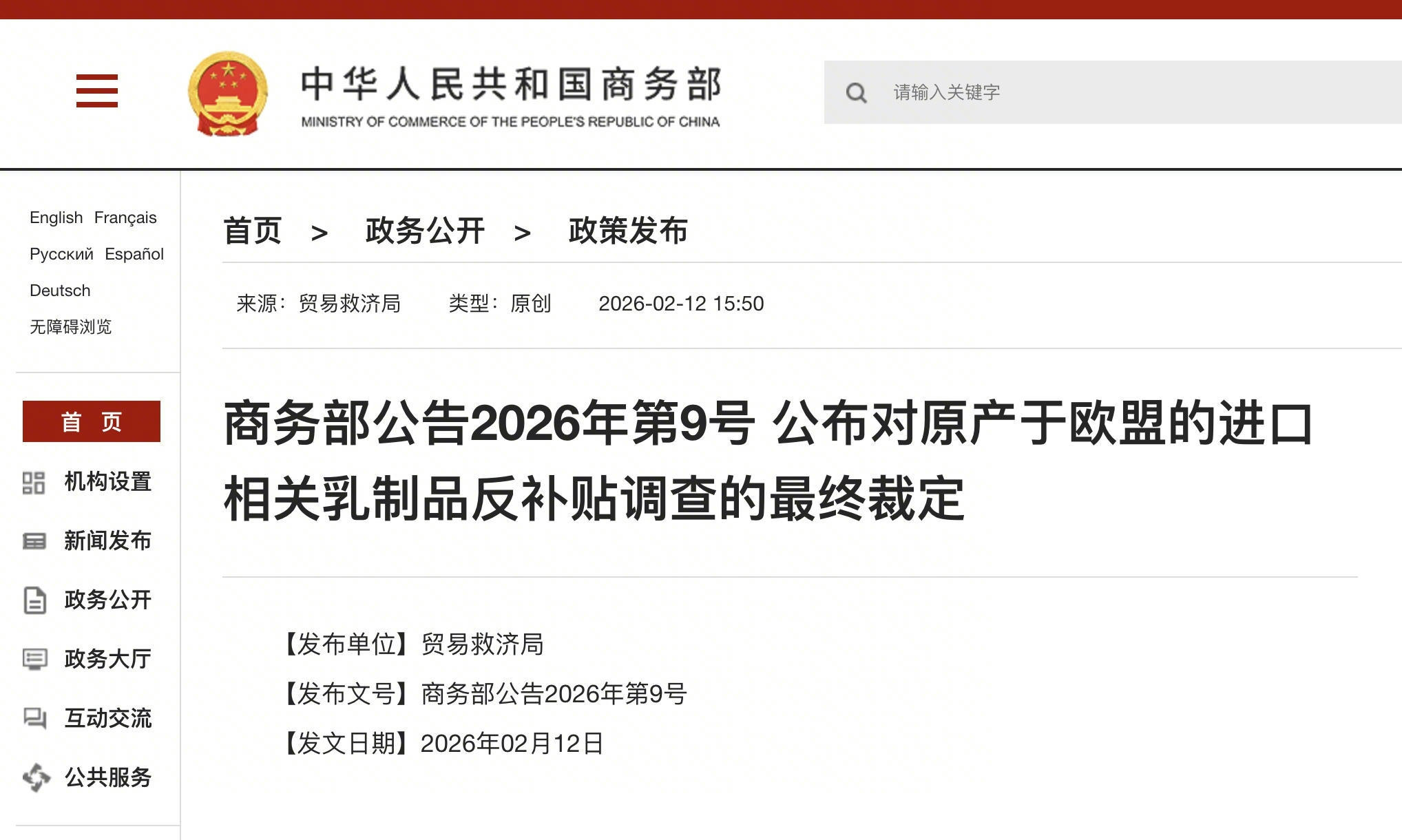
Announcement No. 9 of 2026 of the Ministry of Commerce
Final Determination in the Countervailing Investigation on Certain Dairy Products Imported from the European UnionAccording to the Regulations of the People’s Republic of China on Countervailing Measures (hereinafter, the “Countervailing Regulations”), on August 21, 2024, the Ministry of Commerce (the “investigating authority”) issued Announcement No. 34 of 2024, deciding to initiate a countervailing investigation into certain dairy products imported from the European Union (hereinafter, the “products under investigation”).
The investigating authority examined whether the products under investigation were subsidized and the amount of any subsidies; whether the products under investigation caused injury to the domestic industry and the degree of such injury; and the causal link between the subsidies and the injury. Based on the findings and pursuant to Article 25 of the Countervailing Regulations, the investigating authority issued a preliminary determination on December 22, 2025, finding that the products under investigation were subsidized, that the relevant domestic dairy industry in China had suffered material injury, and that there was a causal relationship between the subsidies and the material injury.
Following the preliminary determination, the investigating authority continued its investigation into the subsidies and subsidy amounts, injury and the degree of injury, and the causal relationship between the subsidies and the injury. The investigation has now concluded. Based on the findings, and pursuant to Article 26 of the Countervailing Regulations, the investigating authority has made a final determination (see Annex 1). The relevant matters are hereby announced as follows:
I. Final Determination
The investigating authority has finally determined that certain dairy products imported from the European Union are subsidized, that the relevant domestic dairy industry in China has suffered material injury, and that there is a causal relationship between the subsidies and the material injury.
II. Countervailing Measures
Pursuant to Article 39 of the Countervailing Regulations, the Ministry of Commerce has submitted to the Customs Tariff Commission of the State Council a recommendation to impose countervailing duties on certain dairy products imported from the European Union. The Customs Tariff Commission of the State Council has decided, based on the Ministry of Commerce’s recommendation, that countervailing duties will be imposed on certain dairy products imported from the European Union as of February 13, 2026.
The products under investigation are described as follows:
Scope of investigation: Certain dairy products imported from the European Union.
Name of products under investigation: Certain dairy products.
English name: Certain dairy products.
Product description: The products under investigation specifically include fresh cheese (including whey cheese) and curd; processed cheese (whether or not grated or powdered); blue-veined cheese and other cheeses with veining produced by Penicillium roqueforti; other cheeses not elsewhere specified; and milk and cream, not concentrated and not containing added sugar or other sweetening matter, with a fat content by weight exceeding 10%.
Main use: Mainly for direct human consumption as food, either as-is or after processing.
HS codes under the Customs Import and Export Tariff of the People’s Republic of China: 04015000, 04061000, 04062000, 04063000, 04064000, 04069000.
The countervailing duty rates applicable to EU companies are set out in Annex 2 to this Announcement.
III. Method of Collection of Countervailing Duties
As of February 13, 2026, importers, when importing certain dairy products originating in the European Union, shall pay the corresponding countervailing duties to China Customs. Countervailing duties shall be levied ad valorem on the dutiable value of the imported goods as determined by Customs, calculated as follows:
Countervailing duty payable = dutiable value as determined by Customs × countervailing duty rate.
Import VAT shall be levied ad valorem on the taxable base consisting of the dutiable value as determined by Customs plus customs duties and countervailing duties.
IV. Retroactive Collection of Countervailing Duties
With respect to the provisional countervailing duty deposits provided by relevant importers to China Customs pursuant to the preliminary determination for imports made from December 23, 2025 to February 12, 2026, countervailing duties shall be assessed and converted from such deposits based on the product scope and countervailing duty rates as determined in the final determination, and import VAT shall be assessed at the applicable VAT rate. Any portion of the provisional deposits exceeding the countervailing duties, as well as any resulting overpaid import VAT, shall be refunded by Customs; any shortfall shall not be collected.
No countervailing duties shall be collected retroactively on certain dairy products originating in the European Union that were imported prior to the implementation of the provisional countervailing measures.
V. Duration of Collection of Countervailing Duties
The countervailing duties on certain dairy products imported from the European Union shall be imposed for a period of five (5) years starting from February 13, 2026.
VI. Review
During the period in which countervailing duties are imposed, interested parties may apply to the investigating authority for a review in accordance with the relevant provisions of the Countervailing Regulations.
VII. Administrative Reconsideration and Administrative Litigation
If any party is dissatisfied with the final determination in this case and the decision to impose countervailing duties, it may, pursuant to Article 52 of the Countervailing Regulations, apply for administrative reconsideration in accordance with law, or file an administrative lawsuit with a people’s court in accordance with law.
VIII. Effective Date
This Announcement shall take effect as of February 13, 2026.