

Ahead of President Xi Jinping’s visit to the United States, China has taken further steps to combat drug-related crimes.
The measures strengthen China’s controls at two different levels: the first expands class-wide scheduling to another family of emerging synthetic opioids, while the second creates more detailed criminal enforcement, prosecution, sentencing, evidence and international cooperation rules specifically for fentanyl-related crimes.
1/ China has placed orphine-type substances under class-wide control.
The Ministry of Public Security, National Health Commission, and National Medical Products Administration issued a joint announcement placing orphine-type substances as an entire class under control. With this latest step, China has now introduced class-wide controls covering the three major groups of synthetic opioids that have been a focus of emerging-drug regulation: fentanyl-related substances in 2019, nitazene-type substances in 2025, and now orphine-type substances in 2026.
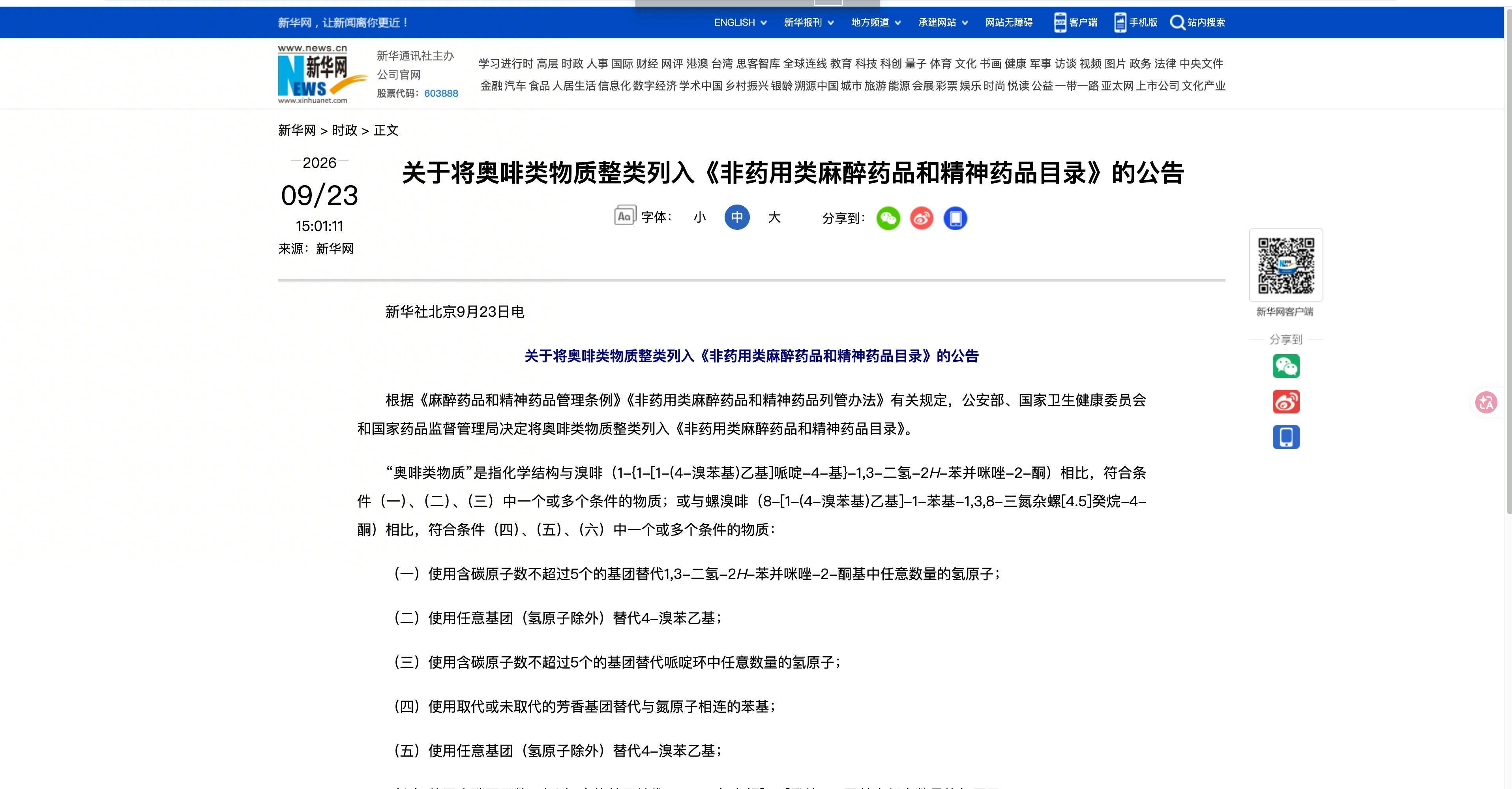
Announcement on the Class-Wide Scheduling of Orphine-Type Substances in the Catalogue of Non-Medical Narcotic Drugs and Psychotropic Substances
Xinhua, Beijing, September 23
Pursuant to the Regulations on the Administration of Narcotic Drugs and Psychotropic Substances and the Measures for the Scheduling of Non-Medical Narcotic Drugs and Psychotropic Substances, the Ministry of Public Security, the National Health Commission, and the National Medical Products Administration have decided to place orphine-type substances as a class in the Catalogue of Non-Medical Narcotic Drugs and Psychotropic Substances.
“Orphine-type substances” refers to substances whose chemical structures, compared with brorphine (1-{1-[1-(4-bromophenyl)ethyl]piperidin-4-yl}-1,3-dihydro-2H-benzimidazol-2-one), meet one or more of conditions (1), (2), and (3) below; or whose chemical structures, compared with spirobrorphine (8-[1-(4-bromophenyl)ethyl]-1-phenyl-1,3,8-triazaspiro[4.5]decan-4-one), meet one or more of conditions (4), (5), and (6):
(1) substitution of any number of hydrogen atoms in the 1,3-dihydro-2H-benzimidazol-2-one group with groups containing no more than five carbon atoms;
(2) substitution of the 4-bromophenethyl group with any group other than a hydrogen atom;
(3) substitution of any number of hydrogen atoms in the piperidine ring with groups containing no more than five carbon atoms;
(4) substitution of the phenyl group attached to the nitrogen atom with a substituted or unsubstituted aromatic group;
(5) substitution of the 4-bromophenethyl group with any group other than a hydrogen atom;
(6) substitution of any number of hydrogen atoms in the 1,3,8-triazaspiro[4.5]decan-4-one group with groups containing no more than five carbon atoms.
If any of the substances covered above are subsequently found to have legitimate medical, industrial, scientific research, or other lawful uses, their regulatory status may be adjusted pursuant to Article 3, paragraph 2 of the Measures for the Scheduling of Non-Medical Narcotic Drugs and Psychotropic Substances.
The announcement will take effect on October 1, 2026.
Ministry of Public Security
National Health Commission
National Medical Products AdministrationSeptember 23, 2026
Opioids are substances that act on opioid receptors in the human body. They include naturally derived substances such as morphine and codeine, as well as semi-synthetic and fully synthetic substances such as heroin, oxycodone, and fentanyl. Some have legitimate medical uses as analgesics or anesthetics, but misuse can lead to dependence, while overdose can cause respiratory depression and death.
Fentanyl itself is a potent synthetic opioid with legitimate medical uses. What is commonly referred to as the “fentanyl crisis” primarily concerns illicitly manufactured, distributed, and consumed fentanyl and related substances.
Orphines are another group of synthetic opioids with chemical structures distinct from fentanyl. Brorphine and spirobrorphine, referenced in the Chinese announcement, belong to this category. The United Nations Office on Drugs and Crime distinguishes orphines from fentanyl analogues and nitazenes. Such substances can emerge in illicit drug markets as alternatives to other synthetic opioids.
China had already individually scheduled brorphine beginning July 1, 2024. Under the latest announcement, effective October 1, 2026, the controls will extend to the entire class of orphine-type substances meeting the specified structural criteria.
The change therefore moves beyond controlling individually named compounds to covering a broader family of structurally related substances. This reduces the scope for circumventing controls by making minor changes to chemical structures and introducing new analogues that have not yet been individually scheduled.
2/ China has also introduced new criminal enforcement rules targeting fentanyl-related substances and emphasized “strict punishment” of fentanyl-related crimes.
China’s Supreme People’s Court, Supreme People’s Procuratorate, and Ministry of Public Security have jointly issued the Opinions on Several Issues Concerning the Application of Law in Handling Criminal Cases Involving Fentanyl-Related Substances.
At the same time, the Supreme People’s Procuratorate and Ministry of Public Security issued new Standards for Filing and Prosecuting Criminal Cases Involving Fentanyl-Related Substances.
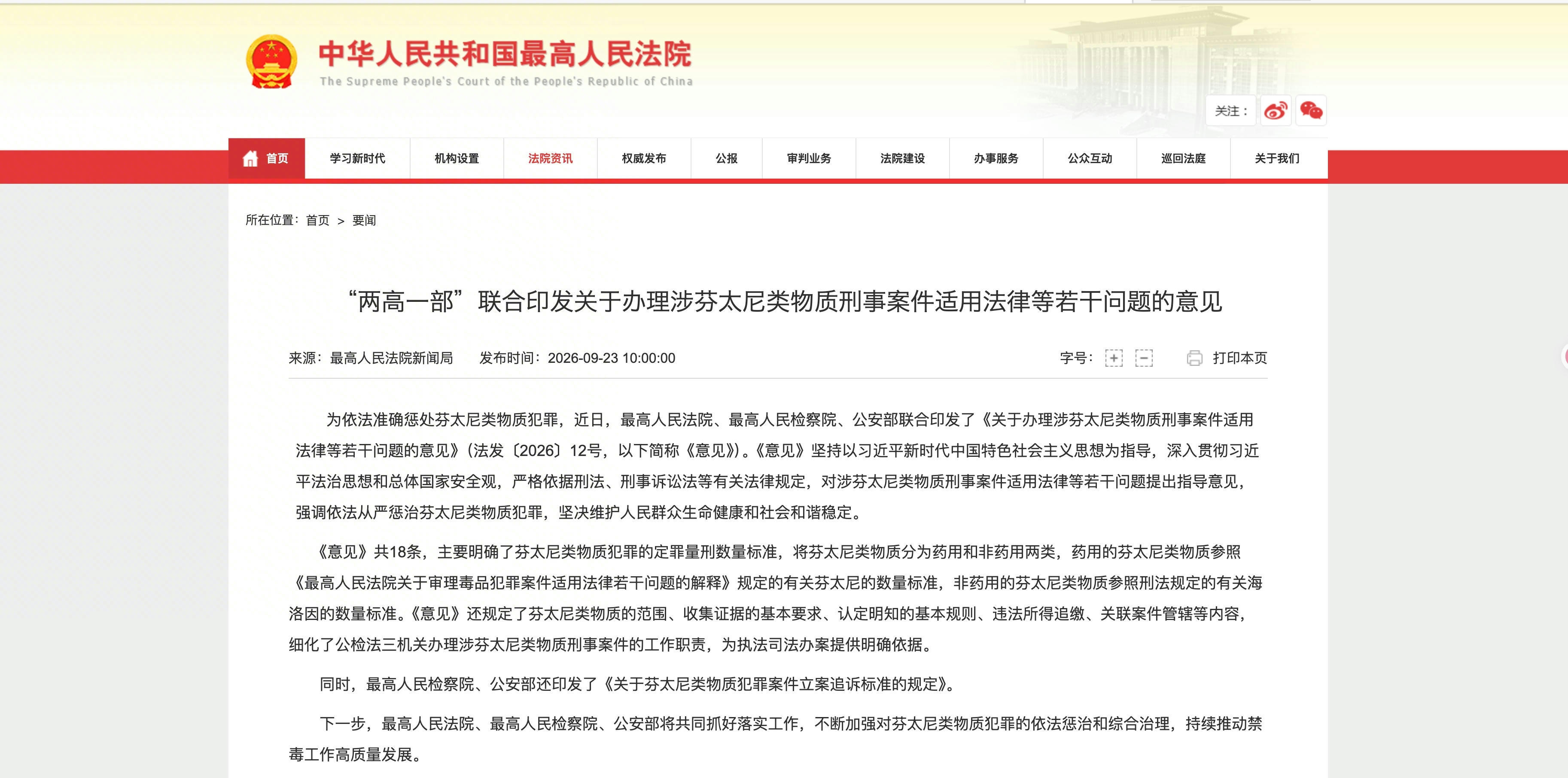
The authorities emphasized the need to “strictly punish fentanyl-related crimes in accordance with law.”
The 18-article Opinions establish more detailed rules governing the prosecution and sentencing of fentanyl-related crimes. Among other things, they:
distinguish between medicinal and non-medical fentanyl-related substances for sentencing purposes;
apply existing fentanyl quantity thresholds to medicinal fentanyl substances;
apply the Criminal Law’s heroin quantity thresholds to non-medical fentanyl-related substances;
clarify what substances fall within the definition of fentanyl-related substances;
establish requirements for evidence collection and forensic identification;
set out rules for determining whether suspects knew they were handling controlled drugs;
provide for the tracing and confiscation of criminal proceeds and other assets;
establish jurisdictional and coordination rules for cases involving multiple regions or related criminal activity;
strengthen monitoring of logistics and delivery networks, international parcels, and internet-based fentanyl trafficking; and
explicitly call for international law-enforcement cooperation, evidence sharing, and judicial assistance with relevant countries in combating cross-border fentanyl trafficking.
The new filing and prosecution standards further provide that smuggling, trafficking, transporting, or manufacturing fentanyl-related substances should be investigated and prosecuted regardless of quantity, where the conduct meets the requirements of Article 347 of China’s Criminal Law.
For illegal possession, the thresholds are:
25 grams or more for medicinal fentanyl-related substances, including fentanyl, remifentanil, sufentanil, and alfentanil; and
10 grams or more for other non-medical fentanyl-related substances.
For illegally supplying controlled narcotic drugs to persons who use or inject drugs, the thresholds include:
12.5 grams or more for medicinal fentanyl-related substances; and
5 grams or more for non-medical fentanyl-related substances.
The rules also specifically address fentanyl-related crimes conducted through the internet. Investigators are instructed to collect online postings, emails, instant-messaging records, documents, images, audio and video files, user-registration information, identity-verification information, and other relevant electronic evidence.
The Opinions further instruct Chinese public-security authorities to strengthen monitoring and enforcement involving logistics and delivery services, international parcels, and the internet, and to cooperate with key foreign countries on cross-border fentanyl cases through evidence sharing, judicial assistance, and coordinated investigations.
Both sets of rules take effect on September 23, 2026.