

On the first working day after the Spring Festival, China’s Ministry of Commerce (MOFCOM) issued two consecutive announcements, placing 40 Japanese companies on its sanctions lists.
Among them, 30 entities were added to the Export Control List (all defense-related companies; Chinese companies are prohibited from conducting transactions with them), while 20 entities were added to the “Watch List” (midstream and supporting enterprises in the defense supply chain. It is similar to the U.S. Unverified List (UVL): Chinese companies may transact with them, but the relevant security review and risk assessment requirements are extremely stringent).
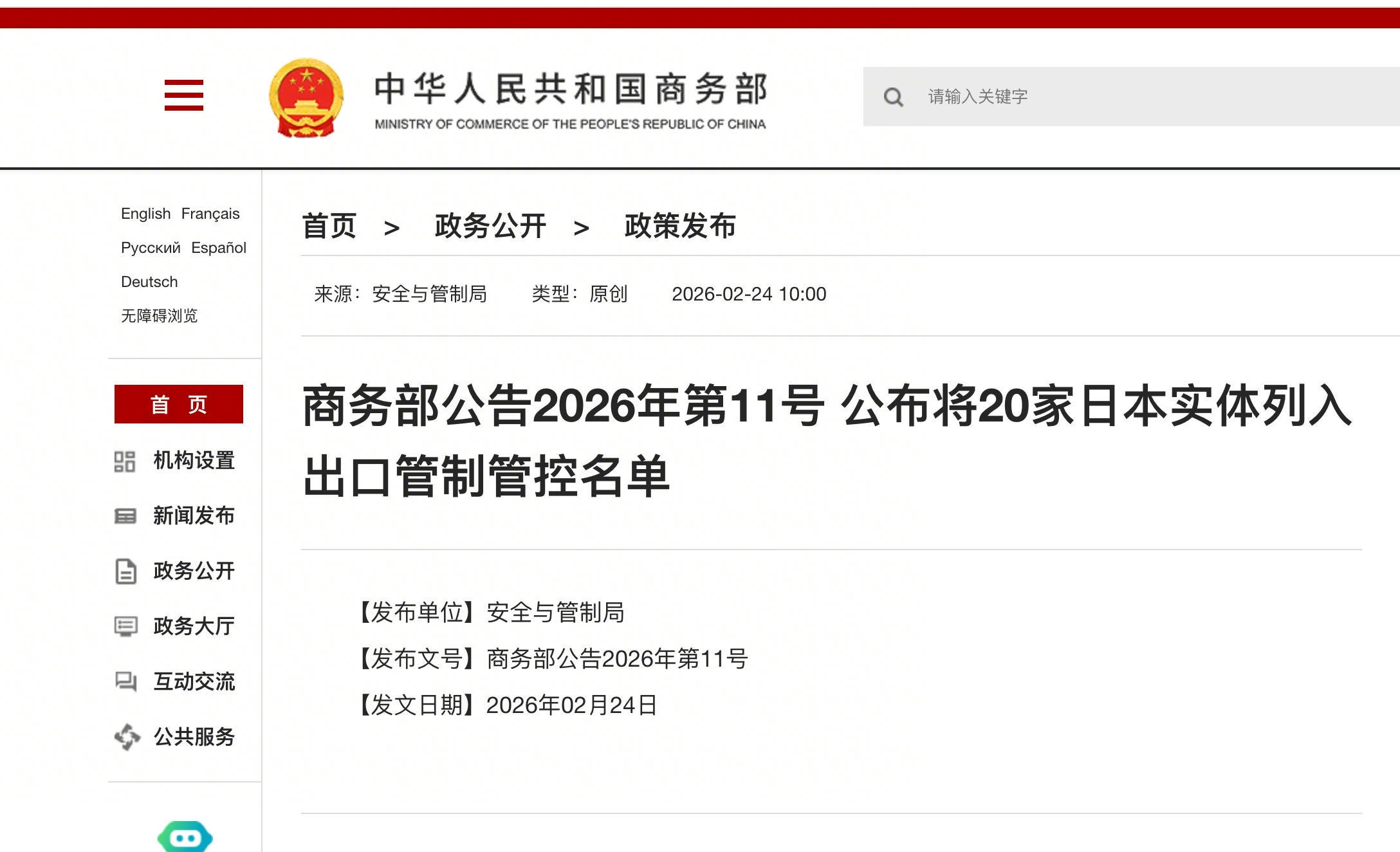
The two announcements:
MOFCOM Announcement No. 11 of 2026
Decision to Add 20 Japanese Entities to the Export Control List
Issuing Authority: Bureau of Security and Control
Document No.: MOFCOM Announcement No. 11 of 2026
Date of Issuance: February 24, 2026
Pursuant to the Export Control Law of the People’s Republic of China and the Regulations of the People’s Republic of China on Export Control of Dual-Use Items, and in order to safeguard national security and interests and fulfill international non-proliferation obligations, it has been decided to add 20 Japanese entities, including Mitsubishi Heavy Industries Shipbuilding Co., Ltd., that are involved in enhancing Japan’s military capabilities, to the Export Control List (see Annex). The following measures are hereby imposed:
Export operators are prohibited from exporting dual-use items to the above-mentioned 20 entities. Overseas organizations and individuals are prohibited from transferring or providing dual-use items originating from the People’s Republic of China to the above-mentioned 20 entities. Ongoing related activities shall be immediately suspended.
Where export is genuinely necessary under special circumstances, export operators shall apply to the Ministry of Commerce for approval.
This Announcement shall take effect as of the date of its publication.
Annex: Export Control List (February 24, 2026)
Ministry of Commerce
February 24, 2026
Annex
Export Control List
(February 24, 2026)
Mitsubishi Heavy Industries Shipbuilding Co., Ltd.
Mitsubishi Heavy Industries Aero Engines, Ltd.
Mitsubishi Heavy Industries Marine Machinery & Equipment Co., Ltd.
Mitsubishi Heavy Industries Engine & Turbocharger, Ltd.
Mitsubishi Heavy Industries Maritime Systems, Ltd.
Kawasaki Heavy Industries Aerospace Systems Company
KAWAJU Gifu Engineering Co., Ltd.
Fujitsu Defense & National Security, Ltd.
IHI Power Systems Co., Ltd.
IHI Master Metal Co., Ltd.
IHI Jet Service Co., Ltd.
IHI Aerospace Co., Ltd.
IHI Aero Manufacturing Co., Ltd.
IHI Aerospace Engineering Co., Ltd.
NEC Network and Sensor Systems, Ltd.
NEC Aerospace Systems, Ltd.
Japan Marine United Corporation
JMU Defense Systems Co., Ltd.
National Defense Academy of Japan
Japan Aerospace Exploration Agency
MOFCOM Announcement No. 12 of 2026
Decision to Add 20 Japanese Entities to the Watch List
Issuing Authority: Bureau of Security and Control
Document No.: MOFCOM Announcement No. 12 of 2026
Date of Issuance: February 24, 2026
Pursuant to the Export Control Law of the People’s Republic of China and the Regulations of the People’s Republic of China on Export Control of Dual-Use Items, it has been decided to add 20 Japanese entities, including SUBARU Corporation, for which the ultimate end users and end uses of dual-use items cannot be verified, to the Watch List (see Annex).
Where export operators export dual-use items to the above-mentioned entities, they shall not apply for a general license nor obtain export documentation through information filing and registration procedures. When applying for an individual license, they shall submit:
A risk assessment report concerning the entity listed on the Watch List; and
A written undertaking that the dual-use items will not be used for any purposes that contribute to enhancing Japan’s military capabilities.
The time limit for license review shall not be subject to the time limits specified in Article 17, Paragraph 1 of the Regulations of the People’s Republic of China on Export Control of Dual-Use Items.
The Ministry of Commerce shall implement stricter end-user and end-use reviews for exports of dual-use items to entities on the Watch List. Exports involving Japanese military end users, military end uses, or any other end users or end uses that contribute to enhancing Japan’s military capabilities shall not be approved.
Entities included on the Watch List may, pursuant to Article 26 of the Regulations of the People’s Republic of China on Export Control of Dual-Use Items, apply for removal from the Watch List after fulfilling their obligation to cooperate with verification. Upon verification, the Ministry of Commerce may remove them from the Watch List.
This Announcement shall take effect as of the date of its publication.
Annex: Watch List (February 24, 2026)
Ministry of Commerce
February 24, 2026
Annex
Watch List
(February 24, 2026)
SUBARU Corporation
FUJI Aerospace Technology Co., Ltd.
ENEOS Corporation
Yusoki Co., Ltd.
ITOCHU Aviation Co., Ltd.
Leda Group Holdings Co., Ltd.
Institute of Science Tokyo
Mitsubishi Materials Corporation
ASPP Co., Ltd.
Yashima Denki Co., Ltd.
Sumitomo Heavy Industries, Ltd.
TDK Corporation
Mitsui Bussan Aerospace Co., Ltd.
Hino Motors, Ltd.
Tokin Corporation
Nissin Electric Co., Ltd.
Sun Tectro Co., Ltd.
Nitto Denko Corporation
NOF Corporation
Nacalai Tesque, Inc.
Why are these companies targeted? A Guancha piece explained a bit.
In December last year, the Stockholm International Peace Research Institute (SIPRI) released its 2024 ranking of the world’s top 100 arms-producing and military services companies. Several Japanese firms, including Mitsubishi Heavy Industries and Kawasaki Heavy Industries, recorded substantial increases in defense-related revenues. This reflects what appears to be a gradual but potentially risky loosening of Japan’s arms export policy.
Mitsubishi Heavy Industries (MHI), Kawasaki Heavy Industries (KHI), and IHI (formerly Ishikawajima-Harima Heavy Industries) are widely regarded as the three pillars of Japan’s postwar heavy industrial complex. Among the entities placed on the control list, the Mitsubishi group occupies the most prominent position, with five affiliated companies included.
Mitsubishi Heavy Industries is Japan’s largest comprehensive defense contractor and is also advancing next-generation nuclear energy technologies. The listed subsidiaries cover key segments of the defense industrial chain, including shipbuilding, aero engines, naval propulsion systems, and maritime systems integration.
Mitsubishi Shipbuilding traces its origins to the Mitsubishi Nagasaki Shipyard, established in 1884. During World War II, it built major warships such as the battleship Musashi and served as a core supplier to the Imperial Japanese Navy. Today, Mitsubishi Shipbuilding continues to participate in the construction of submarines for the Japan Maritime Self-Defense Force, Atago-class Aegis destroyers, and Mogami-class frigates.
Mitsubishi Heavy Industries Aero Engines is a core player in Japan’s aviation power sector and is responsible for maintaining the propulsion systems of Japan Air Self-Defense Force fighter aircraft. Mitsubishi Heavy Industries Marine Machinery provides ship machinery and equipment, including large-scale engines and propulsion systems. Mitsubishi Heavy Industries Engine & Turbocharger produces high-performance engines and turbochargers, some of which are used in Ground Self-Defense Force missile systems. Mitsubishi Heavy Industries Maritime Systems develops combat management systems for naval vessels, airborne radar systems for anti-submarine patrol aircraft, and submarine sonar systems.
Two Kawasaki Heavy Industries subsidiaries were also listed. Its Aerospace Systems Company has long served the Japan Air Self-Defense Force. Major platforms such as the C-2 transport aircraft, the P-1 maritime patrol aircraft, and various helicopters have been led or co-produced by Kawasaki. KAWAJU Gifu Engineering undertakes extensive aerospace design, manufacturing, testing, and maintenance work, supporting both active-duty equipment and next-generation aviation platforms. Structurally, the Kawasaki group forms a key material foundation of Japan’s air defense capabilities.
IHI is another major Japanese defense contractor and a core supplier of engines, rocket systems, and advanced materials. Six IHI subsidiaries were included on the control list, covering businesses such as large gas turbine power systems, high-performance metallic materials for aero engines, and maintenance and support services for military jet engines. IHI Aerospace also participates in rocket engine development and spacecraft structural projects.
Japan Marine United (JMU) is one of Japan’s principal civilian and military shipbuilders. The Izumo-class helicopter carrier, currently the largest operational surface combatant in the Japan Maritime Self-Defense Force, was built by JMU.
The Chinese side emphasized in its statement that the purpose of this round of measures is to curb Japan’s “remilitarization” and its alleged pursuit of nuclear capabilities, and that the actions are entirely justified, reasonable, and lawful. China’s decision to place these entities on the lists in accordance with the law targets only a small number of Japanese entities. The relevant measures apply solely to dual-use items and do not affect normal China–Japan economic and trade relations. Japanese entities that operate in good faith and in compliance with the law have no cause for concern.
NHK Reporter: China’s Ministry of Commerce announced today that it has added 20 Japanese entities to its export control list and another 20 to its watch list. What is the Foreign Ministry’s comment on these measures? Why introduce them at this time?
Mao Ning: For specific questions, I would refer you to the competent Chinese authorities. In order to safeguard national security and interests and to fulfill international non-proliferation obligations, China has taken measures in accordance with the law and relevant regulations. The objective is to curb Japan’s “remilitarization” and its alleged pursuit of nuclear capabilities. These actions are entirely justified, reasonable, and lawful.
Japan’s Foreign Ministry said Masaaki Kanai, head of the Asian and Oceanian Affairs Bureau, spoke with China and “strongly protested and demanded the withdrawal of these measures.” Kanai called them “absolutely unacceptable and deeply regrettable,” the ministry said, adding that they “deviate significantly from international practice.”
Demarche by Director-General KANAI of the Asian and Oceanian Affairs Bureau of the Ministry of Foreign Affairs to Chinese Deputy Chief of Mission SHI
February 24, 2026
On February 24, following the announcement by the Ministry of Commerce of the People’s Republic of China, including the prohibition on exports of dual-use items to certain Japanese companies, on the same day, Director-General KANAI of the Asian and Oceanian Affairs Bureau, strongly protested and demanded the withdrawal of these measures to Chinese Deputy Chief of Mission SHI Yong, since these measures are absolutely unacceptable and deeply regrettable, in the same way as the measures announced on January 6 this year, stating that Japan has been protesting and demanding the withdrawal of the measures announced on January 6, which only target Japan, deviate significantly from international practice, and are absolutely unacceptable.
In a piece by Yu Yuan Tan Tian, the CCTV-affiliated outlets cited its discussion with Ji Wenhua, Professor of China’s UIBE and former official of MOFCOM’s Treaty and Law Department.
How should we assess the Chinese Ministry of Commerce’s latest measures? Tan Zhu discussed the issue with Ji Wenhua, a professor at the University of International Business and Economics. Three notable features stand out.
First, this marks the first activation of the “Watch List” mechanism, opening a new path for more targeted governance in China’s export control regime.
Article 26 of the Regulations on Export Control of Dual-Use Items, which came into effect on December 1, 2024, stipulates that where the ultimate end user or end use of dual-use items cannot be verified, the competent commerce authority of the State Council may place the relevant importer or end user on a Watch List.
The inclusion of 20 Japanese entities—such as SUBARU Corporation, the Institute of Science Tokyo, FUJI Aerospace Technology, and Mitsubishi Materials—represents the first practical application of this provision and carries important institutional significance.
The logic behind the Watch List is clear: by strengthening scrutiny and risk assessment, it enables precise regulatory control over entities whose end use is unclear and may pose potential military risks.
It is not an outright ban, but rather a regime of heightened review.
Moreover, this is not a permanent designation. The Ministry of Commerce has explicitly stated that listed entities may apply for removal if they genuinely fulfill their obligation to cooperate with verification. Once confirmed, they may be removed from the list in accordance with the law.
According to Ji Wenhua, the availability of reasonable and workable remedies reflects the rule-of-law spirit embedded in China’s control measures.
Second, the strict prohibitive measures imposed on entities placed on the Control List underscore China’s firm stance against Japan’s “remilitarization” and alleged pursuit of nuclear capabilities.
For the 20 entities included on the Control List—such as Mitsubishi Heavy Industries Shipbuilding—which are deemed to be involved in enhancing Japan’s military capabilities, the measures operate on two levels:
First, Chinese exporters are prohibited from exporting dual-use items to these entities.
Second, overseas organizations and individuals are prohibited from transferring or providing dual-use items of Chinese origin to these entities. Any ongoing related activities must cease immediately.
These measures are grounded in Articles 29 and 49 of the Regulations on Export Control of Dual-Use Items and are fully supported by law. They enable effective multi-layered control over both “direct exports” and “indirect transfers” of dual-use items, and they also demonstrate the extraterritorial application of China’s export control legislation.
Third, these measures represent an upgraded extension of Announcement No. 1.
On January 6, 2026, the Ministry of Commerce issued the Announcement on Strengthening Export Control of Dual-Use Items to Japan (Announcement No. 1 of 2026).
That announcement was issued in response to public statements by Japanese leaders regarding Taiwan, which implied the possibility of military involvement in the Taiwan Strait, constituted interference in China’s internal affairs, and seriously violated the One-China principle—acts deemed extremely egregious in both nature and impact.
Announcement No. 1 stated that, in order to safeguard national security and interests and fulfill international non-proliferation obligations, China decided to prohibit the export of all dual-use items to Japanese military end users, for military end uses, or for any other end use that would contribute to enhancing Japan’s military capabilities. Organizations and individuals in any country or region that violate these provisions by transferring or providing Chinese-origin dual-use items to Japanese entities will be held legally accountable.
The current listing of Japanese entities therefore constitutes an upgraded measure building upon Announcement No. 1, extending and deepening its scope in order to achieve multi-layered regulation, targeted prevention, and effective countermeasures against military-related Japanese entities.
This is possible because China has now largely established a modern export control legal framework, centered on the Export Control Law, supported by administrative regulations such as the Regulations on Export Control of Dual-Use Items, and coordinated across multiple ministerial rules.
Its defining feature is a clear hierarchical structure and coordinated design.
The Ministry of Commerce’s simultaneous use of a “dual-list” mechanism against Japanese entities represents the latest practice in balancing development and security within China’s export control system.
It builds a solid legal foundation for regulatory action, enhances governance efficiency through precise and tiered enforcement tools, diversifies China’s export control instruments through the first use of the Watch List mechanism, and fulfills international obligations in line with fundamental principles of international law.
At a time when globalization faces headwinds and regional security risks are intensifying, China’s policy toolbox is also expanding rapidly. In responding to actions that infringe upon China’s legitimate interests, China stands ready to take countermeasures at any time.