

In response to remarks by Japanese Prime Minister Sanae Takaichi suggesting that “a Taiwan contingency could trigger Japan’s right of collective self-defense” and that “Japan may deploy troops,” the Chinese government has adopted a series of countermeasures and pressure tactics toward Japan. These have included diplomatic démarches, the suspension of outbound tourism to Japan, bans on the import of Japanese seafood, and law-enforcement patrols or military activities in sensitive areas such as the East China Sea and the Yellow Sea.
China has now moved further to employ export controls and, for the first time since 2010, is again considering a ban on rare-earth exports to Japan.
On January 6, the Ministry of Commerce (MOFCOM) issued Announcement No. 1 of 2026, prohibiting the export of all dual-use items to Japan for military end users, military purposes, and any other end uses that could contribute to enhancing Japan’s military capabilities.
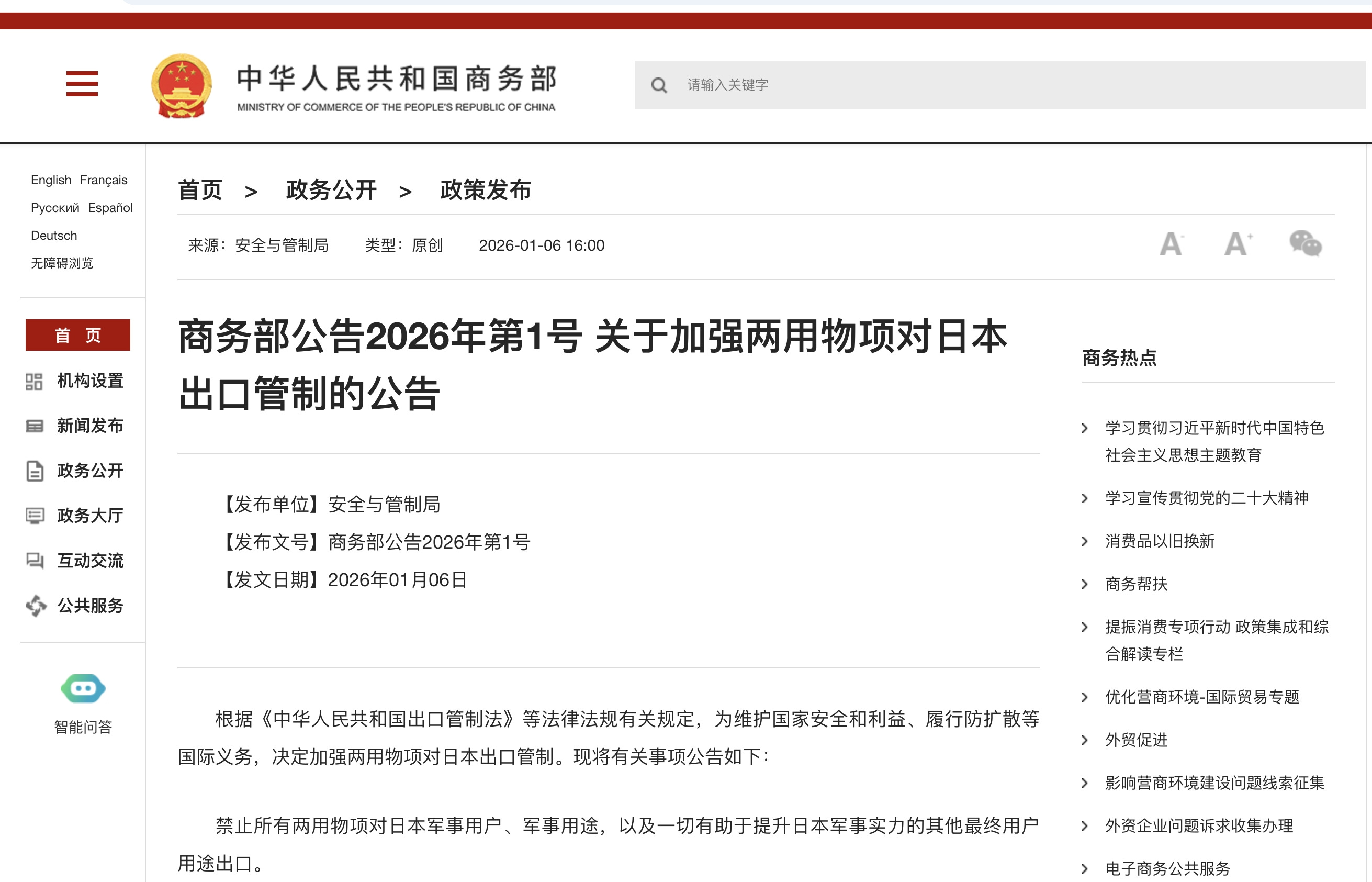
MOFCOM Announcement No. 1 of 2026
Announcement on Strengthening Export Controls on Dual-Use Items to Japan
In accordance with relevant laws and regulations, including the Export Control Law of the People’s Republic of China, and in order to safeguard national security and interests and fulfill international non-proliferation obligations, China has decided to strengthen export controls on dual-use items destined for Japan. The relevant matters are announced as follows:
All dual-use items are prohibited from being exported to Japan for military end users, military purposes, or any other end uses that may contribute to enhancing Japan’s military capabilities.
Any organization or individual in any country or region that violates the above provisions by transferring or providing dual-use items originating from the People’s Republic of China to organizations or individuals in Japan will be held legally liable in accordance with the law.
This announcement shall take effect as of the date of promulgation.
Ministry of Commerce
January 6, 2026
MOFCOM Spokesperson’s Statement on Strengthening Export Controls on Dual-Use Items to Japan
Question: On January 6, 2026, the Ministry of Commerce announced strengthened export controls on dual-use items to Japan. What considerations led to this decision?
Answer:
Japanese leaders have recently made erroneous remarks related to Taiwan, openly suggesting the possibility of military intervention in the Taiwan Strait. Such statements constitute a crude interference in China’s internal affairs, seriously violate the one-China principle, and are extremely egregious in nature and impact.In order to safeguard national security and interests and to fulfill international non-proliferation obligations, and in accordance with the Export Control Law of the People’s Republic of China and the Regulations on Export Control of Dual-Use Items, China has decided to prohibit the export of all dual-use items to Japan for military end users, military purposes, or any other end uses that could enhance Japan’s military capabilities. Any organization or individual in any country or region that violates these provisions by transferring or providing relevant dual-use items of Chinese origin to organizations or individuals in Japan will be held legally responsible in accordance with the law.
At the same time, China Daily, citing “reliable sources,” reported that in light of Japan’s recent egregious behavior, the Chinese government is considering targeted tightening of export licensing reviews for certain medium and heavy rare-earth items that were placed under control on April 4, 2025.
Sources Say China Is Considering Tighter Licensing Reviews on Rare Earth Exports to Japan
China Daily, Beijing, January 6 (Reporter Wang Keju): According to reliable sources, in view of Japan’s recent poor conduct, the Chinese government is considering targeted restrictions on export licensing reviews for medium and heavy rare-earth-related items that were listed for control on April 4, 2025.
On April 4, 2025, in accordance with the Export Control Law of the People’s Republic of China and other relevant laws and regulations, the Ministry of Commerce, together with the General Administration of Customs, issued an announcement imposing export control measures on seven categories of medium and heavy rare-earth-related items, including samarium, gadolinium, terbium, dysprosium, lutetium, scandium, and yttrium. These measures took effect on the date of issuance.
Previously, at a regular press briefing on December 4 of last year, MOFCOM spokesperson He Yadong stated that Prime Minister Sanae Takaichi’s public and erroneous remarks on Taiwan had seriously undermined the political foundation of China–Japan relations, for which the Japanese side bears inescapable responsibility.
He emphasized that China has repeatedly articulated its solemn position and urged Japan to immediately correct its mistaken words and actions, demonstrate its commitments to China through concrete actions, and create conditions for normal bilateral economic and trade cooperation. Should Japan persist in its course, China will take necessary measures, and all consequences will be borne by the Japanese side.
According to assessments by Japan’s Nomura Research Institute, heavy rare earths such as dysprosium and terbium—used in neodymium magnets for electric vehicle drive motors—are almost 100 percent dependent on supplies from China. Any restrictions would therefore pose a significant shock to the Japanese economy.
Nomura estimates that if China’s rare-earth export restrictions on Japan were to last for three months, the resulting losses would amount to approximately ¥660 billion, reducing annual nominal and real GDP by about 0.11 percent. If the restrictions were to persist for one year, losses would reach approximately ¥2.6 trillion, with annual nominal and real GDP declining by around 0.43 percent.
Glad China is taking Japanese militarism seriously.
The dual-use license rule has been applicable since 4 April 2025. All exports for rare earth mil-applications to all destinations off the menu. So what exactly has changed?