

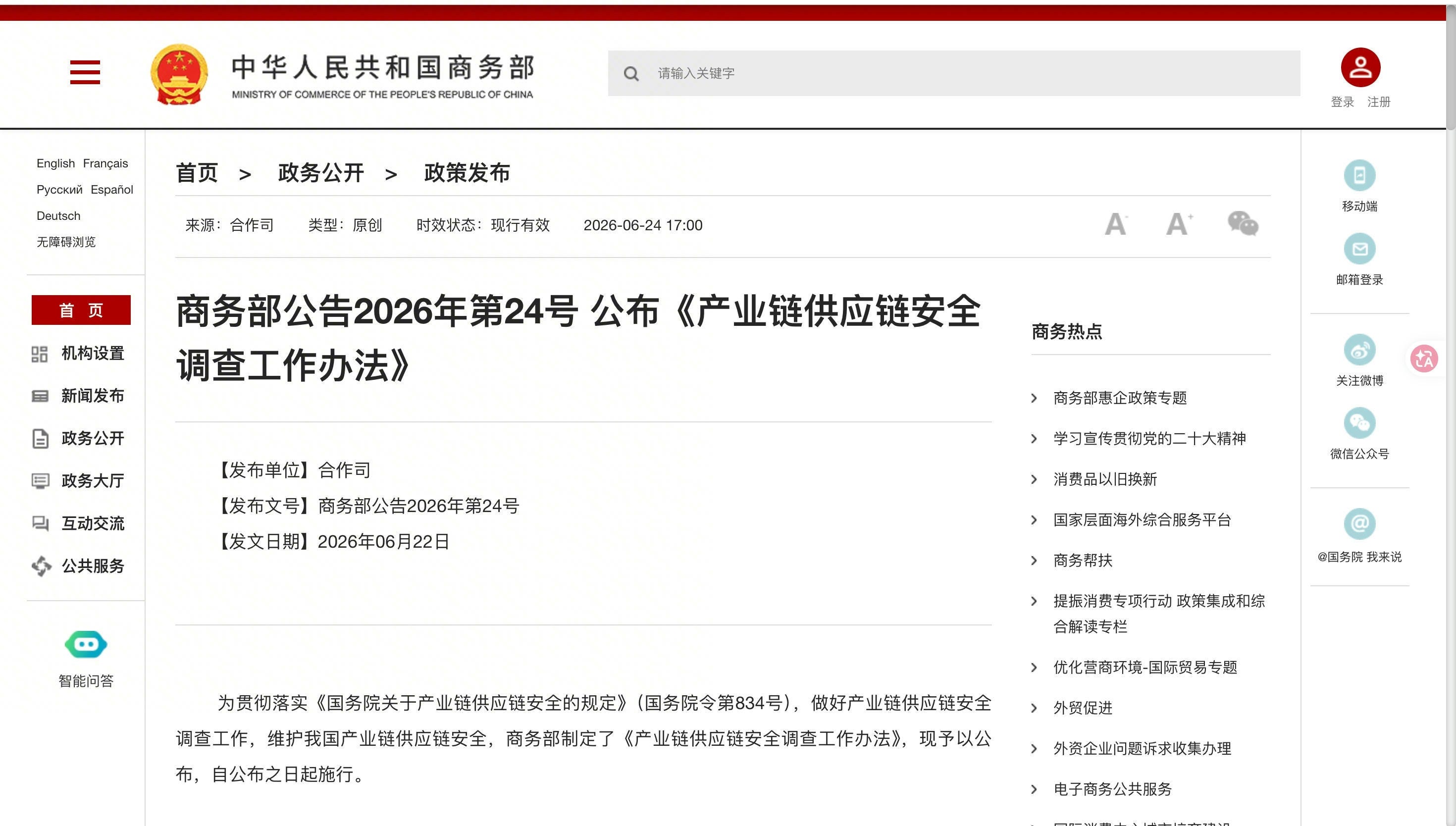
On the evening of June 24, 2026, China’s Ministry of Commerce (MOFCOM) quietly published a short, 22-article regulation of fewer than 2,000 Chinese characters: the Measures for Industrial and Supply Chain Security Investigations (MOFCOM Announcement No. 24 of 2026).
To understand its significance, it helps to look at the broader timeline.
On March 31, 2026, Premier Li Qiang signed State Council Decree No. 834, the Regulations on Industrial and Supply Chain Security. Consisting of just 18 articles, it became China’s first dedicated administrative regulation governing industrial and supply chain security.
A week later, on April 7, Ministry of Justice officials described the regulation as filling a long-standing legislative gap and indicated that a dedicated “industrial and supply chain security investigation mechanism” would be one of its key implementing tools.
On June 22, MOFCOM formally issued the implementing measures.
The relationship between the two documents is straightforward. Decree 834 serves as the framework legislation, granting the government authority to investigate actions that threaten China’s industrial and supply chain security. The newly issued Measures provide the operating manual, explaining how investigations will be initiated, conducted, and ultimately enforced. In practical terms, this marks the first time China has established a standing enforcement mechanism specifically designed to respond to foreign actions deemed harmful to China’s industrial and supply chains.
Compared with the broad principles contained in Decree 834, the Measures provide several important layers of detail.
First, they identify the lead authority. While the State Council regulation referred only to “relevant departments of the State Council,” Article 2 of the Measures explicitly designates MOFCOM as the responsible agency.
Second, they define both the criteria for assessing harm and the channels for initiating investigations. Decree 834 granted investigative authority but did not explain how harm would be evaluated. Article 4 of the Measures fills that gap by identifying four categories of factors, including impacts on the security of critical materials, technologies, capital, assets, data, information, and personnel; impacts on the flow of logistics, trade, people, capital, data, and information; impacts on international competitiveness and development potential; and other relevant factors. What was previously a broad concept of “harm to industrial and supply chain security” is thus transformed into a more operational framework for regulators, companies, and legal advisers.
Articles 5 and 6 also establish formal reporting channels. Chinese companies and organizations may submit evidence and reports directly to MOFCOM or through provincial commerce authorities. In effect, this creates China’s first formal industrial-relief mechanism specifically aimed at foreign measures that disrupt supply chains, somewhat analogous to how companies petition the U.S. International Trade Commission in trade remedy cases.
Third, and most importantly, the Measures establish a detailed investigative process. While Decree 834 merely referenced tools such as interviews and document reviews, Articles 7 through 16 create a complete procedural framework. Article 7 covers case initiation and public notice requirements. Article 8 expands investigative methods to include interviews, document inspection and copying, public solicitation of information, questionnaires, sampling, technical assessments, hearings, and on-site investigations. Article 9 authorizes expert advisory groups. Article 11 guarantees rights of explanation and defense. Article 12 contains a particularly consequential provision: if a target refuses to cooperate, fails to provide information, misses deadlines, or otherwise obstructs an investigation, MOFCOM may make determinations based on available facts.
Among these provisions, Article 10 stands out. It states that MOFCOM may conduct on-site investigations in foreign countries or regions when necessary, provided the relevant jurisdiction does not object. In principle, this extends Chinese investigative authority overseas, while formally preserving respect for sovereignty and territorial jurisdiction. In practice, few governments are likely to permit such investigations, but the provision itself signals Beijing’s growing willingness to project enforcement authority beyond its borders.
Fourth, the Measures establish mechanisms for consultation, suspension, and settlement. Investigations are not designed to be purely punitive. Articles 13 through 16 allow MOFCOM to engage in consultations, suspend investigations, terminate investigations if harmful measures are withdrawn or solutions are reached, and issue final determinations. This creates a flexible framework more akin to a policy instrument than a purely legal proceeding.
Fifth, the Measures establish a layered enforcement structure and domestic compliance mechanism. Articles 17 through 20 elaborate on the response authorities originally provided under Decree 834.
Against foreign governments, regions, or international organizations, China may impose import and export restrictions, special fees, inclusion on countermeasure lists, and other measures.
Against foreign companies and individuals, China may restrict imports, exports, investment, business cooperation, entry, stay, and residence. These restrictions may also extend to entities they control or participate in operating.
Against domestic entities that fail to comply, authorities may first order corrective action and then impose restrictions involving government procurement, public tenders, imports and exports, cross-border data transfers, and other activities.
Article 20 further authorizes MOFCOM to adjust measures dynamically over time.
Several provisions deserve particular attention.
The first is Article 17(2), which authorizes the collection of “special fees.” This concept has few direct precedents in Chinese legislation. The closest example was the special port fees imposed in 2025 on certain U.S.-related vessels in response to U.S. Section 301 measures. The provision effectively creates a mechanism for imposing targeted fees without relying on China’s tariff law. In the future, it could potentially serve as the legal basis for charging security-related fees on specific foreign services, cross-border data transfers, or other activities. Notably, the provision is not limited to goods or country-of-origin concepts. It applies to countries, regions, or organizations that implement or assist actions deemed harmful to China’s supply chain security, and could theoretically cover shipping, ports, certification, licensing, services trade, financial settlement, digital platforms, and other sectors.
The second is Article 18, which functions as a Chinese version of a “50 percent rule.” Measures may apply not only to targeted foreign entities themselves, but also to organizations they actually control or participate in establishing or operating. Unlike U.S. sanctions practice, however, the provision does not rely on specific ownership thresholds. Concepts such as actual control, participation in establishment, and participation in operations leave considerable room for interpretation and could potentially encompass joint ventures, contractual arrangements, and business partners.
The third is Article 19, which effectively creates a secondary compliance obligation. Domestic entities that continue dealing with sanctioned foreign parties may themselves face restrictions involving government procurement, cross-border data transfers, imports and exports, and other activities. The logic resembles U.S. secondary sanctions, although directed toward compliance obligations of domestic Chinese entities. Once measures are imposed under Articles 17 or 18, Chinese customers, suppliers, and business partners may be required to disengage or face consequences themselves.
For foreign companies, the implications are potentially significant. Previously, China’s Unreliable Entity List was primarily triggered by disruptions to normal transactions with Chinese firms. The new framework is broader. Foreign entities may now face investigation if they are deemed to have implemented discriminatory restrictions or measures inconsistent with international law and basic norms of international relations, even when acting pursuant to their own domestic legal obligations. This narrows the scope for the traditional defense that a company was merely complying with home-country law.
Taken together, Articles 17 and 18 create a toolkit that could simultaneously restrict imports, exports, investment, transactions, personnel entry, and work authorization. The scope of potential remedies exceeds anything previously available under China’s existing enforcement mechanisms.
Despite the significance of the Measures, several key questions remain unanswered.
First, will the “critical sectors list” envisioned under Article 11 of Decree 834 be published, and if so, which industries will it cover? This may ultimately prove even more consequential than the investigation mechanism itself.
Second, who will become the target of the first investigation? Historically, the first case often sets the tone for how an entire enforcement system is used.
Third, how will the “special fees” authority be implemented in practice? The provision could become China’s institutionalized equivalent of certain Western tariff and fee-based countermeasures, but substantial implementation details remain undefined.
Fourth, how will the new framework interact with the Unreliable Entity List? The triggering conditions overlap significantly, yet the Measures do not clarify the relationship between the two systems.
Finally, how will China defend the framework under WTO rules? Beijing has long criticized U.S. Section 301 investigations and other unilateral measures. Now that China has created a structurally similar instrument of its own, questions regarding WTO compatibility and legal justification are likely to become increasingly important.
Measures for Industrial and Supply Chain Security Investigations
Article 1
These Measures are formulated in accordance with the National Security Law of the People’s Republic of China, the Foreign Relations Law of the People’s Republic of China, the Anti-Foreign Sanctions Law of the People’s Republic of China, the Foreign Trade Law of the People’s Republic of China, the Regulations of the State Council on Industrial and Supply Chain Security, and other relevant provisions, for the purpose of conducting industrial and supply chain security investigations, preventing industrial and supply chain security risks, and enhancing the resilience and security of industrial and supply chains.
Article 2
The Ministry of Commerce (MOFCOM) shall be responsible for industrial and supply chain security investigations and shall carry out investigative activities accordingly.
Article 3
MOFCOM may conduct industrial and supply chain security investigations into the following measures or acts:
Foreign states, regions, and international organizations that violate international law and the basic norms governing international relations by adopting discriminatory prohibitions, restrictions, or similar measures against China in the field of industrial and supply chains, or by implementing or assisting in acts that harm the security of China’s industrial and supply chains;
Foreign organizations or individuals that violate normal market transaction principles by interrupting normal transactions with Chinese citizens or organizations, imposing discriminatory measures on Chinese citizens or organizations, or engaging in other acts that cause substantial harm or pose a substantial threat to the security of China’s industrial and supply chains.
Article 4
In assessing harm to industrial and supply chain security, MOFCOM may consider the following factors:
The impact of the relevant measures or acts on the security of domestic and overseas industrial and supply chain factors, including important materials, technologies, capital, assets, data, information, personnel, enterprises, and projects;
The impact of the relevant measures or acts on the smooth flow of domestic and overseas industrial and supply chain factors, including logistics flows, commercial flows, personnel flows, capital flows, data flows, and information flows;
The impact of the relevant measures or acts on the international competitiveness and development potential of China’s industrial and supply chains;
Other circumstances affecting industrial and supply chain security.
Article 5
Where domestic legal persons, organizations, or other entities believe that measures or acts undertaken by foreign states, regions, organizations, individuals, or international organizations have harmed or may harm the security of China’s industrial and supply chains, and that an industrial and supply chain security investigation should be initiated, they may submit written materials, including evidence and reports, to MOFCOM.
Article 6
Domestic legal persons, organizations, or other entities may submit relevant evidence, reports, and other written materials to MOFCOM through the commerce authorities of provinces, autonomous regions, municipalities directly under the Central Government, cities under separate state planning, and the Xinjiang Production and Construction Corps.
Article 7
MOFCOM may, based on actual circumstances, decide to initiate a case and publish a notice of investigation.
Article 8
MOFCOM may conduct investigations through means including interviews with investigated parties and other relevant persons, inspection or copying of relevant documents and materials, public solicitation of information, questionnaires, sampling surveys, technical assessments, hearings, and on-site investigations. Relevant parties shall cooperate accordingly.
MOFCOM may also proactively collect relevant information during the course of an investigation.
Article 9
Where deemed necessary, MOFCOM may establish an expert advisory panel to provide opinions on technical and legal issues arising during an investigation.
Members of the expert advisory panel shall properly safeguard confidential materials and information obtained during the investigation and shall bear corresponding confidentiality obligations.
Article 10
Where deemed necessary, MOFCOM may conduct on-site investigations in relevant foreign countries or regions, except where the relevant country or region raises objections.
Article 11
Relevant parties, including the investigated party, may make statements and present defenses to MOFCOM during the course of an investigation.
MOFCOM may require relevant parties to submit or supplement written materials. Relevant parties may also voluntarily submit written materials.
Article 12
Where an investigated party fails to cooperate with an investigation, fails to truthfully provide information or relevant materials within a reasonable period, or otherwise seriously obstructs the investigation, MOFCOM may make determinations based on the facts and information already obtained.
Article 13
During the investigation process, MOFCOM may engage in consultations with relevant foreign parties regarding the measures or acts under investigation.
Article 14
Where deemed necessary, MOFCOM may suspend an investigation.
Article 15
MOFCOM may terminate an investigation and publish a notice under any of the following circumstances:
The investigated country, region, organization, individual, or international organization has cancelled or adjusted the measure or act under investigation and has ceased causing harm or the threat of harm to China’s industrial and supply chain security;
The investigated country, region, organization, individual, or international organization has reached a solution with China;
Other circumstances under which MOFCOM determines that termination of the investigation is appropriate.
Article 16
Upon completion of an investigation, MOFCOM shall determine whether the investigated measures or acts have caused harm to China’s industrial and supply chain security and shall publish the determination.
Article 17
Based on the results of an investigation, MOFCOM may, together with relevant departments and in accordance with applicable procedures, take the following measures against countries, regions, or international organizations that implement or assist in acts harming China’s industrial and supply chain security:
Prohibit or restrict the import and export of goods and technologies, or international trade in services related to them;
Impose special charges or fees on activities related to them;
Pursuant to the Anti-Foreign Sanctions Law of the People’s Republic of China and the Provisions on Implementing the Anti-Foreign Sanctions Law, place organizations and individuals that directly or indirectly participate in formulating, deciding upon, or implementing the measures or acts described in Article 3(1) on a countermeasures list and impose countermeasures against them;
Other necessary measures.
Article 18
Based on the results of an investigation, MOFCOM may, together with relevant departments, take the following measures against foreign organizations and individuals that harm China’s industrial and supply chain security:
Prohibit or restrict their engagement in import and export activities related to China;
Prohibit or restrict their investment within China;
Prohibit or restrict organizations and individuals within China from engaging in transactions, cooperation, or other activities with them;
Prohibit or restrict the entry into China of relevant persons and means of transportation;
Revoke or restrict the qualifications of relevant persons to work, stay, or reside in China;
Other necessary measures.
The above measures may also apply to organizations that are actually controlled by, or whose establishment or operation involves, such foreign organizations or individuals.
Article 19
Where organizations or individuals within China fail to comply with measures imposed by MOFCOM pursuant to Articles 17 or 18 of these Measures, MOFCOM may order corrective action and, together with relevant departments, impose one or more of the following measures depending on the circumstances:
Prohibit or restrict their participation in government procurement, public tenders and bidding, import and export activities, international trade in services, and related activities;
Prohibit or restrict their receipt of data or personal information from abroad, or their provision of data or personal information to parties outside China;
Prohibit or restrict their departure from China, or their stay or residence within China;
Other necessary measures.
Article 20
Where deemed necessary, MOFCOM may adjust measures imposed pursuant to Articles 17, 18, and 19 of these Measures.
Article 21
These Measures shall be interpreted by MOFCOM.
Article 22
These Measures shall enter into force on the date of promulgation.