

On March 27, China launched two trade barrier investigations against the United States. This marks the re-ignition of trade war tensions between the two countries since the trade truce agreed upon in the Busan agreement last October.
The first investigation targets “U.S. practices and measures that disrupt global production and supply chains.” The Chinese government believes that the United States has implemented a large number of practices and measures in trade-related fields that seriously disrupt global production and supply chains, including but not limited to: restricting or prohibiting Chinese products from entering the U.S. market, restricting or prohibiting the export of high-tech products to China, and restricting or prohibiting two-way investment in key areas. The above practices and measures may seriously harm the trade interests of Chinese enterprises, and some of them are suspected of violating WTO rules and other economic and trade treaties or agreements jointly concluded or acceded to by China and the United States.
Ministry of Commerce Announcement No. 17 of 2026
Initiation of Trade Barrier Investigation on U.S. Practices and Measures Disrupting Global Production and Supply ChainsIssuing Authority: Bureau of Trade Remedy Investigations
Announcement No.: Ministry of Commerce Announcement No. 17 of 2026
Date of Issuance: March 27, 2026In accordance with the relevant provisions of the Foreign Trade Law of the People’s Republic of China and the Rules on Foreign Trade Barrier Investigations of the Ministry of Commerce, the Ministry of Commerce may, on its own initiative, conduct investigations into trade barriers of relevant countries and regions in order to safeguard the order of foreign trade.
Preliminary evidence and information obtained by the Ministry of Commerce show that the United States has implemented a large number of practices and measures in trade-related fields that seriously disrupt global production and supply chains, including but not limited to: restricting or prohibiting Chinese products from entering the U.S. market, restricting or prohibiting the export of high-tech products to China, and restricting or prohibiting two-way investment in key areas. These practices and measures may seriously harm the trade interests of Chinese enterprises, and some of them are suspected of violating WTO rules and other economic and trade treaties or agreements jointly concluded or acceded to by China and the United States.
In accordance with Articles 41 and 42 of the Foreign Trade Law of the People’s Republic of China and Articles 12 and 35 of the Rules on Foreign Trade Barrier Investigations, the Ministry of Commerce has decided to initiate a trade barrier investigation into the relevant U.S. practices and measures as of March 27, 2026. The relevant matters are hereby announced as follows:
I. Investigated Measures
The investigated measures in this case are: the practices and measures implemented by the United States in trade-related fields that disrupt global production and supply chains.II. Investigation Procedures
In accordance with the Rules on Foreign Trade Barrier Investigations, the Ministry of Commerce may conduct the investigation by means of questionnaires, hearings, on-site investigations, and other methods to gather information from interested parties.III. Investigation Period
This case shall be concluded within 6 months from the date of the announcement of the decision to initiate the investigation. Under special circumstances, the period may be extended, but the extension shall not exceed 3 months.IV. Access to Public Information
Interested parties may download the public information of this case from the sub-website of the Bureau of Trade Remedy Investigations on the Ministry of Commerce website, or go to the Ministry of Commerce Trade Remedy Public Information Reading Room (Tel: 0086-10-65197878) to search, read, copy, and duplicate the public information of this case.V. Comments on the Initiation of the Investigation
Interested parties who wish to comment on matters relating to the initiation of the investigation shall submit their written comments to the Bureau of Trade Remedy Investigations of the Ministry of Commerce within 20 days from the date of publication of this announcement.VI. Submission and Handling of Information
During the investigation, interested parties shall submit electronic versions of comments, questionnaire responses, and other materials through the “Trade Remedy Investigation Information Platform”, and simultaneously submit written versions as required by the Ministry of Commerce. The content of the electronic and written versions shall be identical, and the format shall be consistent.If an interested party believes that the disclosure of the information it provides would cause serious adverse effects, it may apply to the Ministry of Commerce for confidential treatment and state the reasons. If the Ministry of Commerce approves the request, the interested party applying for confidentiality shall also provide a non-confidential summary of the confidential information. The non-confidential summary shall contain sufficient meaningful information to enable other interested parties to have a reasonable understanding of the confidential information. If a non-confidential summary cannot be provided, the reasons shall be stated. If the information submitted by an interested party does not indicate that it requires confidential treatment, the Ministry of Commerce will treat it as public information.
VII. Contact Information of the Ministry of Commerce
Address: No. 2 East Chang’an Avenue, Beijing
Postal Code: 100731
Bureau of Trade Remedy Investigations, Ministry of Commerce
Tel: 0086-10-65198155 65198070
Fax: 0086-10-65198172
Relevant Website: Sub-website of the Bureau of Trade Remedy Investigations on the Ministry of Commerce websiteMinistry of Commerce of the People’s Republic of China
March 27, 2026
The second investigation targets “U.S. practices and measures that hinder trade in green products.” According to the MOFCOM announcement, the United States has implemented a number of practices and measures in trade-related fields that hinder trade in green products, including but not limited to: restricting the export of green products to the United States, slowing down the deployment of new energy projects, and restricting technology cooperation related to green products. These practices and measures may seriously harm the trade interests of Chinese enterprises, and some of them are suspected of violating WTO rules and other economic and trade treaties or agreements jointly concluded or acceded to by China and the United States.
Ministry of Commerce Announcement No. 18 of 2026
Initiation of Trade Barrier Investigation on U.S. Practices and Measures Hindering Trade in Green ProductsIssuing Authority: Bureau of Trade Remedy Investigations
Announcement No.: Ministry of Commerce Announcement No. 18 of 2026
Date of Issuance: March 27, 2026(The remaining sections of the announcement—investigation procedures, period, access to information, comments, submission of information, and contact details—are almost identical to Announcement No. 17, with only the investigated measures changed to: “the practices and measures implemented by the United States in trade-related fields that hinder trade in green products.”)
The above investigations were launched one day after MOFCOM Minister Wang Wentao met with U.S. Trade Representative Jamieson Greer in Cameroon.
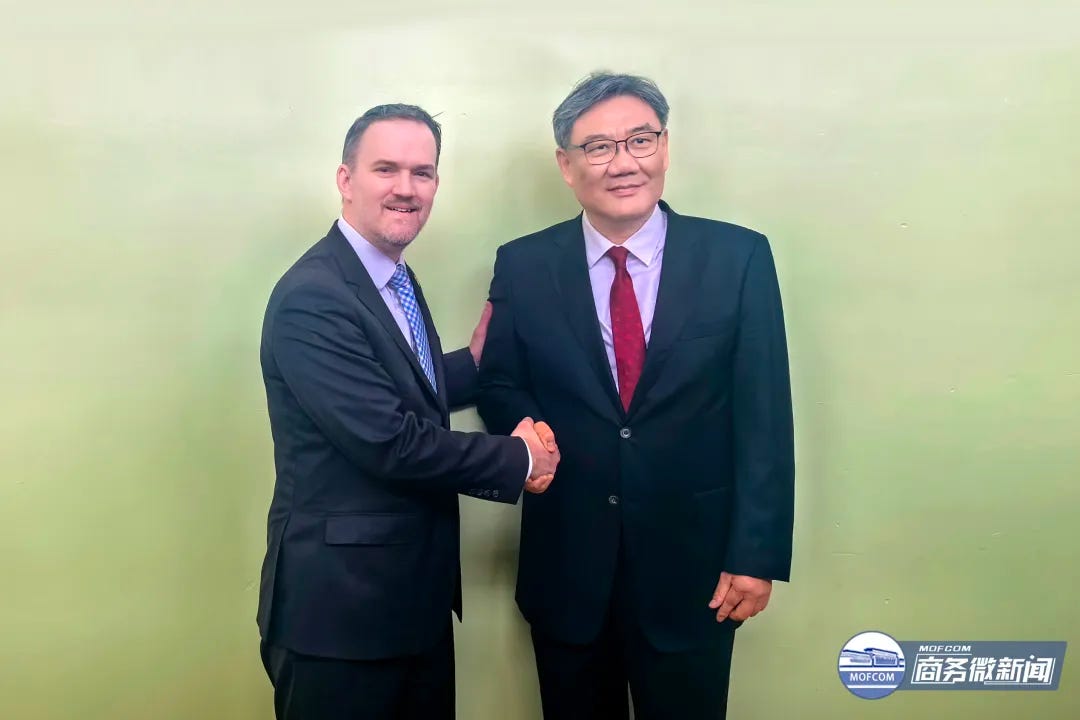
According to the MOFCOM readout, during the meeting Wang Wentao “expressed grave concern over the U.S. side’s initiation of Section 301 investigations against multiple economies, including China, on the grounds of so-called ‘overcapacity’ and ‘failure to prohibit the importation of goods produced with forced labor.’”
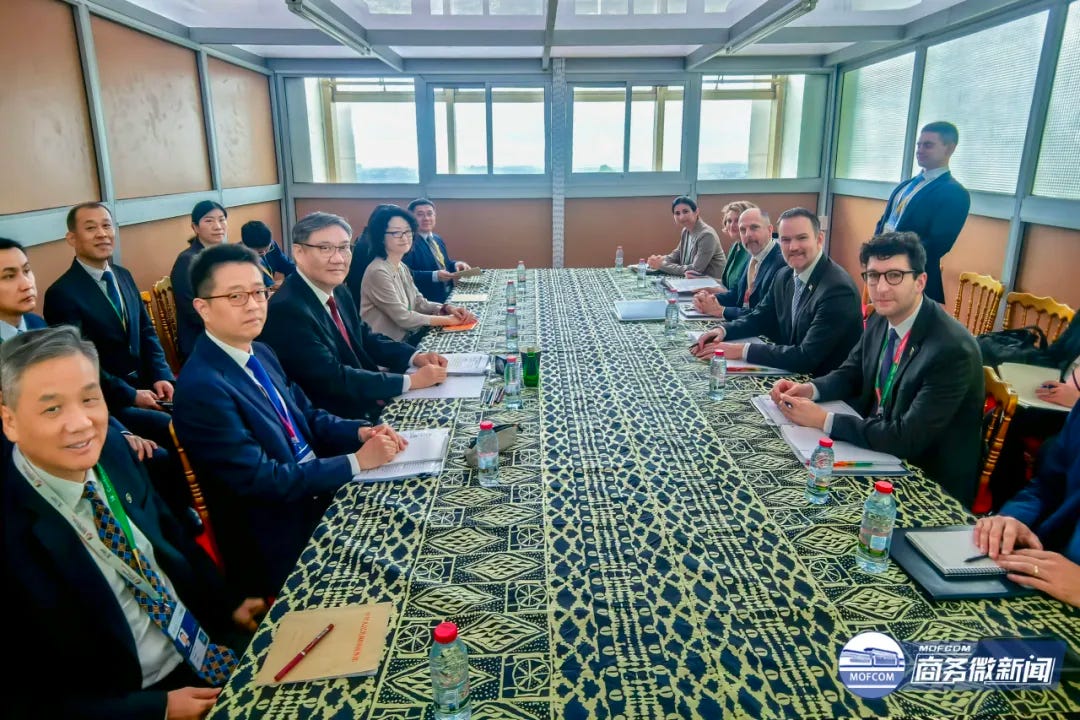
MOFCOM Readout
Minister Wang Wentao Meets with U.S. Trade Representative Jamieson Greer
On March 26, during the 14th Ministerial Conference of the World Trade Organization held in Yaoundé, Cameroon, Minister of Commerce Wang Wentao met with U.S. Trade Representative Jamieson Greer. The two sides had in-depth exchanges of views on China-U.S. economic and trade relations, as well as multilateral and regional economic and trade cooperation. Ambassador Li Yongsheng of the Chinese Permanent Mission to the WTO attended the meeting.
Wang Wentao stated that President Xi Jinping has pointed out that economic and trade relations should continue to serve as the ballast and propeller of China-U.S. relations, rather than a stumbling block or point of conflict. Both sides should jointly implement the important consensus reached at the Busan meeting and previous calls between the two heads of state, properly handle the relationship between competition and cooperation as well as between the past and the future, strengthen mutually beneficial cooperation, avoid vicious competition, maintain close communication, jointly “look forward,” and promote the healthy, stable, and sustainable development of bilateral economic and trade relations.
Wang Wentao emphasized that China is willing to strengthen multilateral and regional economic and trade cooperation with the U.S. side, jointly advance WTO reform, promote practical outcomes at the 14th Ministerial Conference of the WTO, and support positive results from APEC and G20 meetings. Wang Wentao also expressed grave concern over the U.S. side’s initiation of Section 301 investigations against multiple economies, including China, on the grounds of so-called “overcapacity” and “failure to prohibit the importation of goods produced with forced labor.”
Greer stated that over the past year, the U.S. and China have conducted constructive economic and trade consultations and maintained close communication and cooperation. The U.S. side is willing to work with China, guided by the consensus between the two heads of state, to strengthen dialogue, promote sustained and stable China-U.S. economic and trade relations, and achieve mutually beneficial and win-win outcomes in the economic and trade field. The U.S. side is also willing to strengthen communication and exchanges with China under the WTO and regional frameworks.
Following the U.S. initiation of Section 301 investigations against China, the Chinese Ministry of Foreign Affairs and Ministry of Commerce quickly issued strongly worded responses. They emphasized that the U.S. claim of Chinese “overcapacity” is a false proposition and essentially a “political manipulation” by the U.S. side. They urged the U.S. to correct its erroneous practices and return to the correct track of resolving issues through dialogue and consultation. China also stressed that it will closely follow developments and “reserves the right to take all necessary measures” to resolutely safeguard its legitimate rights and interests.
Statement by the Spokesperson of the Ministry of Foreign Affairs
Reuters: The Trump administration announced on Wednesday that it will launch two new trade investigations into “excess industrial capacity” of 16 major trading partners, including China. According to officials from the Office of the U.S. Trade Representative, this could lead to new tariffs. What is China’s comment on this investigation and on the USTR listing China’s automotive industry as a so-called “overcapacity” sector?
Guo Jiakun: China’s position on handling China-U.S. economic and trade issues is consistent and clear. We oppose unilateral tariff measures in all forms. Tariff wars and trade wars are not in the interest of either side. Both sides should resolve relevant issues through consultation on the basis of equality, respect, and reciprocity. The so-called “overcapacity” is a false proposition, and China opposes using it as a pretext for political manipulation.
Statement by the MOFCOM Spokesperson
Reporter: On March 11 Eastern Time, the Office of the U.S. Trade Representative announced the initiation of Section 301 investigations against 16 economies, including China, on the grounds of “overcapacity.” What is China’s comment?
Answer: China has taken note that the U.S. side has initiated Section 301 investigations against 16 economies, including China, on the grounds of “overcapacity.” Section 301 investigations are typical unilateralist actions that seriously undermine the international economic and trade order. A WTO panel has already ruled that tariff measures taken under Section 301 investigations violate WTO rules.
Regarding the U.S. so-called “overcapacity theory,” China has repeatedly clarified its position. The world economy has long become an indivisible whole; both production and consumption are global, requiring supply-demand matching and adjustment from a global perspective. If production in every country could only meet domestic market demand, there would be no cross-border trade. The U.S. side cannot narrowly define production capacity exceeding domestic demand as “overcapacity” and label it as such. The U.S. has even less right to unilaterally determine through Section 301 investigations whether trading partners have “overcapacity” and then adopt unilateral restrictive measures. China has noted that the U.S. side has also initiated Section 301 investigations against 60 economies, including China, on the grounds of “failure to prohibit the importation of goods produced with forced labor.” China is conducting analysis and assessment.
China urges the U.S. to correct its erroneous practices and return to the correct track of resolving issues through dialogue and consultation. China will closely follow developments, reserve the right to take all necessary measures, and resolutely safeguard its legitimate rights and interests.
In the recent China-U.S. talks in Paris, Vice Premier He Lifeng also expressed great concern over the U.S. Section 301 investigations.
Recently, the U.S. Supreme Court ruled that tariffs imposed under the International Emergency Economic Powers Act (IEEPA) were unlawful. Subsequently, the United States imposed a 10 percent import surcharge on all trading partners under Section 122 of the Trade Act of 1974 and has also introduced a number of negative measures targeting China, including Section 301 investigations, corporate sanctions, and market access restrictions.
China’s opposition to the United States’ imposition of unilateral tariffs has been consistent. China urges the United States to completely remove unilateral tariffs and other restrictive measures and will take necessary actions to firmly safeguard its legitimate rights and interests.
In accordance with the relevant provisions of China’s Foreign Trade Law and the Ministry of Commerce’s Rules on Foreign Trade Barrier Investigations, after initiating an investigation into trade barriers of relevant countries and regions, the Ministry of Commerce may use questionnaires, hearings, on-site investigations, and other methods to understand the situation from interested parties and conduct the investigation. It will form different conclusions based on the actual investigation results, which will lead to corresponding legal and practical consequences.
During the investigation, if the party under investigation voluntarily cancels or modifies the relevant restrictive measures, provides reasonable compensation, or fulfills its obligations under relevant international agreements, the investigation may be suspended or even directly terminated in accordance with the law, and subsequent determination procedures will no longer be pursued. If the investigation ultimately confirms that the relevant measures of the country or region do constitute unreasonable restrictions and harm to the entry of Chinese goods, services, or investment into its market, they will be formally determined to constitute trade barriers.
Once a trade barrier is determined to exist, MOFCOM, as appropriate, may adopt one or more of the following measures in response in accordance with Article 33 of the Rules:
First, engage in bilateral official consultations with the government of the country or region under investigation, urging it to remove or modify the relevant barrier measures or provide trade compensation, so as to resolve the dispute in a friendly manner;
Second, initiate dispute settlement procedures through multilateral international platforms such as the World Trade Organization (WTO) dispute settlement mechanism, file complaints, and promote the issuance of rulings, requiring the relevant country or region to correct its non-compliant measures;
Third, take other appropriate measures, including but not limited to imposing reciprocal trade restrictions on the country or region under investigation, such as additional tariffs or restrictions on market access; issuing risk alerts to guide Chinese enterprises in avoiding relevant market risks; supporting affected enterprises in filing applications for trade remedy measures such as anti-dumping and countervailing duties; and coordinating with other countries or regions to jointly exert pressure in order to eliminate the relevant trade barriers.
If, after comprehensive verification, it is determined that the relevant measures do not constitute trade barriers or that the existing evidence is insufficient to establish the existence of trade barriers, the investigation procedure will be normally terminated, the relevant conclusions will be publicly announced, and in principle, no repeated investigation will be conducted on the same grounds. Relevant market entities will then need to continue conducting foreign economic and trade activities in accordance with existing rules.
The silver lining is that, after the Supreme Court struck down the so-called Liberation Day tariffs, the White House has fallen back on established tools such as Section 301 investigations. Though unwelcome, these at least offer a measure of predictability. The wild swings seen last year, when both sides pushed tariffs above 100%, are unlikely to recur.
1. Washington's cry of "overcapacity" simply translates to: "Your manufacturing efficiency is so high and your costs are so low that they have completely obliterated Wall Street's financial models."
2. MOFCOM’s investigation into the US "hindering green product trade" turns Washington's own weapon against it. By sanctioning the only "physical substrate" on Earth capable of delivering cheap, massive volumes of green energy components, Washington is dragging humanity's entire "climate transition" into the grave just to protect its own selfish interests.
3. Both sides are quoting WTO rules at length, but they are merely stockpiling excuses for a brawl. The WTO has long been dead.